Find Hexylene Glycol manufacturers, exporters & distributors on PharmaCompass

PharmaCompass

Synopsis

Related ProductsRelated Products

Synopsis

ACTIVE PHARMA INGREDIENTS

0

USDMF

0

CEP/COS

0

JDMF

0

EU WC

0

KDMF

0

NDC API

0

VMF


0INTERMEDIATES

REF. STANDARDS OR IMPURITIES

0

EDQM

0

USP

0

JP

FINISHED DOSAGE FORMULATIONS

0

FDF Dossiers

0

FDA Orange Book

0

Europe

0

Canada

0

Australia

0

South Africa

0

Listed Dossiers


DRUG PRODUCT COMPOSITIONS

0 DRUGS IN DEVELOPMENT

0RELATED EXCIPIENT COMPANIES


0EXCIPIENTS BY APPLICATIONS

GLOBAL SALES INFORMATION

US Medicaid

NA

Annual Reports

NA

Regulatory FDF Prices

NA


MARKET PLACE

0

API

0

FDF


MARKET PERFORMANCE RECAP

0

Market Analysis

0

Weekly Industry News

0

News #PharmaBuzz

PATENTS & EXCLUSIVITIES

0

US Patents

0

US Exclusivities

0

Health Canada Patents
Chemistry

Click the arrow to open the dropdown
read-moreClick the button for full data set
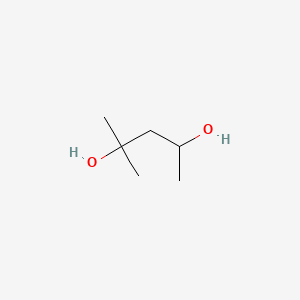
Also known as: 2-methyl-2,4-pentanediol, 107-41-5, 2-methylpentane-2,4-diol, Diolane, 2,4-pentanediol, 2-methyl-, 2,4-dihydroxy-2-methylpentane
Molecular Formula
C6H14O2
Molecular Weight
118.17  g/mol
InChI Key
SVTBMSDMJJWYQN-UHFFFAOYSA-N
FDA UNII
KEH0A3F75J

Hexylene Glycol
1 2D Structure

Hexylene Glycol

2 Identification
2.1 Computed Descriptors
2.1.1 IUPAC Name
2-methylpentane-2,4-diol
2.1.2 InChI
InChI=1S/C6H14O2/c1-5(7)4-6(2,3)8/h5,7-8H,4H2,1-3H3
2.1.3 InChI Key
SVTBMSDMJJWYQN-UHFFFAOYSA-N
2.1.4 Canonical SMILES
CC(CC(C)(C)O)O
2.2 Other Identifiers
2.2.1 UNII
KEH0A3F75J
2.3 Synonyms
2.3.1 MeSH Synonyms

1. 2-methyl-2,4-pentanediol

2. 2-methylpentane-2,4-diol

3. Hexylene Glycol, Titanium(4+) Salt

2.3.2 Depositor-Supplied Synonyms

1. 2-methyl-2,4-pentanediol

2. 107-41-5

3. 2-methylpentane-2,4-diol

4. Diolane

5. 2,4-pentanediol, 2-methyl-

6. 2,4-dihydroxy-2-methylpentane

7. Isol

8. Pinakon

9. 4-methyl-2,4-pentanediol

10. 1,1,3-trimethyltrimethylenediol

11. 2-methyl Pentane-2,4-diol

12. Hexyleneglycol

13. 2-methyl-2,4-pentandiol

14. Hexylene Glycol [nf]

15. Nsc-8098

16. Alpha,alpha,alpha'-trimethyltrimethylene Glycol

17. Keh0a3f75j

18. 1,3-dimethyl-3-hydroxybutanol

19. Chebi:62995

20. 1,3,3-trimethyl-1,3-propanediol

21. Mfcd00004547

22. Hexylene Glycol (nf)

23. Nsc 8098

24. Dsstox_cid_1885

25. Dsstox_rid_76384

26. Dsstox_gsid_21885

27. Caswell No. 574

28. Cas-107-41-5

29. 2-methylpentan-2,4-diol

30. Hsdb 1126

31. 2-methyl-pentane-2,4-diol

32. (+-)-2-methyl-2,4-pentanediol

33. Einecs 203-489-0

34. Unii-keh0a3f75j

35. Epa Pesticide Chemical Code 068601

36. Brn 1098298

37. Ai3-00919

38. Ccris 9439

39. Hexylene Glycol, 99%

40. R-(-)-2-methyl-2,4-pentanediol

41. 2methyl-2,4-pentanediol

42. 2-methyl-2-4-pentanediol

43. Ec 203-489-0

44. Hexylene Glycol, >=99%

45. Hexylene Glycol, 99.5%

46. Schembl19379

47. Hexylene Glycol [ii]

48. Hexylene Glycol [mi]

49. 1,3-trimethyltrimethylenediol

50. 4-01-00-02565 (beilstein Handbook Reference)

51. Hexylene Glycol [hsdb]

52. Hexylene Glycol [inci]

53. Chembl2104293

54. Dtxsid5021885

55. Hexylene Glycol [mart.]

56. Hexylene Glycol [usp-rs]

57. Nsc8098

58. (?)-2-methyl-2,4-pentanediol

59. Hms3264e19

60. 1,1,3-trimethyl-1,3-propanediol

61. Hy-b0903

62. Hexylene Glycol, Analytical Standard

63. Tox21_201975

64. Tox21_302818

65. (+/-)-2-methyl-2,4-pentanediol

66. S3588

67. Akos015901459

68. Ccg-213719

69. Wln: Qy1 & 1xq1 & 1

70. Ncgc00249143-01

71. Ncgc00256494-01

72. Ncgc00259524-01

73. (+/-)-2,4-dihydroxy-2-methyl Pentane

74. Ac-13749

75. As-58339

76. Hexylene Glycol, Bioxtra, >=99% (gc)

77. (+/-)-2-methyl-2,4-pentanediol, Mpd

78. (^+)-2-methyl-2,4-pentanediol, 98%

79. Db-057767

80. Ft-0605050

81. Ft-0605756

82. Ft-0613069

83. Hexylene Glycol, Puriss., >=99.0% (gc)

84. M0384

85. .alpha.,.alpha.'-trimethyltrimethylene Glycol

86. Hexylene Glycol, Bioultra, >=99.0% (gc)

87. D04439

88. Ab01563179_01

89. J-640306

90. J-660006

91. Q2792203

92. W-108748

93. Hexylene Glycol, United States Pharmacopeia (usp) Reference Standard

94. Hexylene Glycol, Pharmagrade, Usp/nf, Manufactured Under Appropriate Gmp Controls For Pharma Or Biopharmaceutical Production

2.4 Create Date
2005-03-26
3 Chemical and Physical Properties
Molecular Weight 118.17 g/mol
Molecular Formula C6H14O2
XLogP30.3
Hydrogen Bond Donor Count2
Hydrogen Bond Acceptor Count2
Rotatable Bond Count2
Exact Mass118.099379685 g/mol
Monoisotopic Mass118.099379685 g/mol
Topological Polar Surface Area40.5 Ų
Heavy Atom Count8
Formal Charge0
Complexity68.9
Isotope Atom Count0
Defined Atom Stereocenter Count0
Undefined Atom Stereocenter Count1
Defined Bond Stereocenter Count0
Undefined Bond Stereocenter Count0
Covalently Bonded Unit Count1
4 Drug and Medication Information
4.1 Minimum/Potential Fatal Human Dose

Between toxicity ratings 2 or 3. 2= Slightly toxic: probable oral lethal dose (human) 5-15 g/kg, between 1 pint & 1 qt for 70 kg person (150 lb). 3= Moderately toxic: probable oral lethal dose (human) 0.5-5 g/kg; between 1 oz & 1 pint (or 1 lb) for 70 kg person (150 lb).

Gosselin, R.E., R.P. Smith, H.C. Hodge. Clinical Toxicology of Commercial Products. 5th ed. Baltimore: Williams and Wilkins, 1984., p. II-179


5 Pharmacology and Biochemistry
5.1 Absorption, Distribution and Excretion

... Mice /were fed hexylene glycol/ orally 20 mg/day in 2 mL of whole milk for up to 81 days ... . approximately 40% of the hexylene glycol was accounted for in the urine, but only 4% of the amount excreted was free glycol; the other 36% was conjugated with glycuronic acid.

Bingham, E.; Cohrssen, B.; Powell, C.H.; Patty's Toxicology Volumes 1-9 5th ed. John Wiley & Sons. New York, N.Y. (2001)., p. V7 50


... Not readily absorbed through the skin ... .

Bingham, E.; Cohrssen, B.; Powell, C.H.; Patty's Toxicology Volumes 1-9 5th ed. John Wiley & Sons. New York, N.Y. (2001)., p. V7 49


Eliminated in urine, partly (20-25%) in conjugated forms.

Gosselin, R.E., R.P. Smith, H.C. Hodge. Clinical Toxicology of Commercial Products. 5th ed. Baltimore: Williams and Wilkins, 1984., p. II-179


... Oral administration of hexylene glycol to rats & rabbits resulted in a substantial increase in the amt of hexuronates in the plasma & in the urine.

Bingham, E.; Cohrssen, B.; Powell, C.H.; Patty's Toxicology Volumes 1-9 5th ed. John Wiley & Sons. New York, N.Y. (2001)., p. V7 50


For more Absorption, Distribution and Excretion (Complete) data for 2-METHYL-2,4-PENTANEDIOL (8 total), please visit the HSDB record page.


5.2 Metabolism/Metabolites

...Five human subjects ... /had/ both free & conjugated hexylene glycol in the urine after single or repeated oral doses. ...

Bingham, E.; Cohrssen, B.; Powell, C.H.; Patty's Toxicology Volumes 1-9 5th ed. John Wiley & Sons. New York, N.Y. (2001)., p. V7 50


(14)C-hexylene glycol fed to rabbits... urine contained 7 metabolites incl glucuronide of hexylene glycol (46% of dose), unchanged hexylene glycol (2.5%), diacetone alcohol (1.4%) & an unidentified glucuronide which could be conjugate of diacetone alcohol. ...Converted into diacetone alc by incubation with rat liver slices.

Parke, D. V. The Biochemistry of Foreign Compounds. Oxford: Pergamon Press, 1968., p. 166


... Oral administration of hexylene glycol to rats & rabbits resulted in a substantial increase in the amt of hexuronates in the plasma & in the urine.

Bingham, E.; Cohrssen, B.; Powell, C.H.; Patty's Toxicology Volumes 1-9 5th ed. John Wiley & Sons. New York, N.Y. (2001)., p. V7 50


It was also shown that approximately 40% of the hexylene glycol was accounted for in the urine, but only 4% of the amount excreted was free glycol; the other 36% was conjugated with glycuronic acid.

Bingham, E.; Cohrssen, B.; Powell, C.H.; Patty's Toxicology Volumes 1-9 5th ed. John Wiley & Sons. New York, N.Y. (2001)., p. V7 50


5.3 Biological Half-Life

...after a single oral (gavage) administration of Hexylene glycol at the dose-level of 590 mg/kg to male Sprague-Dawley rats ...t1/2 21.2 hr

European Chemicals Agency (ECHA); REACH Registration for 2-methylpentane-2,4-diol (CAS 107-41-5); Available from, as of May 29, 2014: https://echa.europa.eu/


5.4 Mechanism of Action

Some effects of gravity on early morphogenesis are correlated with microtubule locations within cells. During first cleavage in Ilyanassa obsoleta embryos, a transitory polar lobe constriction forms and then relaxes, allowing the polar lobe to merge with one daughter cell. If the polar lobe is equally divided or removed, morphogenesis is severely disrupted. To examine microtuble locations during early Ilyanassa development, eggs were fixed and stained for polymerized alpha-tubulin during first cleavage. The mitotic apparatus assembles at the animal pole. The cleavage furrow forms between the asters, constricting to a stabilized intercellular bridge encircling midbody-bound microtubules, whereas the polar lobe constriction forms below and parallel to the spindle, constricting to a transitory intercellular bridge encircling no detectable microtubules. At metaphase an alpha-tubulin epitope is distributed throughout the spindle, whereas a beta-tubulin epitope is present predominantly in the asters. Incubation in hexylene glycol, a drug that increases microtubule polymerization, during mitosis causes the polar lobe constriction to tighten around polymerized alpha-tubulin and remain stably constricted. If hexylene glycol is removed, alpha-tubulin staining disappears from the polar lobe constriction, which relaxes, whereas microtubules remain in the cleavage furrow, which remains constricted. These observations suggest that asymmetric distribution of microtubules affects early Ilyanassa cleavage patterns, and that continued presence of microtubules extending through an intercellular bridge is important for stabilization of the bridge constriction prior to completion of cytokinesis. These data provide the basis for further analysis of the role of microtubules in possible microgravity disruptions of Ilyanassa development.

PMID:11536633 Conrad AH et al; J Exp Zool 269 (3): 188-204 (1994)


API SUPPLIERS

read-more
read-more

01

Prasol Chemicals

India

USDMF, CEP/COS, JDMF, EU-WC, NDC, KDMF, VMF, Others

Bio-Europe
Not Confirmed
arrow

Prasol Chemicals

India

USDMF, CEP/COS, JDMF, EU-WC, NDC, KDMF, VMF, Others

arrow
Bio-Europe
Not Confirmed
USDMF CEP/COS JDMF EU-WC NDC KDMF VMF Others AUDIT
blank
Full Screen ViewFULL SCREEN VIEW Click here to open all results in a new tab [this preview display 10 results]

Listed Suppliers

read-more
read-more

01

Bio-Europe
Not Confirmed
arrow
arrow
Bio-Europe
Not Confirmed

Hexylene Glycol

About the Company : With its establishment in1992, the Prasol belief in ''Customer First, Reputation First'' is one which emphasizes the importance of customer satisfaction through both product qualit...

With its establishment in1992, the Prasol belief in ''Customer First, Reputation First'' is one which emphasizes the importance of customer satisfaction through both product quality and after sales service. The total occupied area of Prasol is 18 Acres with production plants for Phosphorous based, Cumene based and Hydrogenated Products. The products that Prasol manufacturers are prevalent in various sectors such as paints & coatings, Thinners, Agrochemicals, Lubricants, Surfactants, Pharmaceuticals, Fragrances etc. Our global reach spans 40 countries along with local presence pan India.
blank
Full Screen ViewFULL SCREEN VIEW Click here to open all results in a new tab [this preview display 10 results]

Price Reference

read-more
read-more

$ 35.6/KG

Average price based on Brazilian Customs data

pharmascopic-banner

Explore API/FDF price intelligence and advanced market analytics

The average price is calculated based on data reported by Brazilian Customs and is provided for informational purposes only.

Digital Content read-more

Create Content with PharmaCompass, ask us Create Content with PharmaCompass

PHARMA & BIOTECH INSIGHTS

1read-more
read-more
Excipient Market Overview: Clariant sets up its first PEG excipients facility in US; India harmonizes 22 excipient monographs
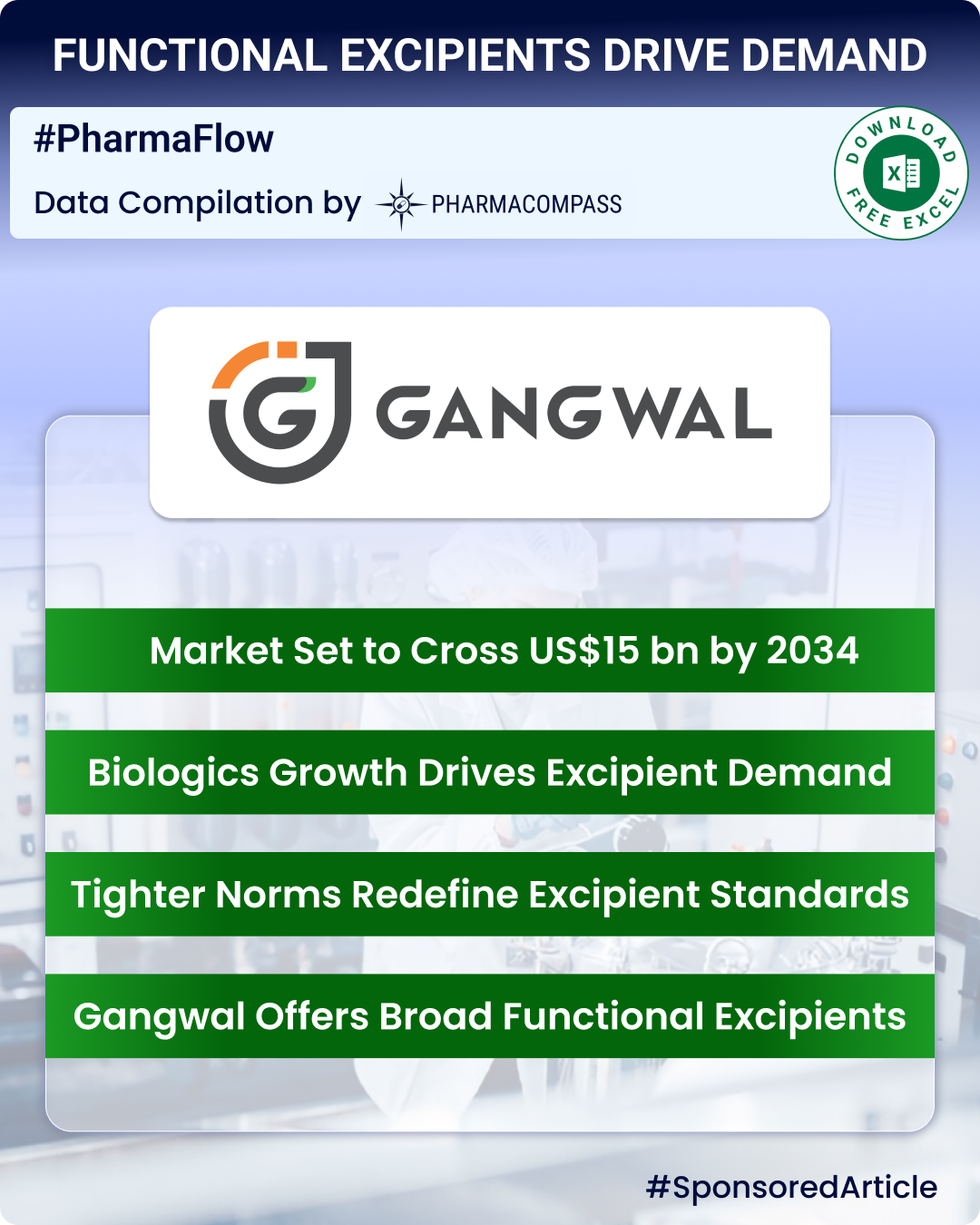
The market for pharmaceutical excipients — or inactive substances used in the production of drugs —  continued to witness significant transformation in the first quarter (Q1) of 2026. The rise of biologics, increasing demand for personalized medicine, and innovations in drug delivery systems are driving demand for a wider range of functional excipients. As a result, the pharmaceutical excipients market is estimated to grow at a compound annual growth rate (CAGR) of 5.75 percent, to exceed US$ 15.43 billion by 2034. Its size was estimated at US$ 9.31 billion in 2025. The North American market for excipients was estimated at US$ 3.1 billion in 2024 and is estimated to increase to US$ 5.66 billion by 2034. In comparison, the European market for pharmaceutical excipients was estimated at US$ 2.35 billion in 2024 and is predicted to reach around US$ 3.95 billion by 2034, while the Asia Pacific market stood at US$ 1.94 billion in 2024 and is projected to grow to US$ 3.65 billion by 2034. The sector remains highly competitive and fragmented. Major excipient providers include BASF, Roquette, Gangwal Healthcare, Croda International, DuPont, Seqens, SPI Pharma, Evonik, PMC Isochem, Pfanstiehl, Colorcon, Kewpie Corporation, ICE Pharma, Nanjing Well Pharmaceutical, Merck KGaA-owned MilliporeSigma, Minakem, Ashland Global and Nippon Fine Chemical.  View Our Dashboard on Major Excipient Companies in 2026 (Free Excel Available) Clariant sets up its first PEG excipients facility in US; Croda opens greenfield facility in India  Swiss specialty chemical company Clariant is expanding its Clear Lake (Texas) site to include GMP-compliant manufacturing of pharmaceutical-grade polyethylene glycol (PEG) excipients. This will improve availability and reliability for North American customers, with extended reach to Latin America. The multi-phase expansion addresses critical industry priorities around supply chain security, continuity, and responsiveness while demonstrating Clariant’s long-term strategic commitment to the US pharmaceutical market. This is the first Clariant facility in the US to manufacture PEG excipients for oral and topical applications. British specialty chemicals company Croda International has inaugurated a greenfield manufacturing facility in Dahej, India, that strengthens its ability to serve fast-growing markets in Asia. The new site represents a significant investment in India and will enhance Croda’s supply capabilities, improve responsiveness to customer demand, and support future growth in high-value sectors. Located in Gujarat, the facility benefits from strong logistics connectivity and is designed to serve both domestic customers and select export markets. It will support demand across Croda’s consumer care, life sciences, and industrial specialties sectors.  Following the acquisition of IFF Pharma Solutions in 2025, French excipient company Roquette has introduced an expanded cosmetics portfolio under the Roquette Beauté brand. This portfolio integrates IFF Pharma Solutions’ ingredients — Methocel, Avicel, Aquacoat, Ethocel, and Polyox — with Roquette’s legacy range, while its core portfolio continues to include widely used pharmaceutical excipients. SPI Pharma-Anek Prayog, Ingredion-Univar ink distribution deals; DFE Pharma, Gericke launch CM platform In February, US-based pharmaceutical excipient and ingredients company SPI Pharma announced a global distribution partnership with Indian pharmaceutical excipient manufacturer Anek Prayog. Under this agreement, SPI will exclusively sell, promote, and distribute Lubripharm Pro SSF, a next-generation sodium stearyl fumarate lubricant manufactured by Anek Prayog. The Ingredients + Specialties division of Univar Solutions was appointed as a distributor for Ingredion Pharma Solutions. The agreement includes distribution of Ingredion’s global pharmaceuticals portfolio and positions Univar as the exclusive distributor of pharmaceutical starches in the US and Canada. The partnership expands its pharmaceutical and nutraceutical excipient offerings, including binders, fillers, superdisintegrants, lubricants, and gelatin alternatives. German excipient solutions company DFE Pharma has launched a continuous manufacturing (CM) platform in collaboration with Switzerland-based Gericke Group to support formulation development, optimization, and lifecycle management. The platform integrates CM-ready excipients, a flexible evaluation environment, and multidisciplinary expertise to enable data-driven decisions from early development to commercial manufacturing. As part of this initiative, DFE Pharma has established CM capabilities at its C2F Center of Excellence in Hyderabad, featuring a Gericke Formulation Skid (GFS) in a non-GMP setup. This modular system enables rapid testing, process optimization, and practical assessment of continuous feeding and blending without impacting existing GMP operations, while supporting alignment with ICH Q13 (an international guideline on CM for drug substances and products). Gangwal Healthcare operates EXCiPACT-certified GMP facilities and offers a broad range of functional excipients, including co-processed blends like ProBlend, Starlose, Tyloxapole, and Microlose. Its excipients, including Solvostar (sodium starch glycolate) and LubMag-W (Magnesium Stearate, Sodium Lauryl Sulfate), support enhanced tablet disintegration and drug release. The company also provides taste-masking agents such as SucreX (sucralose) and CutCal (neotame), supporting the development of patient-friendly oral dosage forms. India harmonizes 22 excipient monographs; EMA updates TE guidelines for inhalation products  Regulators are increasingly tightening requirements around excipients, as they are no longer treated as passive ingredients. They are being recognized as critical to product performance and therapeutic equivalence. India has introduced the Indian Pharmacopoeia 2026 with updated and harmonized standards for pharmaceutical ingredients, including 22 excipient monographs. These revisions align Indian standards more closely with global pharmacopoeias. For excipient manufacturers and drug formulators, this means stricter compliance expectations. In August, India had notified an amendment to the Drugs Rules, 1945 to mandate inclusion of qualitative details of excipients in drug labels through barcodes or QR codes from 2026. The European Medicines Agency (EMA) has issued updated guidelines on the pharmaceutical quality of inhalation and nasal medicines, as well as on demonstrating therapeutic equivalence (TE) of orally inhaled products (OIP) for asthma and chronic obstructive pulmonary disease. These guidelines require manufacturers to provide detailed information on the active substance, finished product composition, pharmaceutical development studies, and the control of excipients and other formulation components. Similar pharmaceutical quality requirements apply to nasal products under the pharmaceutical quality guideline. Excipients are becoming increasingly linked to manufacturing technologies. For instance, the US Food and Drug Administration (FDA) finalized its Advanced Manufacturing Technologies (AMT) Designation Program in 2024. This is expected to increase the need for excipients compatible with such technologies. Our view  While the market for excipients is growing at a healthy pace, the ongoing conflict in the Middle East is disrupting pharmaceutical supply chains, with impacts now extending beyond APIs to critical excipients and packaging materials. Surging crude oil prices are driving up the cost of excipients, with key inputs like chloroform witnessing sharp price increases. In addition, disruptions in logistics are forcing drugmakers to reroute shipments through longer and more expensive routes due to closure of airports and certain sea routes. These developments will have a cascading effect on the pharmaceutical industry and its supply chain in the coming months.

Impressions: 3361

https://www.pharmacompass.com/radio-compass-blog/excipient-market-overview-clariant-sets-up-its-first-peg-excipients-facility-in-us-india-harmonizes-22-excipient-monographs

#PharmaFlow by PHARMACOMPASS
26 Mar 2026

Market Place

Do you need sourcing support? Ask us sourcing support

REF. STANDARDS & IMPURITIES

Upload your portfolio for free, ask us portfolio for free

Others

read-more
read-more

01

XYZ Pharma

Country
arrow
Bio-Europe
Not Confirmed

XYZ Pharma

Country
arrow
Bio-Europe
Not Confirmed

Hexylene Glycol (125 mg)

CAS Number : 107-41-5

Quantity Per Vial : 125

Sale Unit : mg

Price : $265.00

Details : Material Origin- Chemical Synthesis; USMCA- N...

Monograph :

Storage :

Code/Batch No : Catalog #1308200 / R07621

blank
Full Screen ViewFULL SCREEN VIEW Click here to open all results in a new tab [this preview display 10 results]

ABOUT THIS PAGE

active-pharmaceutical-ingredients7870##p

Looking for 107-41-5 / Hexylene Glycol API manufacturers, exporters & distributors?

Hexylene Glycol manufacturers, exporters & distributors 1

21

PharmaCompass offers a list of Hexylene Glycol API manufacturers, exporters & distributors, which can be sorted by GMP, USDMF, JDMF, KDMF, CEP (COS), WC, and more, enabling you to easily find the right Hexylene Glycol manufacturer or Hexylene Glycol supplier for your needs.

Send us enquiries for free, and we will assist you in establishing a direct connection with your preferred Hexylene Glycol manufacturer or Hexylene Glycol supplier.

API | Excipient name

Hexylene Glycol

Synonyms

2-methyl-2,4-pentanediol, 107-41-5, 2-methylpentane-2,4-diol, Diolane, 2,4-pentanediol, 2-methyl-, 2,4-dihydroxy-2-methylpentane

Cas Number

107-41-5

Unique Ingredient Identifier (UNII)

KEH0A3F75J

Hexylene Glycol Manufacturers

A Hexylene Glycol manufacturer is defined as any person or entity involved in the manufacture, preparation, processing, compounding or propagation of Hexylene Glycol, including repackagers and relabelers. The FDA regulates Hexylene Glycol manufacturers to ensure that their products comply with relevant laws and regulations and are safe and effective to use. Hexylene Glycol API Manufacturers are required to adhere to Good Manufacturing Practices (GMP) to ensure that their products are consistently manufactured to meet established quality criteria.

click here to find a list of Hexylene Glycol manufacturers with USDMF, JDMF, KDMF, CEP, GMP, and COA related information on PhamaCompass.

Hexylene Glycol Suppliers

A Hexylene Glycol supplier is an individual or a company that provides Hexylene Glycol active pharmaceutical ingredient (API) or Hexylene Glycol finished formulations upon request. The Hexylene Glycol suppliers may include Hexylene Glycol API manufacturers, exporters, distributors and traders.

click here to find a list of Hexylene Glycol suppliers with USDMF, JDMF, KDMF, CEP, GMP, and COA related information on PharmaCompass.

Hexylene Glycol GMP

Hexylene Glycol Active pharmaceutical ingredient (API) is produced in GMP-certified manufacturing facility.

GMP stands for Good Manufacturing Practices, which is a system used in the pharmaceutical industry to make sure that goods are regularly produced and monitored in accordance with quality standards. The FDA’s current Good Manufacturing Practices requirements are referred to as cGMP or current GMP which indicates that the company follows the most recent GMP specifications. The World Health Organization (WHO) has its own set of GMP guidelines, called the WHO GMP. Different countries can also set their own guidelines for GMP like China (Chinese GMP) or the EU (EU GMP).

PharmaCompass offers a list of Hexylene Glycol GMP manufacturers, exporters & distributors, which can be sorted by USDMF, JDMF, KDMF, CEP (COS), WC, and more, enabling you to easily find the right Hexylene Glycol GMP manufacturer or Hexylene Glycol GMP API supplier for your needs.

Hexylene Glycol CoA

A Hexylene Glycol CoA (Certificate of Analysis) is a formal document that attests to Hexylene Glycol's compliance with Hexylene Glycol specifications and serves as a tool for batch-level quality control.

Hexylene Glycol CoA mostly includes findings from lab analyses of a specific batch. For each Hexylene Glycol CoA document that a company creates, the USFDA specifies specific requirements, such as supplier information, material identification, transportation data, evidence of conformity and signature data.

Hexylene Glycol may be tested according to a variety of international standards, such as European Pharmacopoeia (Hexylene Glycol EP), Hexylene Glycol JP (Japanese Pharmacopeia) and the US Pharmacopoeia (Hexylene Glycol USP).


Inform the supplier about your product requirements, specifying if you need a product with particular monograph like EP (Ph. Eur.), USP, JP, BP, or any other quality. In addition, clarify whether you need hydrochloride (HCl), anhydricum, base, micronisatum or a specific level of purity. To find reputable suppliers, utilize the filters and select those certified by GMP, FDA, or any other certification as per your requirement.
For your convenience, we have listed synonyms and CAS numbers to help you find the best supplier. The use of synonyms and CAS numbers can be helpful in identifying potential suppliers, but it is crucial to note that they might not always indicate the exact same product. It is important to confirm the product details with the supplier before making a purchase to ensure that it meets your requirements.
Ask Us for Pharmaceutical Supplier and Partner
Ask Us, Find A Supplier / Partner
No Commissions, No Strings Attached, Get Connected for FREE

What are you looking for?

How can we help you?

The request can't be empty

Please read our Privacy Policy carefully

You must agree to the privacy policy

The name can't be empty
The company can't be empty.
The email can't be empty Please enter a valid email.
The mobile can't be empty