The US Food and Drug Administration (FDA) made considerable news in June. The agency reversed critical decisions in the case of two gene therapies, and also announced that it would hire 2,200 employees, after firing over 3,000 last year. In drug approvals, FDA cleared the first and only oral carbapenem antibiotic to treat complicated urinary tract infections.
The
month also witnessed two deals worth over US$ 10 billion — AbbVie’s acquisition of Apogee Therapeutics for approximately US$ 10.9 billion, and GSK’s acquisition of Nuvalent, a clinical-stage biopharma, for US$ 10.6 billion.
The indices continued to move upwards. The Nasdaq Biotechnology Index (NBI) increased by 10.65 percent — from 5,932.87 at the end of May to 6,564.93 by June-end. The SPDR S&P Biotech ETF increased from 135.62 to 158.25, an increase of 16.69 percent. The S&P Biotechnology Select Industry Index (SPSIBI) increased by 15.84 percent, from 10,689.60 to 12,383.03.
Access the Clinical Trials Dashboard for June 2026 Newsmakers (Free Excel)
AbbVie acquires Apogee for US$ 10.9 bn; GSK buys out Nuvalent for
US$ 10.6 bn to bolster oncology pipeline
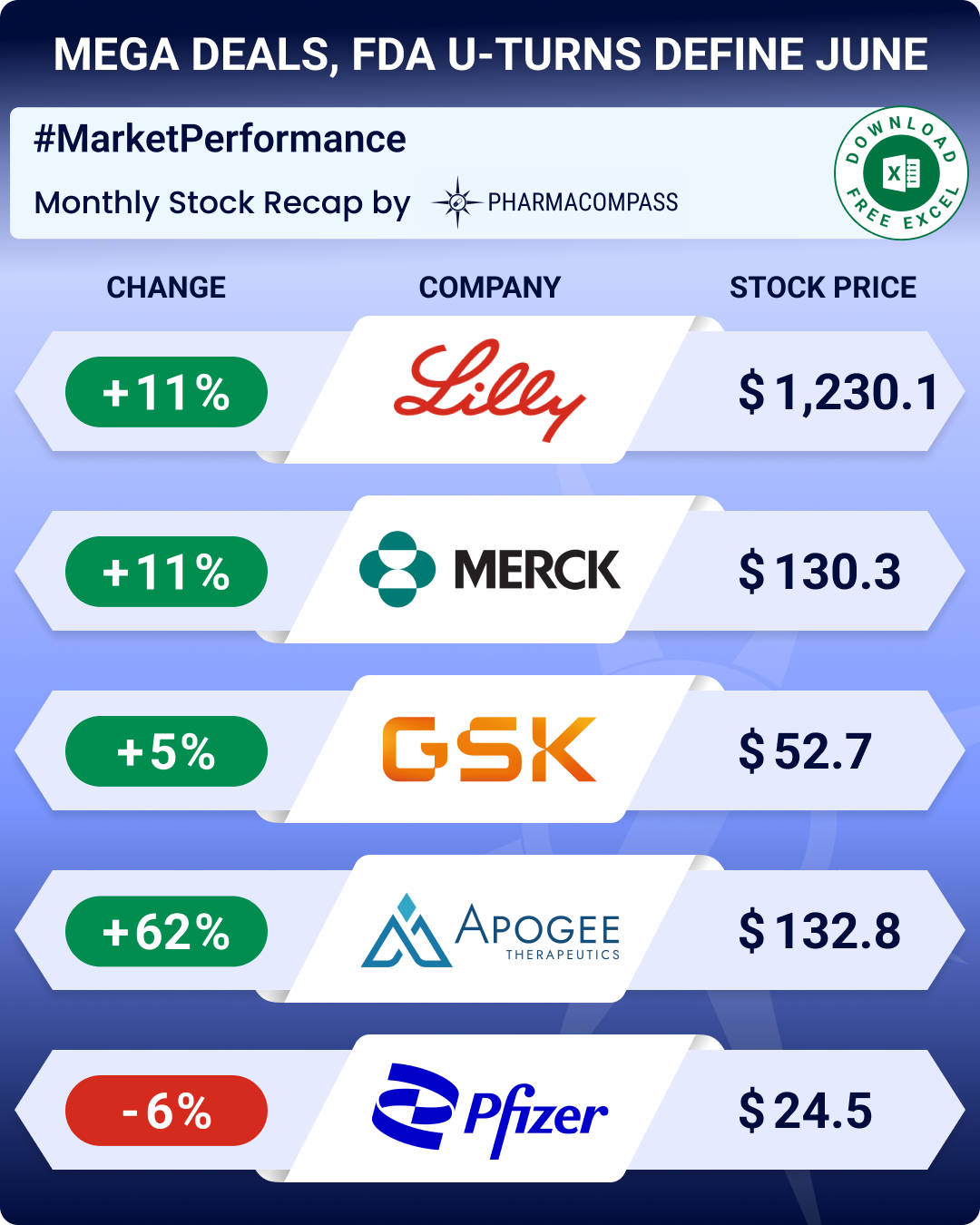
The month’s biggest deal was AbbVie’s acquisition of Apogee Therapeutics (stock up 62 percent in
June) in an all-cash transaction valued at approximately US$ 10.9 billion. The buyout centered around zumilokibart, a late-stage therapy being developed for atopic dermatitis, asthma, and eosinophilic esophagitis. AbbVie’s stock rose by 18 percent in
June.
The second largest acquisition was made by GSK — it acquired Nuvalent, a clinical-stage biopharma focused on developing targeted oncology therapies, for US$ 10.6 billion.
There
were several sub-US$ 5 billion acquisitions. For instance, American biotech Incyte struck a deal
worth up to US$ 2 billion to acquire Vega Therapeutics. Edgewise Therapeutics announced the sale of its muscular dystrophy
business to Servier for up to US$ 2.65 billion, and Ipsen entered into a definitive
agreement to acquire Kartos Therapeutics in a deal worth
up to US$ 1.75 billion.
FDA approves GSK-Spero’s oral antibiotic for complicated UTIs; clears Astra’s drug combo for prostate cancer
The
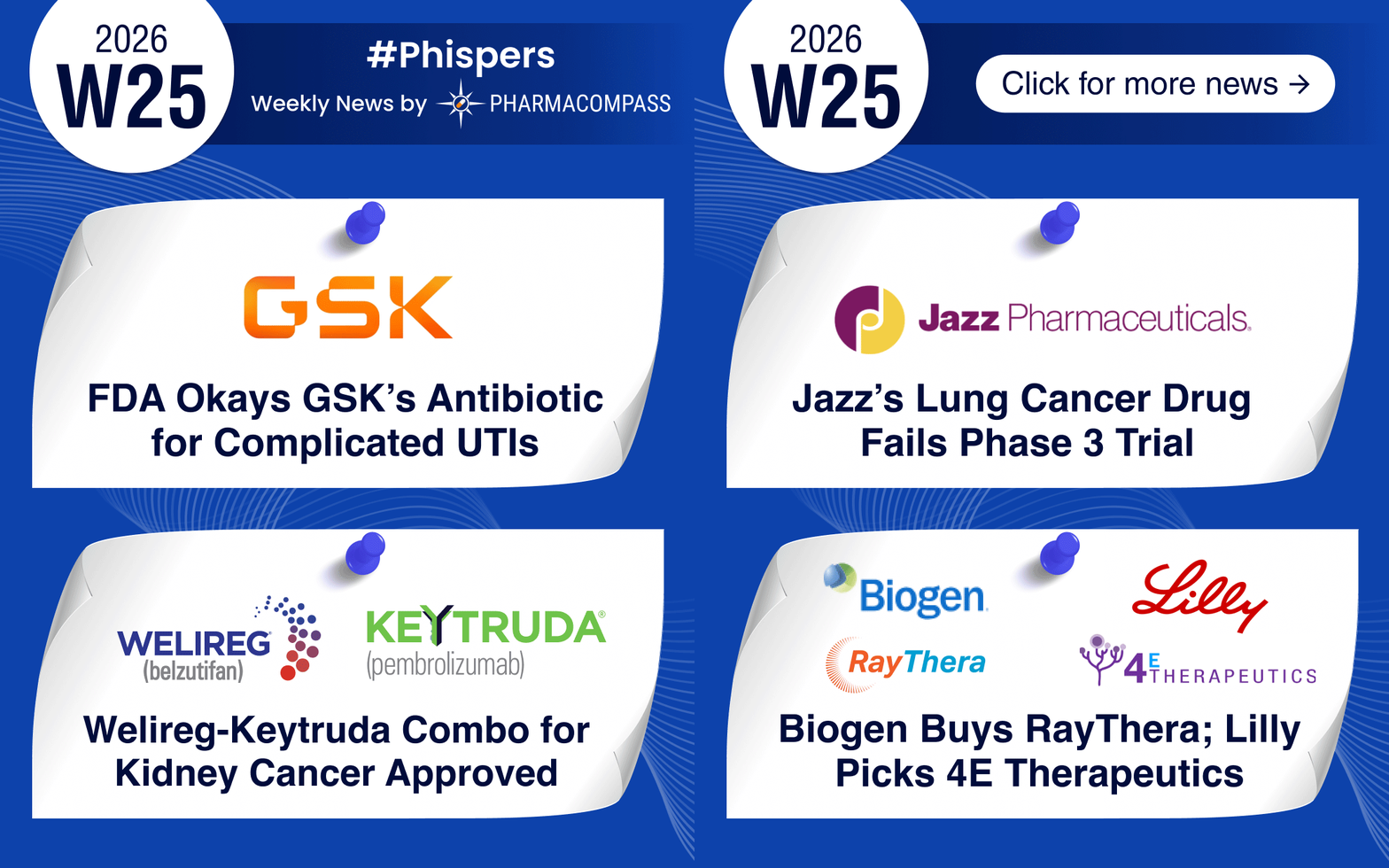
month saw some notable drug approvals. FDA approved Utebzi (tebipenem pivoxil) — developed by Spero Therapeutics and licensed to GSK — as the first and only oral carbapenem antibiotic for adults with complicated urinary tract
infections (cUTIs), including pyelonephritis (a type of kidney inflammation).
Carbapenem is a class of antibiotics which is widely used for the treatment of drug-resistant bacterial
infections.
The agency also approved AstraZeneca’s Truqap (capivasertib), in combination with abiraterone and prednisone, as the first and only targeted treatment for adults with PTEN-deficient metastatic androgen pathway modulation-naïve or sensitive prostate cancer, a genetically distinct, highly aggressive form of
the disease.
Merck’s Keytruda (pembrolizumab) and Keytruda Qlex
(pembrolizumab and berahyaluronidase alfa-pmph), each in combination with Merck’s Welireg (belzutifan), were approved by FDA for adjuvant treatment of a type of kidney cancer
in adults.
In
supplemental approvals, FDA approved Japanese drugmaker Shionogi’s oral antiviral Xocova (ensitrelvir) for preventing Covid-19 after exposure. The agency also expanded the approval of Pfizer’s Hympavzi (marstacimab-hncq) to prevent or reduce the frequency of bleeding episodes in children and adolescents with hemophilia (a condition in which the blood doesn’t clot properly). And it granted accelerated approval to Sanofi’s Tzield (teplizumab-mzwv) to delay the decline in endogenous insulin
production in children aged 8 to 17 years
who were recently diagnosed with stage 3 type 1 diabetes.
Lilly inks up deals with Haisco, Hanmi, AlzeCure, Abbisko; Roche signs licensing deal with Nurix
Eli Lilly (stock up 11 percent)
continued to be on a deal-making spree. It signed a licensing and research collaboration with China’s Haisco Pharmaceutical worth up to US$ 3 billion to develop multiple innovative therapies. It also signed a deal worth up to US$ 1.9 billion with Ascidian Therapeutics to use its gene-editing
technology to develop new therapies for rare inherited
kidney diseases.
In addition, Lilly entered into a
licensing deal worth up to US$ 1.2 billion with South Korea’s Hanmi Pharmaceutical for sonefpeglutide, a drug
aimed at treating short bowel syndrome, a condition where patients cannot absorb enough nutrients. It also doubled down on Alzheimer’s research by signing a collaboration and
out-licensing deal worth over US$ 1 billion with Swedish biotech AlzeCure Pharma for global rights to an experimental drug — ACD680. Moreover, Shanghai-based oncology biotech Abbisko Therapeutics expanded its research collaboration with Lilly in a deal worth up to US$ 1.9 billion.
Roche entered into an exclusive licensing and collaboration agreement with Nurix Therapeutics worth up to US$ 2.3 billion. Under the deal, the two
companies will co-develop and co-commercialize bexobrutideg, a blood cancer drug that
works by degrading targeted proteins.
Novartis entered into a research collaboration with Antares Therapeutics worth up to US$ 1.9 billion to apply Antares’ drug discovery platform to a limited number
of historically undruggable oncology targets. Additionally, Orionis Biosciences expanded its collaboration with Novartis in a deal worth up to US$ 1.4 billion.
Nuvectis Pharma signed a licensing agreement with China’s Haisco Pharmaceutical Group worth up to US$ 1.4 billion
for ex-China rights to two clinical-stage compounds that target
difficult-to-treat tumors, currently in advanced clinical trials.
There were two significant deals in the sphere of artificial intelligence — Insilico Medicine signed a collaboration with Korean drugmaker SK Biopharmaceuticals worth up to US$ 2.5 billion
to develop treatments for neuroimmune disorders
using AI; and Alnylam Pharmaceuticals and Inceptive announced a strategic collaboration worth up to US$ 2 billion to develop
RNA-based medicines using AI.
FDA clears path for uniQure’s Huntington’s filing; Definium’s LSD-based drug shows benefit in depression
FDA took several U-turns in June. Reversing its earlier position, FDA gave a go-ahead to uniQure to pursue an accelerated
approval for its gene therapy for Huntington’s disease (AMT-130).
Similarly,
it came out in support of Regenxbio’s gene therapy for Hunter syndrome (an ultra-rare genetic condition) — Navsunli (clemidsogene lanparvovec-sngl, RGX-121), after declining to approve it in February.
Definium
Therapeutics reported positive phase 3 results for DT120,
an oral drug based on lysergic acid diethylamide (LSD), in patients with major depressive disorder. LSD is a semi-synthetic psychedelic derived from ergot fungi.
In a phase 3 trial, AstraZeneca’s drug Imfinzi (durvalumab) in combination with Imjudo (tremelimumab), Lenvima (lenvatinib), and
transarterial chemoembolisation (TACE), reduced the risk of disease progression versus TACE alone in patients with unresectable
hepatocellular carcinoma (HCC) eligible for embolisation. HCC is a type of
liver cancer.
Our view
June
signaled a clear course correction at the FDA, not just with the two gene
therapies, but also on downsizing. The job cuts had begun disrupting drug reviews and user-fee programs. Hopefully, the new recruitments will augur well for not just the agency, but for the global pharmaceutical industry.














 Share
