July was a month when the US Food and Drug Administration (FDA) cleared several breakthrough drugs, such as Sanofi’s wearable injector to treat multiple myeloma and Otsuka’s once-daily extended-release capsule to treat attention deficit hyperactivity disorder (ADHD). FDA also approved an at-home starter dose of Eisai and Biogen’s Alzheimer’s drug.The Trump
administration announced tariffs on generic drug imports in a bid to “reshore” generic pharmaceutical production in the US. After two years of zero tariffs, generic drug imports would draw tariffs of 100 percent. And third year onwards, tariffs will go up to 200 percent. This measure would impact generic drugmakers across the world, particularly those headquartered in India.For the first time in 2026, pharma indices took a dip. The Nasdaq Biotechnology Index (NBI) declined by 2.08 percent — from 6590.25 at the end of June to 6,452.85 by July-end. The SPDR S&P Biotech ETF fell by 6.91 percent, from 157.93 to 147.01. And the S&P Biotechnology Select Industry Index (SPSIBI) dropped by 7.06 percent, from 12,383 to 11,508.60. Access the Pipeline Prospector Dashboard for July 2026 Newsmakers (Free Excel)FDA okays first wearable, subcutaneous drug for cancer; approves Otsuka’s ADHD med July saw several key approvals. FDA approved a wearable injector form of Sanofi’s multiple myeloma drug Sarclisa Escena
(isatuximab-irfc), making it the first cancer treatment in the US cleared for delivery through an on-body injector.In oncology, the agency approved American biotech Celcuity’s Revtorpyk (gedatolisib), in combination with fulvestrant, with or without Pfizer’s Ibrance (palbociclib), to treat patients with hormone receptor-positive, HER2-negative breast cancer without any mutations in the PIK3CA gene.FDA approved GSK’s Jideytro (zidesamtinib) for adults with locally advanced or metastatic ROS1-positive non-small cell lung cancer
(NSCLC). GSK had
acquired the drug through its US$ 10.6 billion buyout of Nuvalent in June this year. Jideytro is the British drugmaker’s first approved lung cancer medicine.Beyond oncology, FDA approved Merck’s Lipfendra (enlicitide) to reduce bad cholesterol (LDL-C, or low-density lipoprotein cholesterol) in adults, including those with heterozygous familial hypercholesterolemia, a
genetic condition that causes dangerously elevated LDL from birth. The agency also approved the first new ADHD
drug class in decades. Otsuka’s Simtriyo (centanafadine) is a once-daily extended-release capsule for ADHD in patients aged six years and older. It has a new mechanism of action as it boosts three brain chemicals — norepinephrine, dopamine and serotonin — that are involved in attention and behavior regulation.FDA also approved a new at-home subcutaneous starting dose for Leqembi Iqlik (lecanemab-irmb), the Alzheimer’s disease drug developed by Eisai and Biogen. This marks a significant step towards making the treatment more accessible and convenient for patients.The agency cleared Outlook Therapeutics’ Lytenava (bevacizumab-vikg, bevacizumab gamma) for treating wet AMD, a leading cause of severe vision loss in older adults. Meanwhile, FDA granted accelerated approval to Vera Therapeutics’ drug — Trutakna (atacicept-vymj) to reduce proteinuria in adults with primary immunoglobulin A nephropathy (IgAN), a
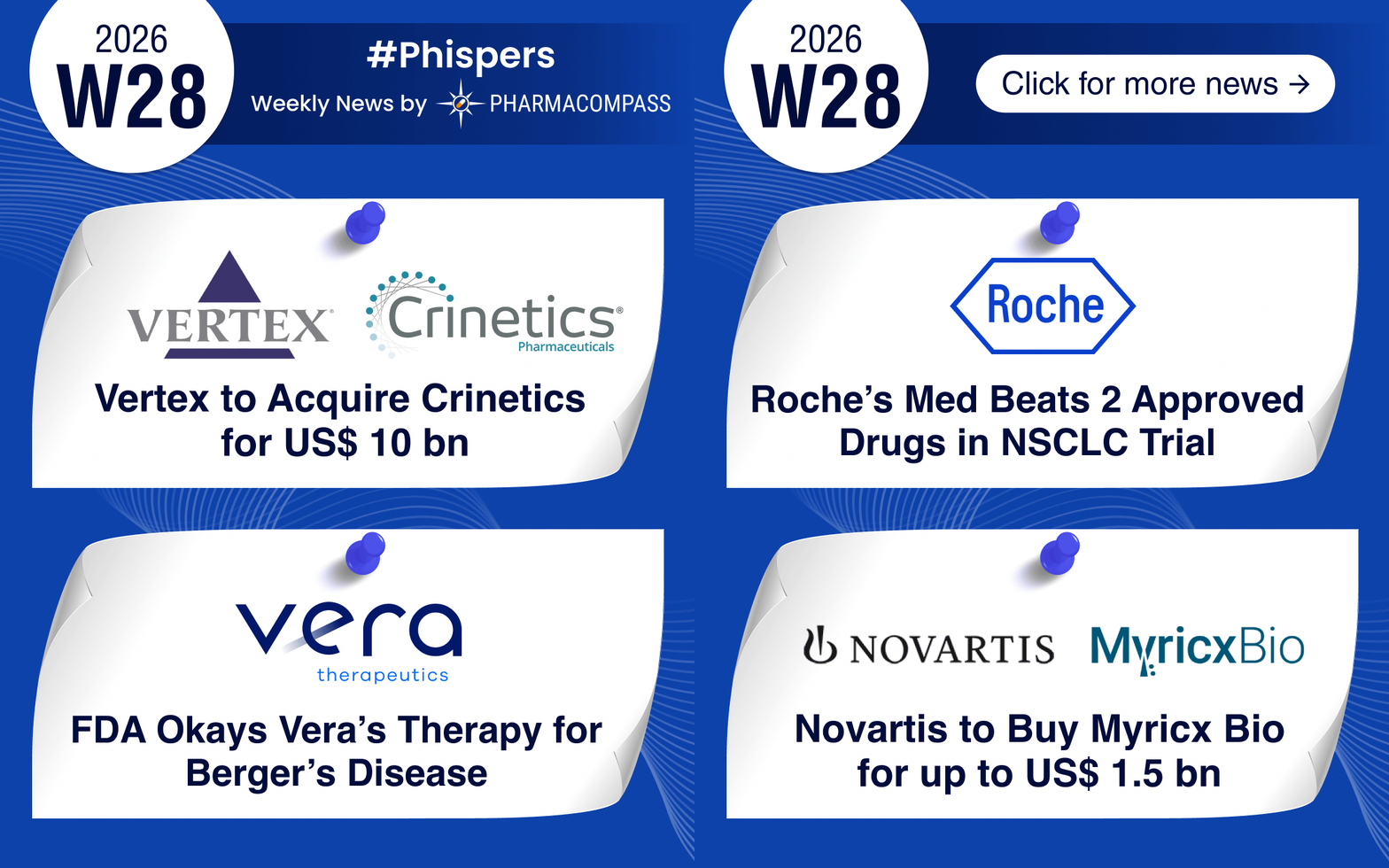
serious, progressive, immune-mediated kidney disease.Vertex acquires
Crinetics for US$ 10 bn, Lilly buys AtaiBeckley for its neurological pipelineThe biggest
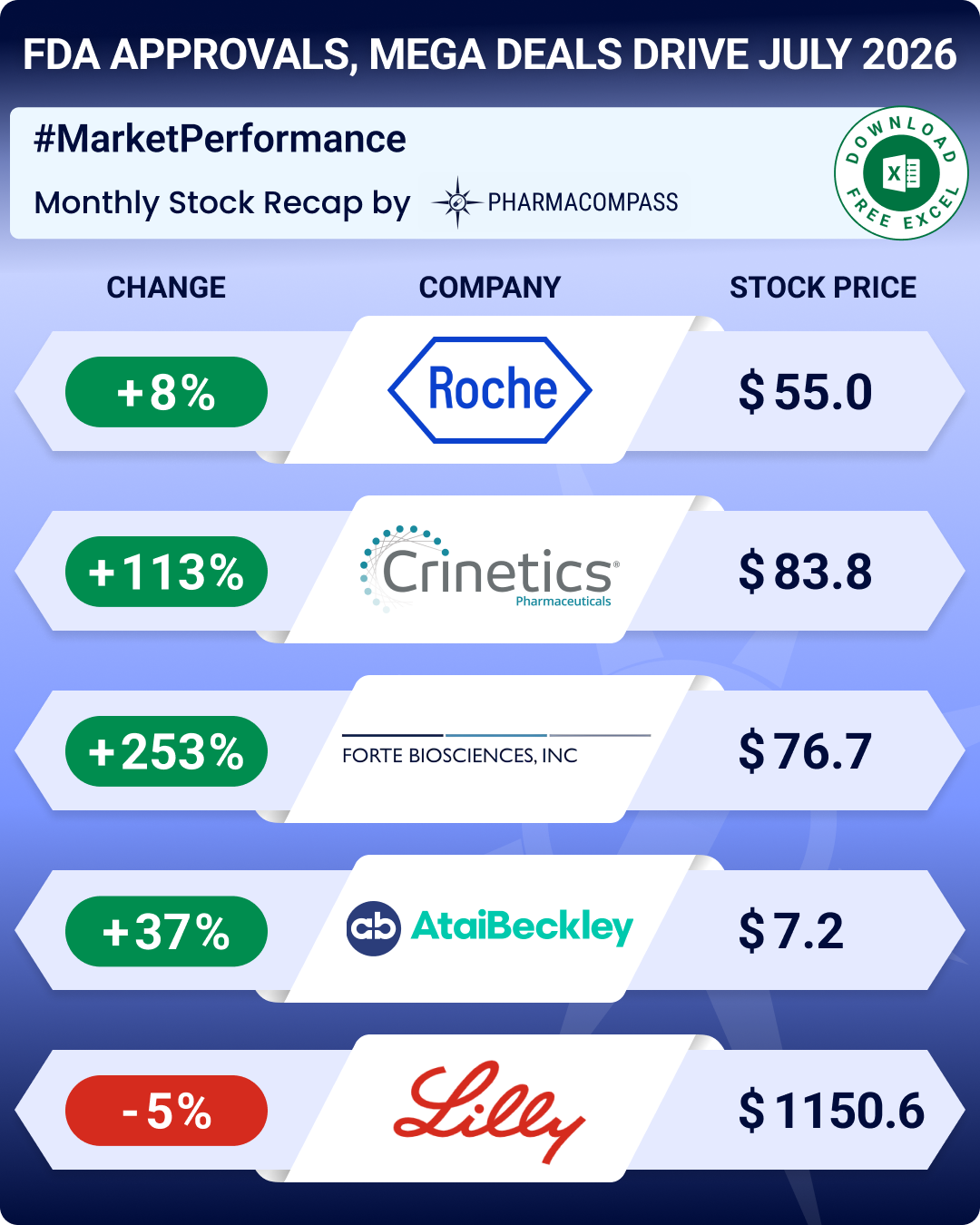
buyout in July was Vertex Pharmaceuticals’ announcement of the acquisition of Crinetics Pharmaceuticals (stock up 113 percent in July) for about US$ 10
billion. Crinetics specializes in treatments for endocrine diseases, while Vertex’s portfolio includes cystic
fibrosis therapies. Eli Lilly announced the acquisition of Atai Beckley (stock up 37 percent), a drugmaker working on treatments for mental
health conditions. The deal includes an upfront cash consideration of about US$
2.8 billion and contingent value rights of approximately US$ 1 billion.Immunology
company Argenx agreed to acquire Forte Biosciences in an all-cash deal worth US$ 2.2 billion. And Novartis entered into an agreement to acquire Myricx Bio, a privately held UK-based biotechnology company developing a new class of antibody-drug
conjugates (ADCs), for up to US$ 1.5 billion.Lilly reports
more phase 3 wins for obesity drug retatrutide; Gilead, Merck’s HIV drug posts
positive dataEli Lilly reported positive results from two additional phase 3 trials on its experimental obesity drug retatrutide. The drugmaker plans to submit an FDA application in the first quarter of 2027. Retatrutide is designed to target three different metabolic hormones — GLP-1, GIP and glucagon — making it a more comprehensive treatment for obesity than its existing drugs Zepbound (tirzepatide) and Foundayo (orforglipron).Gilead Sciences and Merck have reported positive data from two phase 3 trials for their once-a-week HIV pill, which is a combination of Merck’s islatravir and Gilead’s lenacapavir. The pill kept the virus suppressed in both late-stage trials,
supporting a regulatory filing.Arrowhead Pharmaceuticals has reported positive results from two phase 3 trials of Redemplo (plozasiran) in patients with severe
hypertriglyceridemia (sHTG). UK-based Compass Pathways has reported six-month durability data from its second phase 3 trial of its psilocybin-based therapy for treatment-resistant depression (TRD). Compass’ COMP360 is a
synthetic, proprietary formulation of psilocybin (the psychedelic compound
found in certain mushrooms) for TRD, a severe form of depression.Ipsen’s Dysport (abobotulinumtoxinA), a Botox (onabotulinumtoxinA) competitor, posted two phase 3 wins in two migraine indications — episodic and chronic migraine. In both the studies, Dysport significantly reduced the number of monthly migraine days
versus placebo.In oncology, Roche’s experimental drug divarasib outperformed two already-approved drugs — Amgen’s Lumakras (sotorasib) and BMS’ Krazati (adagrasib) — in a direct head-to-head, phase 3 trial on patients with NSCLC who have the KRAS
G12C mutation.Kelun Biotech’s Merck-partnered ADC candidate sacituzumab
tirumotecan, or sac-TMT, succeeded in a late-stage NSCLC trial when combined with Merck’s Keytruda. Johnson & Johnson reported positive results from a phase 3 trial of a combination of two bispecific antibodies — Tecvayli (teclistamab-cqyv) and Talvey (talquetamab-tgvs). The combo reduced the risk of disease progression or death by 89 percent and the risk of death
by 62 percent compared with standard-of-care combinations in relapsed or
refractory multiple myeloma. And GSK’s licensor Hansoh Pharmaceutical said its ADC, Ris-Rez (risvutatug rezetecan), met the primary endpoint in a late-stage clinical trial on patients with osteosarcoma (a common type of bone cancer), compared with chemotherapy alone.Our viewApprovals in July point towards innovations with new delivery mechanisms. Be it Sanofi’s wearable injector for myeloma or Eisai-Biogen’s at-home Alzheimer's starter dose, or Otsuka’s once-daily ADHD capsule, each takes an existing therapeutic idea and removes barriers such as the need for an infusion chair, or a visit to the clinic. It’s not just efficacy, but also convenience that is defining the competitive edge for drugmakers.













 Share
