In Phispers this week, there is news of an experimental
non-opioid painkiller from Vertex Pharmaceuticals showing positive results in
two late-stage trials. Once approved, it will provide a viable alternative to
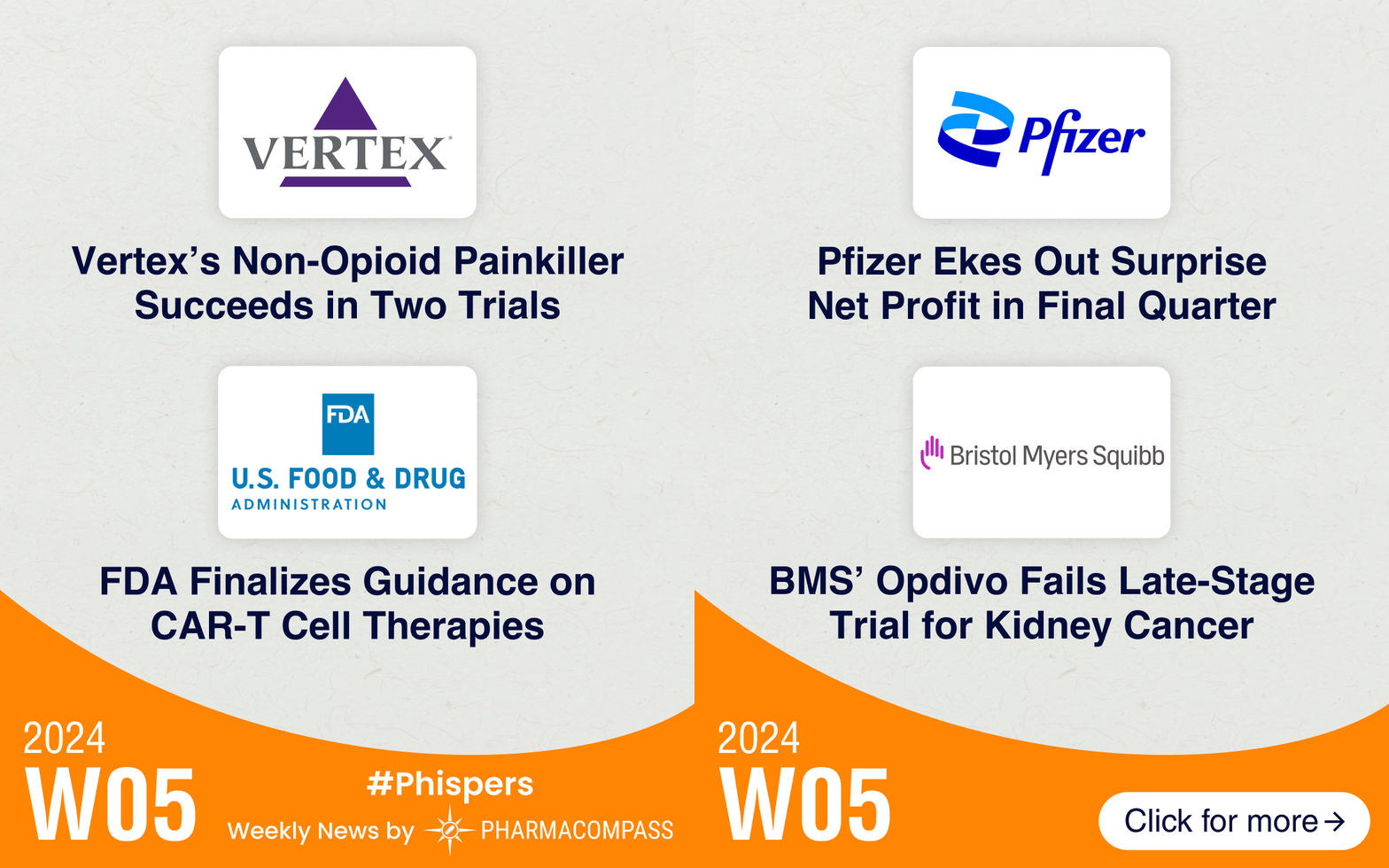
addictive opioids that have led to thousands of deaths and a crisis in America.In other news from clinical trials, BMS’ Opdivo failed to meet its primary endpoint of disease-free survival in patients with localized renal cell carcinoma who have a high risk of relapse after surgery. A day earlier, Merck’s Keytruda showed remarkable clinical benefit for the very same indication.After mandating a serious “boxed warning” on several CAR-T therapies last week, the United States Food and Drug Administration (FDA) has finalized a guidance on how sponsors may go about getting such therapies approved.Pfizer managed to surprise markets by eking out a profit of US$ 593 million in the fourth quarter (Q4) of 2023 when analysts were expecting a 10-figure loss.In deals, 2seventy Bio has decided to sell all its preclinical and clinical programs to Regeneron. It will now focus on commercializing its CAR-T therapy Abecma. Meanwhile, Biogen has ended a post-approval study of its Alzheimer’s drug Aduhelm to focus on its other drug for the disease — Leqembi — which bagged FDA approval last year.Vertex’s non-opioid painkiller succeeds in two late-stage trialsVertex Pharmaceuticals’ non-opioid painkiller VX-548 met its primary goals in two late-stage trials,
marking a major development in a decades-long effort to
have an alternative to opioids. The experimental non-opioid painkiller reduced
acute, post-surgical pain. It was found to be safe, and did the job without the risk of addiction.The opioid crisis in America has claimed over 645,000 lives since 1999. While opioids
work by activating the reward centers in the brain, VX-548 works by blocking
pain signals at the source.Vertex plans to file for FDA approval by mid-2024. Analysts estimate VX-548 to bring in peak sales of US$ 5
billion, if approved.FDA finalizes CAR-T guidance;
gene therapies eligible for accelerated approvalCell therapies have been facing a rough period with narrower
funding options that have forced many startups in the biotech sector to shut
shop. Last week, FDA issued letters to six manufacturers of cancer therapies that use CAR-T technology to
add a boxed warning on their label after the
agency found a serious risk of developing secondary
cancer associated with them. This warning may raise further concerns over CAR-T
therapies.But now, FDA has stepped in and finalized guidance for companies and academic researchers working on CAR-T
cell therapies. The guidance enlists the clinical, non-clinical
and manufacturing expectations the agency has before a premarket approval (PMA)
application is made. FDA also said gene editing therapies are eligible for
accelerated approval and detailed the information that should be provided in an
investigational new drug (IND) application.Approves faster manufacturing of Yescarta: FDA has approved a new manufacturing process for Gilead-owned Kite Pharma’s Yescarta (axicabtagene ciloleucel). The turnaround time for the therapy has now been reduced to 14 days from 16. This gives it an
edge over its competitor, BMS’ Breyanzi (lisocabtagene maraleucel), which targets a turnaround time of 24 days.Regeneron buys 2seventy bio’s pipeline: Cancer
cell therapy company 2seventy bio has decided to sell all its
preclinical and clinical programs to Regeneron. It will now focus on its sole approved product Abecma (idecabtagene
vicleucel). About 160
2seventy bio employees who support the acquired programs will
join Regeneron Cell Medicines, a newly formed research and
development unit to advance cell therapies and combination approaches in
oncology and immunology. Pfizer ekes out surprise Q4 2023 profit after announcing thousands of job cutsPfizer’s full year results for 2023 were being watched closely, given that its record US$ 100 billion revenue for 2022 wasn’t sustainable with the pandemic receding. The New York-based drugmaker’s 2023 revenue fell
42 percent year-on-year to US$ 58.5 billion due to a sharp drop in Comirnaty
and Paxlovid sales. Furthermore, its Q4
2024 revenue of US$ 14.25 billion was lower than Wall Street
predictions of US$ 14.42 billion. Yet, Pfizer managed to eke out a profit of
US$ 593 million in Q4, when analysts were expecting a US$ 1.1 billion loss.Pfizer has been tightening its belt for sometime now, and had
announced over a thousand job cuts on both sides of the Atlantic. The drug behemoth says it’s on track to deliver at least US$ 4 billion in yearly cost savings by the end of 2024, thanks to its “cost realignment program.” That said, Pfizer also saw a record nine molecules being approved by the FDA in 2023. It also won seven novel drug approvals last year, more than double
the number of any other company.Novavax to reduce workforce
by 12 percent: Another drugmaker facing post-Covid blues is Novavax. It plans to reduce its
workforce by 12 percent, bringing its total reduction in workforce since Q1
2023 to 30 percent. The cash-strapped biotech
is now concentrating its efforts on an updated Covid vaccine and a Covid and flu combination vaccine.BMS’ Opdivo disappoints, Merck’s Keytruda scores win in kidney cancer trialsBMS has said its
PD-1 blocker Opdivo (nivolumab) has failed to meet its primary endpoint of disease-free survival in a late-stage trial in
patients with localized renal cell carcinoma who have a high risk of relapse
after surgery. The difference between the Opdivo group and the placebo group in
terms of efficacy was not noteworthy and the treatment-related adverse events
in the former were more. Interestingly, a day prior to this announcement, its
rival Merck’s blockbuster PD-1 inhibitor
Keytruda (pembrolizumab) showed remarkable clinical benefit for the very same
indication. Opdivo as a subcutaneous form, however, did demonstrate non-inferior efficacy and safety compared to its
intravenous formulation.Biogen ends post-approval
study on Aduhelm to focus on LeqembiEisai-Biogen’s first drug to treat Alzheimer’s disease, Aduhelm, faced problems soon after it bagged FDA’s accelerated approval in 2021 with questions being raised about the evidence of patient benefit. Biogen abandoned the drug
in 2022 after Medicare limited its coverage. Now, Biogen is ending a
post-approval study of Aduhelm, and will focus on its other Alzheimer's
medicine Leqembi, also developed along with Eisai. Leqembi bagged FDA approval
last year, and has the ability to slow cognitive decline in early Alzheimer's
patients.














 Share