Please Wait
Applying Filters...
Menu

Digital Content read-more

Create Content with PharmaCompass, ask us

PHARMA & BIOTECH INSIGHTS

1read-more
read-more

A PHP Error was encountered

Severity: 8192

Message: mb_convert_encoding(): Handling HTML entities via mbstring is deprecated; use htmlspecialchars, htmlentities, or mb_encode_numericentity/mb_decode_numericentity instead

Filename: blog/grid.php

Line Number: 52

Backtrace:

File: /var/www/html/application/views/include/media/blog/grid.php
Line: 52
Function: mb_convert_encoding

File: /var/www/html/application/models/Cmn.php
Line: 3595
Function: view

File: /var/www/html/application/views/include/product/digitalContent/grid.php
Line: 17
Function: common

File: /var/www/html/application/views/include/desc/inner.php
Line: 13
Function: view

File: /var/www/html/application/views/include/desc/indexNew.php
Line: 2433
Function: include

File: /var/www/html/application/controllers/Common.php
Line: 11303
Function: view

File: /var/www/html/index.php
Line: 231
Function: require_once

DMF filings rise 4.5% in Q3 2025; China holds lead, India records 20% growth in submissions
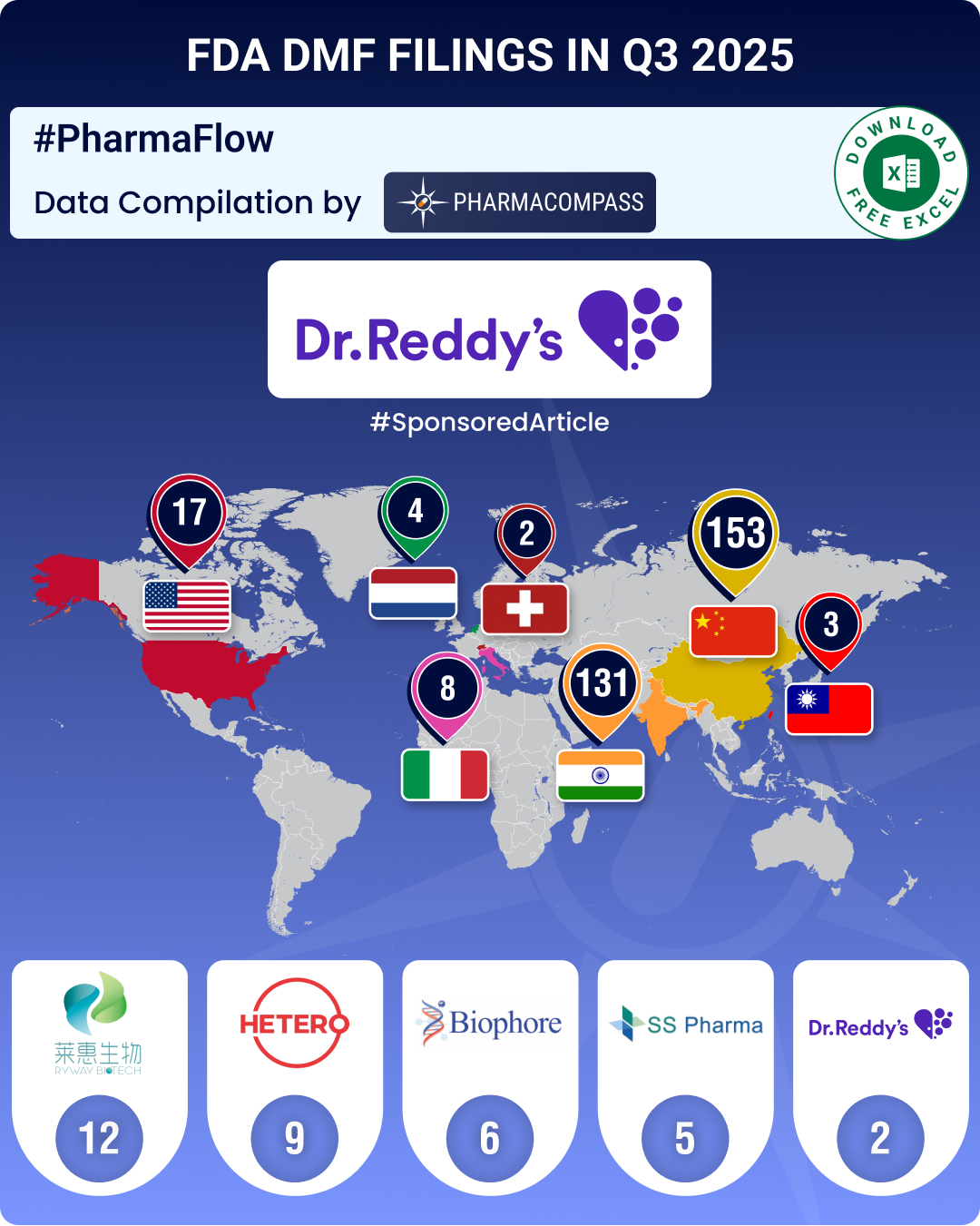
The third quarter (Q3) of 2025 witnessed a steady rise in Drug Master File (DMF) submissions to the US Food and Drug Administration (FDA). DMFs are used to provide confidential, detailed information about facilities, processes, or articles used in the manufacturing, processing, packaging, and storing of human drug products A total of 323 Type II DMFs were submitted during this period, as opposed to 309 submissions in Q3 2024, marking an increase of 4.53 percent. This is the second highest number since 2018. In Q1 2025, 339 Type II filings were recorded. Across all DMF types (II, III, IV, and V), 479 DMFs were filed in Q3 2025, compared to 394 in Q3 2024, representing a 21.57 percent increase. Out of the 323 Type II DMFs submitted in Q3 2025, 40 had completed their review by the end of Q3, reflecting a processing lag between submission and review completion.  View FDA DMF Filings in Q3 2025 (Power BI Dashboard, Free Excel Available) China maintains its lead while India posts double-digit growth in DMF submissions  China and India continued to dominate DMF submissions in Q3 2025. China retained the top spot with 153 Type II DMFs, matching its submission count from Q3 2024. India recorded 131 DMFs, marking a 20.18 percent increase over 109 filings during the corresponding period last year. The United States stood a distant third with 17 filings, compared to 13 in Q3 2024. Among European nations, Italy recorded eight DMFs, doubling its 2024 tally. The Netherlands filed four, up from three. Spain submitted only one DMF, as against seven submitted in Q3 2024. Taiwan made three filings, up from one submitted in Q3 2024. Together, India, China and Taiwan accounted for about 88.9 percent of all Type II DMFs filed during the quarter. China’s Suzhou Ryway Biotech tops corporate tally; India’s Hetero, Biophore follow China’s Suzhou Ryway Biotech led the company-wise tally with 12 DMF submissions in Q3 2025. The company had not filed any DMFs in Q3 2024. India’s Hetero Group followed with nine DMFs, maintaining the same number of filings as Q3 2024. Biophore India Pharmaceuticals ranked third with six DMFs, doubling its count from three last year. Other notable contributors include Sai Sreyas Pharmaceuticals (India) and Shanghai Haoyuan Chemexpress (China), with five DMFs each. Companies such as SNJ Group, Lunan Pharmaceutical, Allsino Pharmaceutical, Shankus Pharma, Jiangxi Xinganjiang Pharmaceutical, Sunpure Extracts, Lee Pharma, Umedica Laboratories, Linhai Tianyu Pharmaceutical and Maithri Drugs filed four DMFs each. Olaparib, semaglutide lead molecular filings; Dr. Reddy’s files DMF for edoxaban & tucatinib Dr. Reddy’s Laboratories also featured among key DMF filers in Q3 2025, submitting two DMFs — for edoxaban tosylate monohydrate and tucatinib copovidone. Edoxaban tosylate monohydrate (marketed as Savaysa by Daiichi Sankyo) is a prescription anticoagulant used to reduce the risk of stroke and to treat deep vein thrombosis and pulmonary embolism. Patent exclusivity for Savaysa extends until October 2026 in the United States, with no generic currently available. In terms of molecules, the highest number of DMFs were filed for olaparib, semaglutide, ruxolitinib phosphate, ferric carboxymaltose, and vismodegib, with three DMFs each in Q3 2025. Olaparib, sold by AstraZeneca under the brand name Lynparza, saw DMFs being filed by BDR Lifesciences and Intas Pharmaceuticals from India, and by ScinoPharm Taiwan during the quarter. Semaglutide, a glucagon-like peptide-1 (GLP-1) receptor agonist developed by Novo Nordisk, continued to draw strong interest from API manufacturers. DMFs for semaglutide were filed by three Chinese companies: Yangzhou Aurisco Pharmaceutical, Zhejiang Peptites Biotech, and Fujian Genohope Biotech. Ruxolitinib phosphate, marketed by Incyte as Jakafi, saw three DMFs. Three Indian companies — Alembic Pharmaceuticals, Valary Labs, and Devi Pharmatech — filed DMFs for this API in Q3 2025. Other molecules that received multiple DMF submissions include ferric carboxymaltose (used to treat iron-deficiency anemia) and vismodegib (an oral therapy for basal-cell carcinoma). First-time DMF filings span 17 companies; India leads with nine first-time DMF The quarter saw first-time DMF filings from 17 companies. India took a lead here with nine first-time DMF filings, followed by China (six), and the US (two). The DMF filings in this quarter included inclisiran sodium (filed by Aurisco Pharmaceutical of China), pacritinib citrate (by TAPI Nl B.V. of the Netherlands), and vosoritide (by Apicore LLC of the US). Out of the 19 first-time DMFs filed in Q3 2025, four completed their Generic Drug User Fee Amendments (GDUFA) review process during the quarter. GDUFA fee for FY 2026: The FDA Generic Drug User Fee Amendments (GDUFA) is a law designed to speed access to safe and effective generic drugs to the public and reduce costs to the industry. Fee rates for fiscal year 2026 were published on July 30, 2025. FDA has revised fees under GDUFA III across all categories. While there is a slight increase in the DMF fee from US$ 95,084 in 2025 to US$ 102,584 in 2026, the ANDA fee has seen a sharp rise: from US$ 321,920 in 2025 to US$ 358,247 in 2026. FY 2025 and FY 2026 User Fee Rates Generic drug fee category Fees rates for FY 2025 Fees rates for FY 2026 Applications:     Abbreviated New Drug Application (ANDA) US$ 3,21,920 US$ 3,58,247 Drug Master File (DMF) US$ 95,084 US$ 1,02,584 Facilities:     Active Pharmaceutical Ingredient (API)—Domestic US$ 41,580 US$ 43,549 API—Foreign US$ 56,580 US$ 58,549 Finished Dosage Form (FDF)—Domestic US$ 2,31,952 US$ 2,38,943 FDF—Foreign US$ 2,46,952 US$ 2,53,943 Contract Manufacturing Organization (CMO)—Domestic US$ 55,668 US$ 57,346 CMO—Foreign US$ 70,668 US$ 72,346 GDUFA Program:     Large size operation generic drug applicant US$ 18,91,664 US$ 19,18,377 Medium size operation generic drug applicant US$ 7,56,666 US$ 7,67,351 Small business generic drug applicant US$ 1,89,166 US$ 1,91,838 Our view For several years prior to the pandemic, India had a lead in Type II DMF submissions. In recent years, China has surpassed India in DMF filings. But Q3 2025 numbers indicate that Indian drugmakers are fast catching up. Since DMFs establish trust in APIs from across the world, we feel this healthy competition between drugmakers from the two countries is good for the global pharmaceutical industry.  

Impressions: 5446

https://dev1.pharmacompass.com/radio-compass-blog/dmf-filings-rise-4-5-in-q3-2025-china-holds-lead-india-records-20-growth-in-submissions

#PharmaFlow by PHARMACOMPASS
13 Nov 2025

WEEKLY INDUSTRY NEWS

1read-more
read-more
GSK, Google form first bioelectronics firm; 11 generic companies benefit from the Teva Allergan deal
This week, Phispers brings to you the details of the bioelectronics firm formed by GSK and Google. There is also news on companies like Teva, Takeda, Jinan Jinda and Eli Lilly, besides two other news snippets pertaining to the FDA -- while the first one pertains to generic approvals, the other one relates to an additional black box warning on a few antibiotics.   GSK and Google join hands to form first bioelectronics startupGlaxoSmithKline and Google’s parent company – Alphabet – have joined hands to create a new company that is focused on fighting diseases by targeting electrical signals in the human body. This way, GSK and Alphabet’s life sciences unit – known as Verily Life Sciences – will be jump-starting a new field of medicine known as bioelectronics.Verily Life Sciences and GSK will together contribute US $ 715.12 million over seven years to the startup Galvani Bioelectronics. The startup will develop miniature electronic implants for the treatment of asthma, diabetes and other chronic conditions. The implantable devices developed by Galvani, which is owned 55 percent by GSK and 45 percent by Verily, can modify electrical nerve signals. The aim is to modulate irregular or altered impulses that occur in many illnesses.The new company will be based at GSK’s Stevenage research center north of London, with a second research hub in South San Francisco.The announcement comes just weeks after GSK had said it was going to use Apple’s HealthKit to conduct clinical trials.Three years ago, GSK had first unveiled its ambitions in bioelectronics in the journal – Nature. Bioelectronic remedies attach battery-powered implants the size of a grain of rice (or even smaller) to individual nerves to correct faulty electrical signals between the nervous system and the body’s organs.GSK believes altering these nerve signals could open up the airways of asthma patients, reduce inflammation in the gut from Crohn’s disease and treat patients with a range of other chronic ailments such as arthritis. So far, the implants have only been tested on animals but the aim is to produce treatments that will supplement or replace drugs that often come with side-effects.GSK has been working on bioelectronic medicines since 2012 in a push to develop new patentable treatments, since its Advair respiratory treatment faces competition from generic versions. It has invested US $50 million in a venture capital fund for bioelectronics and provided funding to scientists working in the field.  Teva divests 79 products to 11 generic players to close Allergan dealTeva Pharmaceutical Industries – the world’s largest generics drug company – won a US anti-trust approval to purchase Allergan's generics business, after agreeing to divest 79 generic drugs to rival firms. This was arrived at to settle Federal Trade Commission (FTC) charges that its proposed US $ 40.5 billion acquisition of Allergan’s generic pharmaceutical business would be anti-competitive. The remedy requires Teva to divest the drug portfolio to 11 firms, and marks the largest drug divestiture order in a FTC pharmaceutical merger case.The Teva-Allergan deal, which was announced in July 2015, solidifies Teva’s position as the world's largest maker of generics while freeing Allergan to focus on branded drugs.The companies that have acquired the divested products are Mayne Pharma Group, Impax Laboratories, Dr Reddy’s Laboratories, Sagent Pharmaceuticals, Cipla Limited, Zydus Worldwide DMCC, Mikah Pharma, Perrigo Pharma International, Aurobindo Pharma USA, Prasco and 3M Company. Eli Lilly CEO steps down; company under probe by US Justice Department Eli Lilly CEO John Lechleiter has stepped down after steering the pharma company through long R&D droughts. The company’s president David Ricks will move up to the top spot. And after a brief spell as executive chairman, Lechleiter will leave the company next spring.Lechleiter has been the company's CEO since April 1, 2008, and the chairman of its board of directors since January 1, 2009.The announcement has come at a time when Eli Lilly has been asked by the Justice Department to disclose information on relationships with pharmacy benefits managers (PBMs), the companies that negotiate prices and set reimbursement conditions.It has not been clear what exactly the department of justice is looking for. In the past, drug makers such as Novartis and AstraZeneca have agreed to pay fines and penalties to settle allegations pertaining to PBMs.  FDA continues to race ahead with generic approvals  The American regulator has reduced its pile of ANDA (abbreviated new drug applications) by about 500 applications in the first six months of 2016. The FDA has also approved 315 more ANDAs over the same time period and has sent 66 more complete response letters — or rejections — to drug makers.This news comes after Bloomberg reported last month that the FDA has become ‘something of a bogeyman’ for India’s stock markets by approving generic drug applications from India at a record place. Similarly, PharmaCompass had reported last week that Indian companies have been fixing compliance issues. China’s Jinan Jinda fails another EDQM inspection; compliance troubles in Denmark  In regulatory news from across the world, Jinan Jinda, a Chinese API manufacturer that had failed an inspection by Italian regulators in June 2015, had more bad news awaiting it a year on. In a June 2016 re-inspection, this time by the Spanish Health Authority, the regulator maintained the ‘facilities non-compliance standing’ since two critical observations were made and the corrections from the previous inspection “were found as not having been implemented in a satisfactory way”. And critical deficiencies were found on raw data.In the June 2015 inspection, the critical observation was related to an unofficial and non-controlled storage area containing mainly raw materials and finished products which had been made inaccessible to inspectors as the door had been removed and replaced with a panel fixed with screws to the wall.Meanwhile, the FDA issued an untitled letter (dated July 15, 2016) to Danish allergy immunotherapy company ALK-Abelló (ALK) over manufacturing and quality control issues at its Horsholm, Denmark facility. The letter comes after a 12-day inspection of the facility in March 2016. During the inspection, the FDA had cited ALK for four “significant deviations” from cGMP requirements.  Another black box warning added to antibiotics like Cipro and LevaquinThe FDA has upgraded warnings on certain antibiotics, such as Johnson & Johnson’s Levaquin, Bayer’s Cipro extended-release tablets and Merck’s Avelox. The FDA had added a black box warning in 2008 about the increased risk of tendinitis in which the tissue connecting muscle to bone becomes inflamed. In May this year, the FDA had advised restricting the use of fluoroquinolone antibiotic for certain uncomplicated infections and had warned about the disabling side-effects of the drug.The new warning talks about long-term risks to the drugs’ current black box warning. The agency also advised using the drugs only for serious infections. Manufacturers of fluoroquinolone have faced thousands of lawsuits from patients who claim that their injuries were caused by the drugs. J&J alone faced 3,400 lawsuits over Levaquin’s links to tendon problems and has also settled many of those cases. Takeda to overhaul R&D, downsize operations in the UKTakeda Pharmaceutical of Japan has said it plans to build a new pipeline of drugs. It plans to revamp its research operations at the cost of around US $ 727 million..  The company also plans to close some of its R&D operations in the UK. Takeda is beginning the first ‘consultation stage’ of the layoff process in the UK, which hosts a pre-clinical R&D operation in Cambridge as well as a development center headquarter with facilities in the UK, Switzerland and Denmark.Under the revamp, Takeda’s R&D activities will be concentrated in Japan and the US, the 235-year old drug company said in a statement. Takeda plans to now focus on the three therapeutic areas of oncology, gastroenterology and the central nervous system.“We need to first build new capabilities and embrace new ways of working,” Andy Plump, Takeda’s chief medical and scientific officer, said in the statement. 

Impressions: 3183

https://dev1.pharmacompass.com/radio-compass-phisper/gsk-google-form-first-bioelectronics-firm-11-generic-companies-benefit-from-the-teva-allergan-deal

#Phispers by PHARMACOMPASS
04 Aug 2016

NEWS LIBRARY

118read-more
read-more

https://www.globenewswire.com/news-release/2026/08/12/3343635/0/en/tris-pharma-expands-support-for-people-living-with-adhd-through-new-partnerships-with-calm-health-and-adhd-central.html

GLOBENEWSWIRE
12 Aug 2026

https://www.sydney.edu.au/news-opinion/news/2026/07/17/leading-adhd-medications-found-to-be-equally-effective-in-children-with-one-key-difference.html

PRESS RELEASE
17 Jul 2026

https://www.pharmacompass.com/pdf/news/enforcement-report-week-of-july-8-2026-94770.pdf

FDA
08 Jul 2026

https://www.globenewswire.com/news-release/2026/06/08/3308368/0/en/tris-pharma-introduces-a-new-60-ml-bottle-size-for-dyanavel-xr-amphetamine-extended-release-oral-suspension-cii.html

GLOBENEWSWIRE
08 Jun 2026

https://www.prnewswire.com/news-releases/kye-pharmaceuticals-announces-the-availability-of-dyanavel-xr-tablets-across-canada-for-the-treatment-of-adhd-302792950.html

PR NEWSWIRE
08 Jun 2026

https://granulesindia.com/wp-content/uploads/2026/01/Granules-Pharmaceuticals-Inc.-Receives-FDA-Tentative-Approval-with-180-Day-Exclusivity-for-Generic-Amphetamine-Extended-Release-Tablets-DYANAVEL-XR.pdf

PRESS RELEASE
08 Jan 2026
digital-content6055##p