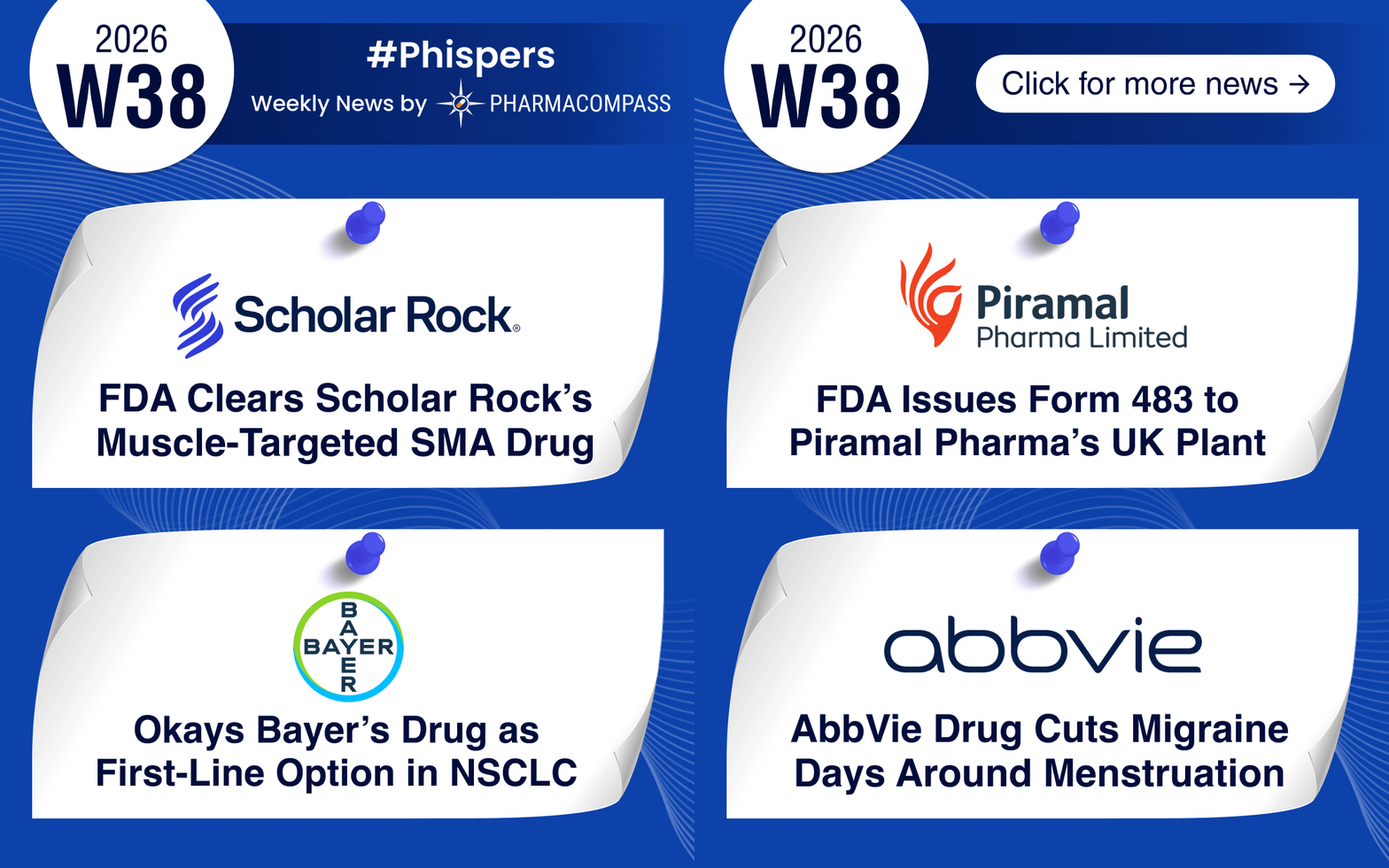
This week’s Phispers is packed with drug approvals. The US Food and Drug Administration (FDA) approved Scholar Rock’s Isembyld (apitegromab-mstn), the first treatment for spinal muscular atrophy (SMA) that targets muscle loss directly. The agency also granted accelerated approval to Bayer’s Hyrnuo (sevabertinib) as a first-line option in HER2-mutant lung cancer. Additionally, it cleared Pharming’s Joenja (leniolisib) for children aged four to 11 with a rare immune disorder, and approved two radiopharmaceuticals — Telix’s Pixclara (floretyrosine F 18) for brain cancer imaging and Curium’s Bexlutry (lutetium Lu 177 dotatate) for neuroendocrine tumors.In news from clinical trials, AbbVie’s atogepant reduced migraine days associated with the menstrual period in a late-stage trial. Definium’s LSD-based drug posted a second late-stage win in generalized anxiety disorder. In negative news from trials, AstraZeneca’s Etcamah (camizestrant), which had been approved last week, missed its primary endpoint in a phase 3 trial. This closes off its path for a broader first-line use in advanced breast cancer.Meanwhile, FDA issued a warning letter to Bausch and Lomb over aseptic practices at its Tampa site in Florida, and Piramal Pharma’s UK facility received a Form 483 with seven observations.In other news, Novo Nordisk rebranded itself as ‘Novo’ and GSK said it will close its vaccine plant in Dresden, Germany.Scholar Rock wins
first approval with Isembyld, its spinal muscular atrophy drug FDA has approved Scholar Rock’s Isembyld (apitegromab-mstn) for SMA in adults and children aged two and above who are already receiving a survival motor neuron 2-targeted treatment. It is the first therapy for SMA
that goes after muscle loss directly rather than the underlying motor neuron
defect.Okays Pharming’s Joenja for younger children: FDA has approved Pharming’s Joenja (leniolisib) for children aged four to 11 weighing at least 27 kg with activated phosphoinositide 3-kinase delta syndrome (APDS), a
rare primary immunodeficiency. It is the first treatment cleared for this age
group.FDA approves Bayer’s Hyrnuo as first-line option in HER2-mutant lung cancerFDA has granted accelerated approval to Bayer’s Hyrnuo (sevabertinib) for adults with locally
advanced or metastatic non-squamous non-small cell lung cancer (NSCLC) whose tumors carry HER2 activating mutations, as identified by an FDA-authorized
test. The approval follows a priority review and breakthrough therapy
designation granted by the agency. Hyrnuo was already approved for patients who
had received prior systemic therapy. This decision extends it to first-line
use.Clears Curium’s Bexlutry: FDA has approved Curium’s Bexlutry (lutetium Lu 177 dotatate) for adults with somatostatin receptor-positive gastroenteropancreatic neuroendocrine tumors (GEP-NETs), or rare growths in the gastrointestinal tract and pancreas. It was cleared through FDA’s 505(b)(2) pathway using Novartis’ Lutathera as the reference product. This is the industry’s first radioligand equivalent for the treatment of GEP-NETs.Okays first glioma imaging drug: FDA has approved Telix Pharmaceuticals’ Pixclara (floretyrosine F 18), a radioactive diagnostic drug used with positron emission tomography (PET) to differentiate recurrent or progressive glioma (brain cancer) from treatment-related changes, in adults and
children one month of age and older.Definium’s LSD drug posts another phase 3 win in generalized anxiety disorderDefinium Therapeutics has reported positive results from a second phase 3 study of DT120 (lysergide), its LSD-based drug, in generalized anxiety disorder. This is the third positive late-stage readout for
the drug. DT120 was also successful in treating depression in a late-stage
study.Astra’s Etcamah fails phase 3 breast cancer trial: Last week, FDA had granted accelerated approval to AstraZeneca’s Etcamah (camizestrant), combined with an existing CDK4/6 inhibitor, for adults with hormone receptor-positive, HER2-negative advanced breast cancer who develop a specific resistance mutation while on first-line treatment.
This week, there is news that the drug has failed in a different setting.
AstraZeneca has said a phase 3 trial of Etcamah plus Pfizer’s Ibrance (palbociclib) did not significantly improve progression-free survival against anastrozole plus Ibrance as upfront first-line treatment in estrogen receptor-positive, HER2-negative
advanced breast cancer.AbbVie’s atogepant reduces migraine days associated with menstrual periodAbbVie has said its migraine treatment atogepant reduced migraine days associated with the menstrual period in a late-stage trial. AbbVie plans to submit the results to global regulators in order to secure a label
expansion. Atogepant is approved in 60 countries for migraine prevention. No
treatment is currently approved specifically for menstrual migraine.Novo Nordisk
rebrands itself as Novo: Novo Nordisk will use the single name Novo under a rebranding exercise built around the tagline ‘Lasting Health Starts Now’. The rebranding comes along with a new internal culture framework known as ‘The Novo Way’. The move comes as the company works to regain ground against Eli Lilly in obesity drugs. The legal name of the company will remain ‘Novo Nordisk A/S’.GE HealthCare
said to be in talks to buy Sofie Biosciences; GSK shuts vaccine plantGE HealthCare is in talks for a possible US$ 1 billion deal to buy radiopharmaceutical developer Sofie Biosciences, the Financial Times reported. Sofie makes radioactive chemicals used in PET scans. A deal would strengthen GE HealthCare’s pharmaceutical diagnostics arm. However, neither company has commented on the FT report.GSK to shut vaccine factory in Germany: GSK
will shut its vaccine manufacturing site in Dresden, Germany, in 2027, citing falling demand for traditional egg-based flu vaccines. The Dresden facility makes
flu and hepatitis shots. The closure puts 641 jobs at risk.FDA issues Form 483 to Piramal Pharma’s UK plant; warns Bausch and Lomb FDA has issued a Form 483 with seven observations to Piramal Pharma’s Morpeth facility in the UK following a good manufacturing practice inspection conducted from September 3 to 11. In a stock exchange filing, the company said the
observations relate to improvements in its practices, procedures and
documentation, and that it is preparing a detailed response within the
stipulated window.Additionally, FDA has
issued a warning letter to Bausch and Lomb over aseptic
practices at its Tampa, Florida site, which makes contact lenses and lens care products. Investigators found the company had not established separate or defined zones to prevent contamination in aseptic processing areas, and that its restricted access barrier system line had design deficiencies and lacked adequate barrier protection. FDA said the findings show the firm does not operate an effective quality system.















 Share