Please Wait
Applying Filters...
Menu

Digital Content read-more

Create Content with PharmaCompass, ask us

PHARMA & BIOTECH INSIGHTS

2read-more
read-more

A PHP Error was encountered

Severity: 8192

Message: mb_convert_encoding(): Handling HTML entities via mbstring is deprecated; use htmlspecialchars, htmlentities, or mb_encode_numericentity/mb_decode_numericentity instead

Filename: blog/grid.php

Line Number: 52

Backtrace:

File: /var/www/html/application/views/include/media/blog/grid.php
Line: 52
Function: mb_convert_encoding

File: /var/www/html/application/models/Cmn.php
Line: 3595
Function: view

File: /var/www/html/application/views/include/product/digitalContent/grid.php
Line: 17
Function: common

File: /var/www/html/application/views/include/desc/inner.php
Line: 13
Function: view

File: /var/www/html/application/views/include/desc/indexNew.php
Line: 2433
Function: include

File: /var/www/html/application/controllers/Common.php
Line: 11303
Function: view

File: /var/www/html/index.php
Line: 231
Function: require_once

Top Pharma Companies & Drugs in 2025: Lilly vaults eight spots to emerge at the top; GLP-1 drugs dominate list
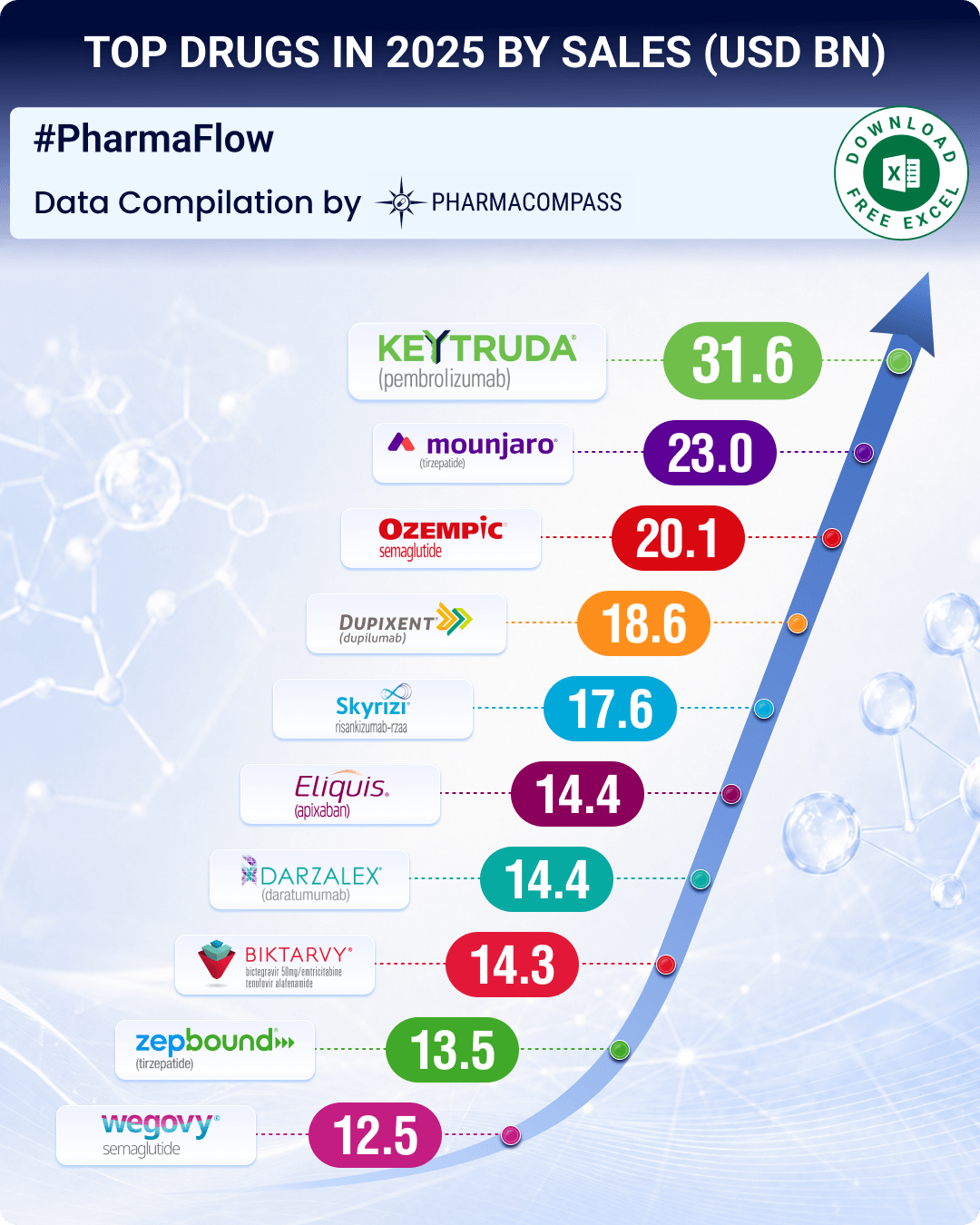
For the pharmaceutical industry, 2025 was a watershed year when obesity drugs settled firmly in the mainstream market. Glucagon-like peptide-1 (GLP-1) receptor agonists that treat diabetes and help in weight loss, dominated our top 10 list of drugs with four entries — Mounjaro (tirzepatide), Ozempic (semaglutide), Zepbound (tirzepatide) and Wegovy (semaglutide). In 2024, the top 10 drugs generated a total revenue of US$ 142 billion. This figure rose significantly in 2025, climbing to US$ 180.02 billion, reflecting strong growth. The year unequivocally belonged to Eli Lilly. The Indiana-headquartered drugmaker made a dramatic ascent, leaping from the ninth spot in 2024 to the numero uno position in our top drugmakers’ list for 2025. It posted 45 percent growth in sales, which rose to US$ 65.18 billion in 2025. In terms of therapeutic areas, oncology saw the maximum sales (at US$ 229.1 billion), followed by immunology (US$ 126.8 billion), infectious diseases (US$ 99.2 billion), diabetes (US$ 95.8 billion), neurology (US$ 70.4 billion), cardiology (US$ 67.6 billion) and hematology (US$ 29.3 billion).  View Our Interactive Dashboard on Top Drugs in 2025 by Sales (Free Excel Available) Lilly zooms past Pfizer on back of tirzepatide franchise; Roche, AbbVie, J&J make it to top five  Eli Lilly’s spectacular climb to the number one spot was driven by Mounjaro and Zepbound. Mounjaro leapt from the eighth spot in 2024 (when its sales stood at US$ 11.5 billion) to the number two position in 2025, raking in US$ 23 billion. Lilly’s other GLP-1 drug, Zepbound, also broke into the top 10, debuting at number nine with sales of US$ 13.5 billion. Taken together, Lilly’s tirzepatide franchise hit US$ 36.50 billion in 2025, surpassing Merck's Keytruda (pembrolizumab). At the number two position was Pfizer, with sales of US$ 62.58 billion. Notably, not a single Pfizer drug made it to the top 10 list. Pfizer’s sales fell by 1.63 percent in 2025, from US$ 63.63 billion in 2024. The decline was attributed to lower Covid‑19 revenues due to reduced infection rates, which impacted Paxlovid (nirmatrelvir/ritonavir) sales, and a narrower US vaccine recommendation, which affected Comirnaty (tozinameran) sales. Roche came third, reporting sales of CHF 47.7 billion  (US$ 62.10 billion) in 2025, compared to CHF 46.2 billion (US$ 50.86 billion) in 2024. At number four was AbbVie — it reported full-year net revenues of US$ 61.16 billion in 2025, compared to US$ 56.33 billion in 2024. The company’s immunology portfolio remained a key driver, bringing in US$ 30.41 billion in sales. Skyrizi (risankizumab) — approved for plaque psoriasis, psoriatic arthritis, Crohn’s disease, and ulcerative colitis — emerged as a major growth engine, with sales of US$ 17.56 billion. Rounding out the top five was Johnson & Johnson, whose innovative medicine division reported sales of US$ 60.4 billion, up from US$ 56.9 billion in 2024. Merck’s Keytruda retains top-selling drug status, followed by Lilly’s Mounjaro, Novo’s Ozempic Merck’s Keytruda retained its position as the world’s best-selling drug for the third consecutive year, generating approximately US$ 31.6 billion in sales, up from US$ 29.5 billion in 2024 and US$ 25 billion in 2023. Keytruda has become the pillar of cancer immunotherapy, with over 40 indications. The launch of Keytruda Qlex, a subcutaneous formulation co-administered with berahyaluronidase alfa, has further strengthens its lifecycle. Amongst other oncology drugs, J&J’s Darzalex (daratumumab) generated US$ 14.4 billion in sales, taking it to the number seven spot. Its strong performance has been supported by Darzalex Faspro, a subcutaneous formulation launched in 2020 that significantly reduces administration time. Growth from Darzalex and other brands helped offset the decline in Stelara (ustekinumab), whose sales fell 41 percent to US$ 6.1 billion, from US$ 10.4 billion in 2024. Among diabetes, obesity and metabolic drugs, Lilly’s Mounjaro was at the number two spot,  followed by Novo Nordisk’s Ozempic at number three. Ozempic posted sales of US$ 20.09 billion. Lilly’s Zepbound was at the ninth spot, with sales of US$ 13.54 billion. Novo’s Wegovy was tenth, with sales of US$ 12.5 billion. Together with Rybelsus, Novo’s semaglutide franchise generated approximately US$ 36.1 billion in 2025 sales. In immunology, Sanofi and Regeneron’s Dupixent (dupilumab) stood fourth and maintained its leadership with sales of US$ 18.6 billion. Dupixent is now approved across nine indications. At fifth position was another immunology drug — AbbVie’s Skyrizi (risankizumab). It has emerged as AbbVie’s key growth engine post‑Humira (adalimumab), delivering 49.87 percent growth and generating US$ 17.56 billion in 2025 sales. First approved in April 2019 for plaque psoriasis, it is now approved across four indications. The other drugs in our top 10 list were Eliquis (apixaban) and Biktarvy (bictegravir/emtricitabine/tenofovir alafenamide). Eliquis, co-developed and commercialized by Bristol Myers Squibb and Pfizer, stood sixth with sales of US$ 14.4 billion. Gilead’s Biktarvy (bictegravir/emtricitabine/tenofovir alafenamide) held the number eight position, with sales of US$ 14.3 billion in 2025. The drug commands over 52 percent of the US market for HIV treatments. Astra’s revenue rises by 8.6 percent; Merck, Novartis, Sanofi, Novo make it to top 10  AstraZeneca’s revenues increased 8.6 percent to US$ 58.73 billion, compared to US$ 54.10 billion in 2024, though its ranking fell from fifth to sixth position in 2025. Astra’s revenue growth was driven by strong performance across oncology, cardiovascular, renal and metabolism, respiratory and immunology, and rare disease portfolios. Farxiga (dapagliflozin), a drug used to manage blood sugar, was a key driver, generating US$ 8.4 billion in revenue in 2025. At number seven was Merck, with sales of US$ 58.1 billion, reflecting a modest growth of 1.3 percent, which was driven by Keytruda. Novartis stood eighth on our 2025 list (against seventh in 2024), with net sales of US$ 54.5 billion in 2025, up from US$ 50.3 billion in 2024. Sanofi landed at the ninth position, with sales of US$ 51.7 billion, against US$ 42.6 billion in 2024. Novo Nordisk rounded out the top ten, posting revenues of DKK 309.06 bn (US$ 48.7 billion) in 2025 — a growth of 21.37 percent compared to DKK 290.40 billion (US$ 40.2 billion) in 2024 — driven primarily by its obesity and diabetes care portfolio. Our view The 2025 rankings confirm what analysts have been expecting for some time — that the market for anti-obesity drugs could reach US$ 100 billion by 2030. The four GLP-1 drugs in our 2025 list together generated combined revenue of approximately US$ 70 billion. At this pace, the US$ 100 billion market size may arrive sooner than projected, perhaps as early as 2026 or 2027.

Impressions: 4578

https://dev1.pharmacompass.com/radio-compass-blog/top-pharma-companies-drugs-in-2025-lilly-vaults-eight-spots-to-emerge-at-the-top-glp-1-drugs-dominate-list

#PharmaFlow by PHARMACOMPASS
11 Jun 2026

MARKET PERFORMANCE RECAP

1read-more
read-more
Market Performance Recap August 2026 highlights: FDA okays first mRNA flu shot; Curium agrees to buy Lantheus for up to US$ 8 bn
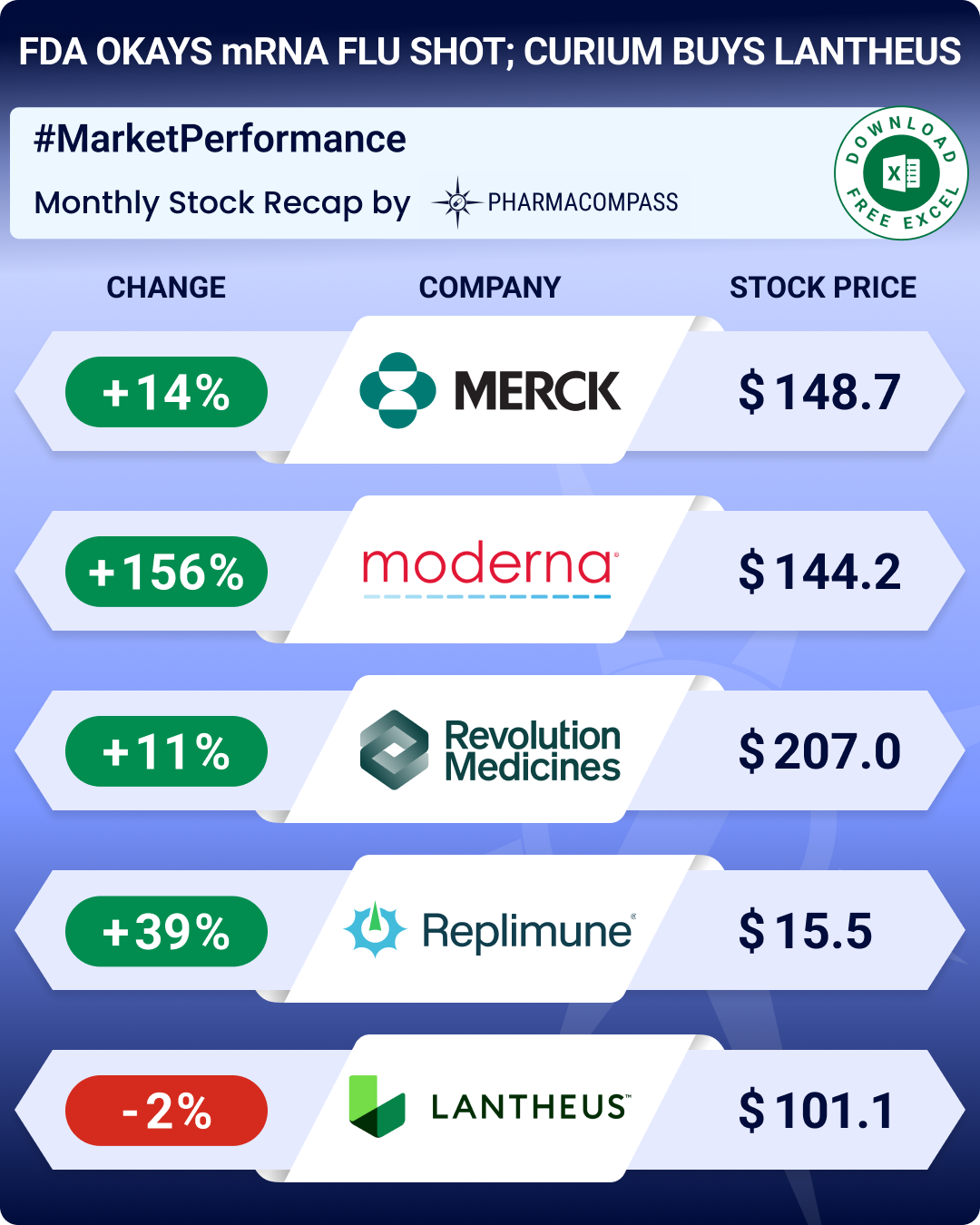
August was an important month for drug approvals, with the US Food and Drug Administration (FDA) approving Moderna’s mRNA-based seasonal influenza vaccine and Revolution Medicines’ drug to treat stage 4 pancreatic cancer. In clinical trials, Merck and Moderna’s personalized mRNA-based cancer vaccine significantly delayed melanoma from returning in patients whose tumors had been surgically removed. And Definium Therapeutics’ oral LSD candidate significantly reduced symptoms of generalized anxiety disorder, after showing benefit in depression earlier this year. As compared to July, the pharma indices rose at a faster clip. The Nasdaq Biotechnology Index (NBI) increased by 10.35 percent, from 6,456.75 in July-end to 7,125.06 at the end of August. The SPDR S&P Biotech ETF (XBI) increased by 10.56 percent, from 146.98 to 162.50. The S&P Biotechnology Select Industry Index (SPSIBI) increased by 10.57 percent, from 11,508.60 to 12,725.46.   Access the Market Performance Dashboard for August 2026 Newsmakers (Free Excel) FDA approves Moderna’s mRNA flu shot, Revolution’s therapy for pancreatic cancer  Amongst the month’s most notable drug approvals was Moderna's mFlusiva (mRNA-1010) — FDA cleared it for preventing seasonal influenza in all adults aged 50 and older. This is Moderna’s fourth approved product, and the first mRNA-based flu shot cleared in the US. Moderna’s stock rose 156 percent in August. Another first was FDA’s approval of Revolution Medicines’ Rasonque (daraxonrasib) for the treatment of adults with metastatic pancreatic ductal adenocarcinoma (PDAC), or stage 4 pancreatic cancer. Rasonque is the first targeted cancer medicine to be approved from a groundbreaking new class of targeted therapy known as RAS(ON) multi-selective and mutant-selective inhibitors. FDA also approved Takeda’s Orzeyful (oveporexton) for a lifelong neuropsychiatric sleep disorder, known as narcolepsy type 1. This is the first medicine approved for addressing the underlying cause of the disease in adults. The agency approved Gilead Sciences’ Bixlenvo (bictegravir/lenacapavir), the smallest once-daily single tablet regimen, for the treatment of HIV in adults who are virologically suppressed. The UK’s Medicines and Healthcare products Regulatory Agency (MHRA) authorized Eli Lilly's Foundayo (orforglipron), making Britain the first country in Europe to clear the GLP-1 tablet. Meanwhile, Japan’s health ministry approved GSK’s Hibsago (bepirovirsen) as a functional cure for chronic hepatitis B in adults who have taken antiviral pills for at least six months. This is the drug’s first approval anywhere in the world. A functional cure means the virus stays undetectable for at least 24 weeks after all treatment is stopped. Curium to acquire Lantheus for up to US$ 8 bn to create global radiopharma player August didn’t see many large M&A deals. The biggest acquisition was announced by Curium — it agreed to buy Lantheus Holdings for up to US$ 8 billion. Both companies are into radiopharmaceuticals, or radioactive isotopes used to diagnose and treat diseases, including cancers. Eli Lilly agreed to acquire Merida Biosciences for up to US$ 2.875 billion in cash. The acquisition gives Lilly access to Merida’s antibody-engineering platform and its lead phase 1 candidate MER511, being developed for Graves’ disease and thyroid eye disease, along with preclinical programs targeting food allergy, asthma and chronic spontaneous urticaria. Jazz Pharmaceuticals agreed to acquire San Diego-based Actio Biosciences for up to US$ 1.32 billion. The deal adds an experimental treatment for a rare inherited form of epilepsy to Jazz’s portfolio. In deals, Roche’s Genentech is partnering with South Korea’s Hanmi Pharm to advance a novel therapy (HM17321) that could improve the quality of weight loss by preserving lean mass in a deal worth up to US$ 2.3 billion. Unlike GLP-1 drugs, which cause muscle loss, HM17321 is designed to cut fat while increasing lean mass. The drug is still in phase 1 trials. FDA approves two drugs for blood cancer — Takeda’s Mimrylo, BMS’s Zenbexus In oncology, FDA approved Takeda’s Mimrylo (rusfertide) for the treatment of erythrocytosis (a condition where the body has a higher-than-normal number of red blood cells) in adults with polycythemia vera, a type of blood cancer. The agency granted accelerated approval to Bristol Myers Squibb’s Zenbexus (iberdomide), combined with subcutaneous daratumumab and hyaluronidase-fihj and dexamethasone, for adults with multiple myeloma (a type of blood cancer) who have had at least one prior line of therapy. FDA also granted accelerated approval to Replimune’s Tudriqev (vusolimogene oderparepvec-wtpg), in combination with BMS’ Opdivo (nivolumab), for treating adults with a difficult form of skin cancer, known as unresectable advanced cutaneous melanoma. The approval follows two rejections, in July 2025 and April 2026. Replimune’s stock was up 39 percent in August. In rare diseases, FDA approved Regeneron Pharmaceuticals’ Pasatru (garetosmab-grts) for a rare genetic disorder known as fibrodysplasia ossificans progressiva (FOP). In this condition, muscle, tendon and ligament tissue gradually turn into bone. FDA also granted accelerated approval to Ultragenyx’s Genglycos (pariglasgene brecaparvovec-opnr), the first treatment for glycogen storage disease type Ia (GSD1a) in patients aged eight and above. Children and adults with the rare disorder lack an enzyme needed to release stored sugar from the liver. As a result, their blood sugar crashes whenever they go too long without eating. Merck-Moderna’s mRNA cancer vaccine notches first phase 3 win; Definium’s LSD drug shows benefit in anxiety In clinical trials, the biggest readout came from Merck and Moderna — in a phase 3 trial, their personalized mRNA cancer vaccine, intismeran autogene, given in combination with Keytruda (pembrolizumab), significantly delayed melanoma recurrence in patients whose tumors had been surgically removed. Otsuka’s Voyxact (sibeprenlimab) became the first drug to stabilize kidney function in IgA nephropathy to the rate seen in healthy adults, according to two-year results from a phase 3 trial. IgA nephropathy is a disease in which faulty antibodies lodge in the kidney’s filters. Psychedelics saw another late-stage success. Definium Therapeutics’ oral LSD candidate DT120 (lysergide) significantly reduced symptoms of generalized anxiety disorder in a phase 3 trial. DT120 is an orally disintegrating tablet. AstraZeneca posted two lung cancer wins on the same day. In one phase 3 trial, Tagrisso (osimertinib) plus Orpathys (savolitinib) showed benefit in a type of lung cancer, known as EGFR-mutated NSCLC driven by MET resistance. In another phase 3 trial, Enhertu (trastuzumab deruxtecan) showed benefit as a first-line treatment of patients with unresectable, locally advanced or metastatic HER2-mutant NSCLC. Our view All three pharma indices rose over 10 percent in August, against the S&P 500’s modest increase of 2.42 percent. As geopolitical uncertainties continue to rock industries across the world, it’s clear that the pharmaceutical industry is building resilience through its laboratories and clinical trials.

Impressions: 1231

https://dev1.pharmacompass.com/pipeline-prospector-blog/market-performance-recap-august-2026-highlights-fda-okays-first-mrna-flu-shot-curium-agrees-to-buy-lantheus-for-up-to-us-8-bn

#PharmaFlow by PHARMACOMPASS
03 Sep 2026

WEEKLY INDUSTRY NEWS

3read-more
read-more
FDA approves Revolution’s pancreatic cancer drug; Novartis pauses eight trials on its CAR-T therapy after patient deaths
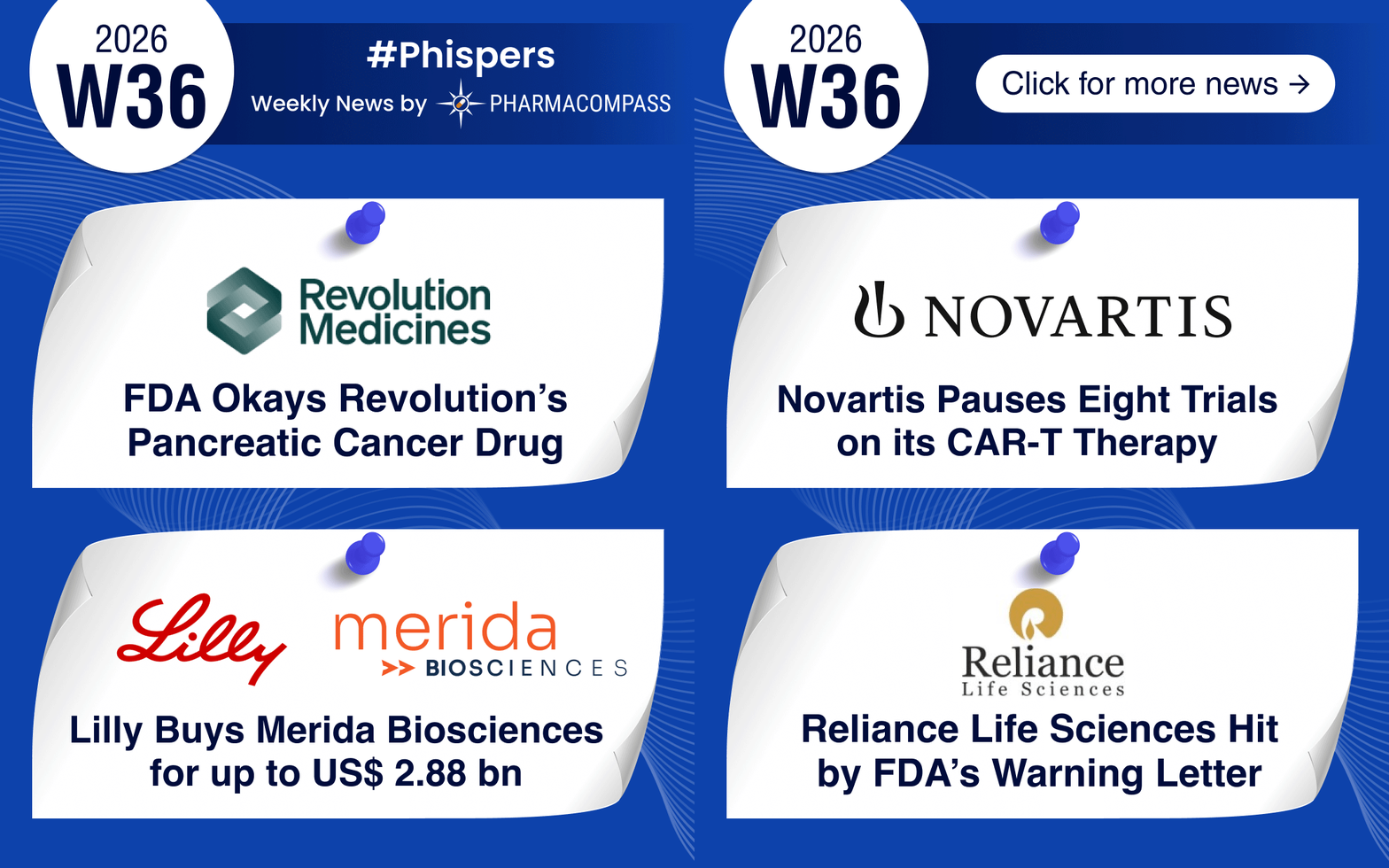
This week’s Phispers is packed with news on drug approvals and clinical trials. The US Food and Drug Administration (FDA) approved Revolution Medicines’ Rasonque (daraxonrasib) to treat metastatic pancreatic cancer, Eli Lilly’s Mounjaro (tirzepatide) to lower the risk of cardiovascular death, heart attack or stroke in adults with type 2 diabetes, and Gilead’s Bixlenvo, a drug that simplifies care for HIV patients whose virus is already under control.The agency approved Takeda and Protagonist Therapeutics’ Mimrylo (rusfertide) to treat polycythemia vera, a type of blood cancer in which the bone marrow overproduces red blood cells (RBCs), thereby increasing the risk of heart attack, stroke and clots. It also approved Priovant Therapeutics’ Lisraya (brepocitinib) for adults with dermatomyositis, an autoimmune disease that causes progressive muscle weakness and painful rashes.Novartis paused eight clinical trials of its experimental CAR-T cell therapy — rapcabtagene autoleucel (rap-cel) — after three patients died from a severe immune reaction. In other trials, Novartis’ drug Rhapsido (remibrutinib) outperformed Sanofi’s Aubagio (teriflunomide) by reducing relapses and inflammatory brain lesions in patients with a form of multiple sclerosis, without any liver safety flags.Amgen has said its cholesterol drug Repatha (evolocumab) reduced the risk of death in high-risk adults without a prior heart attack or stroke in a phase 3 trial. AstraZeneca and Amgen’s Tezspire (tezepelumab) met all its goals in a phase 3 trial in eosinophilic esophagitis, a chronic condition in which immune cells inflame the esophagus.In deals, Eli Lilly announced the acquisition of Merida Biosciences for up to US$ 2.88 billion and Roche entered into an agreement with Simcere Zaiming for exclusive global rights to its experimental blood cancer drug.In regulatory news, FDA issued warning letters to India-based companies Reliance Life Sciences and Shoolin Pharma Chem.FDA approves Revolution Medicines’ metastatic pancreatic cancer drug FDA has approved Revolution Medicines’ Rasonque (daraxonrasib), the first RAS-targeted medicine to treat metastatic pancreatic cancer in patients who have received prior treatment or cannot receive combination chemotherapy. RAS mutations drive nearly all pancreatic cancers. The approval came more than six months ahead of FDA’s own deadline.Approves Gilead’s HIV combination pill: FDA has approved Gilead’s Bixlenvo, a combination of bictegravir and lenacapavir, in adults with HIV who are virologically suppressed. Bixlenvo simplifies care for patients whose virus is already under control.Novartis pauses eight clinical trials on its CAR-T therapy after three deathsNovartis has paused eight clinical trials of its experimental CAR-T cell therapy — rapcabtagene autoleucel (rap-cel) — that targets autoimmune and neurological diseases after three patients died from a severe immune reaction. The therapy reprograms a patient’s own immune cells to fight diseases such as lupus, multiple sclerosis and myasthenia gravis. Meanwhile, Bristol Myers Squibb has also paused enrollment in trials of its autoimmune CAR-T therapy (zola-cel) as a precaution.Rhapsido clears phase 3 MS trial: Novartis has said its drug Rhapsido (remibrutinib) outperformed Sanofi’s Aubagio (teriflunomide) in phase 3 trials by reducing relapses and inflammatory brain lesions in patients with a form of multiple sclerosis (MS), without any liver safety flags. MS is a chronic inflammatory disease of the central nervous system.FDA approves Lilly’s Mounjaro to lower cardiovascular risk in adults with diabetesFDA has approved Eli Lilly’s Mounjaro (tirzepatide) to lower the risk of cardiovascular death, heart attack or stroke in high-risk adults with type 2 diabetes. Mounjaro’s approval was based on results from a phase 3 trial where it outperformed Lilly’s Trulicity (dulaglutide).Clears drug for rare blood cancer: FDA has approved Takeda and Protagonist Therapeutics’ Mimrylo (rusfertide) to treat adults with polycythemia vera, a blood cancer in which the bone marrow overproduces RBCs. This causes erythrocytosis (thickening of blood) and raises the risk of heart attack, stroke and clots.Okays Priovant’s autoimmune disease drug: FDA has approved Priovant Therapeutics’ Lisraya (brepocitinib) for adults with dermatomyositis, an autoimmune disease that causes progressive muscle weakness and painful skin rashes.Lilly to buy Merida Biosciences for up to US$ 2.88 billion in autoimmune pushEli Lilly will acquire privately held Merida Biosciences for up to US$ 2.88 billion in cash, adding a drug-development approach that removes disease-causing antibodies rather than broadly suppressing the immune system. Merida’s lead candidate (MER511) targets Graves’ disease and thyroid eye disease, conditions in which faulty antibodies overstimulate the thyroid or attack eye tissue. MER511 is currently in phase 1 trials.Roche inks deal with China’s Simcere: Roche has entered into a license agreement with Simcere Zaiming (a subsidiary of Simcere Pharmaceutical Group), wherein it will pay the Chinese drugmaker US$ 75 million upfront for exclusive global rights to its experimental blood cancer drug (SIM0660). The drug targets B-cell malignancies. Simcere is also eligible for milestone payments worth up to US$ 1.46 billion. B cells are white blood cells that produce antibodies. When they malfunction, they can drive both cancers and autoimmune disease.Genentech partners China’s DualityBio: Roche’s Genentech has partnered DualityBio to develop next-generation antibody-drug conjugates using the Shanghai-based company’s proprietary payload platform. Roche will pay DualityBio US$ 45 million upfront with more than US$ 1 billion in potential milestones.AstraZeneca-Amgen’s Tezspire succeeds in esophagus disease trialAstraZeneca and Amgen’s Tezspire (tezepelumab) met all primary and secondary goals in a phase 3 trial in eosinophilic esophagitis, a chronic condition in which immune cells inflame the esophagus, making swallowing difficult.Meanwhile, the European Commission has approved AstraZeneca and Daiichi Sankyo’s Enhertu (trastuzumab deruxtecan) in combination with pertuzumab as first-line treatment for HER2-positive metastatic breast cancer.Amgen’s cholesterol drug cuts death risk: Amgen has said its FDA-approved cholesterol lowering drug Repatha (evolocumab) reduced the risk of death in high-risk adults without a prior heart attack or stroke in a phase 3 trial. Repatha was added to statins or other low-density lipoprotein cholesterol-lowering treatments. The drug cut major cardiovascular events by 25 percent. Repatha was first approved by the FDA in 2015.FDA issues warning letter to Reliance Life Sciences over CGMP concerns FDA has issued a warning letter to India-based Reliance Life Sciences over violations of current good manufacturing practices (CGMPs). The letter says the firm failed to ensure that laboratory records included complete data derived from all tests necessary to ensure compliance.The agency also issued a warning letter to Shoolin Pharma Chem, an Ahmedabad-based manufacturer of active pharmaceutical ingredients for the US market, after an April inspection found adulteration of its drug productions.

Impressions: 1868

https://dev1.pharmacompass.com/radio-compass-phisper/fda-approves-revolution-s-pancreatic-cancer-drug-novartis-pauses-eight-trials-on-its-car-t-therapy-after-patient-deaths

#Phispers by PHARMACOMPASS
03 Sep 2026

NEWS LIBRARY

56read-more
read-more

https://firstwordpharma.com/story/8242426

FIRSTWORD PHARMA
19 Oct 2026

https://www.gilead.com/news/news-details/2026/u-s--fda-approves-gileads-bixlenvo-a-new-once-daily-single-tablet-option-for-virologically-suppressed-adults-with-hiv-including-those-on-complex-regimens

PRESS RELEASE
27 Aug 2026

https://www.businesswire.com/news/home/20260727256393/en/ViiV-Healthcares-2-drug-regimen-Dovato-is-as-effective-as-3-drug-regimen-Biktarvy-in-first-of-its-kind-head-to-head-study-in-treatment-nave-adults-living-with-HIV

BUSINESSWIRE
27 Jul 2026

https://www.businesswire.com/news/home/20260427182040/en/U.S.-FDA-Grants-Priority-Review-of-New-Drug-Application-for-Gileads-Once-Daily-HIV-Treatment-of-Bictegravir-Plus-Lenacapavir

BUSINESSWIRE
29 Apr 2026

https://www.fiercebiotech.com/biotech/gilead-cancels-midstage-hiv-trial-fdas-clinical-hold-remains-intact

FIERCE BIOTECH
01 Apr 2026

https://www.businesswire.com/news/home/20260224254904/en/Gileads-Single-Tablet-Regimen-of-Bictegravir-and-Lenacapavir-Maintained-Virological-Suppression-in-People-With-HIV-Who-Switched-Antiretroviral-Therapy

BUSINESSWIRE
25 Feb 2026
digital-content90311989##p