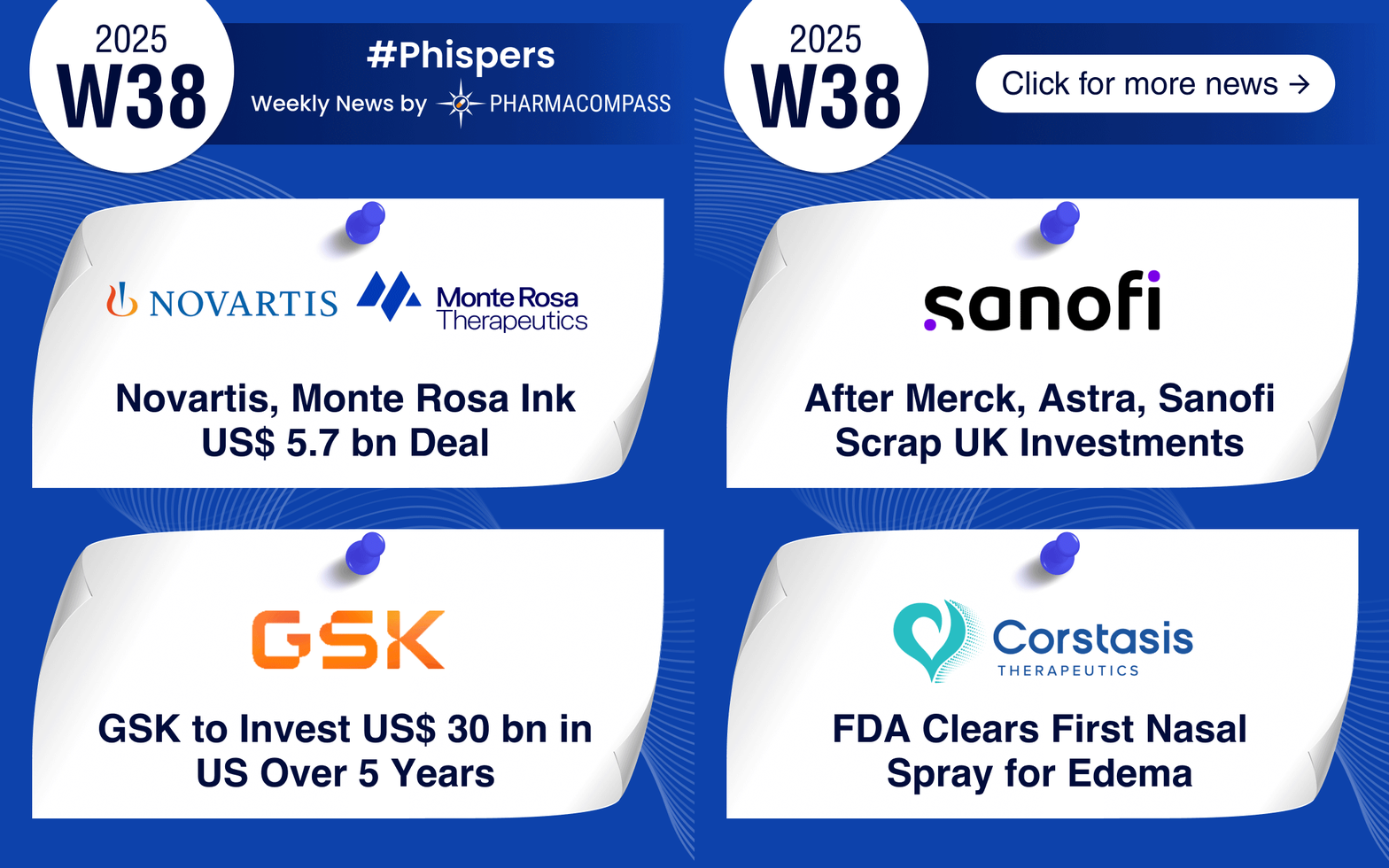
In this week’s news, drugmakers continued to invest heavily in the US in order to avoid tariffs. GSK said it will invest US$ 30 billion across the US over the next five years to expand research, development, and manufacturing. Eli Lilly is investing another US$ 5 billion in the US, this time on a manufacturing facility in Virginia.In deals, Novartis has agreed to license early-stage
programs from US-based Monte Rosa Therapeutics in a deal worth up to US$ 5.7
billion, expanding its pipeline in immune-mediated diseases.In drug approvals, the US Food and Drug Administration (FDA) has approved Corstasis Therapeutics’ Enbumyst, the first nasal spray that treats edema (fluid buildup) in adults caused by heart failure, liver or kidney diseases.In trials, oral obesity pills from Novo Nordisk and Eli
Lilly showed promise in phase 3 trials.After Merck, AstraZeneca and Sanofi have also scrapped
their UK investment plans over new pricing rules. And in the US, The FDA has
reappointed Vinay Prasad as its Chief Medical and Scientific Officer.Novartis, Monte Rosa sign up
to US$ 5.7 bn licensing deal for immune disease drugsSwiss
drugmaker Novartis has agreed to license early-stage programs from Monte Rosa Therapeutics in a deal worth up to US$ 5.7 billion, expanding its pipeline in immune-related diseases. The programs are based on molecular glue degraders discovered using Monte Rosa’s AI- and machine learning-enabled platform. This is the second such agreement signed between the companies, and grants Novartis exclusive rights to one undisclosed target and options on two more within Monte Rosa’s immunology portfolio.GSK pledges US$ 30 bn over
five years in US; to invest US$ 1.2 bn in flexible biologics plantGSK will invest US$ 30 billion across the US over the next
five years to expand research, development, and supply chain capacity. The plan
includes an investment of US$ 1.2 billion on a new biologics (flexible) factory
in Pennsylvania, new AI and advanced digital technology capabilities, new drug
substance manufacturing capabilities and, new and enhanced device and
auto-injector capabilities and assembly. The Pennsylvania facility, set
to begin construction in 2026, will produce next-generation respiratory and cancer medicines.Lilly to invest US$ 5 bn in new Virginia plant: Eli Lilly will invest US$ 5 billion to build a manufacturing facility in Virginia as part of its plan to add
four large plants in the US over the next five years. The site will make active
pharmaceutical ingredients (APIs) and expand capacity for antibody-drug conjugates, a key type of targeted cancer therapy. The investment is part of a broader US$ 27 billion plan to strengthen domestic drug manufacturing.After Merck scraps plans,
Astra, Sanofi, Lilly pause UK investments over new pricing rulesA
week after Merck scrapped plans for a £1 billion (US$ 1.3 billion) London research hub, British drugmaker AstraZeneca has also hit pause on a £200 million (US$ 271 million) expansion of its Cambridge campus. The project, expected to create about 1,000 jobs, is now on hold.Similarly,
Sanofi has said it won’t commit to “substantial investment” in the UK drug R&D until the business climate
improves. Eli Lilly, meanwhile, has frozen its Gateway Labs biotech
incubator project.In total, projects worth about £2 billion (US$ 2.6 billion) have been shelved this year. Drugmakers point
to tougher UK pricing rules as the reason. Since July, the UK government has nearly doubled the “clawback” rate, requiring companies to return 31.3 percent of sales on newer branded medicines to the National Health Service, up from 15.5 percent previously.FDA okays first nasal spray
to treat edema in adults, due to heart, liver, kidney issuesCorstasis Therapeutics, a Nevada-based biopharma,
has received FDA approval for its nasal spray Enbumyst
(bumetanide). This is the first nasal spray of its kind in the US to
treat edema or fluid build up caused by
heart failure, liver disease, or kidney disease in adults. The spray gives
patients an easy, at-home option instead of pills or intravenous treatments. In
studies, it worked quickly, had reliable effects, and caused fewer side effects than pills. Corstasis plans to launch Enbumyst in late 2025.Oral obesity meds — Lilly’s orforglipron, Novo’s semaglutide — show promise in phase 3 trialsBoth Eli Lilly and Novo Nordisk have shared data on their oral weight loss drugs. Patients on Lilly’s orforglipron, a once-daily pill for
obesity, lost 12.4 percent of their body weight, in a phase 3 trial.Similarly, the pill version of Novo Nordisk’s Wegovy (semaglutide) has delivered weight loss almost on par with the
injectable version in a large phase 3 study. This is the first time an oral and injectable
weight-loss drug has performed at a comparable level.Meanwhile,
Novo has also reported phase 3 results for cagrilintide, its experimental,
injectible drug for obesity. Patients taking it once a week lost an average of 11.8
percent of their body weight after 68 weeks. Though positive, the results are
still below Wegovy, which cut weight by 14.9 percent in its main study. Novo is also testing a mix of
cagrilintide and semaglutide, called CagriSema, which has
shown stronger results.Merck’s Capvaxive shows promise in children, teens at high risk of pneumococcal diseaseMerck has shared phase 3 results suggesting its pneumococcal vaccine Capvaxive could also protect children and teens who face
a higher risk of pneumococcal disease. The 21-valent shot, approved last year
for adults in the US and more recently in Europe, is designed to prevent
invasive pneumococcal disease and pneumonia.Areteia’s oral asthma drug: Areteia Therapeutics has announced positive phase 3 results
for its experimental pill, dexpramipexole, which has the potential to
become the first oral treatment approved for eosinophilic asthma (a severe type
of asthma).Regeneron’s rare bone disorder drug: Regeneron has reported a late-stage win for garetosmab, its experimental treatment for fibrodysplasia
ossificans progressiva (FOP), an ultra-rare genetic disease where soft tissues
gets gradually replaced by bone. Regeneron now plans to seek US approval by the end of 2025.FDA reinstates Prasad as CMO; RFK Jr appoints five new members to vaccine panelFDA has reappointed Vinay Prasad as its Chief Medical
and Scientific Officer. In his new role, Prasad will advise the FDA’s senior officials on emerging medical and scientific issues.Meanwhile, US Health
Secretary RFK Jr has appointed five new members to the CDC’s Advisory Committee on Immunization Practices (ACIP), expanding the panel to 12 members. This follows Kennedy’s dismissal of all 17 members in June and the firing of CDC Director Susan Monarez in August.













 Share