September marked the end of 2026’s third quarter (Q3). As Q3 drew to a close, the US Food and Drug Administration (FDA) approved drugs at a brisk pace, including AbbVie’s Juvmo (tavapadon) for treating Parkinson’s disease and Eli Lilly’s Onswik (insulin efsitora alfa-gobe) for type 2 diabetes.
In August,
pharmaceutical indices rose at an impressive rate of over 10 percent. In
comparison, September was a turbulent month, as indices were hit by pressures
in the bond market, rising oil prices, a series of missile attacks on Saudi Arabia by Houthis and rising tensions between the United States and Iran.
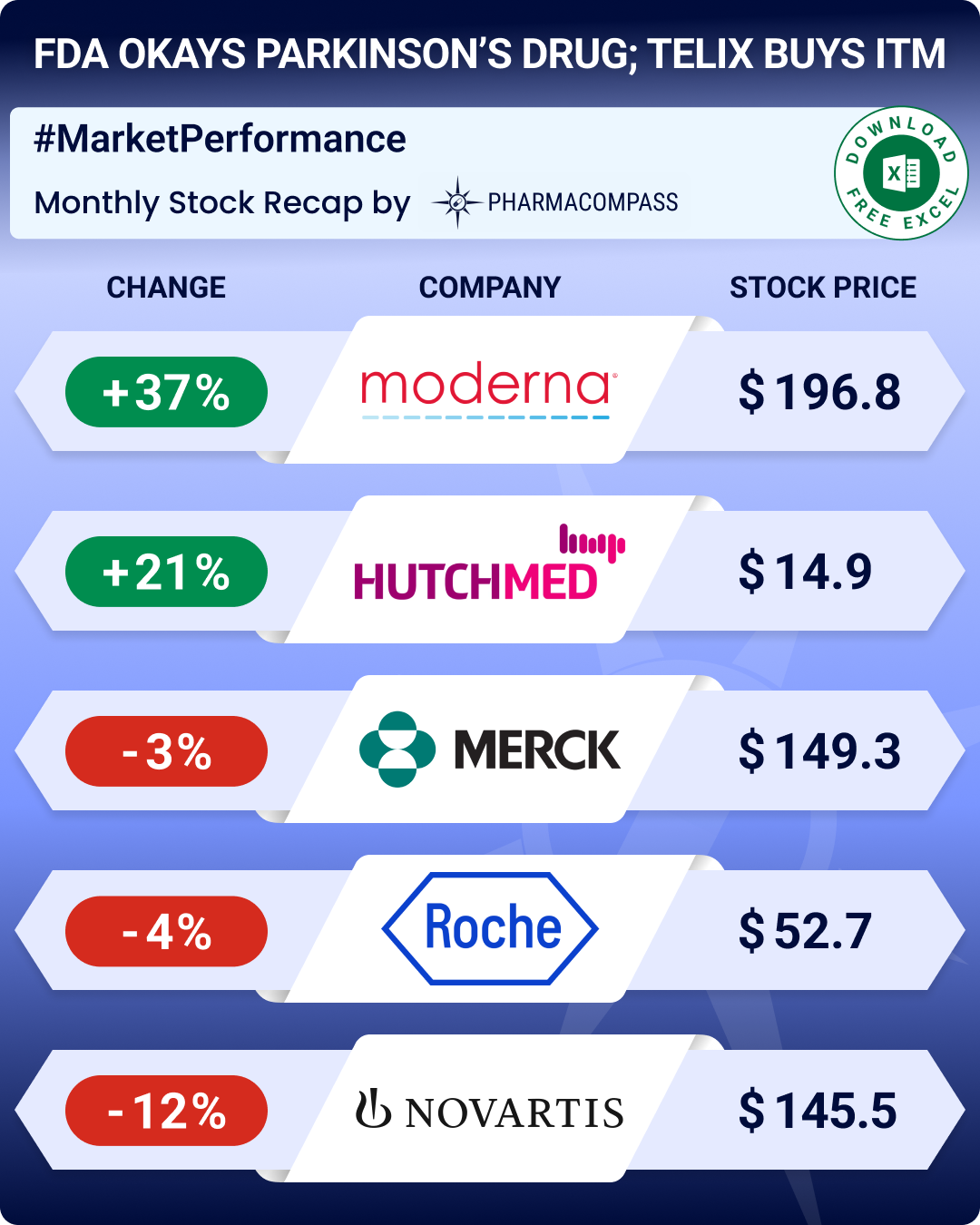
Given these uncertainties, the pharma indices showed resilience. The Nasdaq Biotechnology Index (NBI) declined marginally, by 0.11 percent, from 7,122.63 to 7,114.53. The SPDR S&P Biotech ETF (XBI) declined by 2.52 percent, from 161.75 to 157.68. The S&P Biotechnology Select Industry Index (SPSIBI) declined by 2.98 percent, from 12,725.50 to 12,346.19. Meanwhile, the S&P 500 increased marginally by 0.21 percent — from 7,635.47 to 7,651.54.
Access the Pipeline Prospector Dashboard for September 2026 Newsmakers (Free Excel)
FDA approves AbbVie’s Parkinson’s drug, Lilly’s weekly insulin for type 2 diabetes
September saw several key approvals. FDA
approved AbbVie’s Juvmo (tavapadon), a once-daily pill for adults with Parkinson’s disease, a brain disorder that causes tremors, stiffness, and slowed movement. The agency also approved Eli Lilly’s Onswik (insulin efsitora alfa-gobe), a once-weekly basal (background) insulin, for use with diet and exercise to control blood sugar in adults with type 2 diabetes.
FDA
approved Roche unit Genentech’s Gazyva (obinutuzumab) to reduce the risk of relapse in patients aged two and above with idiopathic nephrotic
syndrome (INS) that relapses often or depends on steroids, once they are in
remission. INS is a kidney disorder of unknown cause that mostly starts in
young children.
In oncology, FDA approved Elevar Therapeutics’ Lyrfigtu (lirafugratinib) for adults with previously treated, advanced bile duct cancer (cholangiocarcinoma) whose tumors carry an FGFR2 gene fusion or rearrangement, a genetic error that drives tumor growth.
FDA also cleared Merck’s Welireg (belzutifan) in combination with Eisai’s Lenvima (lenvatinib) for adults with advanced renal cell carcinoma with a clear cell component (the most common type of kidney cancer) that has progressed after PD-1 or PD-L1 immunotherapy.
Telix Pharma to
buy ITM Isotope; Novo licenses Hengrui’s GLP-1/GIP drug
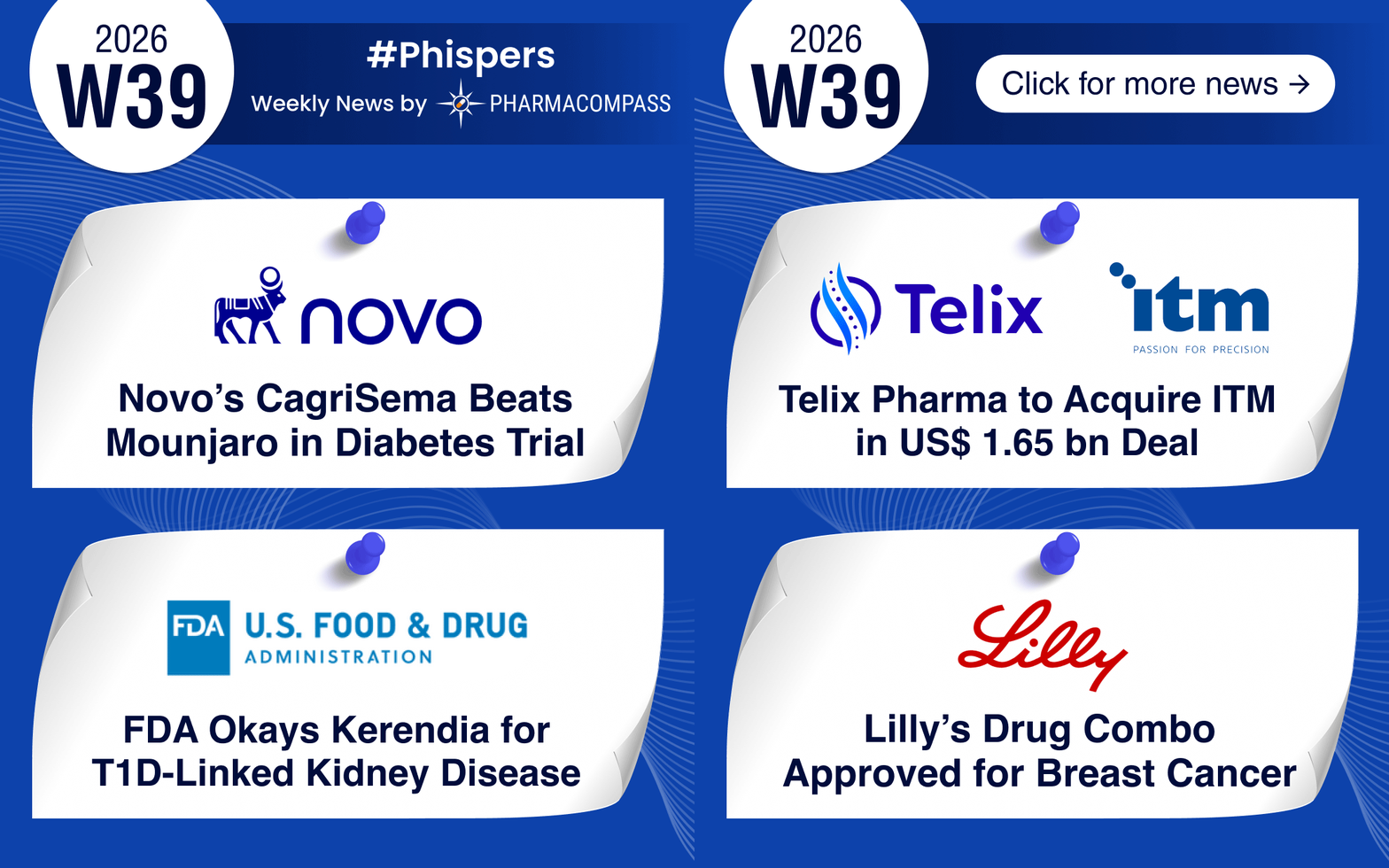
September didn’t see many significant mergers and acquisitions, barring one in radiopharmaceuticals. Australia’s Telix Pharmaceuticals agreed to acquire ITM Isotope Technologies Munich for US$ 1.65 billion upfront on a cash-free, debt-free basis, with up to US$ 700 million more tied to regulatory approvals and sales
milestones for ITM’s lead drug. ITM is a major supplier of lutetium-177, a radioactive isotope used in targeted cancer radiotherapy.
The month
witnessed several licensing deals. Novartis signed an option and license agreement with South Korea’s Alteogen worth up to US$ 3.2 billion for rights to ALT-B4, an enzyme that allows biologics usually given by intravenous infusion to be delivered as faster, more
convenient subcutaneous injections.
Novo
entered into a multi-target discovery and license agreement with Orbis Medicines to develop oral macrocycle drugs for cardiometabolic diseases. Novo also signed a license and collaboration deal worth up to € 1.165 billion (about US$ 1.33 billion) with Sweden’s Nanexa. Novo will apply Nanexa’s PharmaShell delivery technology to its drugs for treating obesity and type 2 diabetes.
Big pharma signed
deals with several Chinese drugmakers. Novo
signed a deal with China’s Hengrui Pharma for exclusive rights to HRS-1596, an experimental obesity and diabetes drug that activates two gut-hormone receptors — GLP-1 and GIP. Eli Lilly signed a research collaboration and license agreement with China’s InnoCare Pharma to discover drugs against up to five targets. Merck licensed exclusive global rights to SPR2015, an investigational, preclinical drug, from Shanghai-based SciBrunch Therapeutics in a deal worth up to US$ 2.13 billion. Roche entered into a license agreement with China’s Simcere Zaiming for exclusive global rights to SIM0660, the latter’s experimental blood cancer drug.
Several rare
diseases get first treatments; Scholar Rock’s Isembyld okayed for SMA
September saw
several rare diseases get first treatments. For instance, FDA granted full approval to Ultragenyx’s Fayuvi (rebisufligene etisparvovec-hopf) — the first treatment for children with Sanfilippo syndrome type A, a rare, progressive and fatal
neurodegenerative disease.
FDA also approved Scholar Rock’s Isembyld (apitegromab-mstn) for spinal muscular
atrophy (SMA) in adults and children aged two and above who are already receiving a survival motor neuron 2-targeted treatment. It is the first therapy for SMA that directly goes after muscle loss.
FDA
cleared Ionis Pharmaceuticals’ Zanvastro (zilganersen) for Alexander
disease in children and adults. This is the first and only
disease-modifying treatment for this ultra-rare disorder that mostly starts in childhood and damages brain cells.
Fibrodysplasia
ossificans progressiva (FOP), a rare genetic condition in which muscle, tendon, and ligament tissue gradually turns into
bone, got its third treatment as FDA approved Mirum Pharmaceuticals’ Atebrioz (zilurgisertib) for patients aged 12 and above.
Novo’s CagriSema beats
Lilly’s Mounjaro in diabetes trial; Otsuka, Ionis’ ALS drug meets
goal
Novo
made considerable news in clinical trials. The company said CagriSema, a combination of cagrilintide and semaglutide, produced greater weight loss than Eli Lilly’s Mounjaro (tirzepatide) in a phase 3 trial in adults with type 2 diabetes not adequately
controlled on metformin, an SGLT2 inhibitor or both. In a separate phase 3 trial, Novo’s semaglutide helped 40.4 percent
of children aged six to under 12 with obesity fall below the obesity BMI threshold after 68 weeks.
Johnson & Johnson’s Caplyta (lumateperone) met the primary endpoint of a phase 3 trial in adults with manic episodes associated with bipolar I disorder. This is the first
of two pivotal trials in mania.
Otsuka and Ionis Pharmaceuticals said ulefnersen met the primary endpoint of a phase 3 trial in amyotrophic lateral sclerosis (ALS) caused by mutations in
the FUS gene, a rare form commonly known as FUS-ALS. This is the first
placebo-controlled trial to succeed against the underlying genetic cause of
FUS-ALS. Additionally, AbbVie's migraine treatment Qulipta (atogepant) reduced migraine days associated with the menstrual period in a late-stage trial.
Our view
Geopolitical tensions, rising oil prices and bond yields weighed on pharma stocks in September. Yet FDA kept approvals flowing, especially in rare diseases, and big pharma kept licensing early-stage assets, increasingly from China. As we step into the last quarter of 2026, the industry's pipeline looks sturdier than its share prices.
















 Share
