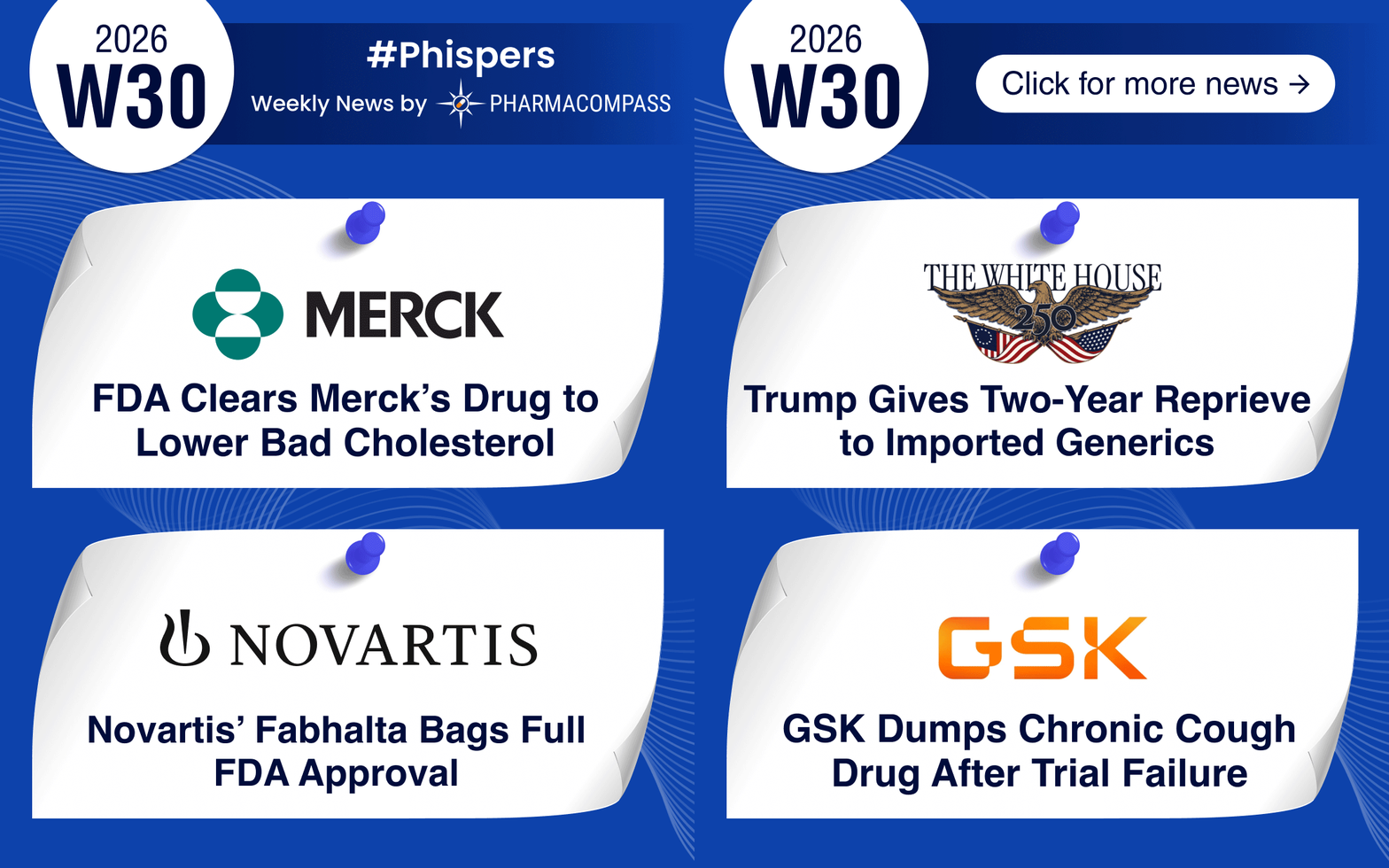
In Phispers this week, US President
Donald Trump has said generic drugs imported into the US will continue to have
zero tariffs for the next two years. Post that, the rate will be raised to 100
percent for one year and 200 percent thereafter.In drug approvals, the US Food and Drug Administration (FDA) has approved Merck’s Lipfendra (enlicitide) to reduce bad cholesterol in adults. The agency also granted a traditional approval to Novartis’ Fabhalta (iptacopan) to slow kidney
function decline in adults with primary immunoglobulin A nephropathy (IgAN). And Takeda’s dengue vaccine Qdenga was approved in India.In clinical trials, Takeda’s experimental plaque psoriasis drug has shown benefit in two late-stage studies. Gilead Sciences and Merck have reported positive data from two phase 3 trials for their once-a-week HIV pill, which is a combination of islatravir
and lenacapavir.Meanwhile, Kolon TissueGene’s experimental cell and gene therapy targeting osteoarthritis of the knee (OAK) failed to meet its co-primary endpoints in a phase 3 study. And GSK said it is discontinuing the development of camlipixant, an experimental drug to treat refractory chronic cough (RCC), after it failed to meet key
goals across two phase 3 trials.In deals, Samsung Biologics has announced an all-cash public tender offer to acquire Switzerland’s PolyPeptide Group for CHF 1.46 billion (US$ 1.81 billion). And American artificial intelligence (AI) company Tempus AI has agreed to acquire cancer diagnostics firm Personalis in a deal valued at US$ 1.5 billion.Trump gives two years’ reprieve to generic drugs, followed by steep tariffs US President Donald Trump has said all generic drugs
being brought into America will continue to enjoy zero tariffs for two years,
beginning August 1. However, post that, the tariff rate will be raised to
100 percent for one year and to 200 percent thereafter. This phased schedule is intended to push generic drugmakers to move production onshore, “with a penalty to those companies that decide not to” build plant and equipment within this period, Trump said. The policy on patented, branded, or innovative drugs will remain unchanged.FDA approves Merck’s Lipfendra, first oral PCSK9 inhibitor to lower LDL cholesterolFDA has approved Merck’s Lipfendra (enlicitide) to reduce bad
cholesterol (LDL-C, or low-density lipoprotein cholesterol), in adults
with high cholesterol (hypercholesterolemia), including those with heterozygous
familial hypercholesterolemia, a genetic condition that causes dangerously
elevated LDL from birth. With this approval, Lipfendra becomes the first oral
treatment that works by blocking a protein called PCSK9, high levels of which
contribute to elevated cholesterol and cardiovascular disease. Until now, this class of drugs was
available only as injectable therapies.Novartis’ Fabhalta gets full FDA approval: FDA has granted
traditional approval to Novartis’ Fabhalta (iptacopan) to slow kidney function decline in adults with primary immunoglobulin A nephropathy
(IgAN) who are at risk of disease progression. Fabhalta had received accelerated approval in August 2024. IgAN
is a chronic, immune-mediated kidney disease that can lead to kidney failure.Takeda’s experimental plaque psoriasis drug shows benefit in two phase 3 trialsJapanese
drugmaker Takeda has announced results from two pivotal phase 3 trials of its experimental oral drug zasocitinib in patients with plaque psoriasis (a chronic autoimmune
disease causing red, scaly skin patches). Zasocitinib demonstrated consistent
and high rates of skin clearance across hard-to-treat, high-impact sites,
including the scalp, nails, palms and soles, compared with placebo.Dengue vaccine approved in India: Takeda has received approval from India’s drug regulator for its dengue vaccine Qdenga for prevention of the disease in individuals aged four to 60 years. This is the first vaccine approved for dengue in India. Qdenga
protects against all four dengue virus serotypes.Gilead, Merck’s HIV pill posts phase 3 win: Gilead Sciences and Merck have reported positive data from two phase 3 trials for their once-a-week HIV pill, which is
a combination of Merck’s islatravir and Gilead’s lenacapavir. The pill kept the virus suppressed in
both late-stage trials, supporting a regulatory filing.Kolon TissueGene’s therapy for knee osteoarthritis fails phase 3 trialSouth Korean biotech Kolon TissueGene’s experimental cell and gene therapy targeting osteoarthritis of the knee (OAK) failed to meet its co-primary endpoints in a phase 3 study. OAK is a degenerative disease causing pain and disability, particularly in the elderly. The therapy — TG-C — did not show statistically significant improvements
in pain or function versus placebo at 12 months in a randomized study involving
531 patients. A second phase 3 trial is expected to report results in October
2026.GSK abandons chronic cough drug: GSK is halting the
development of camlipixant, an experimental drug to treat refractory chronic cough (RCC), after it failed to meet key goals across two phase 3 trials. The trials were assessing the efficacy and safety of two doses of
camlipixant in adults with RCC, a debilitating condition in which cough
persists for more than eight weeks despite treatment.Samsung Biologics
to acquire Swiss peptide manufacturer for US$ 1.81 billion Samsung Biologics has announced an all-cash public tender offer to acquire Switzerland’s PolyPeptide Group, a specialist manufacturer of
peptide-based active pharmaceutical ingredients (APIs), for CHF 1.46 billion
(US$ 1.81 billion). This will be the largest biopharmaceutical M&A deal in South Korea’s history, Samsung Biologics has said. With this acquisition, the Korean company aims to diversify its portfolio and expand into peptide therapeutics, one of the fastest-growing segments in the biopharmaceutical industry.Tempus AI to acquire Personalis for US$ 1.5 bn: American artificial intelligence company Tempus AI has agreed to acquire cancer diagnostics firm Personalis in a deal valued at US$ 1.5 billion. Tempus has the option to
pay up to 50 percent of the deal value in cash. Personalis makes NeXT Personal, an
ultra-sensitive test that detects molecular residual disease, marked by tiny
traces of cancer remaining in the blood after surgery. These traces are too
small to appear on scans. The acquisition is expected to close in late 2026 or
early 2027.BMS to build most powerful AI factory: Bristol Myers Squibb (BMS) has announced it will deploy NVIDIA’s latest AI computing systems known as NVIDIA DGX SuperPOD
with DGX Vera Rubin NVL72, which delivers up to ten times greater performance per unit
of energy than its predecessors, to build what the company terms as the ‘most powerful AI factory in life sciences’. The system will support drug discovery across oncology, cardiovascular, immunology and neuroscience programs.














 Share