The drugs we consume go through several tests before they reach the pharmacy shelf. These tests address questions about the drug’s safety and effectiveness.
Drugmakers often
outsource these tests to laboratory and bioanalytical contract research
organizations (CROs), which have emerged as one of the most important links in
the drug development chain. For pharma and biotech companies, outsourcing means
access to expensive equipment and niche expertise and a faster, cheaper path to
market.
As drug pipelines
shift toward biologics, biosimilars, antibody-drug conjugates (ADCs), cell and
gene therapies, and other complex modalities, the need for bioanalytical
services is growing. These include pharmacokinetic (tracking what the body does
to a drug) and pharmacodynamic (tracking what the drug does to the body)
analysis, immunogenicity (a type of testing undertaken to check whether the
immune system treats the drug as an intruder) and biomarker testing (to spot
biological signals of whether a treatment is working), bioavailability and
bioequivalence studies (to confirm how much drug actually reaches the
bloodstream and whether a generic matches the original), LC-MS/MS (to detect
minute traces of a drug in a blood sample), ligand-binding assays (use of
antibodies to latch onto and measure large protein-based drugs), and other
advanced analytical techniques.
Key companies
active in this landscape include Labcorp, Charles River Laboratories, Thermo Fisher Scientific/PPD,
KCAS Bio, Conscio Group, Cayman Chemical Company, Quinta-Analytica, Quotient Sciences, Cohance Lifesciences, SGS,
Eurofins Scientific, ICON,
WuXi AppTec, Syneos Health, BioAgilytix, Frontage Laboratories, Intertek and Medpace, alongside specialized bioanalytical and analytical CROs.
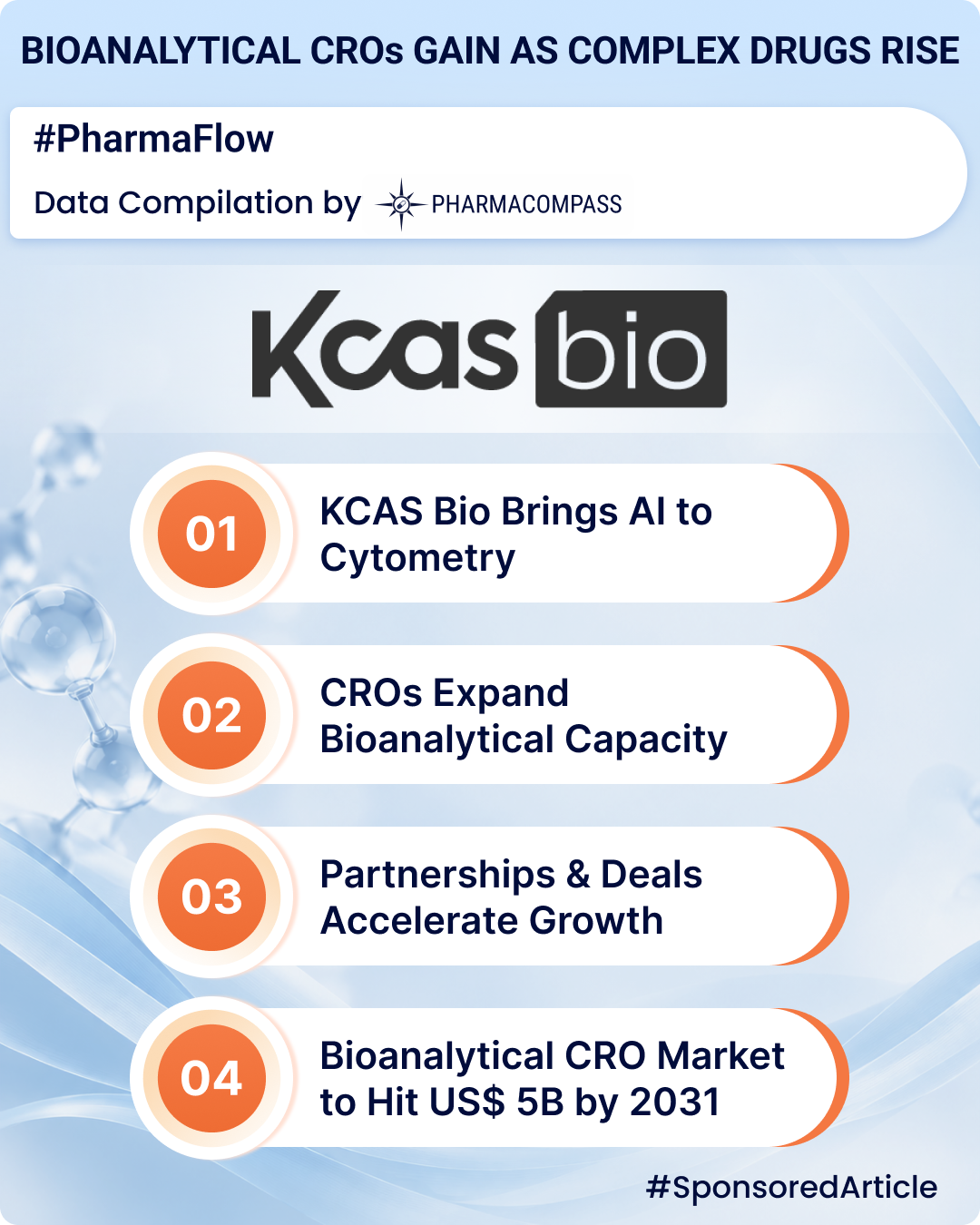
KCAS Bio combines AI-enabled efficiencies with cytometry, ICON deploys Claude
CROs are increasingly using artificial intelligence to improve efficiencies. Kansas City-headquartered KCAS Bio is a full-service bioanalytical and biomarker CRO. It is combining AI-enabled efficiencies with high-parameter flow cytometry (a
technique for analyzing individual cells) and harmonized workflows across its
US, European and Australian network.
The company
provides capabilities across bioanalysis, biomarkers, immunogenicity, cellular
and molecular assays, clinical kitting, and sample management, supporting small
molecules, biologics, and cell and gene therapies from preclinical through
clinical development.
KCAS Bio operates laboratories in Kansas City and Philadelphia (US) and Lyon
(France), with Crux Biolabs in Melbourne, Australia, serving as its strategic
APAC partner.
Similarly,
Massachusetts-headquartered Charles River Laboratories has introduced an end-to-end AI-enabled digital
pathology workflow that is expected to reduce standard pathology timelines by at least
one week. Fortrea, headquartered in Durham (North Carolina, US), has launched an AI solution aimed at improving clinical-trial efficiency across its CRO delivery
model.
Dublin-headquartered
ICON is deploying Anthropic’s AI capabilities across its clinical-development model, combining Claude with ICON’s trial intelligence and operational expertise.
US-based eXoZymes, which develops AI-enhanced enzymes, announced that an independent
partner, Cayman Chemical, successfully ran its technology at pilot scale. Michigan-headquartered Cayman Chemical scaled up the process to produce over 500 grams of pharma-grade N-trans-caffeoyltyramine (NCT) at 99.6 percent purity. NCT is a scarce
compound attracting interest from researchers and drug developers for its
potential role in healthy liver fat metabolism and gut health.
Quinta-Analytica
adds HPLC system; Altasciences, Ardena expand labs for clinical studies
CROs across the
globe are expanding capacities to meet growing demand. Czech CRO Quinta-Analytica has expanded its high-performance liquid chromatography (HPLC) fleet by adding a Thermo Fisher Scientific’s Vanquish Core Binary HPLC system. HPLC is a lab technique for separating a sample into its individual components.
Canadian CRO Altasciences is adding 4,000 square feet to its Greater Montréal laboratory. The company has also announced a new 13,000-square-foot
purpose-built laboratory in Harleysville, Pennsylvania. The expanded network
will increase capacity for larger clinical studies and higher sample volumes.
In April this
year, Ardena, a specialist CDMO and bioanalytical CRO, inaugurated a Good
Laboratory Practice (GLP) bioanalytical laboratory, spanning over 2,500 square
feet, in Somerset, New Jersey.
In May, Thermo Fisher Scientific’s PPD announced the opening of a new bioanalytical and biomarker laboratory in Gothenburg, Sweden. This new facility expands the company’s global bioanalytical capabilities to support
pharmaceutical and biotechnology customers across all phases of drug
development.
Eurofins Viracor
BioPharma expanded its GCP- (Good Clinical Practice) and GLP-compliant bioanalytical testing services, following the merger of Eurofins Pharma
Bioanalytics Services into its Lenexa, Kansas facility. Eurofins Viracor
BioPharma now offers a comprehensive suite of bioanalytical services, including
method development, validation, and sample analysis, consistent with global
regulatory guidance.
Conscio Group partners Paras Biopharma; THL Partners invests in Celerion’s clinical capabilities
The sector is
witnessing increased tie-ups, collaborations and acquisition deals. In June, Conscio Group (a European research service provider) entered into a development and
registration partnership with Paras Biopharmaceuticals (a Finnish biologics developer) to advance
PBR-401, a romiplostim biosimilar, toward EU and US registration. Romiplostim is used to
treat low platelet counts (chronic immune thrombocytopenia). This
month, Conscio also announced a strategic partnership with CellMade
Laboratories.
THL Partners
announced a majority investment in early-phase clinical research CRO Celerion to help expand its clinical and bioanalytical capabilities. In July, Eurofins agreed to acquire Element Materials Technology’s life sciences testing services business in North America for an enterprise value of US$ 400 million.
The acquired business comprises 27 laboratories and facilities and
approximately 750 employees.
Earlier this
month, North Carolina-headquartered Labcorp announced the acquisition of MLM Medical Labs, which has operations in the US, Germany and South Africa. The acquisition enhances Labcorp’s position as a leading independent central laboratory services provider by expanding its presence in key clinical research regions.
Our view
The global market for
laboratory and bioanalytical CROs is projected to grow at a compound annual
growth rate of 6.5 percent between 2026 and 2031, touching market size of US$ 5 billion by 2031, from an estimated US$ 3.65 billion. Though relatively small in size, the sector is making a considerable contribution to drug development.









 KEY SERVICES