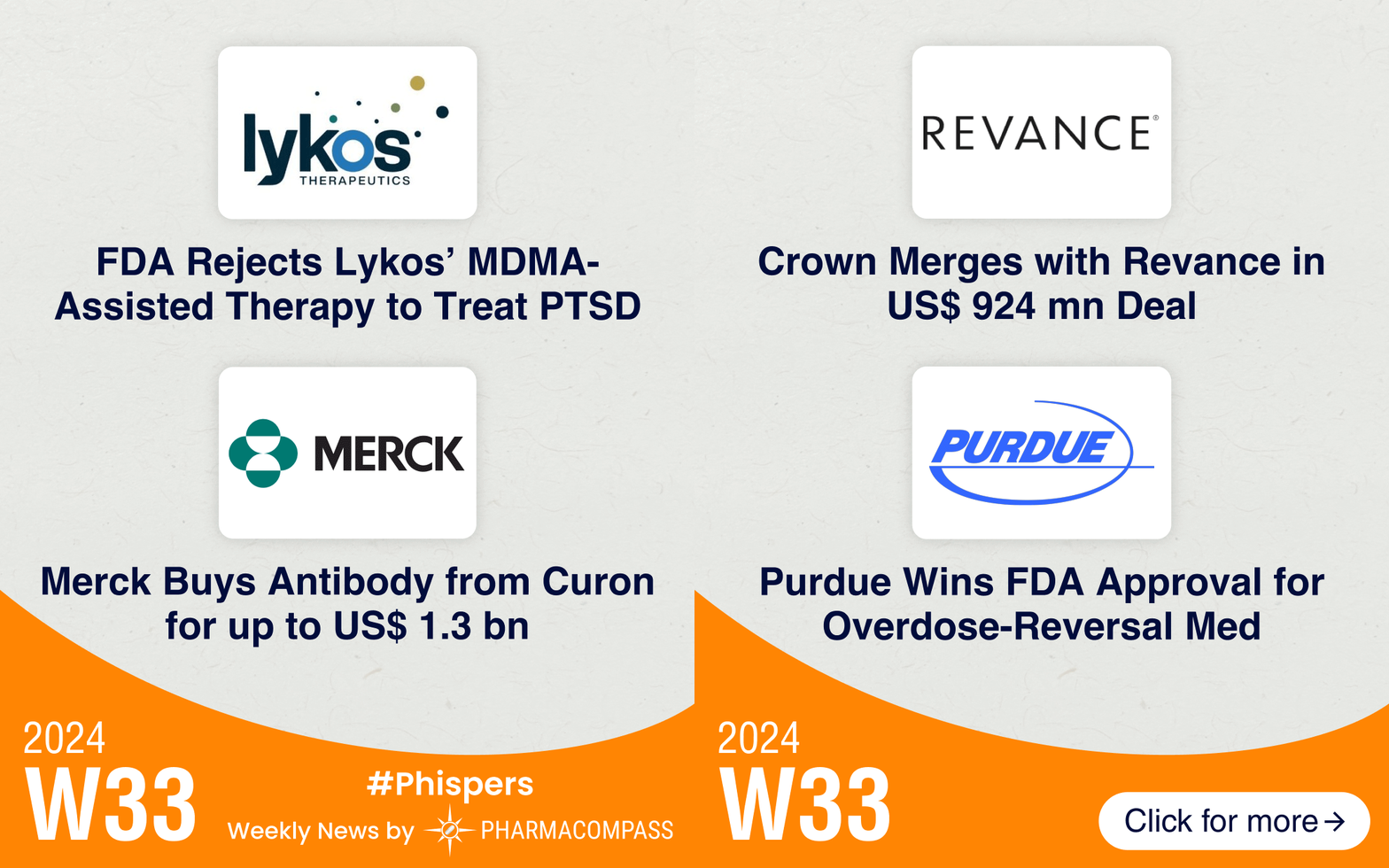
The US Food and Drug Administration (FDA) has declined to approve an MDMA-assisted therapy from Lykos Therapeutics to treat post-traumatic stress disorder (PTSD). Alongside this, the journal Psychopharmacology has retracted three papers on the MDMA-assisted therapy citing “unethical conduct” at one of the study sites.In deals, Merck has signed an up to US$ 1.3 billion deal with China’s Curon Biopharmaceutical for a next-generation bispecific antibody. And skincare company Crown Laboratories is paying US$ 924 million to merge with Botox rival Revance.While FDA rejected Lykos’ MDMA therapy, it approved Purdue Pharma’s auto-injector for the emergency treatment of known or suspected opioid overdose. Purdue Pharma had allegedly fueled the opioid crisis in the US.The agency also greenlit ARS Pharmaceuticals’ Neffy, the first nasal spray alternative to EpiPen approved for severe allergic reactions like anaphylaxis. FDA has also handed Citius Pharmaceuticals its maiden approval for lymphoma, after rejecting the therapy a year back. And Ascendis’ hormone disorder therapy finally got the go-ahead to treat adult patients with hypoparathyroidism.FDA rejects first
MDMA-assisted therapy to treat PTSD, issues CRL to LykosDespite intense
political pressure, FDA has declined to approve MDMA, commonly known as
ecstasy or molly, to treat PTSD, Lykos Therapeutics said after it received a
complete response letter (CRL). The agency had previously cited a “striking lack of abuse-related adverse events”, faulty trial design and the need for more evidence. FDA’s expert panel in June had voted 10 against one, saying the benefits
of using the party drug to treat PTSD do not
outweigh the risks. Last week, 80 members of Congress from both sides of the aisle
had urged President Joe Biden and the FDA to consider further studies on the
MDMA-assisted therapy.Scientific journal retracts three studies over ‘unethical conduct’: The journal Psychopharmacology has retracted three papers on MDMA-assisted therapy citing “unethical conduct” at one of the study sites. Many of the papers’ authors were affiliated with Lykos. However, the drugmaker said those papers weren’t part of its FDA application. The authors confirmed they were aware of violations at the time of submission, but chose not to disclose it to the journal or remove data generated by this site from their analysis. That includes a widely reported case of sexual assault by an unlicensed therapist on a
trial participant.Merck buys next-gen
bispecific antibody from Curon in potential US$ 1.3 bn dealBispecific antibodies, or antibodies that can bind to two
different antigens at the same time, have been drawing interest as a treatment
of cancer. Merck is paying China-based biotech Curon US$ 700 million upfront and an additional US$
600 million in milestone payments for the rights to CN201, a next generation T cell engager that targets both the CD3 and CD19 proteins. It is currently being evaluated in early-stage trials for the treatment of patients with relapsed or refractory non-Hodgkin’s lymphoma and relapsed or refractory B-cell acute lymphocytic leukemia.Meanwhile, Merck has discontinued a trial on its experimental drug vibostolimab when used
in combination with Keytruda in patients with a type of
lung cancer after an interim analysis showed the drug was unlikely to succeed.Crown to take Botox rival Revance private in US$ 924 mn deal: Revance Therapeutics has agreed to go private and merge with Crown Laboratories in a deal valued at US$ 924 million. Crown has multiple aesthetics and skincare products. Revance’s Daxxify (daxibotulinumtoxinA) competes with AbbVie’s Botox (onabotulinumtoxinA).Meanwhile, Recursion Pharmaceuticals has agreed to buy its rival Exscientia for US$ 688 million in an all-stock deal.
Recursion is a biotech firm that uses artificial intelligence to discover new
drug candidates.Lilly opens its center for genetic medicines: Eli Lilly has announced the opening of its 346,000 square foot R&D facility in Boston Seaport. The center will accommodate around 700 Lilly scientists and researchers. It will advance Lilly’s efforts in RNA and DNA-based therapies as well as in discovering new drug targets to create life-changing
medicines across several diseases.After allegedly fueling
opioid crisis, Purdue wins FDA nod for overdose-reversal medFDA has approved Purdue Pharma’s Zurnai, the first nalmefene hydrochloride auto-injector for the emergency treatment of known or suspected opioid overdose
in adults and pediatric patients 12 years of age and older. Purdue is infamous for its misleading marketing
of the painkiller OxyContin that allegedly fueled the
opioid crisis in America around the late 1990s. Drug overdose persists as a
major public health issue in the country, with over 107,000 reported fatal
overdoses occurring in 2023, primarily driven by synthetic opioids like illicit
fentanyl. According to STAT News, many in the addiction advocacy community don’t look favorably at Purdue’s attempts to address a crisis that it ostensibly helped create.Citius’ immunotherapy for lymphoma bags FDA nod: FDA has okayed Citius Pharmaceuticals’ Lymphir (denileukin diftitox-cxdl) immunotherapy for the treatment of adults with relapsed or refractory cutaneous T-cell lymphoma (r/r CTCL), a group of rare blood cancers that affect the skin. A year back, the agency had rejected this therapy. This renders Lymphir the first novel targeted systemic therapy approved by the agency for
r/r CTCL since 2018. Citius had bought Lymphir from India’s Dr Reddy’s Laboratories for US$ 40 million upfront
in 2021 and an additional US$ 40 million on FDA approval. This is the first FDA
approval for Citius.First nasal spray alternative
to EpiPen okayed: FDA has approved ARS Pharmaceuticals’ Neffy, the first nasal spray to treat severe
allergic reactions. This makes Neffy the only needle-free emergency option for
possibly fatal allergic reactions. Seen as an alternative to EpiPen, Neffy (epinephrine) was greenlit to treat reactions like life-threatening anaphylaxis in adult and pediatric patients who weigh at least 30 kilograms (about 66 pounds). “Some people, particularly children, may delay or avoid treatment due to fear of injections,” FDA said, adding that the important treatment option addresses an unmet need.Ascendis’ hormone disorder therapy gets approved: FDA has approved Ascendis Pharma’s therapy — Yorvipath (palopegteriparatide) — to treat adult patients with the hormone disorder hypoparathyroidism. This makes Yorvipath the only approved treatment for the condition in the US after rival Takeda stops making its Natpara (parathyroid hormone) injection by the end of the year due to supply issues, a Reuters news report said.


















 Share