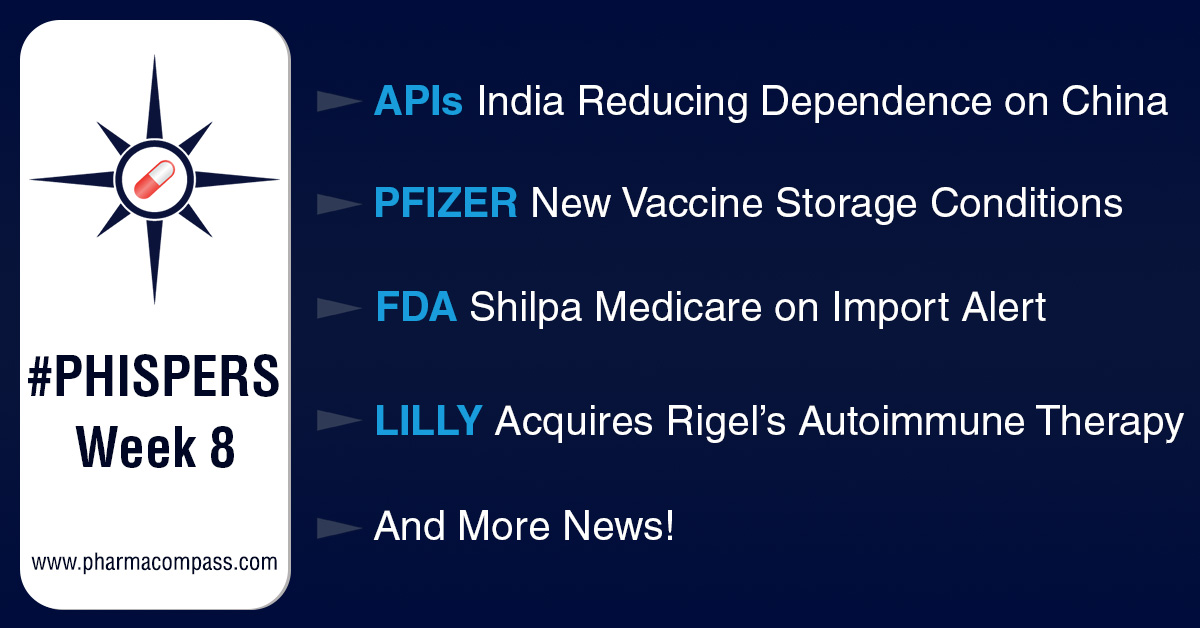
This week, Phispers has lots of updates
on the Pfizer-BioNTech vaccine. The two companies have asked the US Food and
Drug Administration (FDA) to relax storage norms for their vaccine and allow it
to be stored in pharmacy freezers, instead of ultra-low temperature freezers.
And the FDA is likely to oblige, thereby bringing the vaccine within reach of
more countries and people across the world. In Europe, people are turning down
the Oxford-AstraZeneca vaccine and are asking for the Pfizer jab. And
researchers have said that the second dose of the Pfizer vaccine could be delayed
in order to cover all priority groups, as the first dose is being found to be
highly protective.
Due to mounting cross-border tensions
and disruptions to the supply of APIs from China in early 2020, several Indian
drugmakers are looking to reduce their dependence on China-made APIs.
Meanwhile, Indian drug manufacturer Shilpa Medicare
was placed on FDA import alert, after the company was issued a warning letter in October 2020. And Eli Lilly announced a global exclusive license agreement and strategic collaboration with Rigel Pharmaceuticals to co-develop and commercialize Rigel’s autoimmune and inflammatory diseases treatment. The deal is potentially worth around US$ 960 million.
Indian drugmakers look to reduce dependence on China-made APIs
Since June 2020, India and China have seen their relations sour due to
skirmishes at the border. And the political situation has had a bearing on the
pharmaceutical industry.
Even though India bears the tag of being the “pharmacy of the world” due to its massive production capacities of both generic drugs and vaccines, it has been hugely dependent on China for active pharmaceutical ingredients (APIs). In 2019, imports
from China met
half of its API needs.
However, after mounting cross-border tensions, Indian drug companies are
looking to source APIs from local
drugmakers, or are trying to manufacture them in-house, thereby reducing their
dependence on the neighboring country.
According to a Reuters news report, executives at Indian drug
companies such as Cadila Healthcare, Cipla, Sun Pharmaceutical and Biocon have
said they are aggressively working on reducing their dependence on China for
raw materials. One of the major reasons behind this strategic change was the
disruption to supplies from China due to the pandemic. In early 2020, many
Indian drugmakers had to scramble for ingredients to manufacture important
drugs that were exported worldwide.
“Because of the anti-China sentiment ... most of the companies are working towards de-risking themselves in terms of making it clear that their supply chain linkages with China are limited,” Gaurav Suchak, supply head of Cadila, said during a conference.
“For the critical API molecules, the idea is to go for a backward integration where you are in control of that pie which is going to make the most impact on your business, and also to make sure that the entire value chain is secure,” the Cadila executive said.
Companies are also eyeing reliable local vendors who can promise
consistency and competitive prices, he added.
Similarly, Cipla has launched an “API re-imagination”
program in a bid to expand its own manufacturing capacities using recent
government incentives. And a Biocon executive said that the company had a target on what percentage of revenue is “independent of China”.
“We are happy to say that by the last quarter, we were almost 50 percent completely independent of China,” the Biocon executive said. “That does not mean we will not source from China, but we are not dependent on China anymore.”
Pfizer seeks FDA go-ahead for storing its vaccine in pharmacy
freezers
The Pfizer-BioNTech
vaccine soon may not require ultra-low
temperature freezers. Pfizer and BioNTech have asked the US Food and Drug
Administration (FDA) to relax requirements for their Covid-19 vaccine and to allow
it to be stored in pharmacy freezers.
The companies have submitted new temperature data to the agency to
support an update to the current label of their vaccine, so that vials can be
stored at -25 to -15 degrees Celsius (-13°F to 5°F) for
a total of two weeks. The current label requires the vaccine to be stored at
temperatures between -80ºC and
-60ºC (-112ºF to
-76ºF) and to be
shipped in specially designed containers.
A Reuters news report said the FDA plans to approve Pfizer’s request to store its vaccine at standard freezer temperatures and is likely to announce the new guidance soon by modifying documents related to the emergency use authorization that was previously granted for the vaccine.
If the FDA gives its go-ahead to the jab for storage in pharmacy
freezers, this could send a strong message to regulators worldwide and they are
likely to follow suit. This will also bring the messenger RNA vaccine within
reach of lower-income countries that do not have the capacity for deep freeze
storage.
Europeans turn down Astra-Oxford jab: People
in countries like France, Germany, and the UK are turning down the AstraZeneca vaccine in
favor of the Pfizer jab. The reason behind this resistance, according to news
reports, stems from clinical trial data that suggests Astra’s vaccine is less effective than the one from Pfizer.
In Germany, hundreds of thousands of doses of the Oxford-AstraZeneca shot
have gone unused and officials in Austria and Bulgaria have described public
resistance to the Astra vaccine.
In France, officials staggered vaccinations for health workers after
several workers who had received the AstraZeneca vaccine called in sick and
complained of flu-like side effects. Last month, French President Emmanuel
Macron had expressed doubts about the effectiveness of
the AstraZeneca vaccine, especially in people over 65 years of age. And in Sweden,
two regions temporarily suspended the rollout of AstraZeneca vaccine after
hospital staffers who had received one jab reported mild side effects.
However, there are some people in the UK who prefer the AstraZeneca-Oxford vaccine. “They’ve seen its inventors, the confident Sarah Gilbert and the calming Andrew Pollard, on television — and to them, the Oxford option just feels right,” a Washington Post report said.
Researchers suggest delaying Pfizer vaccine’s second dose to cover priority groups
In an article published in the New England
Journal of Medicine, researchers have said that administration of the
second dose of Pfizer-BioNTech’s Covid-19
vaccine could be delayed in order to cover all priority groups, as
the first dose is highly protective.
Some countries are grappling with low supplies of Covid vaccines and are looking at dosing patterns or volumes that differ from how the vaccines were tested in clinical trials. Moreover, the virus is killing “approximately 3,000 people in the United States per day” and the world has seen the emergence of several viral variants.
“One model shows that the expected number of Covid-19 cases would be significantly lower if more people were given a first dose, even if it came at the cost of deferring the second doses,” the NEJM article said.
The Pfizer vaccine had an efficacy of 92.6 percent after the first dose.
And the findings were similar to the first-dose efficacy of 92.1 percent
reported for Moderna’s mRNA-1273
vaccine.
“Some argue that any deviation from the protocol used in the clinical trials is unscientific,” the NEJM article said. “But the argument is based on an overly narrow definition of science. In both trials, the cases in the placebo and active vaccine groups began to diverge about 10 days after the first dose, with growing vaccine efficacy over time. By the day of the injection of the second dose, the efficacy of the first dose was somewhere in the range of 80 to 90 percent,” it added.
Similarly, a small study supported by the National Institutes of Health (NIH) shows that the immune response to the first
vaccine dose in a person who has already had Covid-19 is equal to, or in some
cases better, than the response to the second dose in a person who hasn’t had Covid-19.
“While much more research is needed—and I am definitely not suggesting a change in the current recommendations right now—the results raise the possibility that one dose might be enough for someone who’s been infected with SARS-CoV-2 and already generated antibodies against the virus,” Francis Collins, Director, NIH, said in a blog.
These findings come from a research
team led by Florian Krammer and Viviana Simon, Icahn School of Medicine at
Mount Sinai, New York. The researchers reasoned that for people whose bodies
have already produced antibodies following a Covid-19 infection, the first shot
might act in a similar fashion as the second one in someone who hasn’t had the virus before. There is also some anecdotal evidence that suggests that previously infected people were experiencing stronger evidence of an active immune response (sore arm, fever, chills, fatigue) than never-infected individuals after getting their first shots.
In its response to these findings, Pfizer said alternative dosing
regimens of the vaccine had not been evaluated yet and that the decision
resided with the health authorities.
Indian drug manufacturer Shilpa Medicare placed on FDA
import alert
In early November, we had carried news of Shilpa Medicare being issued a warning
letter by the US Food and Drug Administration (FDA) for violating current good
manufacturing practice (CGMP) norms at its manufacturing plant in Telangana,
India. In the warning letter, the agency said its inspectors had found significant
deviations from standard manufacturing practices at Shilpa’s Unit-IV at Polepally village in Mahabubnagar
district (in the state of Telangana) during the inspection held in February
2020.
Last week, there was news that the FDA has slapped an import
alert on Shilpa Medicare's formulation plant in Telangana. The ban
applies to all but three of its drugs, after the company failed to address
problems cited in the warning letter issued in October 2020.
The three drugs that have been spared by the FDA in
its alert are injectable
azacitidine, cyclophosphamide capsules and erlotinib tablets. All these are chemotherapies for
cancer. Interestingly, the three drugs account for the bulk of Shilpa Medicare’s sales. And injectable azacitidine is on the FDA’s list of drugs that are facing a shortage. Therefore, it’s unlikely that the import ban will have a serious impact on Shilpa. However, the alert could impact the growth of the company’s formulation business, which grew by 40 percent between 2019 and 2020
The import alert only applies to the company’s Telangana plant. Shilpa also operates two FDA-approved API plants in
Raichur, India.
Eli Lilly buys rights to Rigel’s
autoimmune therapy for up to US$ 960 million
Eli Lilly and Rigel Pharmaceuticals have announced a global exclusive license agreement and strategic collaboration to co-develop and commercialize Rigel’s autoimmune and inflammatory diseases treatment, including its lead candidate — R552 — for potentially up to US$ 960 million.
Rigel’s lead
therapy has completed early-stage trials and will begin mid-stage trials this
year.
Pursuant to the collaboration, Lilly will also lead all clinical
development of brain penetrating RIPK1 inhibitors in central nervous system
(CNS) diseases, a press statement said.
As per the agreement, Rigel will receive an upfront cash payment of US$
125 million, with the potential for an additional US$ 835 million in milestone
payments.
R552 belongs to a class of drugs called RIPK1 inhibitors which target a
critical signaling protein that regulates inflammation and cell death in
tissues. It is a new approach to treat various autoimmune, inflammatory, and
neurodegenerative disorders.
Under the deal, Lilly will foot the costs for the global commercialization of the therapy —
R552 — and Rigel will have the right to co-sell the treatment in the United States.













 Share
