The
first quarter (Q1) of 2026 witnessed a steady rise in Drug Master File (DMF) submissions to the US
Food and Drug Administration (FDA). DMFs are used to provide confidential,
detailed information about facilities, processes, or articles used in the
manufacturing, processing, packaging, and storing of human drug products.
Overall, 462 DMFs were filed across all types (II, III, IV, and V) in Q1 2026, against 440 in Q1 2025, representing a 5 percent increase. Of the four types, Type II DMFs involve active pharmaceutical ingredients (APIs) for both branded and generic drugs.
A total of 379 Type II DMFs were filed in Q1 2026, compared to 339 in Q1 2025, marking an 11.7 percent increase — the highest level recorded since 2018. Out of the 379 Type II DMFs, only 31 had completed their review by the end of Q1, reflecting a processing lag between submission and review completion.
View FDA DMF Filings in Q1 2026 (Power BI Dashboard, Free Excel Available)
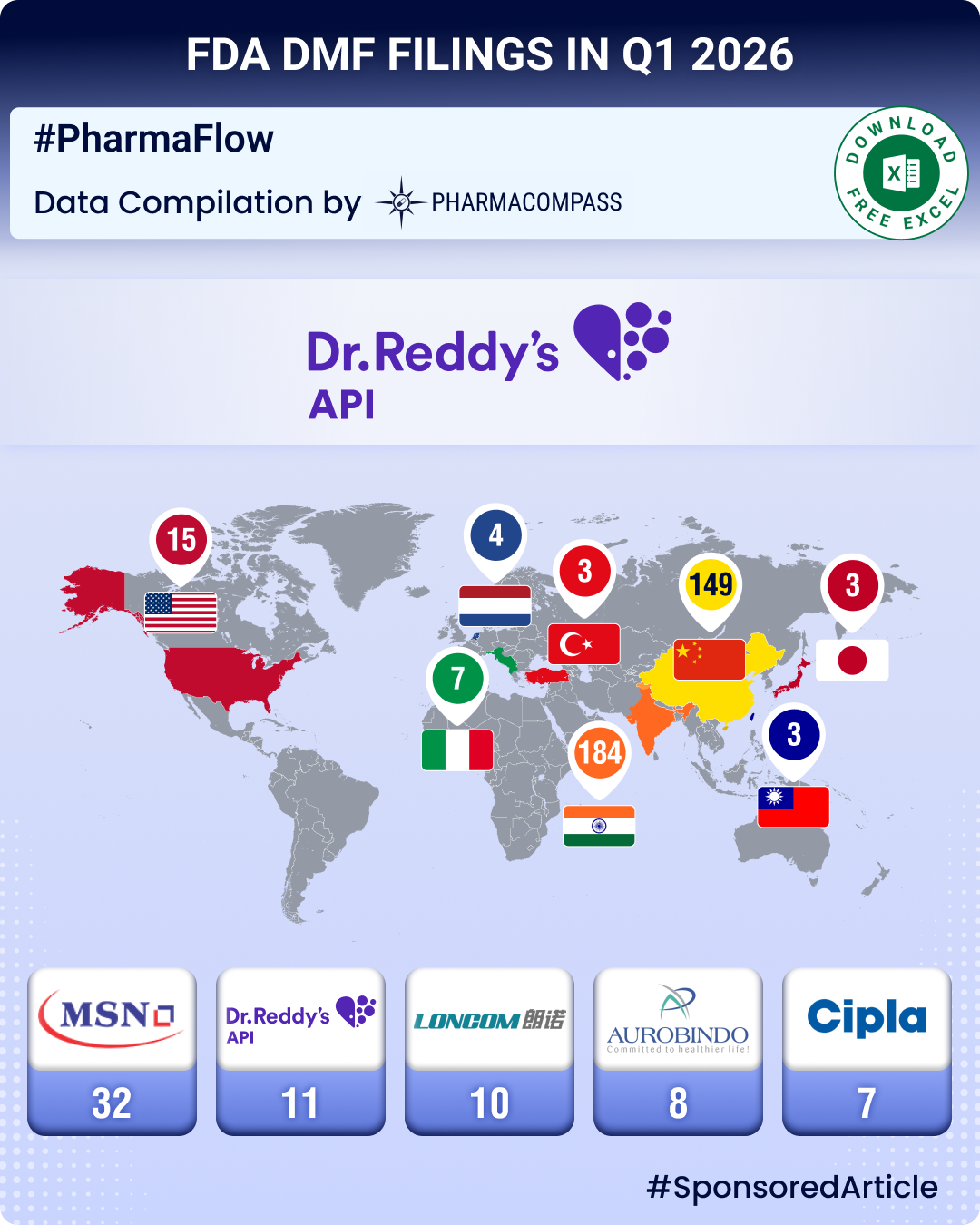
India leads with 184 DMF submissions; MSN Group, Dr Reddy’s among top filers
As expected, DMFs filed from India and China were significantly higher than those filed by other countries. In an interesting turn of events, India regained its top position in DMF submissions after briefly losing it to China in some quarters of 2025 and 2024.
During Q1 2026, DMF submissions from India reached 184, up from 162 recorded in Q1 2025, a growth of 13.6 percent. DMF submissions from China stood at 149, up from 136 in Q1 2025, reflecting a growth of 9.5 percent over Q1 2025.
The
United States ranked a distant third with 15 DMF submissions (as opposed to 11
in Q1 2025), followed by Italy with seven submissions (five in Q1 2025) and the
Netherlands with four submissions (four in Q1 2025).
India’s MSN Group led the company-wise tally for DMF submissions, with 32 filings compared to 23 in Q1 2025, representing a growth of 39.1 percent. MSN Group was also the top filer of DMFs in Q1 2025.
India’s Dr Reddy’s Laboratories ranked second, having filed 11 DMFs compared to seven in the corresponding period last year, an increase of 57.1 percent.
Other leading companies among the top filers were China’s Shandong Loncom
Pharmaceutical (with 10 submissions), followed by Indian firms Aurobindo Pharma (eight), Cipla (seven), and Alembic Pharmaceuticals (six).
GLP-1 drugs see maximum filings; semaglutide, retatrutide,
tirzepatide lead pack
Drugs targeting GLP-1, GIP, and glucagon receptors — widely used for treating obesity and weight loss — saw the maximum number of DMF filings. Among these, semaglutide, developed by Novo Nordisk, saw five filings. Semaglutide is a GLP-1 receptor
agonist marketed as Ozempic for treating type 2 diabetes and as Wegovy for
chronic weight management. The molecule continues to generate strong industry
interest, supported by expanding indications and ongoing lifecycle management
strategies.
FDA and the UK Medicines and Healthcare products Regulatory Agency (MHRA) recently
approved oral semaglutide (Wegovy tablet), improving patient convenience
and broadening market reach. Additionally,
the expiry of Novo Nordisk’s semaglutide patent in India in March 2026 has triggered a wave of generic competition. More than 40 manufacturers are expected
to launch low-cost versions of semaglutide in India, with Dr Reddy’s Laboratories, Eris Lifesciences, Sun Pharma, and Zydus having already launched their products. This will significantly improve accessibility while intensifying market competition.
In
terms of molecules, the
maximum number of DMF filings were for semaglutide (five), retatrutide (five), tirzepatide
(four), vonoprazan fumarate (three) and trofinetide (three).
Eli Lilly’s experimental drug retatrutide is a novel triple agonist targeting GLP-1, GIP, and glucagon receptors. It is currently in phase 3 trials and is being
evaluated for obesity and type 2 diabetes.
Eli Lilly’s tirzepatide is a dual GIP/GLP-1
agonist marketed as Mounjaro for treating type 2 diabetes and as Zepbound for
obesity.
There were 19 molecules for which DMFs were filed for the first time. This includes several oncology APIs, such as fruquintinib, pirtobrutinib, trofinetide and capivasertib. Out of these 19
molecules, three completed their GDUFA (Generic Drug User Fee Amendments)
review. These include lorlatinib (DMF filed by Sun Pharmaceuticals), ganaxolone (Curia) and, vutrisiran sodium (Aurisco Pharmaceutical).
Dr Reddy’s Laboratories filed 11 DMFs, of
which one has completed its GDUFA DMF review. Filings by Dr Reddy’s Laboratories have expanded across multiple therapeutic areas, including oncology (adagrasib, alectinib hydrochloride, pirtobrutinib), metabolic
disorders (empagliflozin, dapagliflozin propanediol, tirzepatide), urology (pentosan polysulfate sodium, finasteride), ocular care (perfluorohexyloctane), and autoimmune and
rare diseases (deucravacitinib and tafamidis).
Our view
The DMF filings for Q1 2026 indicate that the global pharmaceutical industry is placing its bets on GLP-1 and other related drugs. What stands out is that retatrutide, still in phase 3 trials, is already drawing generic interest. The GLP-1 wave is no longer just a branded drug story. It is fast becoming an API story, one that could make weight loss and diabetes management more affordable for patients across the world.

















 Share