Please Wait
Applying Filters...
Menu

Digital Content read-more

Create Content with PharmaCompass, ask us

PHARMA & BIOTECH INSIGHTS

2read-more
read-more

A PHP Error was encountered

Severity: 8192

Message: mb_convert_encoding(): Handling HTML entities via mbstring is deprecated; use htmlspecialchars, htmlentities, or mb_encode_numericentity/mb_decode_numericentity instead

Filename: blog/grid.php

Line Number: 52

Backtrace:

File: /var/www/html/application/views/include/media/blog/grid.php
Line: 52
Function: mb_convert_encoding

File: /var/www/html/application/models/Cmn.php
Line: 3595
Function: view

File: /var/www/html/application/views/include/product/digitalContent/grid.php
Line: 17
Function: common

File: /var/www/html/application/views/include/desc/inner.php
Line: 13
Function: view

File: /var/www/html/application/views/include/desc/indexNew.php
Line: 2433
Function: include

File: /var/www/html/application/controllers/Common.php
Line: 11303
Function: view

File: /var/www/html/index.php
Line: 231
Function: require_once

DMF filings rise 4.5% in Q3 2025; China holds lead, India records 20% growth in submissions
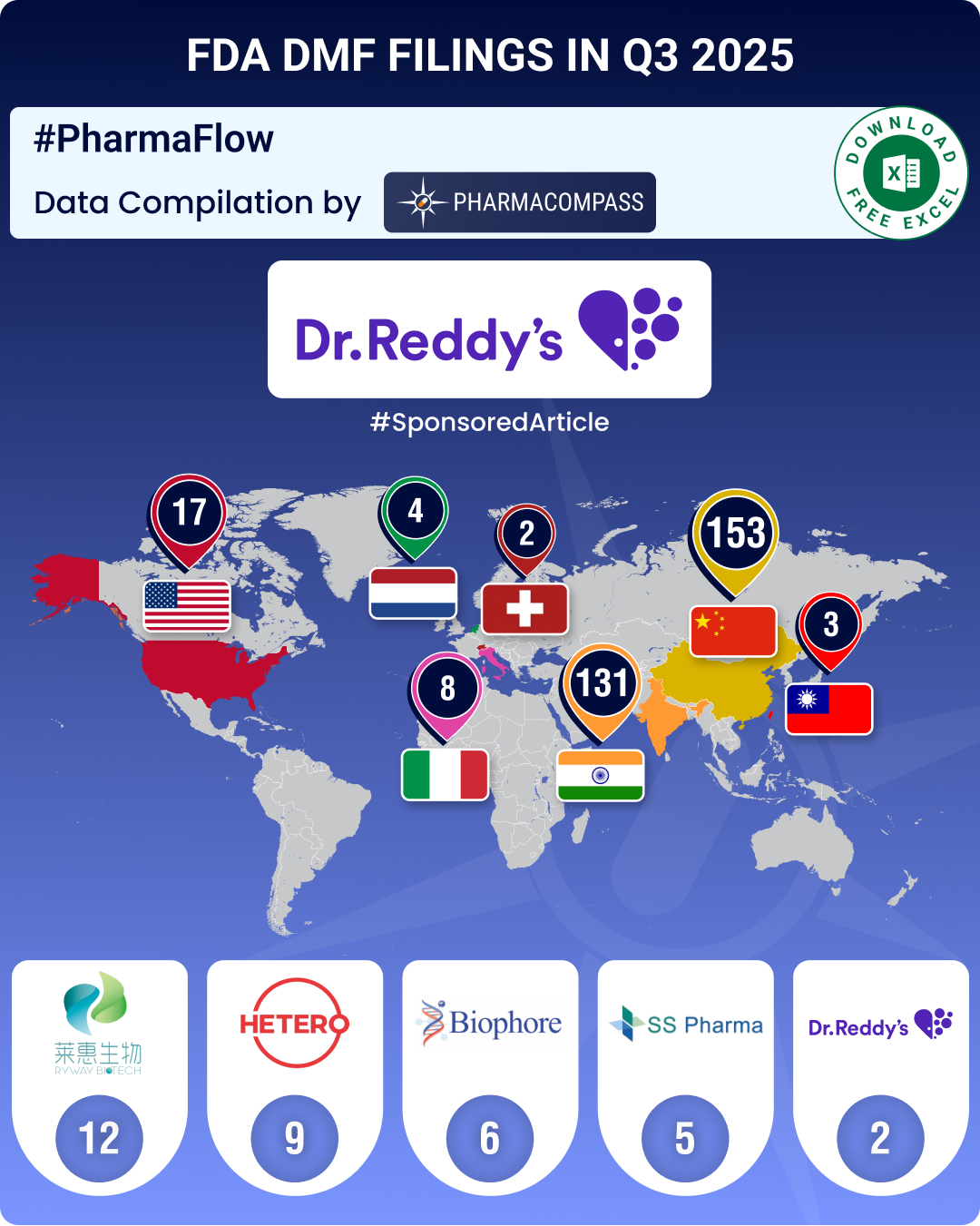
The third quarter (Q3) of 2025 witnessed a steady rise in Drug Master File (DMF) submissions to the US Food and Drug Administration (FDA). DMFs are used to provide confidential, detailed information about facilities, processes, or articles used in the manufacturing, processing, packaging, and storing of human drug products A total of 323 Type II DMFs were submitted during this period, as opposed to 309 submissions in Q3 2024, marking an increase of 4.53 percent. This is the second highest number since 2018. In Q1 2025, 339 Type II filings were recorded. Across all DMF types (II, III, IV, and V), 479 DMFs were filed in Q3 2025, compared to 394 in Q3 2024, representing a 21.57 percent increase. Out of the 323 Type II DMFs submitted in Q3 2025, 40 had completed their review by the end of Q3, reflecting a processing lag between submission and review completion.  View FDA DMF Filings in Q3 2025 (Power BI Dashboard, Free Excel Available) China maintains its lead while India posts double-digit growth in DMF submissions  China and India continued to dominate DMF submissions in Q3 2025. China retained the top spot with 153 Type II DMFs, matching its submission count from Q3 2024. India recorded 131 DMFs, marking a 20.18 percent increase over 109 filings during the corresponding period last year. The United States stood a distant third with 17 filings, compared to 13 in Q3 2024. Among European nations, Italy recorded eight DMFs, doubling its 2024 tally. The Netherlands filed four, up from three. Spain submitted only one DMF, as against seven submitted in Q3 2024. Taiwan made three filings, up from one submitted in Q3 2024. Together, India, China and Taiwan accounted for about 88.9 percent of all Type II DMFs filed during the quarter. China’s Suzhou Ryway Biotech tops corporate tally; India’s Hetero, Biophore follow China’s Suzhou Ryway Biotech led the company-wise tally with 12 DMF submissions in Q3 2025. The company had not filed any DMFs in Q3 2024. India’s Hetero Group followed with nine DMFs, maintaining the same number of filings as Q3 2024. Biophore India Pharmaceuticals ranked third with six DMFs, doubling its count from three last year. Other notable contributors include Sai Sreyas Pharmaceuticals (India) and Shanghai Haoyuan Chemexpress (China), with five DMFs each. Companies such as SNJ Group, Lunan Pharmaceutical, Allsino Pharmaceutical, Shankus Pharma, Jiangxi Xinganjiang Pharmaceutical, Sunpure Extracts, Lee Pharma, Umedica Laboratories, Linhai Tianyu Pharmaceutical and Maithri Drugs filed four DMFs each. Olaparib, semaglutide lead molecular filings; Dr. Reddy’s files DMF for edoxaban & tucatinib Dr. Reddy’s Laboratories also featured among key DMF filers in Q3 2025, submitting two DMFs — for edoxaban tosylate monohydrate and tucatinib copovidone. Edoxaban tosylate monohydrate (marketed as Savaysa by Daiichi Sankyo) is a prescription anticoagulant used to reduce the risk of stroke and to treat deep vein thrombosis and pulmonary embolism. Patent exclusivity for Savaysa extends until October 2026 in the United States, with no generic currently available. In terms of molecules, the highest number of DMFs were filed for olaparib, semaglutide, ruxolitinib phosphate, ferric carboxymaltose, and vismodegib, with three DMFs each in Q3 2025. Olaparib, sold by AstraZeneca under the brand name Lynparza, saw DMFs being filed by BDR Lifesciences and Intas Pharmaceuticals from India, and by ScinoPharm Taiwan during the quarter. Semaglutide, a glucagon-like peptide-1 (GLP-1) receptor agonist developed by Novo Nordisk, continued to draw strong interest from API manufacturers. DMFs for semaglutide were filed by three Chinese companies: Yangzhou Aurisco Pharmaceutical, Zhejiang Peptites Biotech, and Fujian Genohope Biotech. Ruxolitinib phosphate, marketed by Incyte as Jakafi, saw three DMFs. Three Indian companies — Alembic Pharmaceuticals, Valary Labs, and Devi Pharmatech — filed DMFs for this API in Q3 2025. Other molecules that received multiple DMF submissions include ferric carboxymaltose (used to treat iron-deficiency anemia) and vismodegib (an oral therapy for basal-cell carcinoma). First-time DMF filings span 17 companies; India leads with nine first-time DMF The quarter saw first-time DMF filings from 17 companies. India took a lead here with nine first-time DMF filings, followed by China (six), and the US (two). The DMF filings in this quarter included inclisiran sodium (filed by Aurisco Pharmaceutical of China), pacritinib citrate (by TAPI Nl B.V. of the Netherlands), and vosoritide (by Apicore LLC of the US). Out of the 19 first-time DMFs filed in Q3 2025, four completed their Generic Drug User Fee Amendments (GDUFA) review process during the quarter. GDUFA fee for FY 2026: The FDA Generic Drug User Fee Amendments (GDUFA) is a law designed to speed access to safe and effective generic drugs to the public and reduce costs to the industry. Fee rates for fiscal year 2026 were published on July 30, 2025. FDA has revised fees under GDUFA III across all categories. While there is a slight increase in the DMF fee from US$ 95,084 in 2025 to US$ 102,584 in 2026, the ANDA fee has seen a sharp rise: from US$ 321,920 in 2025 to US$ 358,247 in 2026. FY 2025 and FY 2026 User Fee Rates Generic drug fee category Fees rates for FY 2025 Fees rates for FY 2026 Applications:     Abbreviated New Drug Application (ANDA) US$ 3,21,920 US$ 3,58,247 Drug Master File (DMF) US$ 95,084 US$ 1,02,584 Facilities:     Active Pharmaceutical Ingredient (API)—Domestic US$ 41,580 US$ 43,549 API—Foreign US$ 56,580 US$ 58,549 Finished Dosage Form (FDF)—Domestic US$ 2,31,952 US$ 2,38,943 FDF—Foreign US$ 2,46,952 US$ 2,53,943 Contract Manufacturing Organization (CMO)—Domestic US$ 55,668 US$ 57,346 CMO—Foreign US$ 70,668 US$ 72,346 GDUFA Program:     Large size operation generic drug applicant US$ 18,91,664 US$ 19,18,377 Medium size operation generic drug applicant US$ 7,56,666 US$ 7,67,351 Small business generic drug applicant US$ 1,89,166 US$ 1,91,838 Our view For several years prior to the pandemic, India had a lead in Type II DMF submissions. In recent years, China has surpassed India in DMF filings. But Q3 2025 numbers indicate that Indian drugmakers are fast catching up. Since DMFs establish trust in APIs from across the world, we feel this healthy competition between drugmakers from the two countries is good for the global pharmaceutical industry.  

Impressions: 5446

https://dev1.pharmacompass.com/radio-compass-blog/dmf-filings-rise-4-5-in-q3-2025-china-holds-lead-india-records-20-growth-in-submissions

#PharmaFlow by PHARMACOMPASS
13 Nov 2025

WEEKLY INDUSTRY NEWS

6read-more
read-more
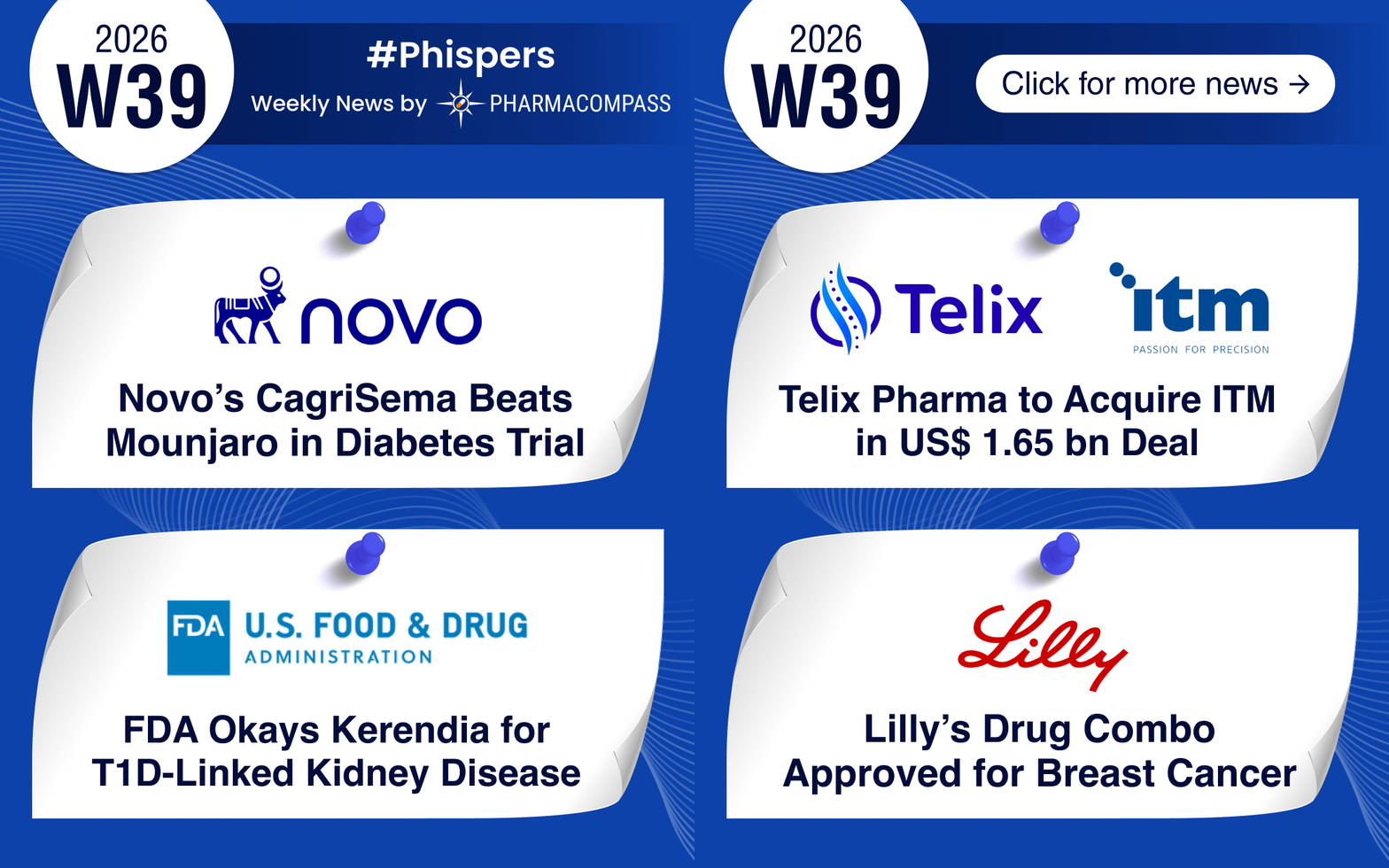
 FDA clears Bayer’s Kerendia for kidney disease in type 1 diabetes; Novo’s CagriSema beats Lilly’s Mounjaro
In Phispers this week, Novo’s CagriSema produced greater weight loss than Eli Lilly’s Mounjaro (tirzepatide) in a phase 3 trial in adults with type 2 diabetes. Novo, which dropped Nordisk from its everyday name last week, also signed a deal with Orbis Medicines.Artificial intelligence deals made headlines this week — Novo partnered Anthropic to use Claude models for drug discovery; AbbVie inked a deal with Iambic; and Boehringer Ingelheim signed a pact with Envisagenics.The US Food and Drug Administration (FDA) approved Bayer’s Kerendia (finerenone) for kidney disease associated with type 1 diabetes. The agency approved Eli Lilly’s Inluriyo (imlunestrant) in combination with Verzenio (abemaciclib) for treating a type of breast cancer. FDA also approved Ultragenyx’s Fayuvi (rebisufligene etisparvovec-hopf) as the first treatment for children with a rare disorder known as Sanfilippo syndrome type A.In news from clinical trials, Genentech’s Lunsumio (mosunetuzumab) showed benefit in relapsed or refractory follicular lymphoma; Johnson & Johnson’s Caplyta (lumateperone) reduced manic episodes associated with bipolar I disorder; and Otsuka and Ionis Pharmaceuticals’ ulefnersen showed benefit in amyotrophic lateral sclerosis (ALS) caused by mutations in the FUS gene.In deals, Australia’s Telix Pharmaceuticals agreed to acquire ITM Isotope Technologies Munich for US$ 1.65 billion upfront and Roche entered into a potential US$ 1 billion deal with Dualitas Therapeutics.Novo’s CagriSema beats Lilly’s Mounjaro in late-stage type 2 diabetes trial Novo has said CagriSema, a combination of cagrilintide and semaglutide, produced greater weight loss than Eli Lilly’s Mounjaro (tirzepatide) in a phase 3 trial in adults with type 2 diabetes not adequately controlled on metformin, an SGLT2 inhibitor or both. Novo’s CagriSema is being seen as a successor to the blockbuster weight loss drug Wegovy (semaglutide).Partners Anthropic for drug discovery: Novo has entered into a collaboration with American AI company Anthropic to apply its Claude models to drug discovery and software development. The two will work on drug discovery problems identified by Novo’s scientists and computational teams, and build tools for specific research workflows. In August, Novo had entered into an AI drug discovery pact with Amazon Web Services.Signs macrocycle pact with Orbis: Novo has entered into a multi-target discovery and license agreement with fellow Copenhagen company Orbis Medicines to develop oral macrocycle drugs for cardiometabolic disease. Orbis is eligible for up to US$ 1.4 billion in upfront and milestone payments plus tiered royalties.FDA approves Bayer’s Kerendia for kidney disease in type 1 diabetesFDA has approved Bayer’s Kerendia (finerenone) to reduce urinary albumin-to-creatinine ratio (UACR), a measure of protein leaking into the urine, in adults with chronic kidney disease (CKD) associated with type 1 diabetes. This is the first new treatment for the condition in over 30 years.Lilly’s drug combo approved for breast cancer: FDA has approved Eli Lilly’s Inluriyo (imlunestrant) in combination with its other drug Verzenio (abemaciclib) for adults with estrogen receptor-positive, HER2-negative, ESR1-mutated advanced or metastatic breast cancer whose disease has progressed after at least one line of endocrine therapy. FDA also approved the Guardant360 CDx blood test as a companion diagnostic device.Ultragenyx’s Fayuvi becomes first approved drug for Sanfilippo syndrome type AFDA has granted full approval to Ultragenyx’s Fayuvi (rebisufligene etisparvovec-hopf), the first treatment for children with Sanfilippo syndrome type A, a rare, progressive and fatal neurodegenerative disease. Ultragenyx has set a US list price of US$ 3.95 million for this gene therapy, making it one of the world’s most expensive drugs. Children with this disease are unable to make enough sulfamidase, an enzyme needed to break down a complex sugar. The sugar builds up in cells, progressively damaging the brain and nervous system.Approves IntraBio’s Aqneursa: FDA has approved IntraBio’s Aqneursa (levacetylleucine) to treat ataxia (loss of control of body movements) in adults and children weighing at least 15 kg with ataxia-telangiectasia, an inherited neurodegenerative disorder. This is the first treatment approved for ataxia in these patients.Genentech’s Lunsumio clears confirmatory phase 3 trial in follicular lymphomaRoche has said Genentech’s Lunsumio (mosunetuzumab) combined with lenalidomide significantly improved progression-free survival against Genentech-Biogen’s Rituxan (rituximab) plus lenalidomide in patients with relapsed or refractory follicular lymphoma who had received at least one prior line of treatment.Roche ties up with Dualitas: Roche has entered into a research collaboration and license agreement with South San Francisco-based Dualitas Therapeutics to screen over 300,000 novel bispecific combinations in search of new treatments for immunology and inflammation diseases. Dualitas receives US$ 36.5 million upfront and is eligible for research, development and commercial milestones plus tiered royalties, taking the potential total to US$ 1 billion.Telix Pharma to acquire ITM Isotope in US$ 1.65 bn radiopharma dealAustralia’s Telix Pharmaceuticals has agreed to acquire ITM Isotope Technologies Munich for US$ 1.65 billion upfront on a cash-free, debt-free basis, with up to US$ 700 million more tied to regulatory approvals and sales milestones for ITM’s lead drug. ITM is a major supplier of lutetium-177, a radioactive isotope used in targeted cancer radiotherapy. Its lead candidate, ITM-11 (lutetium Lu 177 edotreotide), targets gastroenteropancreatic neuroendocrine tumors and would compete with Novartis’ Lutathera (lutetium Lu 177 dotatate).AbbVie, Iambic ink AI deal: AbbVie has entered a multi-year collaboration with San Diego-based Iambic to use artificial intelligence to discover small molecule drugs in immunology, neuroscience and oncology.Boehringer, Envisagenics sign oncology pact: Boehringer Ingelheim has entered into a multi-year research collaboration and option agreement with New York-based Envisagenics to find and validate tumor-specific drug targets in hard-to-treat solid tumors. Envisagenics is eligible to receive more than US$ 1 billion in potential payments, plus royalties.J&J’s Caplyta cuts manic symptoms associated with bipolar disorder in phase 3 trial Johnson & Johnson has said Caplyta (lumateperone) met the primary endpoint of a phase 3 trial in adults with manic episodes associated with bipolar I disorder. This is the first of two pivotal trials in mania. Caplyta, an oral antipsychotic, is already approved in the US for schizophrenia, bipolar depression, and as an add-on treatment for major depressive disorder.Otsuka, Ionis’ ALS drug meets goal: Otsuka and Ionis Pharmaceuticals have said ulefnersen met the primary endpoint of a phase 3 trial in amyotrophic lateral sclerosis (ALS) caused by mutations in the FUS gene, a rare form commonly known as FUS-ALS. This is the first placebo-controlled trial to succeed against the underlying genetic cause of FUS-ALS.

Impressions: 1717

https://dev1.pharmacompass.com/radio-compass-phisper/fda-clears-bayer-s-kerendia-for-kidney-disease-in-type-1-diabetes-novo-s-cagrisema-beats-lilly-s-mounjaro

#Phispers by PHARMACOMPASS
24 Sep 2026

NEWS LIBRARY

86read-more
read-more

https://www.fiercepharma.com/pharma/bayers-kerendia-secures-fda-nod-3rd-indication-now-first-drug-30-years-ckd-t1d-patients

FIERCE PHARMA
17 Sep 2026

https://firstwordpharma.com/story/7931034

FIRSTWORD PHARMA
30 Aug 2026

https://www.bayer.com/en/us/bayer-to-present-new-phase-iii-data-at-esc-2026

PRESS RELEASE
20 Aug 2026

https://www.bayer.com/media/en-us/bayers-finerenone-significantly-reduced-kidney-function-decline-and-a-composite-of-cardiovascular-kidney-outcomes-versus-placebo-in-patients-with-non-diabetic-chronic-kidney-disease/

PRESS RELEASE
05 Jun 2026

https://www.bayer.com/media/en-us/finerenone-significantly-reduced-the-risk-of-kidney-disease-progression-and-cardiovascular-outcomes-in-broad-patient-populations-with-ckd/

PRESS RELEASE
05 Jun 2026

https://www.businesswire.com/news/home/20260602507254/en/Bayer-to-Present-First-Full-FIND-CKD-Results-Investigating-KERENDIA-finerenone-in-Non-Diabetic-Chronic-Kidney-Disease-at-ERA-2026

BUSINESSWIRE
02 Jun 2026
digital-content60150535##p