Please Wait
Applying Filters...
Menu

Digital Content read-more

Create Content with PharmaCompass, ask us

PHARMA & BIOTECH INSIGHTS

3read-more
read-more

A PHP Error was encountered

Severity: 8192

Message: mb_convert_encoding(): Handling HTML entities via mbstring is deprecated; use htmlspecialchars, htmlentities, or mb_encode_numericentity/mb_decode_numericentity instead

Filename: blog/grid.php

Line Number: 52

Backtrace:

File: /var/www/html/application/views/include/media/blog/grid.php
Line: 52
Function: mb_convert_encoding

File: /var/www/html/application/models/Cmn.php
Line: 3595
Function: view

File: /var/www/html/application/views/include/product/digitalContent/grid.php
Line: 17
Function: common

File: /var/www/html/application/views/include/desc/inner.php
Line: 13
Function: view

File: /var/www/html/application/views/include/desc/indexNew.php
Line: 2433
Function: include

File: /var/www/html/application/controllers/Common.php
Line: 11303
Function: view

File: /var/www/html/index.php
Line: 231
Function: require_once

FDA approvals drop 24% in H1 2025; GSK’s UTI med, Vertex’s non-opioid painkiller lead pack of first-in-class meds
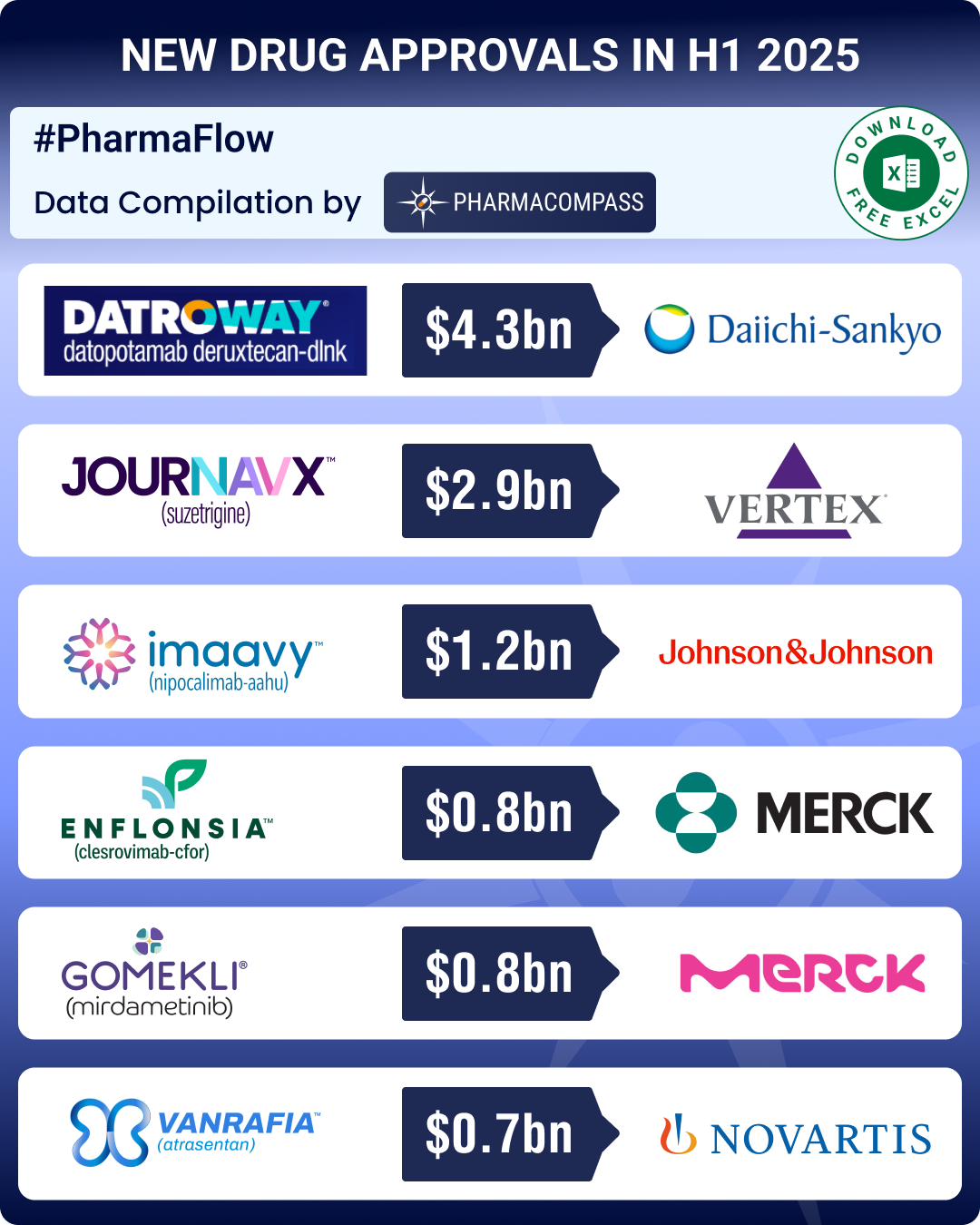
It has been a turbulent year for the US Food and Drug Administration (FDA), marked by reductions in both staff and budget, shake-ups at the top and a reduction in inspections. This upheaval has clearly impacted the functioning of the agency, with reports of missed deadlines and reduced responsiveness. This disruption resulted in a slowdown in new drug approvals in the first half of 2025 (H1 2025), as opposed to the same period last year. Incidentally, drug approvals in H1 2024 were also down by 19 percent compared to H1 2023. FDA’s Center for Drug Evaluation and Research (CDER) approved 16 novel drugs in H1 2025, down from 21 in H1 2024, a decline of nearly 24 percent. Of these, nine were small molecules and seven were biologics. The period saw eight first-in-class therapies get CDER’s approval, as opposed to 17 in H1 2024. FDA’s Center for Biologics Evaluation and Research (CBER) approved seven biologics in H1 2025, compared to eight in the same period last year. In comparison, both Health Canada and the European Medicines Agency (EMA) reported a strong rebound in approvals and authorizations, respectively. Health Canada approved 20 drugs in H1 2025, as opposed to 10 in H1 2024. Similarly, EMA authorized 19 new therapies in H1 2025, compared to 15 in H1 2024. Notably, EMA’s pending decisions increased to 25 in H1 2025, from 14 in the same period last year, while conditional authorizations remained static at five. This underscores EMA’s active regulatory pipeline, suggesting that more drugs could be approved in Europe soon.   View New Drug Approvals in H1 2025 with Estimated Sales (Free Excel Available) Vertex’s non-opioid painkiller, GSK’s antibiotic for UTI, Merck’s RSV antibody bag FDA nods  Oncology remained the single largest category in H1 2025 with seven new drugs being approved by the FDA, followed by four rare diseases and disorders and as many infections and infective diseases.  The eight drugs that were designated first-in-class in H1 2025 are: Journavx (Suzetrigine), Imaavy (nipocalimab), Emrelis (telisotuzumab vedotin), Blujepa (gepotidacin mesylate), Qfitlia (fitusiran), Avmapki Fakzynja Co-Pack (avutometinib potassium/defactinib hydrochloride), Tryptyr (acoltremon), and Andembry (garadacimab). In January, a new class of non-opioid pain therapy made a debut — FDA approved Vertex Pharmaceuticals’ Journavx (suzetrigine). This first-in-class oral analgesic could bring in US$ 2.9 billion in sales for Vertex by 2030. The half year also saw a new oral antibiotic — GSK’s Blujepa (gepotidacin) — for treating uncomplicated urinary tract infections (uUTIs) bag FDA approval. This is the first new antibiotic for uUTIs in nearly three decades. It treats infections caused by resistant pathogens such as E. coli and K. pneumoniae In June, Merck’s Enflonsia (clesrovimab), a long-acting monoclonal antibody, won FDA approval to prevent respiratory syncytial virus (RSV) lower respiratory tract disease in neonates and infants entering their first RSV season. A single 105 mg dose provides protection for about five months, the length of a typical RSV season. Enflonsia could bring in US$844 million in annual sales by 2030. FDA approves four meds for rare diseases, including SpringWorks’ Gomekli, Novartis’ Vanrafia In H1 2024, rare genetic diseases had witnessed some significant approvals. The trend continued in H1 2025. In February, Gomekli (mirdametinib), developed by SpringWorks Therapeutics, became the first approved therapy for neurofibromatosis type 1 (a genetic disorder that causes tumors to grow on nerve tissues) in adult and pediatric patients who have symptomatic plexiform neurofibromas (benign, complex nerve tumors) not amenable to complete resection. Analysts expect peak sales of around US$ 0.8 billion by 2030. Post this approval, SpringWorks got acquired by Merck KGaA for approximately US$ 3.9 billion. The same month, Ono Pharma-owned Deciphera’s Romvimza (vimseltinib) became the first oral therapy approved for another rare disease known as symptomatic tenosynovial giant cell tumor. This is a benign but aggressive growth that can be painful. This new drug offers patients an option beyond surgery. In March, Sanofi’s Qfitlia (fitusiran) was approved for routine prophylaxis in hemophilia A or B, with or without inhibitors. And in April, Novartis’ Vanrafia (atrasentan) was granted accelerated approval for IgA nephropathy (a chronic autoimmune kidney disease), which is at the risk of rapid progression. Vanrafia could bring in sales of over US$ 735 million by 2030 Johnson & Johnson secured approval for Imaavy (nipocalimab-aahu) for generalized myasthenia gravis (a chronic autoimmune disease that causes muscle weakness) in adults and adolescents. Imaavy’s sales could cross US$1.17 billion by 2030. Rare diseases continue to attract regulatory attention, with the trend carrying into the current quarter. July witnessed two noteworthy rare-disease approvals — Ekterly (garadacimab), CSL’s once-monthly prophylactic treatment for hereditary angioedema (a genetic disorder that causes recurrent episodes of swellings), and Sephience (pegvaliase-abcx), BioMarin’s new therapy for phenylketonuria (a rare metabolic disorder). FDA greenlights new oncology therapies, including Astra’s Datroway, AbbVie’s Emrelis The field of oncology saw some notable new drug approvals. In January, Datroway (datopotamab deruxtecan), an antibody-drug conjugate (ADC) developed by AstraZeneca and Daiichi Sankyo, was granted approval for adults with unresectable or metastatic, hormone receptor-positive, HER2-negative breast cancer. Later, in June, the FDA granted accelerated approval  to AstraZeneca;s Datroway for adults with locally advanced or metastatic, EGFR-mutated non-small cell lung cancer. The drug’s peak annual sales are projected at about US$ 4.2 billion by 2030. In May, Emrelis (telisotuzumab vedotin-tllv), AbbVie’s ADC was granted FDA’s accelerated approval. Emrelis treats locally advanced or metastatic non-squamous non-small cell lung cancer (NSCLC) characterized by significantly increased levels of the c-Met protein in cancer cells. FDA also approved a companion diagnostic test — Roche's Ventana — in May to determine the c-Met protein biomarker status in order to identify patients eligible for Emrelis.  The same month, FDA also granted accelerated approval to Verastem’s Avmapki Fakzynja Co-pack, a dual oral therapy for adults with KRAS‑mutated recurrent low‑grade serous ovarian cancer (LGSOC). This novel regimen combines two inhibitors — avutometinib and defactinib — to disrupt critical signaling pathways that fuel tumor growth. In ophthalmology, Alcon re-entered the prescription pharmaceutical market with Tryptry (acoltremon), a first-in-class TRPM8 agonist for dry eye disease, which stimulates corneal nerves to increase tear production. Our view The changes in the FDA are clearly having a far-reaching impact on the global pharmaceutical industry. There have been reports of drugmakers losing confidence in the FDA, which has been a gold standard for drug regulation. Some American biotechs are shifting early trials outside of the US. With EMA and Health Canada authorizing/approving a larger number of drugs in H1 2025, we do see some changes underway that may eventually reshape drug development.  

Impressions: 8108

https://dev1.pharmacompass.com/radio-compass-blog/fda-approvals-drop-24-in-h1-2025-gsk-s-uti-med-vertex-s-non-opioid-painkiller-lead-pack-of-first-in-class-meds

#PharmaFlow by PHARMACOMPASS
28 Aug 2025

MARKET PERFORMANCE RECAP

2read-more
read-more
Pipeline Prospector 2025 highlights: FDA approves pill version of Novo’s Wegovy; BioMarin acquires Amicus for US$ 4.8 bn
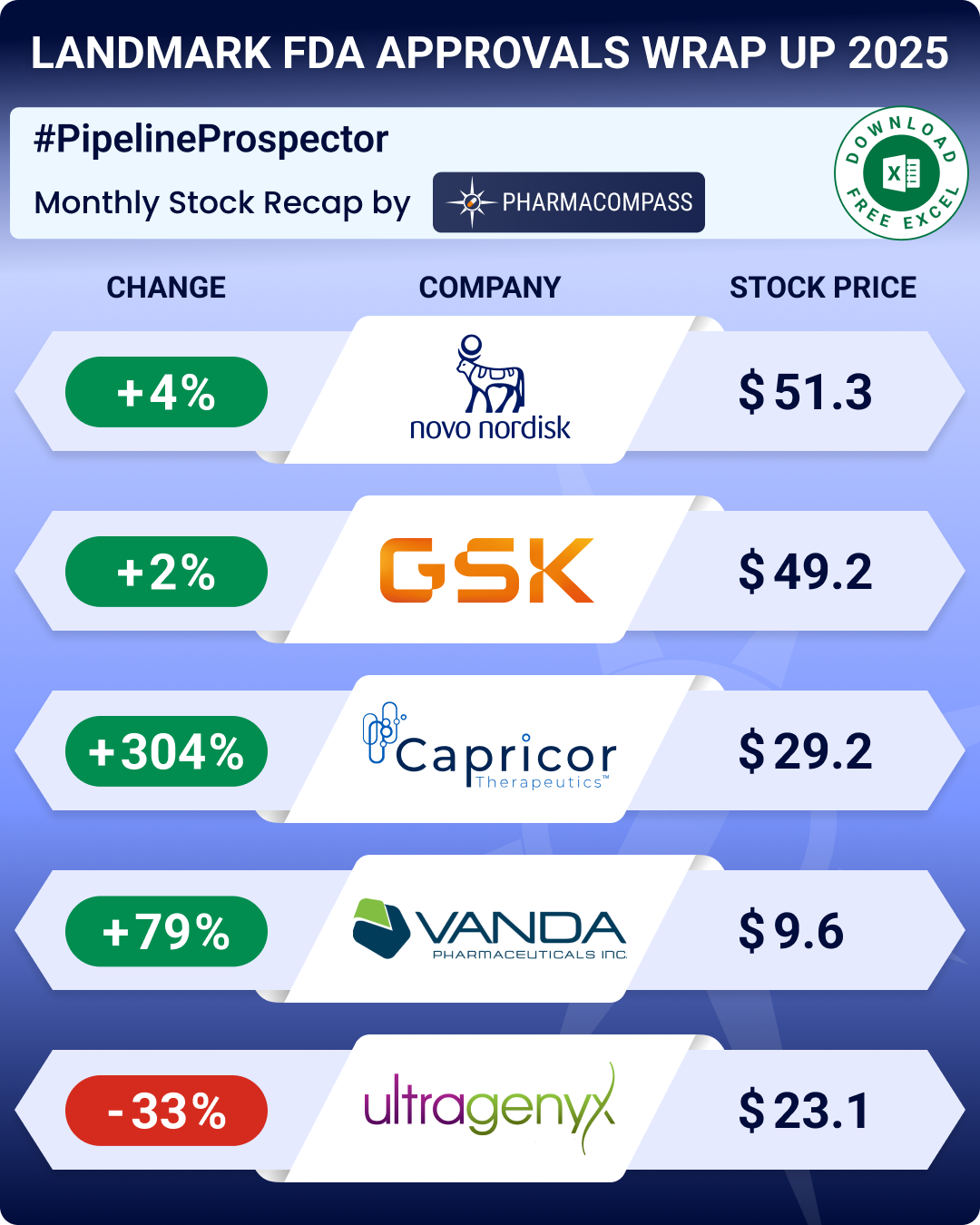
Even though the biotech indices delivered strong gains through 2025, December closed on a muted note. The Nasdaq Biotechnology Index (NBI) declined 1.12 percent in December, slipping from 5,772.06 to 5,707.20. The SPDR S&P Biotech ETF (XBI) was largely flat, edging up 0.07 percent from 121.85 to 121.93. Meanwhile, the S&P Biotechnology Select Industry Index (SPSIBI) fell 0.62 percent, from 9,588.09 to 9,528.24. Overall, biotech indices showed sharp gains during 2025. From January to December, NBI rose 31.48 percent, climbing from 4,340.87 to 5,707.20. XBI gained 34.06 percent over the same period, increasing from 90.95 to 121.93, while SPSIBI jumped 36.52 percent, advancing from 7,023.04 to 9,528.24. The year saw the world’s largest pharmaceutical market put pressure on drugmakers to invest and reduce drug prices. In December, US President Donald Trump and nine major drugmakers — including Bristol Myers Squibb, Gilead Sciences, Merck, Genentech, Novartis, Amgen, Boehringer Ingelheim, Sanofi and GSK — announced agreements to lower prescription drug prices for the Medicaid program and for cash-paying patients under a most-favored-nation (MFN) pricing framework. These announcements built on earlier MFN pricing agreements the administration had signed with Pfizer and AstraZeneca. During 2025, several big drugmakers announced new US investments to avert the looming threat of import tariffs. In all, drugmakers pledged over US$ 370 billion in the US in 2025. In December, the US also finalized a trade agreement with the UK, eliminating US tariffs on British pharmaceutical products and medical technology for at least three years in return for Britain spending more on medicines and overhauling how it values drugs.  Access the Pipeline Prospector Dashboard for December 2025 Newsmakers (Free Excel)  FDA approves pill version of Novo’s Wegovy, GSK’s treatment for eosinophilic asthma okayed  Regulatory approvals remained a major theme in December 2025. Novo Nordisk (stock up 4 percent in December) gained an edge in the obesity market after the FDA approved the oral pill version of its blockbuster Wegovy (semaglutide) for weight management and reduction of cardiovascular risk in overweight and obese patients. The drug is approved for maintenance doses of up to 25 mg.  On December 16, GSK secured FDA approval for Exdensur (depemokimab) as an add-on maintenance treatment for patients aged 12 and older with eosinophilic asthma. During the same week, UK regulators approved Exdensur for both asthma and nasal polyps. GSK also received FDA approval for a label expansion of Blujepa (gepotidacin) — now approved as a treatment for gonorrhea for the same age bracket. California-based Innoviva received FDA approval for Nuzolvence (zoliflodacin), a first-in-class oral antibiotic for uncomplicated gonorrhea for patients aged 12 and older. Milestone Pharmaceuticals secured FDA approval for Cardamyst (etripamil), becoming the the first and only approved nasal spray to treat acute symptomatic episodes of paroxysmal supraventricular tachycardia (PSVT), a type of abnormal heart rhythm. Cytokinetics secured FDA approval for Myqorzo (aficamten), an oral treatment for obstructive hypertrophic cardiomyopathy. The approval marks the company’s first FDA-cleared product. Vanda Pharmaceuticals received FDA approval for Nereus (tradipitant) to prevent motion-induced vomiting, becoming the first new FDA-approved treatment for the condition in more than 40 years. US-based Agios Pharmaceuticals won FDA approval to expand the use of mitapivat, sold as Aqvesme, to treat anemia in adults with alpha- or beta-thalassemia, making it the first oral therapy for anemia in both transfusion-dependent and non-transfusion-dependent patients. BioMarin acquires Amicus for US$ 4.8 bn, Sanofi buys Dynavax, Shionogi bags Tanabe’s ALS biz December 2025 witnessed some mid-sized deals. BioMarin Pharmaceutical (stock up 6 percent) agreed to acquire Amicus Therapeutics in an all-cash transaction valued at approximately US$ 4.8 billion, marking the largest deal in BioMarin’s 28-year history. The acquisition adds two approved and fast-growing rare disease therapies — Galafold (migalastat) for Fabry disease and the Pompe disease combination treatment Pombiliti (cipaglucosidase alfa-atga) + Opfolda (miglustat) — to BioMarin’s portfolio. Sanofi announced the acquisition of Dynavax Technologies for around US$ 2.2 billion (€1.9 billion). The transaction, all cash, strengthens Sanofi’s vaccine portfolio with an approved adult hepatitis B vaccine and an experimental shingles shot. In all, Sanofi cracked over a dozen deals in 2025. Japan-based Shionogi agreed to acquire Tanabe Pharma’s ALS business for US$ 2.5 billion, gaining both the oral and intravenous formulations of Radicava (edaravone), a US Food and Drug Administration (FDA)-approved treatment for amyotrophic lateral sclerosis (a progressive neurodegenerative disorder). Under the deal, Tanabe Pharma will set up a new company in the US to hold the rights to Radicava, which Shionogi will then acquire outright. Lilly to build new API plant in Alabama for its GLP-1 drug; Ultragenyx faces phase 3 setback The year 2025 was a good year for Eli Lilly — it inked nearly 30 deals through the year and became the first healthcare company in the world to reach a market capitalization of US$ 1 trillion in November. Lilly closed the year by pledging over  US$ 6 billion towards building a new API manufacturing facility in Huntsville, Alabama. The plant will produce small-molecule and peptide medicines, including orforglipron, Lilly’s oral GLP-1 weight-loss drug. Earlier in the year, Lilly had committed US$ 27 billion towards expanding US manufacturing capacity.  After failing to bag an FDA approval for its rare disease gene therapy in July, Ultragenyx Pharmaceutical faced yet another setback in December when a late-stage trial of its experimental drug setrusumab failed to meet its primary endpoint in children and young adults with osteogenesis imperfecta (brittle bone disease). The trials were conducted in partnership with Mereo BioPharma. Ultragenyx’s stock was down 33 percent in December. There was some good news for patients suffering from Duchenne muscular dystrophy (DMD). Capricor Therapeutics reported positive phase 3 results for its DMD cell therapy — deramiocel. This success comes after Sarepta’s gene therapy Elevidys (delandistrogene moxeparvovec-rokl) suffered a setback in June, following patient deaths. Our view The pharmaceutical industry is growing at a healthy rate, and is expected to attain a size of US$ 1.19 trillion in 2026 (up from US$ 1.16 trillion in 2025). The industry is also expected to witness innovations, especially in fields such as weight management, rare diseases and oncology. However, we do expect some tug-of-war on drug prices. According to a Reuters report, drugmakers plan to raise US prices on at least 350 branded medications including some vaccines, even as the US administration pressures them for price cuts. On the geopolitical front, 2026 began with the US military capturing Venezuelan president Nicolás Maduro. Such developments can add to the volatility and uncertainties in the market, impacting supply chains, energy prices and investor sentiments.

Impressions: 4461

https://dev1.pharmacompass.com/pipeline-prospector-blog/pipeline-prospector-2025-highlights-fda-approves-pill-version-of-novo-s-wegovy-biomarin-acquires-amicus-for-us-4-8-bn

#PharmaFlow by PHARMACOMPASS
08 Jan 2026

WEEKLY INDUSTRY NEWS

2read-more
read-more
FDA okays GSK’s Exdensur as first biologic, add-on med for severe asthma; issues OAI status to Sun Pharma’s India facility
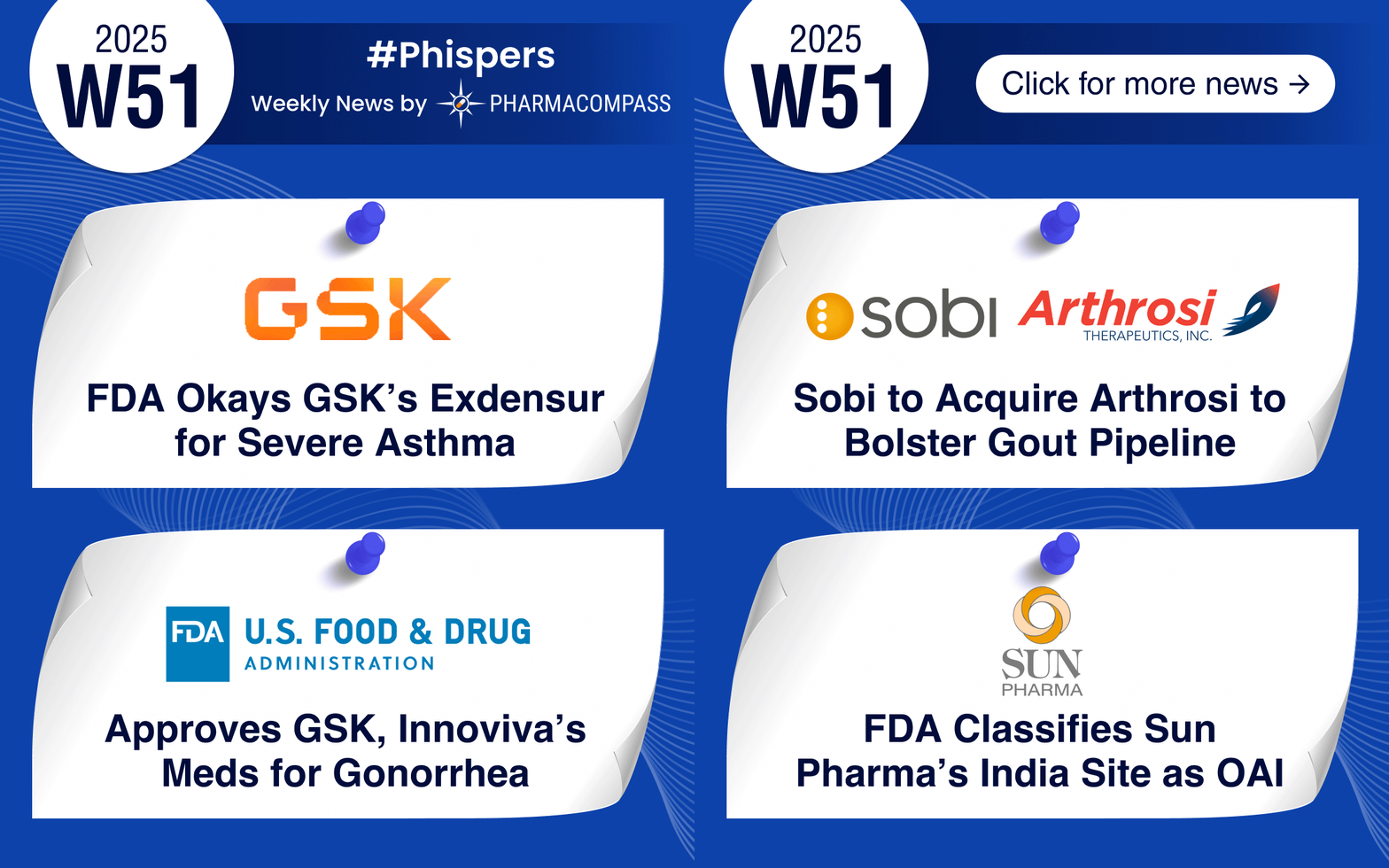
As the year draws to a close, the US Food and Drug Administration (FDA) appears busy approving drugs at a fast pace. This week, it approved the first biologic, add-on maintenance therapy for severe, difficult to treat asthma.In oncology, the agency expanded the approval of Johnson & Johnson’s Akeega (niraparib and abiraterone acetate) for patients with BRCA2-mutated metastatic castration-sensitive prostate cancer. It also okayed the combination of AstraZeneca and Daiichi Sankyo’s Enhertu (fam-trastuzumab deruxtecan-nxki) and Roche’s Perjeta (pertuzumab) as a first-line treatment for unresectable or metastatic HER2-positive breast cancer.Additionally, it approved Milestone Pharmaceuticals’ Cardamyst (etripamil) nasal spray to treat acute symptomatic episodes of paroxysmal supraventricular tachycardia (PSVT), a type of abnormal heart rhythm. The week also saw two approvals for gonorrhea — FDA expanded the label of GSK’s Blujepa (gepotidacin) for gonorrhea and approved Innoviva’s oral antibiotic Nuzolvence (zoliflodacin) to treat uncomplicated gonorrhea.In deals, Sobi agreed to acquire Arthrosi Therapeutics for up to US$ 1.5 billion to bolster its gout pipeline. US-based Yarrow Bioscience struck a licensing deal worth up to US$ 1.37 billion for a China-developed autoimmune thyroid antibody, and Sanofi signed a pact with South Korea’s Adel for an Alzheimer’s antibody therapy.In regulatory news, FDA issued an ‘Official Action Indicated’ status to Sun Pharma’s Baska manufacturing facility in Gujarat. And the White House is reportedly preparing deals with more drugmakers as part of its “most favored nation” (MFN) pricing push.FDA approves GSK’s Exdensur — first biologic to treat eosinophilic asthmaFDA has approved GSK’s Exdensur (depemokimab) as an add-on maintenance treatment for patients aged 12 and older with eosinophilic asthma, a severe, difficult to treat asthma. The drug becomes the first biologic for asthma that is dosed twice a year. Earlier this week, the UK had approved Exdensur for both asthma and nasal polyps.Okays Milestone’s nasal spray for heart disease: FDA has approved Milestone Pharmaceuticals’ Cardamyst (etripamil) nasal spray to treat acute symptomatic episodes of paroxysmal supraventricular tachycardia (PSVT), a type of abnormal heart rhythm. This is Milestone’s first FDA approval, and Cardamyst is the first self-administered treatment that allows patients to manage PSVT episodes outside of a hospital setting.Clears two drugs for gonorrhea: FDA has approved a label expansion for GSK’s Blujepa (gepotidacin), introducing a new class of treatment to gonorrhea for the first time in over 30 years. The approval allows oral use in adults and pediatric patients (aged 12 and older) when standard injectable therapy is contraindicated or not tolerated. The agency also approved Innoviva’s oral antibiotic Nuzolvence (zoliflodacin) to treat uncomplicated gonorrhea. The approval addresses growing antibiotic resistance, as gonorrhea has become resistant to most available treatments.FDA clears J&J’s Akeega for prostate cancer, Enhertu-Perjeta combo for breast cancerJohnson & Johnson has received FDA approval to expand the use of Akeega (niraparib and abiraterone acetate) for patients with BRCA2-mutated metastatic castration-sensitive prostate cancer. The approval makes Akeega the first precision-medicine combination for this patient group. Patients with BRCA2 mutations often have more aggressive disease.Enhertu-Perjeta combo: FDA has approved AstraZeneca and Daiichi Sankyo’s Enhertu (fam-trastuzumab deruxtecan-nxki) in combination with Roche’s Perjeta (pertuzumab) as a first-line treatment for unresectable or metastatic HER2-positive breast cancer.FDA classifies Sun Pharma’s Baska facility in Gujarat as Official Action IndicatedSun Pharmaceutical Industries has said the FDA has classified its Baska (Gujarat) manufacturing facility as “Official Action Indicated” (OAI), following an inspection conducted from September 8 to 19, 2025. The company said the classification means regulatory or administrative action is recommended based on the inspection findings. Sun Pharma has said it will work with the regulator to bring the facility to full compliance.Sobi to acquire Arthrosi for up to US$ 1.5 bn to strengthen gout portfolioSwedish Orphan Biovitrum (Sobi) has agreed to acquire US-based Arthrosi Therapeutics for up to US$ 1.5 billion to expand its gout treatment pipeline. Arthrosi, headquartered in San Diego, is developing an experimental gout therapy that has shown effectiveness in mid-stage trials.Yarrow in US$ 1.37 bn deal for thyroid antibody: US-based Yarrow Bioscience has licensed an antibody therapy ((GS-098), developed by Shanghai Scizeng Medical Technology (a subsidiary of Changchun GeneScience). The deal is worth up to US$ 1.37 billion. Meanwhile, Yarrow Bioscience and VYNE Therapeutics have entered an all-stock merger to form a combined company, Yarrow Bioscience, focused on advancing the clinical-stage anti-thyroid-stimulating hormone receptor antibody for Graves’ disease and thyroid eye disease.Sanofi signs licensing deal with South Korea’s Adel for its Alzheimer’s antibodySanofi has entered into a licensing agreement with Seoul-based biotech Adel for ADEL-Y01, an experimental antibody therapy for Alzheimer’s disease. Under the deal, Sanofi will pay US$ 80 million upfront to Adel, with potential milestone payments of up to US$ 1.04 billion, plus royalties. ADEL-Y01 targets a specific modified form of the tau protein, which plays a key role in Alzheimer’s and other neurodegenerative diseases.BMS in deal with China’s Harbour BioMed: Bristol Myers Squibb has entered into a collaboration and licensing agreement with China-based Harbour BioMed to develop multi-specific antibody therapies. Under the deal, BMS will pay Harbour US$ 90 million upfront and could provide up to US$ 1.035 billion more in milestone payments and royalties.Genentech, Caris in AI-driven cancer drug deal: Roche’s subsidiary Genentech has entered into a partnership with AI-focused Caris Life Sciences to support the discovery and development of new treatments for solid tumors. Under the agreement, Genentech will pay US$ 25 million upfront and could provide up to US$ 1.1 billion in other milestone payments.White House ‘preparing new deals with drugmakers’ as part of MFN pricing pushIn July this year, US President Donald Trump had sent letters to 11 drugmakers demanding they reduce cash-pay prices and give better deals to government programs. This week, a Reuters report citing sources has said the White House is preparing to unveil several new deals with large drugmakers on Friday as part of the administration’s “most favored nation” pricing push.So far, Pfizer, AstraZeneca, Eli Lilly, Novo Nordisk and EMD Serono have struck deals with the US government. Later this week, AbbVie and four others are expected to announce agreements with the US government.Affordable Care Act subsidy to expire: The Affordable Care Act subsidy, which was extended in 2021 through 2025-end due to the pandemic, is set to expire. The House passed a healthcare bill this week that did not address expiring Affordable Care Act tax credits. According to estimates, premium payments will increase by an average of US$ 1,016 in 2026. 

Impressions: 1635

https://dev1.pharmacompass.com/radio-compass-phisper/fda-okays-gsk-s-exdensur-as-first-biologic-add-on-med-for-severe-asthma-issues-oai-status-to-sun-pharma-s-india-facility

#Phispers by PHARMACOMPASS
18 Dec 2025

NEWS LIBRARY

6read-more
read-more

https://firstwordpharma.com/story/7520495

FIRSTWORD PHARMA
02 Jun 2026

https://www.contractpharma.com/breaking-news/gsks-gepotidacin-granted-priority-review-by-u-s-fda/

CONTRACTPHARMA
11 Aug 2025

https://www.gsk.com/en-gb/media/press-releases/blujepa-gepotidacin-approved-by-us-fda-for-treatment-of-uncomplicated-urinary-tract-infections/

PRESS RELEASE
26 Mar 2025

https://www.gsk.com/en-gb/media/press-releases/eagle-1-phase-iii-data-show-potential-for-gepotidacin-as-a-new-oral-treatment-option-for-uncomplicated-gc/

PRESS RELEASE
18 Apr 2024

https://www.biospace.com/article/gsk-posts-positive-phase-iii-gonorrhea-results-for-antibiotic-gepotidacin/

BIOSPACE
27 Feb 2024
GSK halts successful UTI trials early, preps FDA submission

04 Nov 2022

// James Waldron FIERCEBIOTECH

https://www.fiercebiotech.com/biotech/eagles-have-landed-gsk-halts-successful-uti-trials-early-preps-fda-submission

James Waldron FIERCEBIOTECH
04 Nov 2022
digital-content25101874##p