Please Wait
Applying Filters...
Menu

Digital Content read-more

Create Content with PharmaCompass, ask us

MARKET PERFORMANCE RECAP

1read-more
read-more
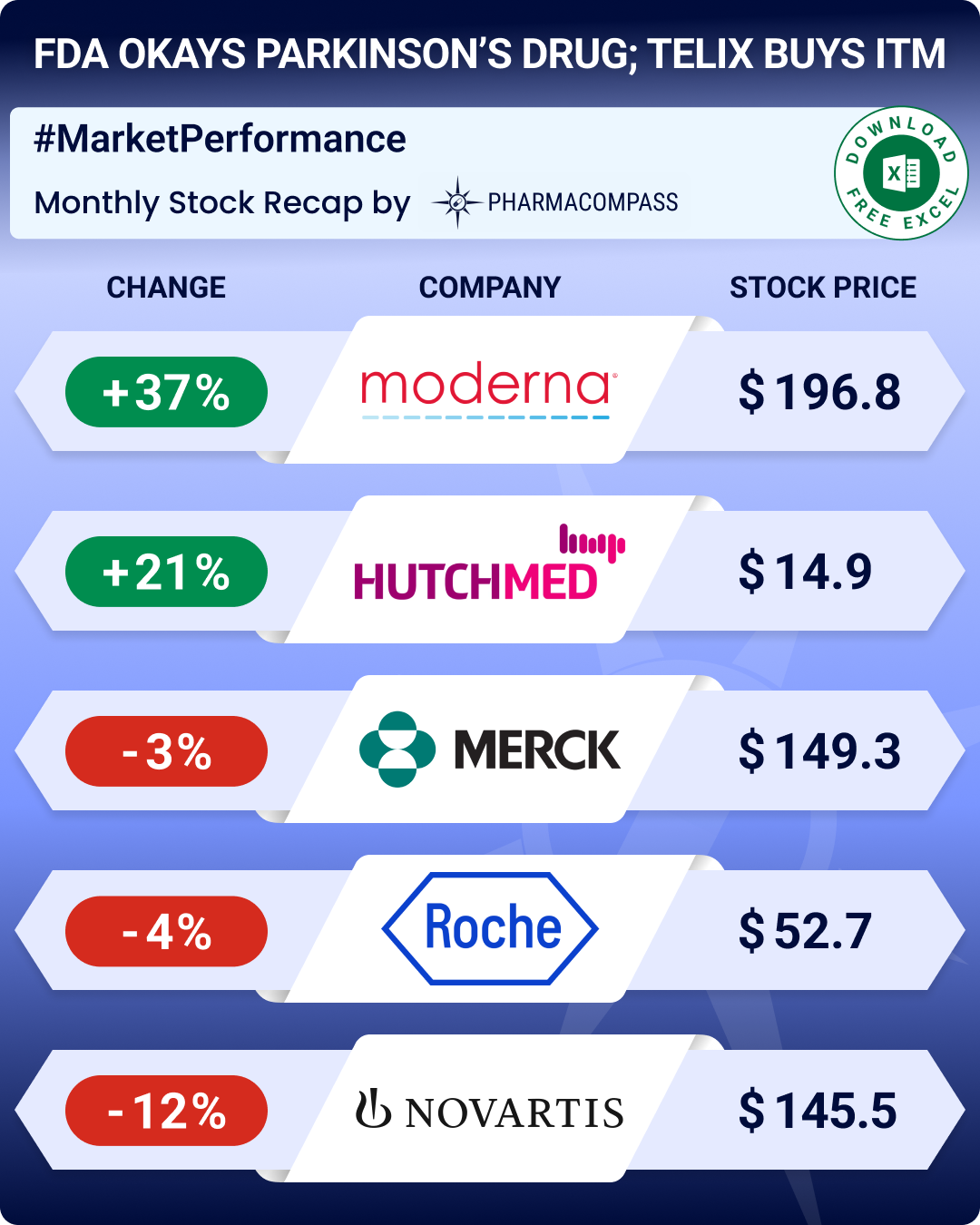
Market Performance Recap September 2026 highlights: FDA okays AbbVie’s Juvmo for Parkinson’s; Telix Pharma to acquire ITM Isotope
September marked the end of 2026’s third quarter (Q3). As Q3 drew to a close, the US Food and Drug Administration (FDA) approved drugs at a brisk pace, including AbbVie’s Juvmo (tavapadon) for treating Parkinson’s disease and Eli Lilly’s Onswik (insulin efsitora alfa-gobe) for type 2 diabetes. In August, pharmaceutical indices rose at an impressive rate of over 10 percent. In comparison, September was a turbulent month, as indices were hit by pressures in the bond market, rising oil prices, a series of missile attacks on Saudi Arabia by Houthis and rising tensions between the United States and Iran. Given these uncertainties, the pharma indices showed resilience. The Nasdaq Biotechnology Index (NBI) declined marginally, by 0.11 percent, from 7,122.63 to 7,114.53. The SPDR S&P Biotech ETF (XBI) declined by 2.52 percent, from 161.75 to 157.68. The S&P Biotechnology Select Industry Index (SPSIBI) declined by 2.98 percent, from 12,725.50 to 12,346.19. Meanwhile, the S&P 500 increased marginally by 0.21 percent — from 7,635.47 to 7,651.54.  Access the Pipeline Prospector Dashboard for September 2026 Newsmakers (Free Excel) FDA approves AbbVie’s Parkinson’s drug, Lilly’s weekly insulin for type 2 diabetes  September saw several key approvals. FDA approved AbbVie’s Juvmo (tavapadon), a once-daily pill for adults with Parkinson’s disease, a brain disorder that causes tremors, stiffness, and slowed movement. The agency also approved Eli Lilly’s Onswik (insulin efsitora alfa-gobe), a once-weekly basal (background) insulin, for use with diet and exercise to control blood sugar in adults with type 2 diabetes. FDA approved Roche unit Genentech’s Gazyva (obinutuzumab) to reduce the risk of relapse in patients aged two and above with idiopathic nephrotic syndrome (INS) that relapses often or depends on steroids, once they are in remission. INS is a kidney disorder of unknown cause that mostly starts in young children. In oncology, FDA approved Elevar Therapeutics’ Lyrfigtu (lirafugratinib) for adults with previously treated, advanced bile duct cancer (cholangiocarcinoma) whose tumors carry an FGFR2 gene fusion or rearrangement, a genetic error that drives tumor growth. FDA also cleared Merck’s Welireg (belzutifan) in combination with Eisai’s Lenvima (lenvatinib) for adults with advanced renal cell carcinoma with a clear cell component (the most common type of kidney cancer) that has progressed after PD-1 or PD-L1 immunotherapy. Telix Pharma to buy ITM Isotope; Novo licenses Hengrui’s GLP-1/GIP drug September didn’t see many significant mergers and acquisitions, barring one in radiopharmaceuticals. Australia’s Telix Pharmaceuticals agreed to acquire ITM Isotope Technologies Munich for US$ 1.65 billion upfront on a cash-free, debt-free basis, with up to US$ 700 million more tied to regulatory approvals and sales milestones for ITM’s lead drug. ITM is a major supplier of lutetium-177, a radioactive isotope used in targeted cancer radiotherapy. The month witnessed several licensing deals. Novartis signed an option and license agreement with South Korea’s Alteogen worth up to US$ 3.2 billion for rights to ALT-B4, an enzyme that allows biologics usually given by intravenous infusion to be delivered as faster, more convenient subcutaneous injections. Novo entered into a multi-target discovery and license agreement with Orbis Medicines to develop oral macrocycle drugs for cardiometabolic diseases. Novo also signed a license and collaboration deal worth up to € 1.165 billion (about US$ 1.33 billion) with Sweden’s Nanexa. Novo will apply Nanexa’s PharmaShell delivery technology to its drugs for treating obesity and type 2 diabetes. Big pharma signed deals with several Chinese drugmakers. Novo signed a deal with China’s Hengrui Pharma for exclusive rights to HRS-1596, an experimental obesity and diabetes drug that activates two gut-hormone receptors — GLP-1 and GIP. Eli Lilly signed a research collaboration and license agreement with China’s InnoCare Pharma to discover drugs against up to five targets. Merck licensed exclusive global rights to SPR2015, an investigational, preclinical drug, from Shanghai-based SciBrunch Therapeutics in a deal worth up to US$ 2.13 billion. Roche entered into a license agreement with China’s Simcere Zaiming for exclusive global rights to SIM0660, the latter’s experimental blood cancer drug. Several rare diseases get first treatments; Scholar Rock’s Isembyld okayed for SMA September saw several rare diseases get first treatments. For instance, FDA granted full approval to Ultragenyx’s Fayuvi (rebisufligene etisparvovec-hopf) — the first treatment for children with Sanfilippo syndrome type A, a rare, progressive and fatal neurodegenerative disease. FDA also approved Scholar Rock’s Isembyld (apitegromab-mstn) for spinal muscular atrophy (SMA) in adults and children aged two and above who are already receiving a survival motor neuron 2-targeted treatment. It is the first therapy for SMA that directly goes after muscle loss. FDA cleared Ionis Pharmaceuticals’ Zanvastro (zilganersen) for Alexander disease in children and adults. This is the first and only disease-modifying treatment for this ultra-rare disorder that mostly starts in childhood and damages brain cells. Fibrodysplasia ossificans progressiva (FOP), a rare genetic condition in which muscle, tendon, and ligament tissue gradually turns into bone, got its third treatment as FDA approved Mirum Pharmaceuticals’ Atebrioz (zilurgisertib) for patients aged 12 and above. Novo’s CagriSema beats Lilly’s Mounjaro in diabetes trial; Otsuka, Ionis’ ALS drug meets goal Novo made considerable news in clinical trials. The company said CagriSema, a combination of cagrilintide and semaglutide, produced greater weight loss than Eli Lilly’s Mounjaro (tirzepatide) in a phase 3 trial in adults with type 2 diabetes not adequately controlled on metformin, an SGLT2 inhibitor or both. In a separate phase 3 trial, Novo’s semaglutide helped 40.4 percent of children aged six to under 12 with obesity fall below the obesity BMI threshold after 68 weeks. Johnson & Johnson’s Caplyta (lumateperone) met the primary endpoint of a phase 3 trial in adults with manic episodes associated with bipolar I disorder. This is the first of two pivotal trials in mania. Otsuka and Ionis Pharmaceuticals said ulefnersen met the primary endpoint of a phase 3 trial in amyotrophic lateral sclerosis (ALS) caused by mutations in the FUS gene, a rare form commonly known as FUS-ALS. This is the first placebo-controlled trial to succeed against the underlying genetic cause of FUS-ALS. Additionally, AbbVie's migraine treatment Qulipta (atogepant) reduced migraine days associated with the menstrual period in a late-stage trial. Our view Geopolitical tensions, rising oil prices and bond yields weighed on pharma stocks in September. Yet FDA kept approvals flowing, especially in rare diseases, and big pharma kept licensing early-stage assets, increasingly from China. As we step into the last quarter of 2026, the industry's pipeline looks sturdier than its share prices.   

Impressions: 1249

https://dev1.pharmacompass.com/pipeline-prospector-blog/pipeline-prospector-september-2026-highlights-fda-okays-abbvie-s-juvmo-for-parkinson-s-telix-pharma-to-acquire-itm-isotope

#PharmaFlow by PHARMACOMPASS
01 Oct 2026

WEEKLY INDUSTRY NEWS

19read-more
read-more
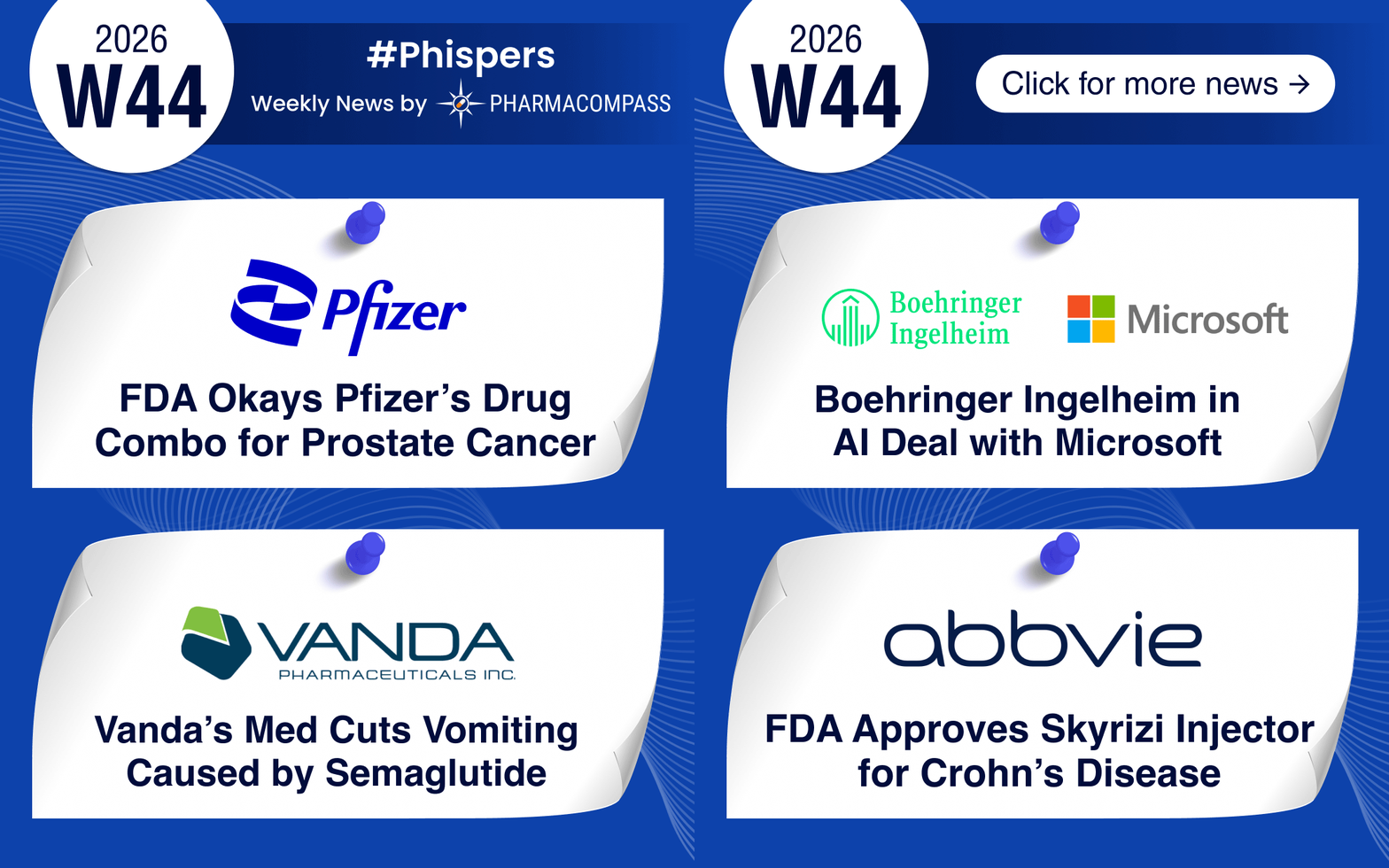
FDA approves Pfizer’s Talzenna drug combo for prostate cancer; clears AbbVie’s on-body Skyrizi injector for Crohn’s disease
In news this week, the US Food and Drug Administration (FDA) approved Pfizer’s Talzenna (talazoparib), in combination with Xtandi (enzalutamide), for a type of metastatic prostate cancer. The agency approved a subcutaneous regimen of AbbVie’s Skyrizi (risankizumab) to treat Crohn’s disease, and granted accelerated approval to AstraZeneca’s Ultomiris (ravulizumab) to reduce protein in the urine of adults with primary immunoglobulin A nephropathy (IgAN), a rare autoimmune kidney disease. It also cleared Novo Nordisk’s insulin Awiqli for children with type 2 diabetes. In clinical trials, Vanda Pharmaceuticals’ Nereus (tradipitant) reduced vomiting caused by semaglutide, a GLP-1 weight-loss drug. Pfizer’s Elrexfio (elranatamab) met the main goal of a phase 3 trial in patients with multiple myeloma whose cancer had returned after earlier treatment. Meanwhile, Artiva Biotherapeutics had to scrap its experimental cell therapy AlloNK after two patient deaths in a mid-stage trial. A patient with highly active relapsing multiple sclerosis died in an early-stage trial of an experimental CAR-T therapy from Bristol Myers Squibb, known as zolacabtagene autoleucel (zola-cel). In deals, Gilead Sciences said it will acquire PepStar Therapeutics’ experimental oral drug for inflammatory bowel disease — HCXT-2001 — for US$ 1.275 billion in cash upfront. Stemline Therapeutics secured exclusive worldwide rights to Georgiamune’s GIM-621, a preclinical pill designed to boost the immune system against cancer. And Boehringer Ingelheim signed an AI deal with Microsoft to speed up clinical development. Additionally, FDA issued Form 483 to two Indian companies — Gland Pharma and Gufic Biosciences. The agency also issued a warning letter to Baxter International over cGMP violations at its Illinois plant, which makes sterile injectable drugs. FDA approves Pfizer’s Talzenna combo for earlier-stage prostate cancer  FDA has approved Pfizer’s Talzenna (talazoparib), in combination with Xtandi (enzalutamide), for metastatic hormone-sensitive prostate cancer in patients whose tumors carry mutations in DNA-repair genes, known as homologous recombination repair (HRR) genes. Hormone-sensitive cancer still responds to hormone-blocking therapy, so this approval moves Talzenna to an earlier stage of disease. The combination was approved in 2023 for prostate cancer that no longer responds to hormone therapy. Okays AbbVie’s Skyrizi injector for Crohn’s disease: FDA has approved a subcutaneous (under-the-skin) regimen for AbbVie’s Skyrizi (risankizumab) in adults with moderately to severely active Crohn’s disease, an inflammatory bowel disease. Patients can now begin treatment at home with a wearable on-body injector, instead of relying only on intravenous infusions. Vanda’s Nereus reduces vomiting caused by obesity drug semaglutide in phase 3 trial Vanda Pharmaceuticals said its drug Nereus (tradipitant) reduced vomiting caused by the GLP-1 weight-loss drug semaglutide in a phase 3 trial. Nereus was approved in December 2025 for vomiting caused by motion sickness. Vanda plans to file for approval in this new use. Pfizer’s Elrexfio scores phase 3 win: Pfizer said its drug Elrexfio (elranatamab) met the main goal of a phase 3 trial in patients with multiple myeloma (a blood cancer) whose disease had returned after earlier treatment. Given alone, it delayed cancer progression or death compared with standard drug combinations. Pfizer plans to file for approval worldwide. Artiva drops cell therapy after two deaths, cuts 94 percent of staff Artiva Biotherapeutics has scrapped its experimental cell therapy AlloNK after two patient deaths in a mid-stage trial. The company will cut about 94 percent of its workforce. The cell therapy was being tested as a potential treatment for autoimmune conditions such as rheumatoid arthritis. BMS discloses patient death in CAR-T trial: Bristol Myers Squibb has disclosed that a patient with highly active relapsing multiple sclerosis died of septic pneumonia in an early-stage trial of zolacabtagene autoleucel (zola-cel), an experimental CAR-T cell therapy. CAR-T therapies are made by reengineering a patient’s own immune cells. Gilead to buy PepStar’s inflammation drug program for US$ 1.3 billion upfront Gilead Sciences will acquire PepStar Therapeutics’ experimental oral IL-23 receptor blocker, HCXT-2001, along with worldwide rights to the program, for US$ 1.275 billion in cash upfront. IL-23 is a protein that drives inflammation in inflammatory bowel disease (IBD) and psoriasis. Current IL-23 drugs, such as AbbVie’s Skyrizi, are injected. HCXT-2001 is a pill that is in phase 1 trials. Gilead plans to develop it for IBD. Stemline licenses Georgiamune’s immunotherapy: Stemline Therapeutics, part of Italy’s Menarini Group, has secured exclusive worldwide rights to Georgiamune’s GIM-621, a preclinical pill designed to boost the immune system against cancer. Georgiamune will receive US$ 45 million in upfront and near-term payments, with milestone payments taking the deal value up to US$ 1.1 billion, plus royalties. Boehringer Ingelheim in AI deal with Microsoft: Boehringer Ingelheim has partnered with Microsoft to use AI to speed up clinical development. The companies will research digital patient twins, or computer models of individual patients that predict how a disease will progress. The initial focus is lung disease. The companies have not disclosed any financial terms. FDA grants accelerated approval to Astra’s Ultomiris for treating rare kidney disease FDA has granted accelerated approval to AstraZeneca’s Ultomiris (ravulizumab) to reduce protein in the urine of adults with primary immunoglobulin A nephropathy (IgAN) who are at risk of disease progression. IgAN is a rare autoimmune kidney disease in which antibody deposits damage the kidney’s filters, causing protein to leak into the urine. Novo’s insulin okayed for diabetic children: FDA has approved Novo Nordisk’s Awiqli (insulin icodec) for children aged 10 and older with type 2 diabetes. FDA says it is the first once-weekly insulin approved for children with the condition. FDA issues warning letter to Baxter over cGMP violations at its Illinois plant  FDA has issued a warning letter to Baxter International over cGMP violations at its Illinois plant, which makes sterile injectable drugs. An inspection in March and April found that Baxter failed to stop cephalosporin antibiotics from contaminating other drug products made in the same building. Cephalosporins can trigger life-threatening allergic reactions in sensitive patients. Form 483 issued to Gland Pharma’s Hyderabad plant: FDA has issued a Form 483 with four observations to Gland Pharma’s formulation facility in Dundigal, Hyderabad (India), after an unannounced inspection from October 12 to 23. Gufic Biosciences’ Form 483: FDA issued a Form 483 with three observations to Gufic Biosciences after a pre-approval inspection of its plant in Pithampur, Indore (India), from October 15 to 23. The company did not disclose the nature of the observations and said it would address them within the stipulated time.

Impressions: 1782

https://dev1.pharmacompass.com/radio-compass-phisper/fda-approves-pfizer-s-talzenna-drug-combo-for-prostate-cancer-clears-abbvie-s-on-body-skyrizi-injector-for-crohn-s-disease

#Phispers by PHARMACOMPASS
29 Oct 2026

NEWS LIBRARY

630read-more
read-more

https://www.prnewswire.com/news-releases/paulex-bio-announces-registration-of-phase-12a-trial-of-pal-119-an-oral-small-molecule-designed-to-regenerate-and-restore-the-function-of-insulin-producing-beta-cells-302925540.html

PR NEWSWIRE
02 Nov 2026

https://www.prnewswire.com/news-releases/novos-awiqli-receives-fda-approval-as-the-first-and-only-once-weekly-insulin-for-children-10-years-of-age-and-older-with-type-2-diabetes-302918384.html

PR NEWSWIRE
23 Oct 2026
Canada Invests $880M to Support Researchers

22 Oct 2026

// GOVT OF CANADA

https://www.canada.ca/en/institutes-health-research/news/2026/10/government-of-canada-invests-880-million-to-empower-the-next-generation-of-researchers.html

GOVT OF CANADA
22 Oct 2026

https://www.prnewswire.com/news-releases/genprex-highlights-new-preclinical-data-identifying-role-of-tusc2-the-gene-used-in-reqorsa-in-maintaining-cellular-function-during-brain-aging-302914872.html

PR NEWSWIRE
21 Oct 2026

https://www.biospace.com/drug-delivery/sanofi-breaks-ground-on-insulin-plant-after-securing-german-government-support

BIOSPACE
19 Oct 2026

https://www.globenewswire.com/news-release/2026/10/13/3379572/35186/en/caspian-therapeutics-and-kura-oncology-outline-ko-7246-development-strategy-in-diabetes.html

GLOBENEWSWIRE
13 Oct 2026
digital-content70678557##p