Please Wait
Applying Filters...
Menu

Digital Content read-more

Create Content with PharmaCompass, ask us

PHARMA & BIOTECH INSIGHTS

2read-more
read-more

A PHP Error was encountered

Severity: 8192

Message: mb_convert_encoding(): Handling HTML entities via mbstring is deprecated; use htmlspecialchars, htmlentities, or mb_encode_numericentity/mb_decode_numericentity instead

Filename: blog/grid.php

Line Number: 52

Backtrace:

File: /var/www/html/application/views/include/media/blog/grid.php
Line: 52
Function: mb_convert_encoding

File: /var/www/html/application/models/Cmn.php
Line: 3595
Function: view

File: /var/www/html/application/views/include/product/digitalContent/grid.php
Line: 17
Function: common

File: /var/www/html/application/views/include/desc/inner.php
Line: 13
Function: view

File: /var/www/html/application/views/include/desc/indexNew.php
Line: 2433
Function: include

File: /var/www/html/application/controllers/Common.php
Line: 11303
Function: view

File: /var/www/html/index.php
Line: 231
Function: require_once

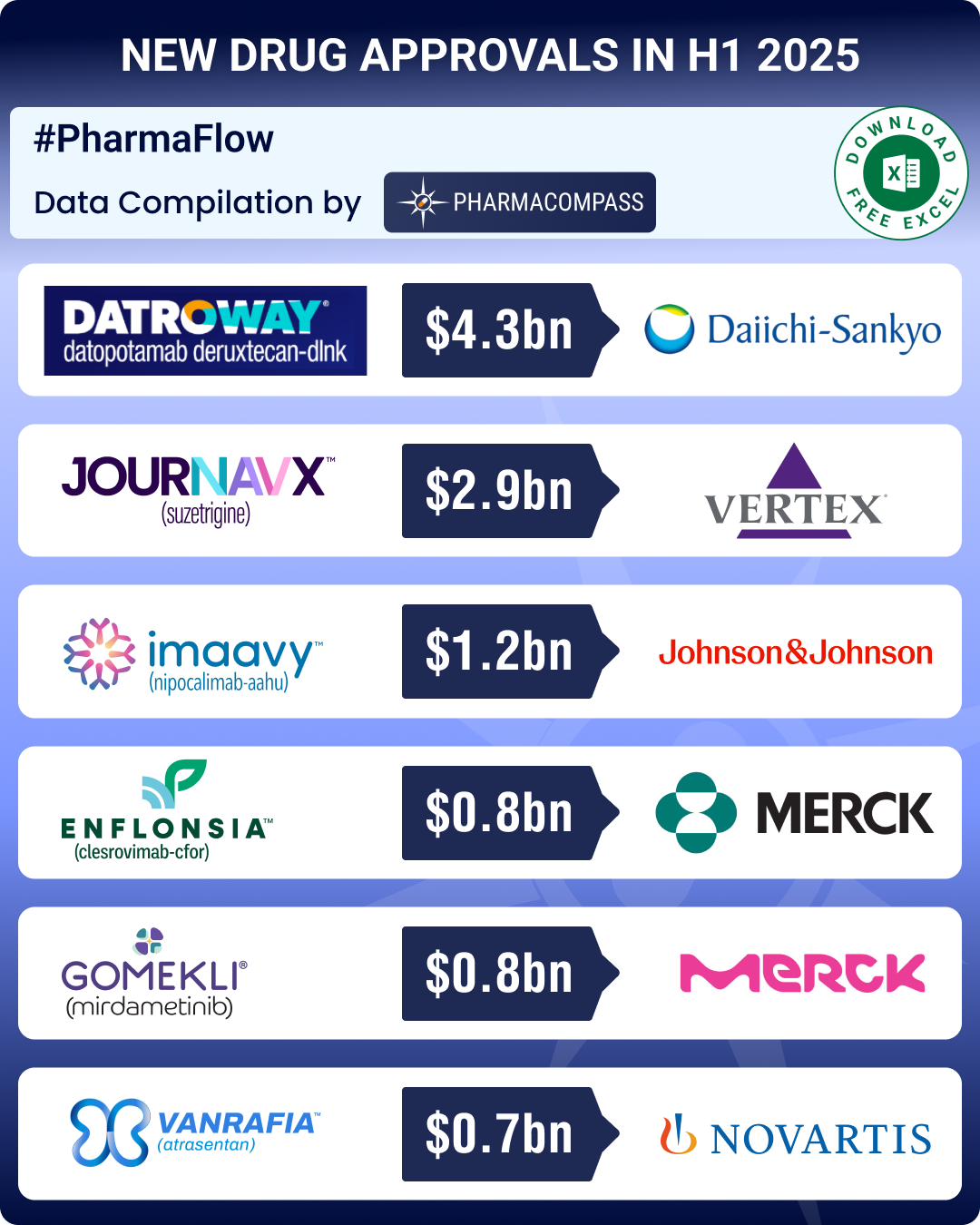
FDA approvals drop 24% in H1 2025; GSK’s UTI med, Vertex’s non-opioid painkiller lead pack of first-in-class meds
It has been a turbulent year for the US Food and Drug Administration (FDA), marked by reductions in both staff and budget, shake-ups at the top and a reduction in inspections. This upheaval has clearly impacted the functioning of the agency, with reports of missed deadlines and reduced responsiveness. This disruption resulted in a slowdown in new drug approvals in the first half of 2025 (H1 2025), as opposed to the same period last year. Incidentally, drug approvals in H1 2024 were also down by 19 percent compared to H1 2023. FDA’s Center for Drug Evaluation and Research (CDER) approved 16 novel drugs in H1 2025, down from 21 in H1 2024, a decline of nearly 24 percent. Of these, nine were small molecules and seven were biologics. The period saw eight first-in-class therapies get CDER’s approval, as opposed to 17 in H1 2024. FDA’s Center for Biologics Evaluation and Research (CBER) approved seven biologics in H1 2025, compared to eight in the same period last year. In comparison, both Health Canada and the European Medicines Agency (EMA) reported a strong rebound in approvals and authorizations, respectively. Health Canada approved 20 drugs in H1 2025, as opposed to 10 in H1 2024. Similarly, EMA authorized 19 new therapies in H1 2025, compared to 15 in H1 2024. Notably, EMA’s pending decisions increased to 25 in H1 2025, from 14 in the same period last year, while conditional authorizations remained static at five. This underscores EMA’s active regulatory pipeline, suggesting that more drugs could be approved in Europe soon.   View New Drug Approvals in H1 2025 with Estimated Sales (Free Excel Available) Vertex’s non-opioid painkiller, GSK’s antibiotic for UTI, Merck’s RSV antibody bag FDA nods  Oncology remained the single largest category in H1 2025 with seven new drugs being approved by the FDA, followed by four rare diseases and disorders and as many infections and infective diseases.  The eight drugs that were designated first-in-class in H1 2025 are: Journavx (Suzetrigine), Imaavy (nipocalimab), Emrelis (telisotuzumab vedotin), Blujepa (gepotidacin mesylate), Qfitlia (fitusiran), Avmapki Fakzynja Co-Pack (avutometinib potassium/defactinib hydrochloride), Tryptyr (acoltremon), and Andembry (garadacimab). In January, a new class of non-opioid pain therapy made a debut — FDA approved Vertex Pharmaceuticals’ Journavx (suzetrigine). This first-in-class oral analgesic could bring in US$ 2.9 billion in sales for Vertex by 2030. The half year also saw a new oral antibiotic — GSK’s Blujepa (gepotidacin) — for treating uncomplicated urinary tract infections (uUTIs) bag FDA approval. This is the first new antibiotic for uUTIs in nearly three decades. It treats infections caused by resistant pathogens such as E. coli and K. pneumoniae In June, Merck’s Enflonsia (clesrovimab), a long-acting monoclonal antibody, won FDA approval to prevent respiratory syncytial virus (RSV) lower respiratory tract disease in neonates and infants entering their first RSV season. A single 105 mg dose provides protection for about five months, the length of a typical RSV season. Enflonsia could bring in US$844 million in annual sales by 2030. FDA approves four meds for rare diseases, including SpringWorks’ Gomekli, Novartis’ Vanrafia In H1 2024, rare genetic diseases had witnessed some significant approvals. The trend continued in H1 2025. In February, Gomekli (mirdametinib), developed by SpringWorks Therapeutics, became the first approved therapy for neurofibromatosis type 1 (a genetic disorder that causes tumors to grow on nerve tissues) in adult and pediatric patients who have symptomatic plexiform neurofibromas (benign, complex nerve tumors) not amenable to complete resection. Analysts expect peak sales of around US$ 0.8 billion by 2030. Post this approval, SpringWorks got acquired by Merck KGaA for approximately US$ 3.9 billion. The same month, Ono Pharma-owned Deciphera’s Romvimza (vimseltinib) became the first oral therapy approved for another rare disease known as symptomatic tenosynovial giant cell tumor. This is a benign but aggressive growth that can be painful. This new drug offers patients an option beyond surgery. In March, Sanofi’s Qfitlia (fitusiran) was approved for routine prophylaxis in hemophilia A or B, with or without inhibitors. And in April, Novartis’ Vanrafia (atrasentan) was granted accelerated approval for IgA nephropathy (a chronic autoimmune kidney disease), which is at the risk of rapid progression. Vanrafia could bring in sales of over US$ 735 million by 2030 Johnson & Johnson secured approval for Imaavy (nipocalimab-aahu) for generalized myasthenia gravis (a chronic autoimmune disease that causes muscle weakness) in adults and adolescents. Imaavy’s sales could cross US$1.17 billion by 2030. Rare diseases continue to attract regulatory attention, with the trend carrying into the current quarter. July witnessed two noteworthy rare-disease approvals — Ekterly (garadacimab), CSL’s once-monthly prophylactic treatment for hereditary angioedema (a genetic disorder that causes recurrent episodes of swellings), and Sephience (pegvaliase-abcx), BioMarin’s new therapy for phenylketonuria (a rare metabolic disorder). FDA greenlights new oncology therapies, including Astra’s Datroway, AbbVie’s Emrelis The field of oncology saw some notable new drug approvals. In January, Datroway (datopotamab deruxtecan), an antibody-drug conjugate (ADC) developed by AstraZeneca and Daiichi Sankyo, was granted approval for adults with unresectable or metastatic, hormone receptor-positive, HER2-negative breast cancer. Later, in June, the FDA granted accelerated approval  to AstraZeneca;s Datroway for adults with locally advanced or metastatic, EGFR-mutated non-small cell lung cancer. The drug’s peak annual sales are projected at about US$ 4.2 billion by 2030. In May, Emrelis (telisotuzumab vedotin-tllv), AbbVie’s ADC was granted FDA’s accelerated approval. Emrelis treats locally advanced or metastatic non-squamous non-small cell lung cancer (NSCLC) characterized by significantly increased levels of the c-Met protein in cancer cells. FDA also approved a companion diagnostic test — Roche's Ventana — in May to determine the c-Met protein biomarker status in order to identify patients eligible for Emrelis.  The same month, FDA also granted accelerated approval to Verastem’s Avmapki Fakzynja Co-pack, a dual oral therapy for adults with KRAS‑mutated recurrent low‑grade serous ovarian cancer (LGSOC). This novel regimen combines two inhibitors — avutometinib and defactinib — to disrupt critical signaling pathways that fuel tumor growth. In ophthalmology, Alcon re-entered the prescription pharmaceutical market with Tryptry (acoltremon), a first-in-class TRPM8 agonist for dry eye disease, which stimulates corneal nerves to increase tear production. Our view The changes in the FDA are clearly having a far-reaching impact on the global pharmaceutical industry. There have been reports of drugmakers losing confidence in the FDA, which has been a gold standard for drug regulation. Some American biotechs are shifting early trials outside of the US. With EMA and Health Canada authorizing/approving a larger number of drugs in H1 2025, we do see some changes underway that may eventually reshape drug development.  

Impressions: 8107

https://dev1.pharmacompass.com/radio-compass-blog/fda-approvals-drop-24-in-h1-2025-gsk-s-uti-med-vertex-s-non-opioid-painkiller-lead-pack-of-first-in-class-meds

#PharmaFlow by PHARMACOMPASS
28 Aug 2025

WEEKLY INDUSTRY NEWS

2read-more
read-more
Novo bets up to US$ 4.6 bn on AI drug development, expands deal with Valo Health; WuXi sells Irish vaccine plant to Merck
As the embattled WuXi Biologics faces increasing pressure from the impending US Biosecure Act, it has decided to sell its vaccine manufacturing facility in Dundalk, Ireland, to Merck for € 500 million (US$ 521 million). Wuxi also struck a US$ 925 million deal with Candid Therapeutics for its tri-specific T-cell engager candidate.In deals, Novo Nordisk and Valo Health expanded their existing AI-driven drug development partnership to discover and develop novel treatments for cardiometabolic diseases.In oncology, J&J achieved a notable victory as its lung cancer combination therapy, which was approved last August by the US Food and Drug Administration (FDA), demonstrated superior survival benefits compared to AstraZeneca’s Tagrisso in a head-to-head study.The week saw another disappointment in treating major depressive disorder as Neumora Therapeutics’ novel drug failed to meet its primary endpoint in a pivotal trial. Meanwhile Denali Therapeutics’ ALS candidate fell short in a late-stage trial.On the regulatory front, FDA has mandated that GSK and Pfizer include warnings about the risk of Guillain-Barré syndrome (GBS), a rare neurological disorder, in the prescribing information for their RSV vaccines — Arexvy and Abrysvo.WuXi Biologics sells Irish vaccine facility to Merck for US$ 521 mnWuXi Biologics has agreed to sell its vaccine manufacturing facility in Dundalk, Ireland, to Merck (known as MSD outside US) for € 500 million (US$ 521 million). This transaction marks a strategic divestiture for WuXi Biologics, which has been facing increasing global pressure, particularly from the US Biosecure Act that targets Chinese biotech firms on national security grounds.The US House of Representatives had passed the Biosecure Act in September, aiming to prohibit federal contracts with certain firms and their business partners. It had specifically mentioned WuXi. The Act still needs approval of the Senate, and the president’s approval to become law. Meanwhile, WuXi AppTec reached an agreement with US-based private equity firm Altaris last month to sell its US and UK-based cell and gene therapy operations.Candid gains rights to WuXi’s T-cell engager in US$ 925 mn deal: Candid Therapeutics has entered into an agreement with WuXi Biologics to acquire exclusive global rights to a trispecific T-cell engager. This preclinical candidate, developed using WuXi's WuXiBody platform, aims to advance treatments for autoimmune and inflammatory diseases. The deal, valued at up to US$ 925 million, includes an upfront payment, development, and sales milestones.J&J’s lung cancer combo keeps patients alive a year longer than Astra’s Tagrisso in head-to-head studyJohnson & Johnson said its lung cancer drug combination, Rybrevant (amivantamab-vmjw) and Lazcluze (lazertinib), keeps patients alive for at least a year longer than those treated with the current standard of care – AstraZeneca’s Tagrisso (osimertinib). J&J executives hailed the result as a game-changer. J&J is aiming to supplant Astra’s blockbuster Tagrisso, a once-daily pill that has revolutionized the treatment of non-small cell lung cancer (NSCLC) with EGFR mutations, extending median survival to about three years. These genetic mutations cause cancer cells to proliferate and are responsible for 10 to 15 percent of lung cancer cases in the US, according to the American Lung Association.Novo, Valo Health expand AI-driven drug development partnership in US$ 4.6 bn dealNovo Nordisk and Valo Health have announced an expansion of their collaboration to discover and develop novel treatments for cardiometabolic diseases, including obesity, type 2 diabetes, and cardiovascular disease. The collaboration aims to harness the power of artificial intelligence and extensive human datasets, and builds on their initial 2023 partnership. It will enable the development of up to 20 drug programs. Valo will receive up to US$ 190 million in near-term payments, with the potential for milestone payments totaling approximately US$ 4.6 billion, plus R&D funding and potential royalty payments.Neumora’s novel depression drug flops in pivotal late-stage trial, adding to MDD setbacksNeumora Therapeutics suffered a setback with its experimental depression drug, navacaprant. In the first of three pivotal phase 3 trials, the drug failed to reduce symptoms such as sadness and pessimistic thoughts, raising concerns over its future development. The study in adults with major depressive disorder (MDD) showed that navacaprant did not significantly outperform a placebo in alleviating depressive symptoms. Neumora called the outcome “disappointing” as it had previously seen promising results in smaller studies.Last month, Relmada scrapped two late-stage trials of its MDD drug after an independent data monitoring committee called the effort “futile”. In 2023, Biogen and Sage’s Zurzuvae (zuranolone) gained FDA approval for postpartum depression but was rejected for MDD.Another Denali ALS candidate fails in late-stage: Denali Therapeutics’ experimental drug, DNL343, to treat the fatal neurodegenerative disease amyotrophic lateral sclerosis (ALS) has failed to meet the primary and key secondary endpoints of a mid-to-late stage trial. The trial’s primary endpoint was to measure changes in disease severity and survival over 24 weeks, but the drug did not show significant improvements. Key secondary endpoints included meaningful improvements in muscle strength and respiratory function. Last year, Denali’s other ALS candidate had failed.GSK, Pfizer’s RSV jabs must warn about risk of rare paralysis disorder, says FDAFDA has mandated that GSK and Pfizer include warnings about the risk of Guillain-Barré syndrome (GBS), a rare neurological disorder, in the prescribing information for their respiratory syncytial virus (RSV) vaccines, Arexvy and Abrysvo. GBS, where the body’s immune system attacks its own nerves, can cause muscle weakness and potentially lead to paralysis. FDA’s analysis found an estimated nine excess cases of GBS per million doses of Abrysvo and seven excess cases per million doses of Arexvy in individuals aged 65 and older. While the data suggests an increased risk, there isn't enough evidence to definitively tie the vaccines as the cause of the condition. The risks flagged in the prescribing information were not the regulator’s strictest “boxed” warnings.Galapagos to split into two, spinning off innovative medicines businessGalapagos is splitting into two distinct publicly traded entities. The first entity, which will retain the Galapagos name, will focus on advancing its cell therapy programs in oncology, addressing critical unmet medical needs. The second entity will concentrate on developing a pipeline of innovative medicines through strategic transactions. The new entity will be capitalized with approximately € 2.45 billion (US$ 2.53 billion) from Galapagos’ current cash reserves. As part of this reorganization, Galapagos and Gilead Sciences have amended their 10-year agreement.

Impressions: 1318

https://dev1.pharmacompass.com/radio-compass-phisper/novo-bets-up-to-us-4-6-bn-on-ai-drug-development-expands-deal-with-valo-health-wuxi-sells-irish-vaccine-plant-to-merck

#Phispers by PHARMACOMPASS
09 Jan 2025

NEWS LIBRARY

28read-more
read-more

https://www.jnj.com/media-center/press-releases/rybrevant-amivantamab-vmjw-plus-lazcluze-lazertinib-demonstrates-prolonged-clinical-benefit-as-a-first-line-treatment-for-atypical-egfr-mutated-non-small-cell-lung-cancer

PRESS RELEASE
29 May 2026

https://www.globenewswire.com/news-release/2025/09/07/3145711/0/en/Data-published-in-The-New-England-Journal-of-Medicine-demonstrate-RYBREVANT-amivantamab-plus-LAZCLUZE-lazertinib-could-re-set-survival-expectations-in-first-line-EGFR-mutated-advan.html

GLOBENEWSWIRE
07 Sep 2025

https://www.globenewswire.com/news-release/2025/04/07/3056770/0/en/European-Commission-approves-subcutaneous-RYBREVANT-amivantamab-for-the-treatment-of-patients-with-advanced-EGFR-mutated-non-small-cell-lung-cancer.html

GLOBENEWSWIRE
07 Apr 2025

https://www.prnewswire.com/news-releases/european-commission-approves-subcutaneous-rybrevant-amivantamab-co-formulated-with-enhanze-for-the-treatment-of-patients-with-advanced-egfr-mutated-non-small-cell-lung-cancer-302422049.html

PR NEWSWIRE
07 Apr 2025

https://www.prnewswire.com/news-releases/rybrevant-amivantamab-vmjw-plus-lazcluze-lazertinib-outperforms-osimertinib-with-a-significant-and-unprecedented-overall-survival-benefit-in-patients-with-egfr-mutated-non-small-cell-lung-cancer-302412036.html

PR NEWSWIRE
27 Mar 2025

https://www.globenewswire.com/news-release/2025/03/26/3049913/0/en/RYBREVANT-amivantamab-plus-LAZCLUZE-lazertinib-demonstrates-significant-overall-survival-benefit-in-patients-with-EGFR-mutated-advanced-non-small-cell-lung-cancer-versus-osimertini.html

GLOBENEWSWIRE
26 Mar 2025
digital-content121269225##p