Please Wait
Applying Filters...
Menu

Digital Content read-more

Create Content with PharmaCompass, ask us

PHARMA & BIOTECH INSIGHTS

1read-more
read-more

A PHP Error was encountered

Severity: 8192

Message: mb_convert_encoding(): Handling HTML entities via mbstring is deprecated; use htmlspecialchars, htmlentities, or mb_encode_numericentity/mb_decode_numericentity instead

Filename: blog/grid.php

Line Number: 52

Backtrace:

File: /var/www/html/application/views/include/media/blog/grid.php
Line: 52
Function: mb_convert_encoding

File: /var/www/html/application/models/Cmn.php
Line: 3595
Function: view

File: /var/www/html/application/views/include/product/digitalContent/grid.php
Line: 17
Function: common

File: /var/www/html/application/views/include/desc/inner.php
Line: 13
Function: view

File: /var/www/html/application/views/include/desc/indexNew.php
Line: 2433
Function: include

File: /var/www/html/application/controllers/Common.php
Line: 11303
Function: view

File: /var/www/html/index.php
Line: 231
Function: require_once

DMF filings rise 4.5% in Q3 2025; China holds lead, India records 20% growth in submissions
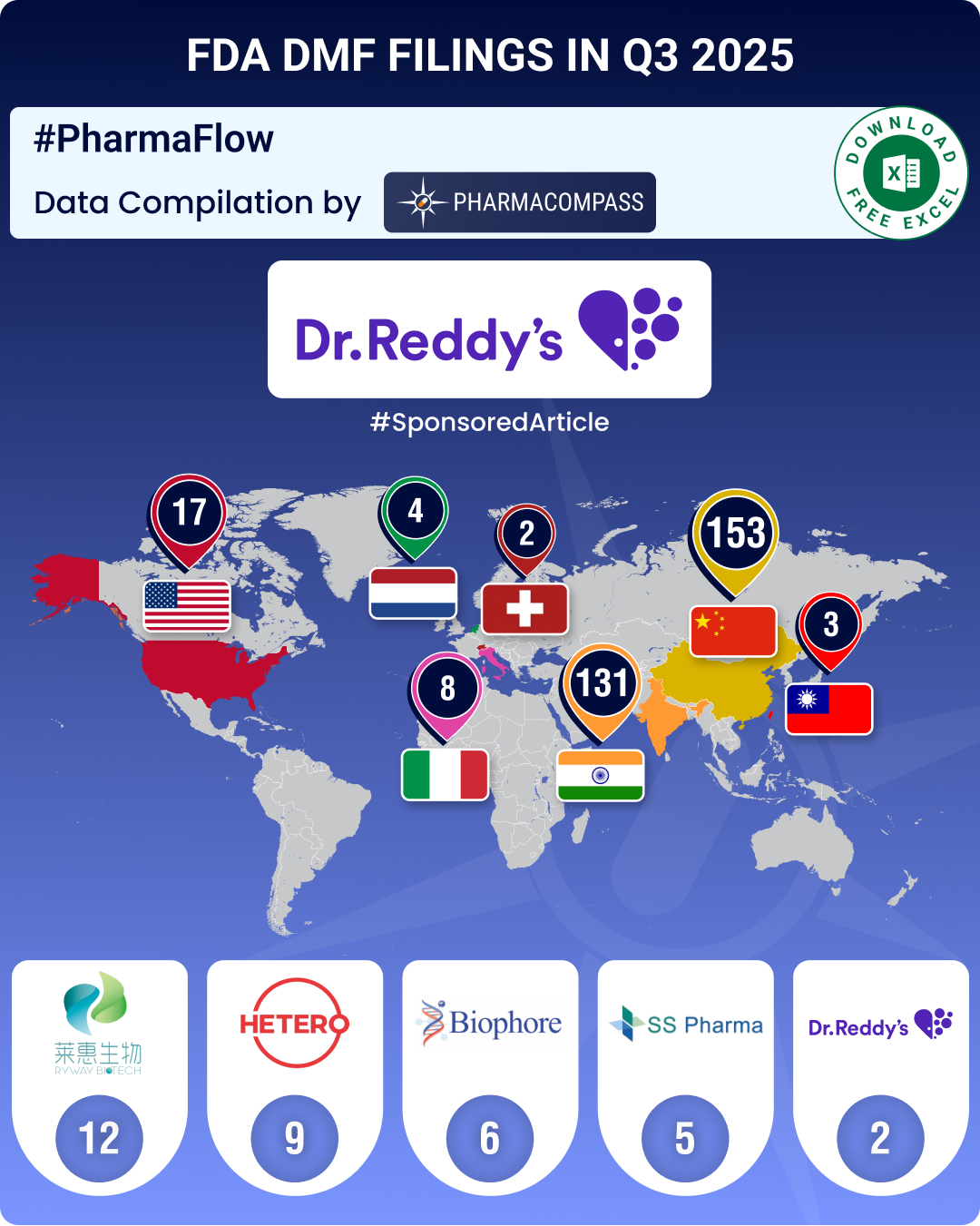
The third quarter (Q3) of 2025 witnessed a steady rise in Drug Master File (DMF) submissions to the US Food and Drug Administration (FDA). DMFs are used to provide confidential, detailed information about facilities, processes, or articles used in the manufacturing, processing, packaging, and storing of human drug products A total of 323 Type II DMFs were submitted during this period, as opposed to 309 submissions in Q3 2024, marking an increase of 4.53 percent. This is the second highest number since 2018. In Q1 2025, 339 Type II filings were recorded. Across all DMF types (II, III, IV, and V), 479 DMFs were filed in Q3 2025, compared to 394 in Q3 2024, representing a 21.57 percent increase. Out of the 323 Type II DMFs submitted in Q3 2025, 40 had completed their review by the end of Q3, reflecting a processing lag between submission and review completion.  View FDA DMF Filings in Q3 2025 (Power BI Dashboard, Free Excel Available) China maintains its lead while India posts double-digit growth in DMF submissions  China and India continued to dominate DMF submissions in Q3 2025. China retained the top spot with 153 Type II DMFs, matching its submission count from Q3 2024. India recorded 131 DMFs, marking a 20.18 percent increase over 109 filings during the corresponding period last year. The United States stood a distant third with 17 filings, compared to 13 in Q3 2024. Among European nations, Italy recorded eight DMFs, doubling its 2024 tally. The Netherlands filed four, up from three. Spain submitted only one DMF, as against seven submitted in Q3 2024. Taiwan made three filings, up from one submitted in Q3 2024. Together, India, China and Taiwan accounted for about 88.9 percent of all Type II DMFs filed during the quarter. China’s Suzhou Ryway Biotech tops corporate tally; India’s Hetero, Biophore follow China’s Suzhou Ryway Biotech led the company-wise tally with 12 DMF submissions in Q3 2025. The company had not filed any DMFs in Q3 2024. India’s Hetero Group followed with nine DMFs, maintaining the same number of filings as Q3 2024. Biophore India Pharmaceuticals ranked third with six DMFs, doubling its count from three last year. Other notable contributors include Sai Sreyas Pharmaceuticals (India) and Shanghai Haoyuan Chemexpress (China), with five DMFs each. Companies such as SNJ Group, Lunan Pharmaceutical, Allsino Pharmaceutical, Shankus Pharma, Jiangxi Xinganjiang Pharmaceutical, Sunpure Extracts, Lee Pharma, Umedica Laboratories, Linhai Tianyu Pharmaceutical and Maithri Drugs filed four DMFs each. Olaparib, semaglutide lead molecular filings; Dr. Reddy’s files DMF for edoxaban & tucatinib Dr. Reddy’s Laboratories also featured among key DMF filers in Q3 2025, submitting two DMFs — for edoxaban tosylate monohydrate and tucatinib copovidone. Edoxaban tosylate monohydrate (marketed as Savaysa by Daiichi Sankyo) is a prescription anticoagulant used to reduce the risk of stroke and to treat deep vein thrombosis and pulmonary embolism. Patent exclusivity for Savaysa extends until October 2026 in the United States, with no generic currently available. In terms of molecules, the highest number of DMFs were filed for olaparib, semaglutide, ruxolitinib phosphate, ferric carboxymaltose, and vismodegib, with three DMFs each in Q3 2025. Olaparib, sold by AstraZeneca under the brand name Lynparza, saw DMFs being filed by BDR Lifesciences and Intas Pharmaceuticals from India, and by ScinoPharm Taiwan during the quarter. Semaglutide, a glucagon-like peptide-1 (GLP-1) receptor agonist developed by Novo Nordisk, continued to draw strong interest from API manufacturers. DMFs for semaglutide were filed by three Chinese companies: Yangzhou Aurisco Pharmaceutical, Zhejiang Peptites Biotech, and Fujian Genohope Biotech. Ruxolitinib phosphate, marketed by Incyte as Jakafi, saw three DMFs. Three Indian companies — Alembic Pharmaceuticals, Valary Labs, and Devi Pharmatech — filed DMFs for this API in Q3 2025. Other molecules that received multiple DMF submissions include ferric carboxymaltose (used to treat iron-deficiency anemia) and vismodegib (an oral therapy for basal-cell carcinoma). First-time DMF filings span 17 companies; India leads with nine first-time DMF The quarter saw first-time DMF filings from 17 companies. India took a lead here with nine first-time DMF filings, followed by China (six), and the US (two). The DMF filings in this quarter included inclisiran sodium (filed by Aurisco Pharmaceutical of China), pacritinib citrate (by TAPI Nl B.V. of the Netherlands), and vosoritide (by Apicore LLC of the US). Out of the 19 first-time DMFs filed in Q3 2025, four completed their Generic Drug User Fee Amendments (GDUFA) review process during the quarter. GDUFA fee for FY 2026: The FDA Generic Drug User Fee Amendments (GDUFA) is a law designed to speed access to safe and effective generic drugs to the public and reduce costs to the industry. Fee rates for fiscal year 2026 were published on July 30, 2025. FDA has revised fees under GDUFA III across all categories. While there is a slight increase in the DMF fee from US$ 95,084 in 2025 to US$ 102,584 in 2026, the ANDA fee has seen a sharp rise: from US$ 321,920 in 2025 to US$ 358,247 in 2026. FY 2025 and FY 2026 User Fee Rates Generic drug fee category Fees rates for FY 2025 Fees rates for FY 2026 Applications:     Abbreviated New Drug Application (ANDA) US$ 3,21,920 US$ 3,58,247 Drug Master File (DMF) US$ 95,084 US$ 1,02,584 Facilities:     Active Pharmaceutical Ingredient (API)—Domestic US$ 41,580 US$ 43,549 API—Foreign US$ 56,580 US$ 58,549 Finished Dosage Form (FDF)—Domestic US$ 2,31,952 US$ 2,38,943 FDF—Foreign US$ 2,46,952 US$ 2,53,943 Contract Manufacturing Organization (CMO)—Domestic US$ 55,668 US$ 57,346 CMO—Foreign US$ 70,668 US$ 72,346 GDUFA Program:     Large size operation generic drug applicant US$ 18,91,664 US$ 19,18,377 Medium size operation generic drug applicant US$ 7,56,666 US$ 7,67,351 Small business generic drug applicant US$ 1,89,166 US$ 1,91,838 Our view For several years prior to the pandemic, India had a lead in Type II DMF submissions. In recent years, China has surpassed India in DMF filings. But Q3 2025 numbers indicate that Indian drugmakers are fast catching up. Since DMFs establish trust in APIs from across the world, we feel this healthy competition between drugmakers from the two countries is good for the global pharmaceutical industry.  

Impressions: 5446

https://dev1.pharmacompass.com/radio-compass-blog/dmf-filings-rise-4-5-in-q3-2025-china-holds-lead-india-records-20-growth-in-submissions

#PharmaFlow by PHARMACOMPASS
13 Nov 2025

WEEKLY INDUSTRY NEWS

1read-more
read-more
Amsterdam to host EMA; China pulls Skype out of app stores
This week in Phispers, we tell you how Amsterdam became EU’s choice for hosting the EMA. As Biocon receives an inspection closure from the FDA for its Bengaluru sterile injectables facility, we analyze how news reports on Biocon and Mylan moving a step closure to getting an FDA nod for its Herceptin biosimilar could be misplaced. We also bring you news on the positive trials from Roche and the Skype ban in China. Meanwhile, Concordia got into yet another drug price hike controversy. This time for its thyroid drug — liothyronine. Lucky draw gets Brexit-struck EMA a new home in Amsterdam The biggest news from the world of pharmaceuticals this week was the decision to relocate the European Medicines Agency (EMA), with nearly 900 employees, to Amsterdam (the Netherlands). The relocation of EMA from London is a consequence of the UK’s withdrawal from the European Union. The agency was not involved in the selection of the new location. Amsterdam was one of the 19 offers to host the EMA submitted by the EU member states at the end of July 2017. The EMA now has just over 16 months to prepare for the move and take up its operations in Amsterdam by March 30, 2019. “Amsterdam ticks many of our boxes,” Guido Rasi, executive director, EMA said. “It offers excellent connectivity and a building that can be shaped according to our needs,” Rasi added. The decision was made by closed ballot votes from each EU member state held in Brussels this week. An EMA survey of its staff found most of them might quit if posted to the bloc’s poor eastern regions. The employees had rated Amsterdam, Barcelona and Vienna as the top choices, while Warsaw, Poland, Bucharest, Romania, and Sofia, Bulgaria were rated the lowest.  Milan, Amsterdam and Barcelona campaigned hard. But there was a push from eastern states, as Slovak capital Bratislava turned out to be a strong contender. In the first round, Milan (with 25 votes), Copenhagen and Amsterdam (with 20 votes each) advanced out. Bratislava had 15 votes and Barcelona had 12 votes. Milan (with 12 votes) and Amsterdam (with 9 votes) then proceeded into the third round of voting. In the final round of voting, Milan and Amsterdam both tied with 13 votes each. The decision was taken through a draw of lots, that Amsterdam won. Biocon gets EIR for sterile injectables facility; FDA nod for its biosimilar still in question  India’s Biocon has received an EIR (establishment inspection closure) for its sterile injectables facility, inspected by the US Food and Drug Administration (FDA) earlier this year. However, contrary to what some recent news reports suggest, the company and its partner Mylan are not a step closer to getting an FDA nod for its biosimilar of Roche’s blockbuster cancer drug — Herceptin. According to these reports, Biocon and Mylan have resolved FDA concerns about its Bommasandra plant, setting it and Mylan up to potentially win FDA approval for the first Herceptin biosimilar. According to PharmaCompass’ analysis, there were two inspections at Biocon — the first one was for the biosimilars (during March 27 to April 7 this year); while the second one was for their sterile injectables facility (during May 25 to June 3 this year). Based on the dates shared in Biocon’s statement, the EIR is for the second inspection and there is no ‘exact’ news on the biosimilars inspection. The location of both inspections is the same — Plot 2-4, Phase IV, in Bommasandra, Bengaluru. However, there maybe different buildings within the campus that were inspected by the FDA. The same location in Bommasandra was also put on Health Canada’s Inspection Tracker list for data-integrity concerns found by a regulatory partner of Health Canada.  According to news reports, the FDA EIR to the sterile plant comes less than two weeks before the December 3 date that the FDA has set for considering approval of the Herceptin biosimilar. The original action date was September 3, but the FDA delayed that for three months after seeking additional information from Mylan and Biocon. However, in our view, the EIR and the December 3 date have no correlation. After receiving the EIR, the FDA further indicated that Biocon needs to implement the CAPA (corrective action and preventive action) plan and resubmit the updated details. Meanwhile, Roche is using all its might to prevent its revenues from getting chewed away by cheaper biosimilars. This week, Roche Holding sued Pfizer Inc to stop it from selling a copy of Herceptin in the US. Boehringer opens the door for crowdsourced research through opnMe.com Germany’s Boehringer Ingelheim has launched opnMe.com — a platform that offers free and open access to certain pre-clinical molecules and non-clinical investigation to scientists worldwide. The opnMe.com platform provides scientists with many best-in-class molecules supported by comprehensive data packages on one centralized platform. It also offers them direct access to molecules for independent research as well as other molecules for partnering with Boehringer. Through opnMe.com, molecules for some of the most relevant targets in biomedical research would be shared. This, in turn, would create possibilities for further independent and collaborative discovery as well as the identification of novel treatment approaches for patients.  “Working together with scientists across the world, we can accelerate research in a wide range of biomedical research areas,” Clive R. Wood, PhD, senior corporate vice president, Discovery Research at Boehringer Ingelheim, said.  This launch is part of the German research-based pharma company’s ongoing mission to further scientific research and medical progress through collaboration and innovation.  Roche’s shares surge after two trial wins of its potential blockbuster drugs Roche, which has been plagued by shrinking revenues from its older medicines, got a shot in the arm this week with two trial wins for its cancer (Tecentriq) and hemophilia (Hemlibra) drugs. The two drugs are potential blockbusters. Expectedly, Roche shares surged by 6.5 percent on Monday. This added more than US$ 12 billion to the company’s market capitalization. With Tecentriq, in combination with Avastin and chemotherapy, Roche has posted significant gains for progression-free survival and risk of death for a segment of lung cancer patients. Hemophilia agent Hemlibra, on the other hand, had reduced bleeds in a new group of patients. Tecentriq and Hemlibra, along with Roche’s multiple sclerosis medicine Ocrevus, are pillars of CEO Severin Schwan’s strategy that would offset the patent expiry of its top-selling drugs — Rituxan, Avastin and Herceptin. Together, these three drugs account for US$ 20 billion in annual sales. Since lung cancer is the largest oncology market, Roche’s trial of Tecentriq, in combination with Avastin and chemo, has been closely observed. With this drug, Roche seeks to compete with rivals in cancer immunotherapy. The mixture “provided a statistically significant and clinically meaningful reduction” in the risk of the disease worsening or death compared to Avastin plus chemotherapy in first-line treatment of advanced non-squamous non-small cell lung cancer (NSCLC), Roche said. Concordia’s thyroid drug caught in price hike controversy in the UK Last month, PharmaCompass had reported on a popular thyroid drug levothyroxine receiving several complaints of severe side effects from patients in France. The drug works as a stand-in for the hormone thyroxine in patients suffering from hypothyroidism, a condition that affects the body’s metabolism. And this week, Concordia Healthcare’s thyroid drug — liothyronine — got caught in a drug price hike controversy. An antitrust probe in the UK into Concordia’s pricing for liothyronine has found that the drug is now 57 times more expensive than it was in 2006. Both the thyroid drugs are different compounds — while liothyronine is the synthetic form of T3-triiodothyronine, levothyroxine is the manufactured form of T4-thyroxin. Physicians use liothyronine instead of or in addition to levothyroxine for patients undergoing thyroid hormone withdrawal. Concordia Healthcare has caught the ire of watchdogs even earlier for hikes in their drug prices. This matter only adds to the ongoing investigations. The UK Competition and Markets Authority (CMA) recently levied its biggest fine ever against Pfizer and Flynn Pharma, for driving up the price of an epilepsy drug. The fine is currently under appeal. “Pharmaceutical companies which abuse their position and overcharge for drugs are forcing the NHS—and the UK taxpayer—to pay over the odds for important medical treatments,” CMA chief Andrea Coscelli said in a statement. “We allege that Concordia used its market dominance in the supply of liothyronine tablets to do exactly that.” According to a statement provided to the Financial Times, Concordia said the pricing of liothyronine has been “conducted openly and transparently with the Department of Health in the UK over a period of 10 years.” Drug industry in China hit by local law that pulls Skype out from app stores Like several other industries, the pharmaceutical industry relies heavily on Microsoft’s Skype to communicate with its business partners. But this telecommunications application can no longer be downloaded in China, as Skype has been removed from both the Apple and Android app stores there. Apple said it is one of the several voice over internet protocol (VoIP) apps which was found not to comply with the local law by the Chinese government. Microsoft told the BBC that the app had been “temporarily removed” and the company was “working to reinstate the app as soon as possible”. China has increased scrutiny of internet applications this year, ordering firms to remove hundreds of apps that allow users to communicate confidentially or get around China’s so-called ‘great firewall system of censorship’ to use overseas social media. According to Reuters, over the last two months, authorities have also periodically interrupted services of Facebook Inc’s encrypted messenger app WhatsApp.  Alphabet’s Google, Facebook and Twitter are unavailable to Chinese users. According to news reports, downloaded Skype apps continue to operate. However, users will not be able to update them.   

Impressions: 2654

https://dev1.pharmacompass.com/radio-compass-phisper/amsterdam-to-host-ema-china-pulls-skype-out-of-app-stores

#Phispers by PHARMACOMPASS
23 Nov 2017

NEWS LIBRARY

28read-more
read-more

https://www.indianpharmapost.com/drug-approval/zydus-receives-approval-from-health-canada-for-liothyronine-tablets-5-mcg-and-25-mcg-17952

INDPHARMAPOST
07 Oct 2025

https://www.accessdata.fda.gov/scripts/cder/daf/index.cfm?event=overview.process&ApplNo=218070

FDA
06 Feb 2024

https://www.pharmacompass.com/pdf/news/enforcement-report-week-of-december-20-2023-27421.pdf

FDA
20 Dec 2023

https://timesofindia.indiatimes.com/business/india-business/sun-pharma-lupin-recall-drugs-in-us-on-manufacturing-woes/articleshow/106069616.cms?from=mdr

TIMES OF INDIA
18 Dec 2023

https://www.pharmacompass.com/pdf/news/enforcement-report-week-of-november-8-2023-82126.pdf

FDA
08 Nov 2023
ALTURiX acquires UK rights to Liothyronine

31 May 2022

// PHARMACEUTICALMANUFACTURER

https://pharmaceuticalmanufacturer.media/pharma-manufacturing-news/new-drug-development-approvals-regulatory-news/alturix-acquires-uk-rights-to-liothyronine/

PHARMACEUTICALMANUFACTURER
31 May 2022
digital-content23666110##p