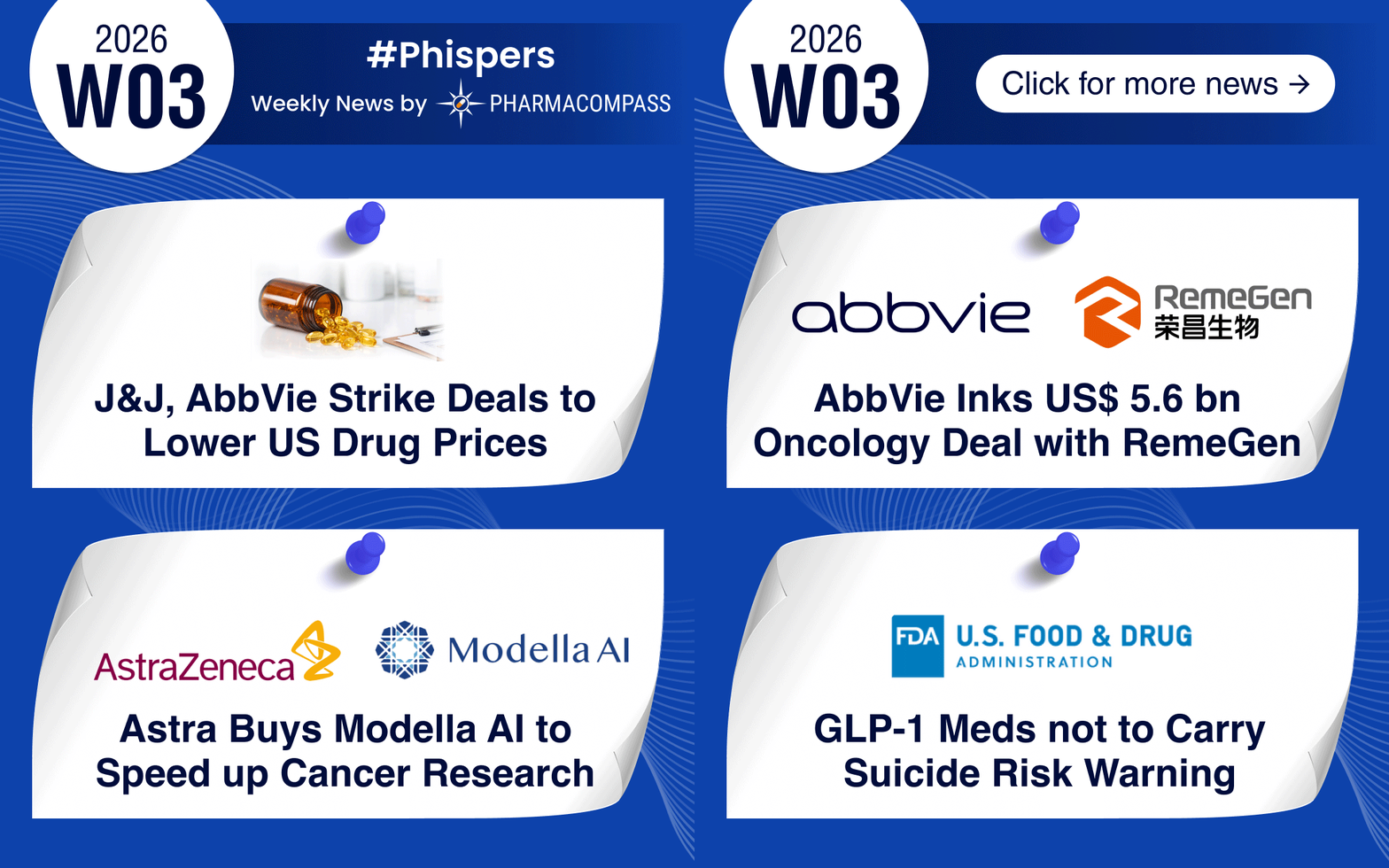
This week’s Phispers is packed with news from the ongoing JP Morgan Healthcare Conference (JPM26). Notably, AbbVie said it is partnering with China-based RemeGen to develop and commercialize an experimental cancer therapy that is designed to treat multiple advanced solid tumors. Novartis entered a worldwide licensing and collaboration deal with SciNeuro Pharmaceuticals to develop a next-generation antibody therapy for Alzheimer’s disease.Artificial intelligence (AI)
appeared to be a key focus area at JPM26.
AstraZeneca announced the acquisition of Boston-based AI firm Modella
AI, and Nvidia and Eli Lilly expanded their existing collaboration. They have
announced a US$ 1 billion five-year investment to set up a joint AI research
lab in the San Francisco Bay Area.Meanwhile, Johnson & Johnson and AbbVie struck agreements with the Trump administration to cut drug prices for Americans while expanding US-based manufacturing and R&D investments.The US Food and Drug
Administration (FDA) approved Zycubo (copper histidinate), the first US therapy
for rare Menkes disease. The agency also asked drugmakers to remove suicidal
risk warnings from GLP-1 weight-loss drugs.In news from clinical trials, Eli Lilly said combining Zepbound (tirzepatide) with Taltz (ixekizumab) improved psoriatic arthritis outcomes in a late-stage trial. Bristol Myers Squibb’s Camzyos (mavacamten) met phase 3 goals in adolescents with obstructive hypertrophic cardiomyopathy (oHCM).And, a US judge temporarily
blocked the Trump administration from freezing over US$ 10 billion in child
welfare funds to five states.J&J, AbbVie strike deals with Trump admin to cut drug prices; AbbVie commits US$ 100 bn in US investmentsAfter the Trump administration signed agreements with 11 large
drugmakers in December, Johnson & Johnson and AbbVie have also reached similar agreements.J&J has agreed to lower drug prices for Americans in return for exemptions from US tariffs on its pharmaceutical products. Under the agreement, J&J will participate in the TrumpRx.gov website (yet to be launched). J&J also reaffirmed its US$ 55 billion US investment plan.Similarly, AbbVie entered into a three-year agreement with the Trump
administration to reduce prices of select medicines
in the US, while committing to invest US$ 100 billion over the next decade
in domestic research, development and manufacturing. AbbVie also agreed to expand direct-to-patient
sales through the TrumpRx.gov. In return, it will receive tariff exemptions.Meanwhile, AbbVie has agreed to acquire a drug delivery
device manufacturing facility and related
intellectual property from West Pharmaceutical Services in Tempe, Arizona, as part of its broader push to expand US-based
manufacturing.Deals@JPM26: AbbVie inks US$ 5.6 bn oncology deal with China’s RemeGen; Novartis ties up with SciNeuroAbbVie has partnered with China-based RemeGen to develop and commercialize an experimental cancer
therapy, RC148, as it looks to strengthen its oncology pipeline.
The drug is designed to treat multiple advanced solid tumors, including
non-small cell lung cancer and colorectal cancer, where treatment options
remain limited. Under the deal, AbbVie will gain rights to develop, manufacture
and sell RC148 outside Greater China. RemeGen will receive US$ 650 million
upfront and could earn up to US$ 4.95 billion in milestone payments, along with
double-digit royalties if the drug reaches the market.Similarly, Novartis has entered a worldwide licensing and collaboration deal with SciNeuro Pharmaceuticals to develop a next-generation antibody therapy for Alzheimer’s disease. SciNeuro will receive US$ 165 million upfront and is eligible for up to US$ 1.5 billion in milestone payments, along with tiered royalties.AI Deals@JPM26: Nvidia, Lilly to invest US$ 1 bn in AI drug research labs; Astra acquires Modella AIAstraZeneca has agreed to acquire Boston-based AI firm Modella AI. This is “the first acquisition of an AI firm by a big pharmaceutical company,” Astra said. Modella’s “foundation models” and AI agents will be integrated into AstraZeneca’s oncology R&D, supporting clinical development, biomarker discovery, and quantitative pathology.Additionally, Nvidia and Eli Lilly have announced a US$ 1 billion five-year investment to set up a joint AI
research lab in the San Francisco Bay Area, expanding an existing collaboration
between the chipmaker and the drugmaker. The partnership builds on Lilly’s growing use of AI in drug discovery.FDA orders removal of
suicidal risk warning from GLP-1 drugs; okays first US drug for Menkes diseaseFDA has asked drugmakers to remove warning about potential suicidal thoughts from GLP-1
weight-loss medications, including Novo Nordisk’s Wegovy (semaglutide) and Saxenda (liraglutide), and Eli Lilly’s Zepbound (tirzepatide). The move follows a review of 91
placebo-controlled clinical trials involving over 107,910 patients, which found no evidence linking GLP-1 receptor agonists to increased risk of suicidal thoughts, behavior, or other psychiatric side effects.Approves Zycubo for rare
disease: FDA has approved Zycubo (copper histidinate), a drug developed by Fortress Biotech and Sentynl Therapeutics (a US-based
biopharma owned by Zydus Lifesciences), to treat Menkes disease, a
rare genetic disorder that prevents
children from absorbing copper. This makes Zycubo the first FDA-approved
therapy for the condition in the US.Lilly’s Zepbound-Taltz combo improves psoriatic arthritis outcomes in phase 3 trialEli Lilly has said a late-stage study showed that
using its weight-loss drug Zepbound (tirzepatide) together with its
psoriatic arthritis treatment Taltz (ixekizumab) improved arthritis symptoms and led to greater weight loss than Taltz alone. The trial included overweight or obese adults with psoriatic arthritis, a condition that causes joint pain and is commonly linked to obesity.Amgen’s MariTide helped patients maintain weight loss: Amgen’s experimental obesity
drug MariTide (maridebart cafraglutide) helped patients maintain weight loss
when given at a lower dose or less frequently, according to a study presented at JPM26. The drug
differs from weekly-injection weight-loss treatments, with potential for long-term weight management.BMS’ Camzyos meets phase 3 goals in adolescents with heart disease: Bristol Myers Squibb reported positive topline results from its phase 3 trial of Camzyos (mavacamten) in adolescents aged
12 to under 18 with symptomatic obstructive hypertrophic cardiomyopathy (oHCM).
In 2022, Camzyos was granted FDA approval for
treating oHCM in adults.US judge blocks Trump admin
from freezing US$ 10 bn in child welfare fundsA US federal judge has temporarily blocked the Trump
administration from freezing more than US$ 10 billion in childcare and
family assistance funds to five Democratic-led states. The restraining order came after
California, Colorado, Illinois, Minnesota and New York sued the administration
over the funding freeze due to concerns of fraud and misuse of
benefits.

















 Share