August was an important month for drug approvals, with the US Food and Drug Administration (FDA) approving Moderna’s mRNA-based seasonal influenza vaccine and Revolution Medicines’ drug to treat stage 4 pancreatic cancer.
In clinical trials, Merck and Moderna’s personalized mRNA-based cancer vaccine significantly delayed melanoma from returning in patients whose tumors had been surgically removed. And Definium Therapeutics’ oral LSD
candidate significantly reduced symptoms of generalized anxiety disorder, after
showing benefit in depression earlier this year.
As compared to July, the pharma indices rose at a faster clip. The Nasdaq Biotechnology Index (NBI) increased by 10.35 percent, from 6,456.75 in July-end to 7,125.06 at the end of August. The SPDR S&P Biotech ETF (XBI) increased by 10.56 percent, from 146.98 to 162.50. The S&P Biotechnology Select Industry Index (SPSIBI) increased by 10.57 percent, from 11,508.60 to 12,725.46.
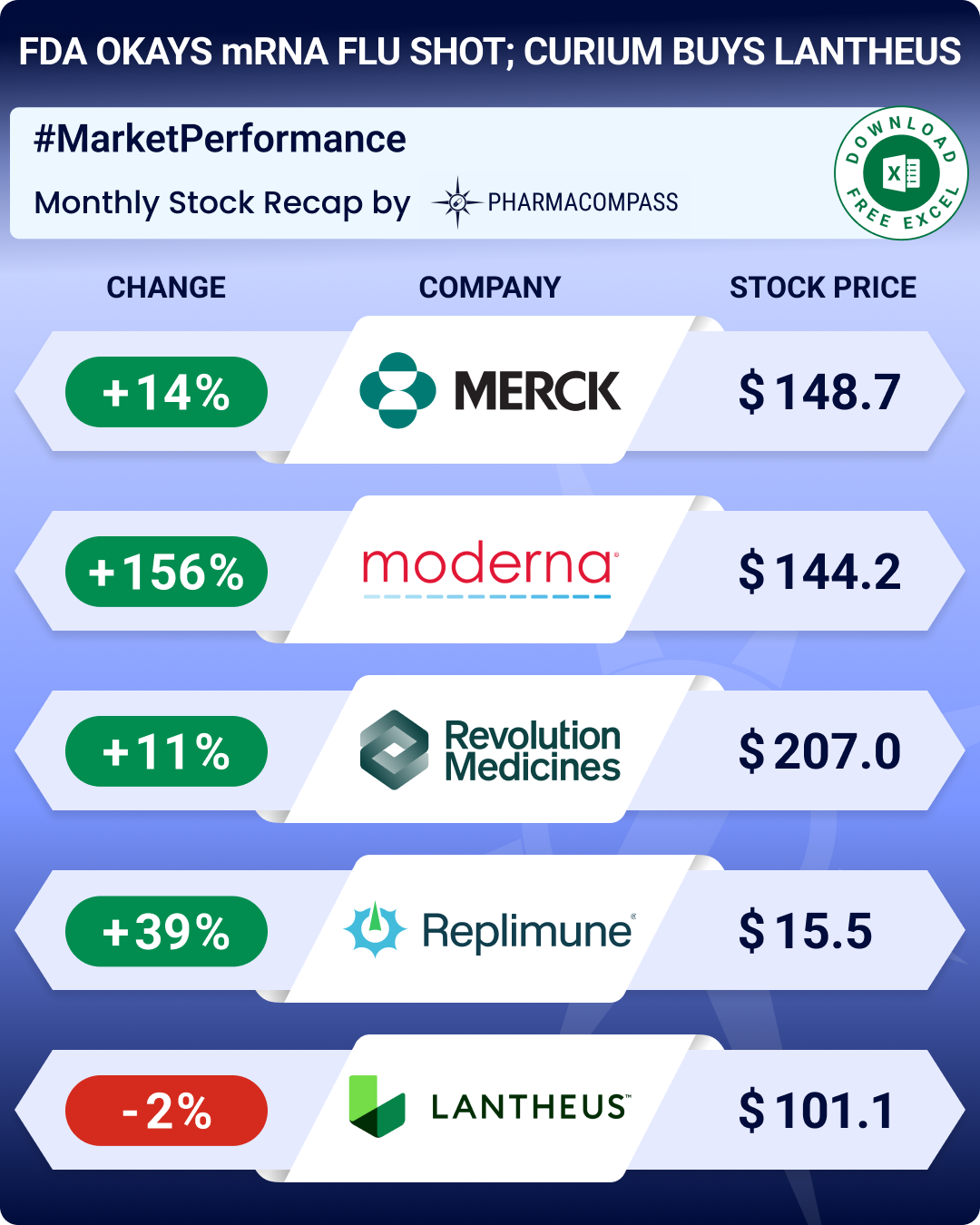
Access the Market Performance Dashboard for August 2026 Newsmakers (Free Excel)
FDA approves Moderna’s mRNA flu shot, Revolution’s therapy for pancreatic cancer
Amongst the month’s most notable drug approvals was Moderna's mFlusiva (mRNA-1010) — FDA cleared it for preventing seasonal influenza in all adults aged 50 and older. This is Moderna’s fourth approved product, and the first mRNA-based flu shot cleared in the US. Moderna’s stock rose 156 percent in August.
Another first was FDA’s approval of Revolution Medicines’ Rasonque (daraxonrasib) for the treatment of adults with metastatic pancreatic ductal
adenocarcinoma (PDAC), or stage 4 pancreatic cancer. Rasonque is the first targeted cancer medicine to be approved from a groundbreaking new class of
targeted therapy known as RAS(ON) multi-selective and mutant-selective
inhibitors.
FDA also approved
Takeda’s Orzeyful (oveporexton) for a lifelong neuropsychiatric sleep disorder, known as narcolepsy type 1. This is the first medicine approved for addressing the underlying cause of the disease in adults.
The agency
approved Gilead Sciences’ Bixlenvo (bictegravir/lenacapavir), the smallest once-daily single tablet regimen, for the treatment of
HIV in adults who are virologically suppressed. The UK’s Medicines and Healthcare products Regulatory
Agency (MHRA)
authorized Eli Lilly's Foundayo (orforglipron), making Britain the first country in Europe to clear the GLP-1 tablet.
Meanwhile, Japan’s health ministry approved GSK’s Hibsago (bepirovirsen) as a functional cure for chronic hepatitis B in adults who have taken antiviral pills for at least six months. This is the drug’s first approval anywhere in the world. A functional cure means the virus stays undetectable for at least 24 weeks after all treatment is stopped.
Curium to acquire
Lantheus for up to US$ 8 bn to create global radiopharma player
August didn’t see many large M&A deals. The biggest acquisition was announced by Curium — it agreed to buy Lantheus Holdings for up to US$ 8 billion. Both companies are into radiopharmaceuticals, or radioactive isotopes used to diagnose and
treat diseases, including cancers.
Eli Lilly agreed to acquire Merida Biosciences for up to US$ 2.875 billion in cash. The acquisition gives Lilly access to Merida’s
antibody-engineering platform and its lead phase 1 candidate MER511, being
developed for Graves’ disease and thyroid eye disease, along with preclinical programs
targeting food allergy, asthma and chronic spontaneous urticaria.
Jazz Pharmaceuticals agreed to acquire San Diego-based Actio Biosciences for up to US$ 1.32 billion. The deal adds an experimental treatment for a rare inherited form of
epilepsy to Jazz’s portfolio.
In deals, Roche’s Genentech is partnering with South Korea’s Hanmi Pharm to advance a novel therapy (HM17321) that could improve the quality of weight loss
by preserving lean mass in a deal worth up to US$ 2.3 billion. Unlike GLP-1 drugs, which cause muscle loss,
HM17321 is designed to cut fat while increasing lean mass. The drug is still in
phase 1 trials.
FDA approves two drugs for blood cancer — Takeda’s Mimrylo, BMS’s Zenbexus
In oncology, FDA
approved Takeda’s Mimrylo (rusfertide) for the treatment of erythrocytosis (a condition where the body has a higher-than-normal number of red
blood cells) in adults with polycythemia vera, a type of blood cancer.
The agency granted accelerated approval to Bristol Myers Squibb’s Zenbexus (iberdomide), combined with subcutaneous daratumumab and hyaluronidase-fihj and dexamethasone, for adults with multiple myeloma (a type of blood cancer) who have had at least one prior line
of therapy.
FDA also granted accelerated approval to Replimune’s Tudriqev (vusolimogene oderparepvec-wtpg), in combination with BMS’ Opdivo (nivolumab), for treating adults with a difficult form of skin cancer, known as unresectable advanced cutaneous melanoma. The approval follows two rejections, in July 2025 and April 2026.
Replimune’s stock was up 39 percent in August.
In rare diseases, FDA approved Regeneron Pharmaceuticals’ Pasatru (garetosmab-grts) for a rare genetic disorder known as fibrodysplasia ossificans progressiva (FOP). In this condition, muscle, tendon
and ligament tissue gradually turn into bone.
FDA also granted accelerated approval to Ultragenyx’s Genglycos (pariglasgene brecaparvovec-opnr),
the first treatment for glycogen storage disease type Ia (GSD1a) in patients aged eight and above. Children and adults with the rare disorder lack an enzyme needed to release stored sugar from the liver. As a
result, their blood sugar crashes whenever they go too long without eating.
Merck-Moderna’s mRNA cancer vaccine notches first phase 3 win; Definium’s LSD drug shows benefit in anxiety
In clinical
trials, the biggest readout came from Merck and Moderna — in a phase 3 trial, their personalized mRNA cancer vaccine, intismeran autogene, given in combination with Keytruda (pembrolizumab), significantly delayed melanoma recurrence in patients whose tumors had been surgically removed.
Otsuka’s Voyxact (sibeprenlimab) became the first drug to stabilize kidney function in IgA nephropathy to the rate seen in healthy adults, according to
two-year results from a phase 3 trial. IgA nephropathy is a disease in which
faulty antibodies lodge in the kidney’s filters.
Psychedelics saw
another late-stage success. Definium Therapeutics’ oral LSD candidate DT120 (lysergide) significantly reduced symptoms of generalized anxiety disorder in a phase 3 trial. DT120 is
an orally disintegrating tablet.
AstraZeneca posted two lung cancer wins on the same day. In one phase 3 trial, Tagrisso (osimertinib) plus Orpathys (savolitinib) showed benefit in a type of lung cancer, known as EGFR-mutated NSCLC
driven by MET resistance. In another phase 3 trial, Enhertu (trastuzumab deruxtecan) showed benefit as a first-line
treatment of patients with unresectable, locally advanced or metastatic
HER2-mutant NSCLC.
Our view
All three pharma indices rose over 10 percent in August, against the S&P 500’s modest increase of 2.42 percent. As geopolitical uncertainties continue to rock industries across the world, it’s clear that the pharmaceutical industry is building resilience through its laboratories and clinical trials.













 Share
