Please Wait
Applying Filters...
Menu

Digital Content read-more

Create Content with PharmaCompass, ask us

PHARMA & BIOTECH INSIGHTS

3read-more
read-more

A PHP Error was encountered

Severity: 8192

Message: mb_convert_encoding(): Handling HTML entities via mbstring is deprecated; use htmlspecialchars, htmlentities, or mb_encode_numericentity/mb_decode_numericentity instead

Filename: blog/grid.php

Line Number: 52

Backtrace:

File: /var/www/html/application/views/include/media/blog/grid.php
Line: 52
Function: mb_convert_encoding

File: /var/www/html/application/models/Cmn.php
Line: 3595
Function: view

File: /var/www/html/application/views/include/product/digitalContent/grid.php
Line: 17
Function: common

File: /var/www/html/application/views/include/desc/inner.php
Line: 13
Function: view

File: /var/www/html/application/views/include/desc/indexNew.php
Line: 2433
Function: include

File: /var/www/html/application/controllers/Common.php
Line: 11303
Function: view

File: /var/www/html/index.php
Line: 231
Function: require_once

CEP Q1 2026 Update: CEP 2.0, EDQM’s new guidelines strengthen ecosystem; Indian firms top list of CEPs issued
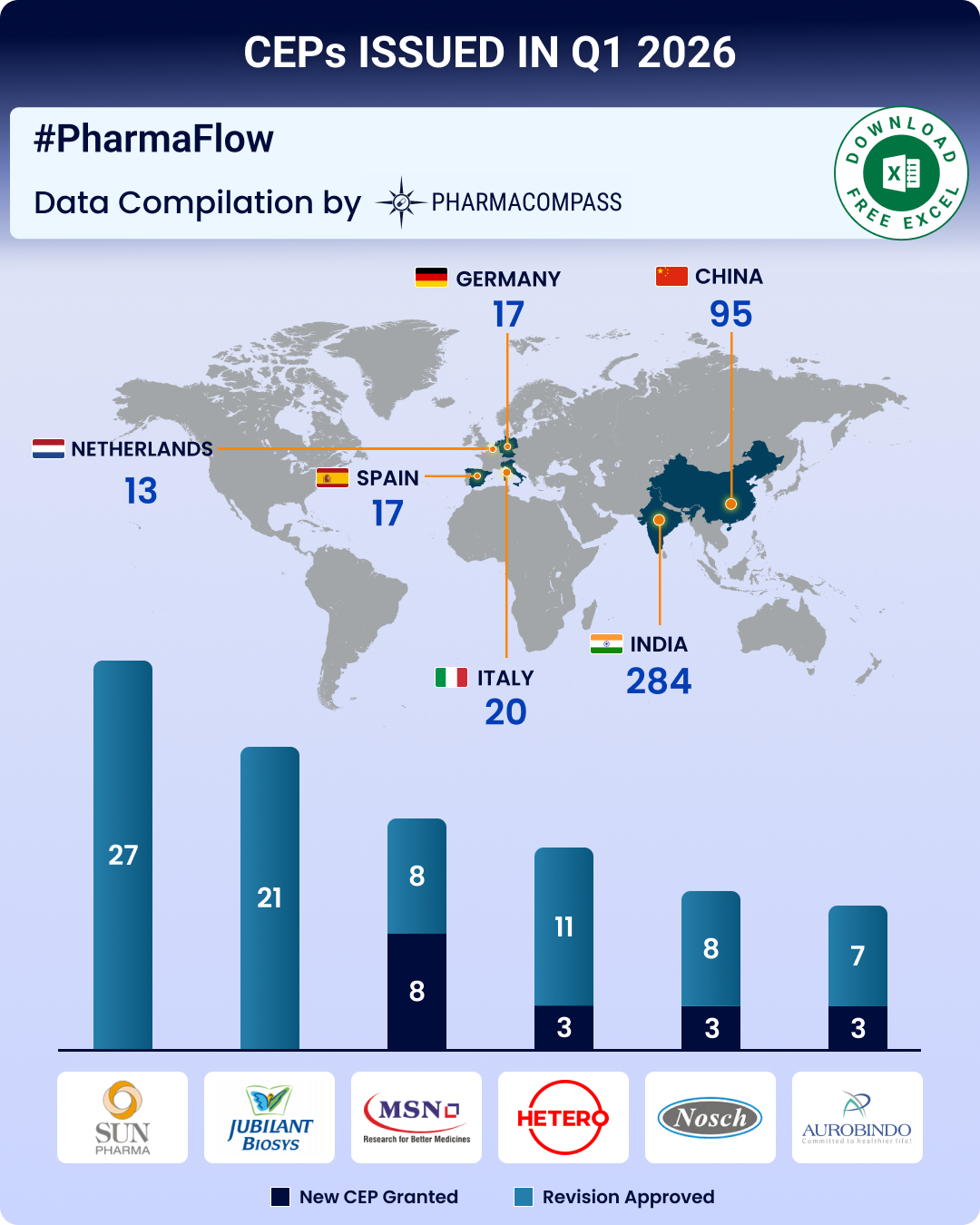
PharmaCompass is introducing a new regulatory update that tracks developments in Certificates of Suitability to the Monographs of the European Pharmacopoeia, referred to as CEPs. These certificates are a critical regulatory instrument in the global pharmaceutical supply chain. Also known as a Certification of Suitability (COS), CEPs are issued by the European Directorate for the Quality of Medicines and HealthCare (EDQM), with or without inspection of the manufacturing site. A CEP must be renewed every five years from its original issue date to remain valid, regardless of any revisions made during the interim period. However, a CEP does not replace Good Manufacturing Practice certification. CEPs are recognized as a trusted reference for API quality, thereby simplifying global registration strategies. Apart from Europe, the CEP system is widely used by many regulatory authorities, including those in Canada, Australia, Brazil, Singapore and South Africa.  View CEPs Issued in Q1 2026 (Power BI Dashboard, Free Excel Available) CEP 2.0 enhances regulatory clarity, brings efficiency, global interoperability  There are several types of CEPs, depending on the nature of the substance and evaluation. The most common type is the Chemical CEP, which confirms that a chemically synthesized API meets standards for purity and impurity control. Then there are Herbal CEPs for herbal substances and preparations. Another key category is the TSE CEP, which addresses risks associated with transmissible spongiform encephalopathies in animal-derived materials. In addition, there are Combined CEPs that may cover multiple aspects, such as chemical quality, TSE risk, and sterility. However, biological products such as vaccines and blood products fall outside the scope of the CEP framework. In 2023, the CEP system underwent a major transformation with the introduction of CEP 2.0, which marks a shift from a largely document-based system to a more structured, transparent, and digitally aligned model. This makes it easier for companies to manage compliance while improving trust among global regulators. While increasing data and compliance requirements for API manufacturers, CEP 2.0 enables better regulatory clarity, streamlined dossier integration, and stronger global acceptance. Overall, CEP 2.0 is designed to enhance regulatory clarity while making the system more efficient and globally interoperable. Indian firms issued maximum CEPs; Sun Pharma and its subsidiaries, Jubilant Biosys top list India topped the charts for CEPs issued, both in terms of new CEPs and revisions in the first quarter (Q1) of 2026. Indian companies were issued 81 new CEPs in Q1 2026 (as against 40 in Q1 2025) and 203 revisions (as against 129 in Q1 2025). In comparison, Chinese companies were issued 42 new CEPs in Q1 2026 (against 25 in Q1 2025) and 53 revisions (against 67 in Q1 2025). Italy came a distant third, followed by Germany and Spain. India’s Sun Pharmaceuticals and its subsidiaries topped the list of companies with the maximum number of CEPs issued— while no new CEP was issued, 27 CEPs were revised in Q1 2026. At second place was Jubilant Biosys — 21 CEPs were revised in Q1 2026. In terms of products, the maximum CEPs were issued for amlodipine besylate (a calcium channel blocker used for treating hypertension), followed by sitagliptin phosphate (a type 2 diabetes medicine) and pregabalin (a drug used to treat neuropathic pain, fibromyalgia, seizures, and generalized anxiety disorder). Both amlodipine besylate and sitagliptin phosphate had not been issued new CEPs or revisions in Q1 2025. EDQM introduces new guidelines to accelerate CEP assessments The EDQM charges fees for various services related to CEPs that depend on the type of request or regulatory activity involved. In general, fees apply to handling CEP applications, revisions or renewals and for offering technical advice (where applicants seek scientific or regulatory guidance). In March 2026, the EDQM introduced two new guidelines aimed at accelerating CEP assessments. The first is a reliance-based assessment pathway, which allows regulators to leverage prior approvals from trusted authorities, such as those in the EU, UK, Australia, Canada, and the WHO pre-qualification program. The second is a fast-track assessment route designed to expedite reviews in situations such as medicine shortages and to support initiatives like the EU Critical Medicines Act. Timelines have been significantly compressed under these new pathways. Initial evaluations are completed within 46 working days, compared to up to 115 days under the standard procedure. Applicants are given 30 calendar days to respond to queries, after which regulators complete the final assessment within 23 working days. Another important regulatory update relates to electronic submissions. From April 1, 2026, the EDQM will reject non-compliant CEP applications at the point of submission. All applications must include a validated electronic Common Technical Document (eCTD) dossier along with a proper validation report, submitted in line with the updated Common European Submission Portal (CESP) guidelines. Taken together, these developments signal a more rigorous yet efficient CEP ecosystem. Our view The shift to CEP 2.0 signals a move toward greater transparency, digitalization, and global regulatory alignment. Though enhanced disclosure and stricter e-submission requirements may increase the compliance burden, especially for smaller manufacturers, the long-term gains are expected to be significant. Going forward, companies that invest in data quality and regulatory readiness stand to gain from these changes.

Impressions: 3970

https://dev1.pharmacompass.com/radio-compass-blog/cep-q1-2026-update-cep-2-0-edqm-s-new-guidelines-strengthen-ecosystem-indian-firms-top-list-of-ceps-issued

#PharmaFlow by PHARMACOMPASS
09 Apr 2026

WEEKLY INDUSTRY NEWS

1read-more
read-more
FDA haunted by problems at Chinese plant; Sun Pharma gets entangled in price gouging furor
Phispers brings you the latest in global pharma news, such as how the drug price hike uproar in the US is affecting Sun Pharma, how the UN may adopt a resolution on fighting the menace of antibiotic resistance and how bioelectronics is working towards improving diabetes care. And there is more on Zhejiang Hisun, Novartis and GSK. Import alert on Zhejiang Hisun continues to haunt the FDAA little over a month ago, Bloomberg highlighted the challenges of banning China’s Zhejiang Hisun. This week, the FDA had to exempt even more products to ensure supply sustainability in the United States. In addition to the 14 drugs which were exempted when the initial import alert was announced, Sulbactam Sodium and Mesna have now been excluded from the import alert list.The FDA had issued an indefinite ban on the Zhejiang Hisun factory. Yet, in order to avoid possible shortages of drugs, the FDA allowed the plant to continue to export 15 ingredients for use in finished drugs in the US, including nine key cancer medicine components. In the US, more than 80 percent of drug ingredients are produced overseas, in mainly China and India. The FDA has stepped up inspections in order to check quality. However, it relies on pharmaceutical companies to ensure the ingredients are up to the US standards. Sun Pharma’s unit gets summoned for price gouging in the USThe ripples of the ongoing uproar in the US over high drug prices can be felt in India. Last week, the US Department sent grand jury subpoenas to Sun Pharmaceutical Industries’ unit – Taro Pharmaceuticals. In a statement to the Securities Exchange Commission, Taro said two of its commercial executives in its US unit were summoned by the antitrust division of the Department of Justice (DOJ). The DOJ sought “communications with competitors and others” regarding the sale of generic drugs. Taro contributed US $ 230 million to Sun Pharma’s US $ 375 million revenue from the US last year.According to a news report, Taro has received notice for raising the price on clobetasol – a steroid that is sold as a topical ointment, cream, and gel – substantially between July 2011 and June 2014. The price of 15 grams of 0.05 percent topical ointment increased from US $5.75 to US $124.36 during the period, according to Truven Health Analytics.  UN General Assembly to take up antibiotic resistance next weekNext week, we will know whether combatting the menace of antibiotic resistance will become an international priority or not. The United Nations will open its two-week long General Assembly in New York next week, where it will debate issues of global importance. On September 21, the assembly will host a “high-level meeting” on the threat of resistant bacteria. The assembly will showcase presentations from representatives of governments and non-profit and academic organizations. The same day, the UN is expected to adopt its first-ever resolution on the importance of combating antibiotic resistance, and perhaps also some sort of a commitment to action.According to estimates, antibiotic resistance kills 700,000 people around the globe each year, with 23,000 people dying each year in the US and 25,000 in Europe.  After Novartis and GSK, Google now ties up with Sanofi This week, there was some big news in the field of bioelectronics, a novel field of medicine that is focused on fighting diseases by targeting electrical signals in the body. Sanofi and Verily (the life sciences unit of Google parent Alphabet) announced they would invest about US $ 500 million in a joint venture combining devices with services to improve diabetes care.The deal with the French drug maker Sanofi comes after British drug maker GlaxoSmithKline (GSK) and Verily created a new bioelectronics company. Verily is also working on the development of a smart contact lens in partnership with Swiss drug maker Novartis that has an embedded glucose sensor to help monitor diabetes. These partnerships are examples of growing ties between the pharma and tech sectors.There was more positive news from Sanofi. Last week, it received positive data from a Phase III study of their diabetes drug sotagliflozin. Considered the next-gen improvement on the SGLT2 (sodium/glucose cotransporter 2) inhibitors, investigators say that two doses of sotagliflozin were able to reduce A1C levels by 0.43 percent and 0.49 percent in patients with type 1 diabetes.  GSK sells anesthetic drugs to South Africa’s Aspen for US $ 370 millionAs part of its drive to focus on core therapy areas, British drug maker GlaxoSmithKline is selling its portfolio of anesthetic drugs to South Africa's Aspen Pharmacare for around US $ 372 million (GBP 280 million).On Monday, the two companies announced that Aspen would pay GBP 180 million (US $ 238 million) for the products Ultiva, Nimbex, Tracrium, Mivacron and Anectinein, and an additional GBP 100 million (US $ 132 million) in milestone payments. The two firms have a long history of working together. GSK has already sold the US and Canadian rights to these drugs. The company earned around GBP 35 million (US $ 46 million) from the anaesthetics in the first half of 2016. Novartis finds ECA support in its battle over ban on toxic chemicalNovartis recently received significant support from the European Chemicals Agency in its battle over diglyme – a toxic chemical that Novartis used for making an ingredient found in two medicines.Last month, the ECA decided to support a Novartis request for a seven-year exemption from a pending ban on diglyme. The chemical is used to make indacaterol, an ingredient in treatments for chronic obstructive pulmonary disorder. The ban goes into effect in August 2017.A final decision, however, will be made by the European Commission. And, it is unclear when the decision will be made. However, a leading environment group – ChemSec -- has urged ECA to support the ban. ChemSec had insisted the ban should be upheld due to “socio-economic” costs associated with continued use of the chemical, as well as negative consequences for companies that produce potential alternatives. 

Impressions: 3165

https://dev1.pharmacompass.com/radio-compass-phisper/fda-haunted-by-problems-at-chinese-plant-sun-pharma-gets-entangled-in-price-gouging-furor

#Phispers by PHARMACOMPASS
15 Sep 2016

NEWS LIBRARY

4read-more
read-more

https://www.accessdata.fda.gov/scripts/cder/daf/index.cfm?event=overview.process&ApplNo=220518

FDA
27 Jan 2026

https://www.accessdata.fda.gov/scripts/cder/daf/index.cfm?event=overview.process&ApplNo=218871

FDA
14 Jan 2025

http://www.accessdata.fda.gov/scripts/cder/daf/index.cfm?event=overview.process&varApplNo=218871

FDA
13 Jan 2025

https://www.accessdata.fda.gov/scripts/cder/daf/index.cfm?event=overview.process&ApplNo=208199

FDA
20 Dec 2017
digital-content23662354##p