Please Wait
Applying Filters...
Menu

Digital Content read-more

Create Content with PharmaCompass, ask us

PHARMA & BIOTECH INSIGHTS

1read-more
read-more
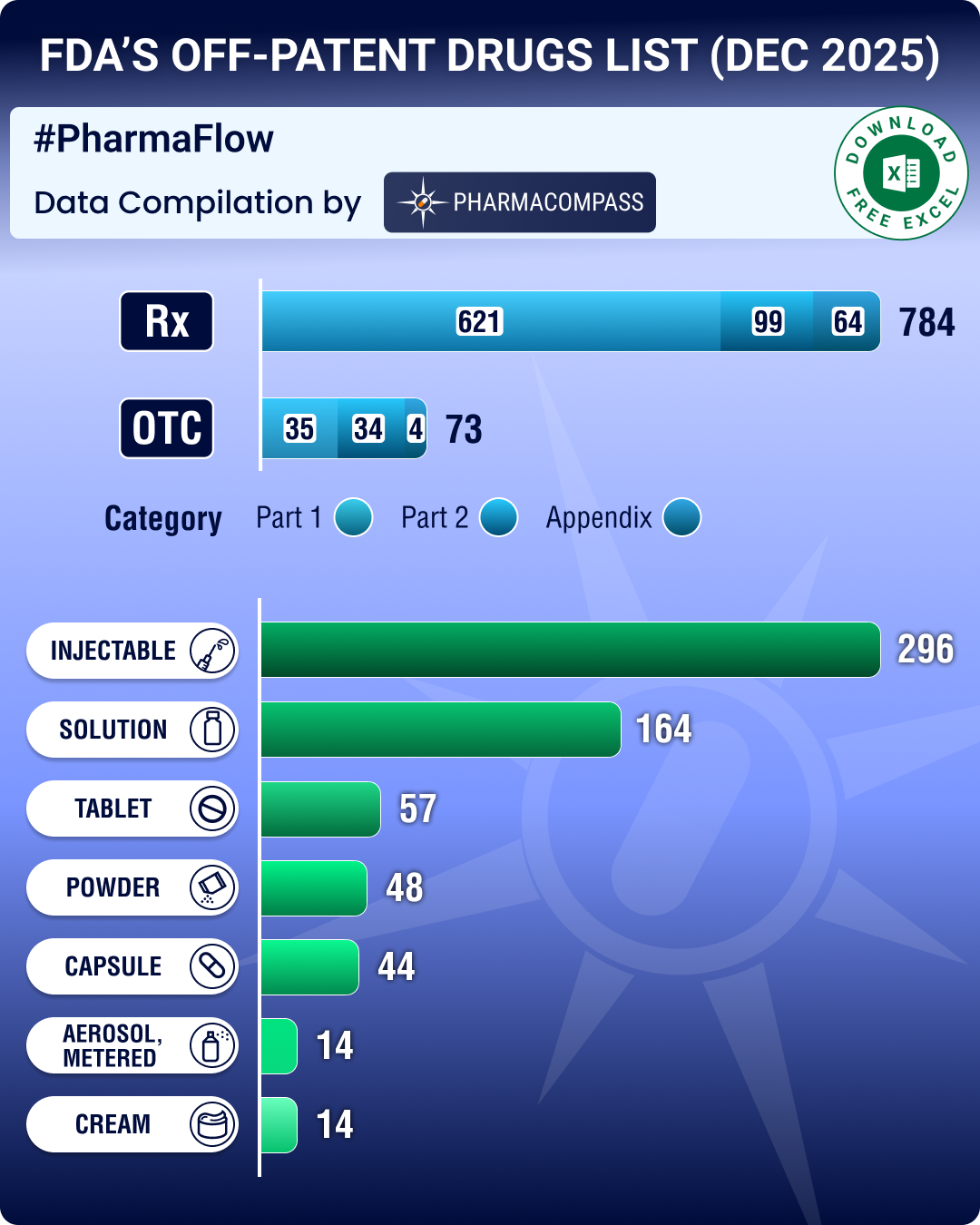
FDA’s December 2025 OPOE list features 784 prescription drugs, 73 OTC drugs
This week, PharmaCompass brings you key highlights of the US Food and Drug Administration’s December 2025 list of Off-Patent, Off-Exclusivity Drugs (OPOE) without an approved generic. The OPOE list gets updated every six months. This list highlights drug products that have lost patent protection and regulatory exclusivity, but remain without approved generic competition in the US market. With this list, the FDA hopes to bolster competitiveness in the generics market, improve transparency and encourage the development and submission of abbreviated new drug applications (ANDAs) in markets with little competition. Since December 2021, FDA has been publishing two versions of the OPOE list — one for prescription (Rx) drug products and the other for over-the-counter (OTC) drug products that are approved and marketed under a new drug approval (NDA).   Access the Interactive Dashboard on FDA's December 2025 List of OPOE Drugs (Free Excel) Injectables continue to dominate FDA’s OPOE Rx list; 73 OTC drugs figure in Dec list  FDA’s December 2025 OPOE Rx list includes 784 drug products that currently have no approved generics. Out of these, 296 are injectables and 126 are oral solid dosage forms (such as tablets, capsules and modified release forms). In June 2025, the OPOE Rx list had 765 drug products without an approved generic, out of which 304 were injectables, while 109 were oral solid drug forms.  The increase in drug products from 765 to 784 from June 2025 to December 2025 was due to the inclusion of additional dosage strengths in the OPOE Rx list. Otherwise, no new drugs were added to the December 2025 OPOE Rx list. The December 2025 OPOE list has 73 OTC drugs, slightly higher than the 69 drugs in the June 2025 list. Among the 73, 21 are oral solid dosage forms. Among the OTC drugs on the December 2025 OPOE list are ibuprofen and ibuprofen sodium (for pain and inflammation), pseudoephedrine hydrochloride and phenylephrine hydrochloride (nasal decongestants), nizatidine and famotidine (for gastroesophageal reflux disease), loratadine, cetirizine hydrochloride and chlorpheniramine maleate (for allergy relief), loperamide hydrochloride (anti-diarrheal), and orlistat (for weight management). FDA fast-tracks initiatives to accelerate market entry of generics, biosimilars FDA has launched several regulatory initiatives designed to accelerate the market entry of generics and biosimilars. In October 2025, the agency announced a new pilot prioritization program for the review of ANDAs that aims to encourage and reward investment in drug manufacturing, research and development and strengthen the pharmaceutical supply chain in the United States. Separately, FDA has also come out with a new draft guidance that seeks to simplify biosimilarity studies and reduce unnecessary clinical testing. Through a separate initiative, the agency also plans to make it easier for biosimilars to be developed as interchangeable with brand-name biologics, thereby helping patients and pharmacists choose lower-cost options. Our view The global generic drugs market was valued at US$ 445.62 billion in 2024 and is projected to reach US$ 728.64 billion by 2034, growing at a compound annual growth rate of 5.04 percent from 2025 to 2034. With several diabetes, immunology, oncology and cardiology drugs slated to face patent expirations this year, and continued pressure on drugmakers to improve affordability, we believe the generic market could grow at an even faster rate in the near term.

Impressions: 3672

https://dev1.pharmacompass.com/radio-compass-blog/fda-s-december-2025-opoe-list-features-784-prescription-drugs-73-otc-drugs

#PharmaFlow by PHARMACOMPASS
22 Jan 2026

MARKET PERFORMANCE RECAP

1read-more
read-more
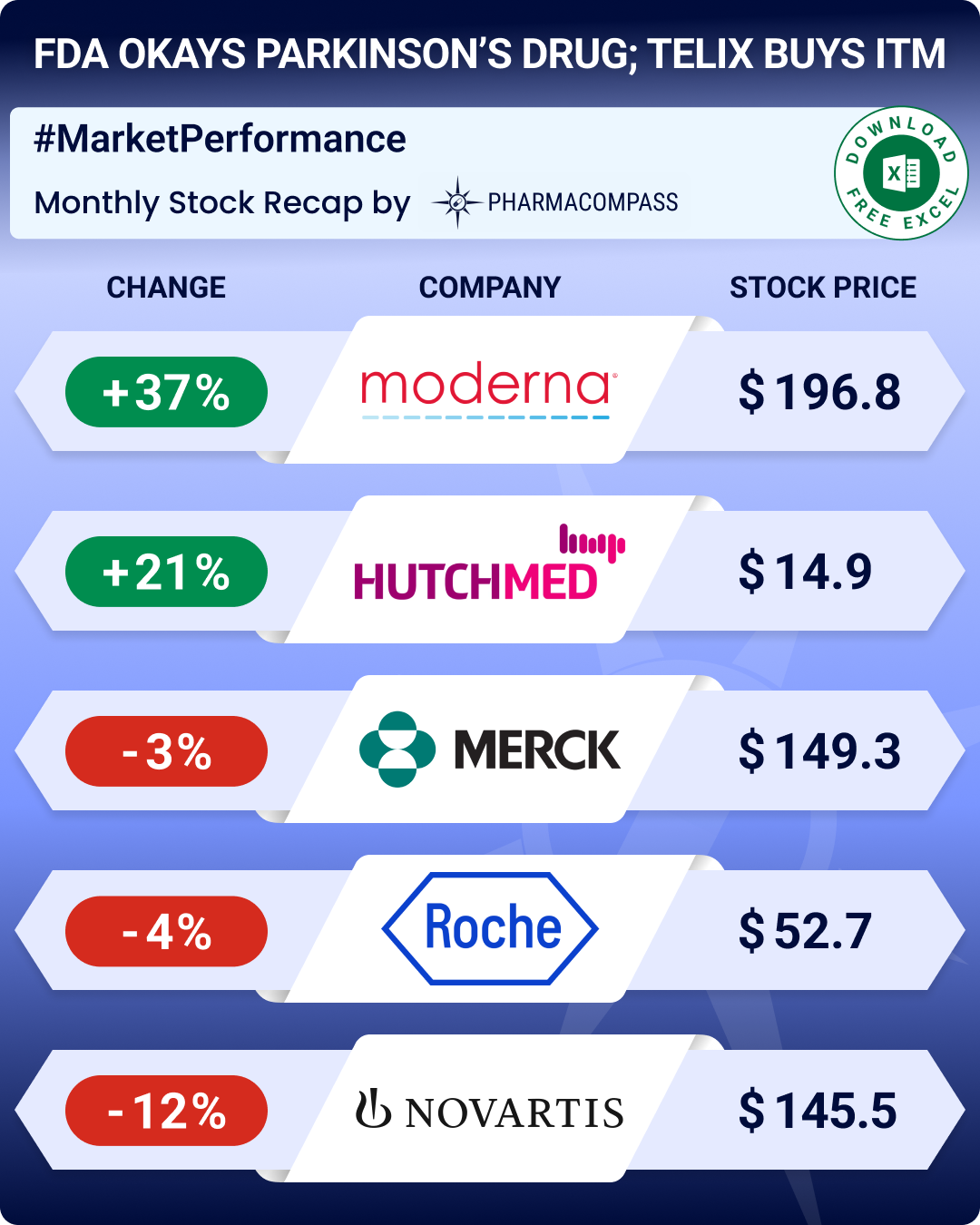
Market Performance Recap September 2026 highlights: FDA okays AbbVie’s Juvmo for Parkinson’s; Telix Pharma to acquire ITM Isotope
September marked the end of 2026’s third quarter (Q3). As Q3 drew to a close, the US Food and Drug Administration (FDA) approved drugs at a brisk pace, including AbbVie’s Juvmo (tavapadon) for treating Parkinson’s disease and Eli Lilly’s Onswik (insulin efsitora alfa-gobe) for type 2 diabetes. In August, pharmaceutical indices rose at an impressive rate of over 10 percent. In comparison, September was a turbulent month, as indices were hit by pressures in the bond market, rising oil prices, a series of missile attacks on Saudi Arabia by Houthis and rising tensions between the United States and Iran. Given these uncertainties, the pharma indices showed resilience. The Nasdaq Biotechnology Index (NBI) declined marginally, by 0.11 percent, from 7,122.63 to 7,114.53. The SPDR S&P Biotech ETF (XBI) declined by 2.52 percent, from 161.75 to 157.68. The S&P Biotechnology Select Industry Index (SPSIBI) declined by 2.98 percent, from 12,725.50 to 12,346.19. Meanwhile, the S&P 500 increased marginally by 0.21 percent — from 7,635.47 to 7,651.54.  Access the Pipeline Prospector Dashboard for September 2026 Newsmakers (Free Excel) FDA approves AbbVie’s Parkinson’s drug, Lilly’s weekly insulin for type 2 diabetes  September saw several key approvals. FDA approved AbbVie’s Juvmo (tavapadon), a once-daily pill for adults with Parkinson’s disease, a brain disorder that causes tremors, stiffness, and slowed movement. The agency also approved Eli Lilly’s Onswik (insulin efsitora alfa-gobe), a once-weekly basal (background) insulin, for use with diet and exercise to control blood sugar in adults with type 2 diabetes. FDA approved Roche unit Genentech’s Gazyva (obinutuzumab) to reduce the risk of relapse in patients aged two and above with idiopathic nephrotic syndrome (INS) that relapses often or depends on steroids, once they are in remission. INS is a kidney disorder of unknown cause that mostly starts in young children. In oncology, FDA approved Elevar Therapeutics’ Lyrfigtu (lirafugratinib) for adults with previously treated, advanced bile duct cancer (cholangiocarcinoma) whose tumors carry an FGFR2 gene fusion or rearrangement, a genetic error that drives tumor growth. FDA also cleared Merck’s Welireg (belzutifan) in combination with Eisai’s Lenvima (lenvatinib) for adults with advanced renal cell carcinoma with a clear cell component (the most common type of kidney cancer) that has progressed after PD-1 or PD-L1 immunotherapy. Telix Pharma to buy ITM Isotope; Novo licenses Hengrui’s GLP-1/GIP drug September didn’t see many significant mergers and acquisitions, barring one in radiopharmaceuticals. Australia’s Telix Pharmaceuticals agreed to acquire ITM Isotope Technologies Munich for US$ 1.65 billion upfront on a cash-free, debt-free basis, with up to US$ 700 million more tied to regulatory approvals and sales milestones for ITM’s lead drug. ITM is a major supplier of lutetium-177, a radioactive isotope used in targeted cancer radiotherapy. The month witnessed several licensing deals. Novartis signed an option and license agreement with South Korea’s Alteogen worth up to US$ 3.2 billion for rights to ALT-B4, an enzyme that allows biologics usually given by intravenous infusion to be delivered as faster, more convenient subcutaneous injections. Novo entered into a multi-target discovery and license agreement with Orbis Medicines to develop oral macrocycle drugs for cardiometabolic diseases. Novo also signed a license and collaboration deal worth up to € 1.165 billion (about US$ 1.33 billion) with Sweden’s Nanexa. Novo will apply Nanexa’s PharmaShell delivery technology to its drugs for treating obesity and type 2 diabetes. Big pharma signed deals with several Chinese drugmakers. Novo signed a deal with China’s Hengrui Pharma for exclusive rights to HRS-1596, an experimental obesity and diabetes drug that activates two gut-hormone receptors — GLP-1 and GIP. Eli Lilly signed a research collaboration and license agreement with China’s InnoCare Pharma to discover drugs against up to five targets. Merck licensed exclusive global rights to SPR2015, an investigational, preclinical drug, from Shanghai-based SciBrunch Therapeutics in a deal worth up to US$ 2.13 billion. Roche entered into a license agreement with China’s Simcere Zaiming for exclusive global rights to SIM0660, the latter’s experimental blood cancer drug. Several rare diseases get first treatments; Scholar Rock’s Isembyld okayed for SMA September saw several rare diseases get first treatments. For instance, FDA granted full approval to Ultragenyx’s Fayuvi (rebisufligene etisparvovec-hopf) — the first treatment for children with Sanfilippo syndrome type A, a rare, progressive and fatal neurodegenerative disease. FDA also approved Scholar Rock’s Isembyld (apitegromab-mstn) for spinal muscular atrophy (SMA) in adults and children aged two and above who are already receiving a survival motor neuron 2-targeted treatment. It is the first therapy for SMA that directly goes after muscle loss. FDA cleared Ionis Pharmaceuticals’ Zanvastro (zilganersen) for Alexander disease in children and adults. This is the first and only disease-modifying treatment for this ultra-rare disorder that mostly starts in childhood and damages brain cells. Fibrodysplasia ossificans progressiva (FOP), a rare genetic condition in which muscle, tendon, and ligament tissue gradually turns into bone, got its third treatment as FDA approved Mirum Pharmaceuticals’ Atebrioz (zilurgisertib) for patients aged 12 and above. Novo’s CagriSema beats Lilly’s Mounjaro in diabetes trial; Otsuka, Ionis’ ALS drug meets goal Novo made considerable news in clinical trials. The company said CagriSema, a combination of cagrilintide and semaglutide, produced greater weight loss than Eli Lilly’s Mounjaro (tirzepatide) in a phase 3 trial in adults with type 2 diabetes not adequately controlled on metformin, an SGLT2 inhibitor or both. In a separate phase 3 trial, Novo’s semaglutide helped 40.4 percent of children aged six to under 12 with obesity fall below the obesity BMI threshold after 68 weeks. Johnson & Johnson’s Caplyta (lumateperone) met the primary endpoint of a phase 3 trial in adults with manic episodes associated with bipolar I disorder. This is the first of two pivotal trials in mania. Otsuka and Ionis Pharmaceuticals said ulefnersen met the primary endpoint of a phase 3 trial in amyotrophic lateral sclerosis (ALS) caused by mutations in the FUS gene, a rare form commonly known as FUS-ALS. This is the first placebo-controlled trial to succeed against the underlying genetic cause of FUS-ALS. Additionally, AbbVie's migraine treatment Qulipta (atogepant) reduced migraine days associated with the menstrual period in a late-stage trial. Our view Geopolitical tensions, rising oil prices and bond yields weighed on pharma stocks in September. Yet FDA kept approvals flowing, especially in rare diseases, and big pharma kept licensing early-stage assets, increasingly from China. As we step into the last quarter of 2026, the industry's pipeline looks sturdier than its share prices.   

Impressions: 1249

https://dev1.pharmacompass.com/pipeline-prospector-blog/pipeline-prospector-september-2026-highlights-fda-okays-abbvie-s-juvmo-for-parkinson-s-telix-pharma-to-acquire-itm-isotope

#PharmaFlow by PHARMACOMPASS
01 Oct 2026

WEEKLY INDUSTRY NEWS

17read-more
read-more
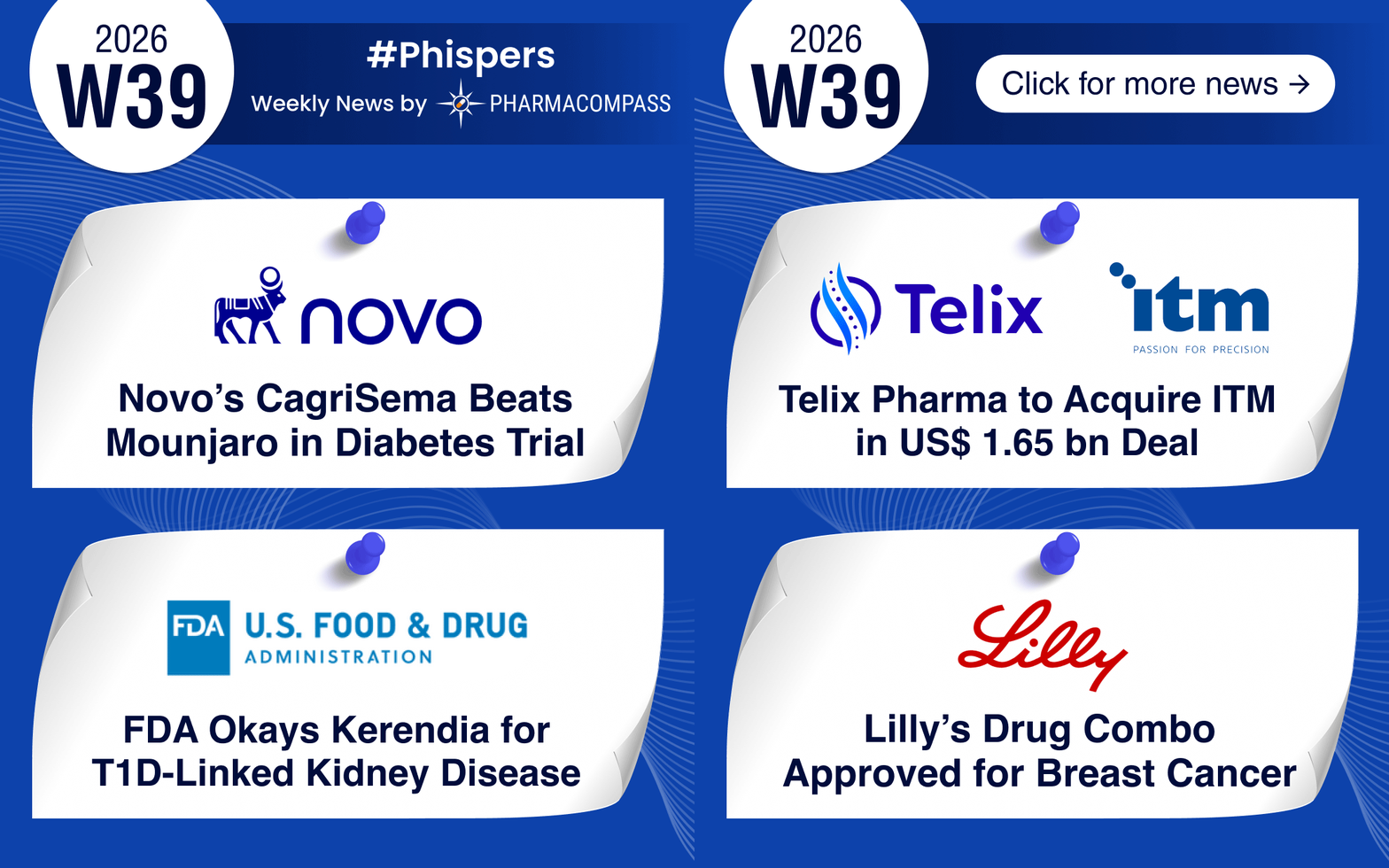
 FDA clears Bayer’s Kerendia for kidney disease in type 1 diabetes; Novo’s CagriSema beats Lilly’s Mounjaro
In Phispers this week, Novo’s CagriSema produced greater weight loss than Eli Lilly’s Mounjaro (tirzepatide) in a phase 3 trial in adults with type 2 diabetes. Novo, which dropped Nordisk from its everyday name last week, also signed a deal with Orbis Medicines.Artificial intelligence deals made headlines this week — Novo partnered Anthropic to use Claude models for drug discovery; AbbVie inked a deal with Iambic; and Boehringer Ingelheim signed a pact with Envisagenics.The US Food and Drug Administration (FDA) approved Bayer’s Kerendia (finerenone) for kidney disease associated with type 1 diabetes. The agency approved Eli Lilly’s Inluriyo (imlunestrant) in combination with Verzenio (abemaciclib) for treating a type of breast cancer. FDA also approved Ultragenyx’s Fayuvi (rebisufligene etisparvovec-hopf) as the first treatment for children with a rare disorder known as Sanfilippo syndrome type A.In news from clinical trials, Genentech’s Lunsumio (mosunetuzumab) showed benefit in relapsed or refractory follicular lymphoma; Johnson & Johnson’s Caplyta (lumateperone) reduced manic episodes associated with bipolar I disorder; and Otsuka and Ionis Pharmaceuticals’ ulefnersen showed benefit in amyotrophic lateral sclerosis (ALS) caused by mutations in the FUS gene.In deals, Australia’s Telix Pharmaceuticals agreed to acquire ITM Isotope Technologies Munich for US$ 1.65 billion upfront and Roche entered into a potential US$ 1 billion deal with Dualitas Therapeutics.Novo’s CagriSema beats Lilly’s Mounjaro in late-stage type 2 diabetes trial Novo has said CagriSema, a combination of cagrilintide and semaglutide, produced greater weight loss than Eli Lilly’s Mounjaro (tirzepatide) in a phase 3 trial in adults with type 2 diabetes not adequately controlled on metformin, an SGLT2 inhibitor or both. Novo’s CagriSema is being seen as a successor to the blockbuster weight loss drug Wegovy (semaglutide).Partners Anthropic for drug discovery: Novo has entered into a collaboration with American AI company Anthropic to apply its Claude models to drug discovery and software development. The two will work on drug discovery problems identified by Novo’s scientists and computational teams, and build tools for specific research workflows. In August, Novo had entered into an AI drug discovery pact with Amazon Web Services.Signs macrocycle pact with Orbis: Novo has entered into a multi-target discovery and license agreement with fellow Copenhagen company Orbis Medicines to develop oral macrocycle drugs for cardiometabolic disease. Orbis is eligible for up to US$ 1.4 billion in upfront and milestone payments plus tiered royalties.FDA approves Bayer’s Kerendia for kidney disease in type 1 diabetesFDA has approved Bayer’s Kerendia (finerenone) to reduce urinary albumin-to-creatinine ratio (UACR), a measure of protein leaking into the urine, in adults with chronic kidney disease (CKD) associated with type 1 diabetes. This is the first new treatment for the condition in over 30 years.Lilly’s drug combo approved for breast cancer: FDA has approved Eli Lilly’s Inluriyo (imlunestrant) in combination with its other drug Verzenio (abemaciclib) for adults with estrogen receptor-positive, HER2-negative, ESR1-mutated advanced or metastatic breast cancer whose disease has progressed after at least one line of endocrine therapy. FDA also approved the Guardant360 CDx blood test as a companion diagnostic device.Ultragenyx’s Fayuvi becomes first approved drug for Sanfilippo syndrome type AFDA has granted full approval to Ultragenyx’s Fayuvi (rebisufligene etisparvovec-hopf), the first treatment for children with Sanfilippo syndrome type A, a rare, progressive and fatal neurodegenerative disease. Ultragenyx has set a US list price of US$ 3.95 million for this gene therapy, making it one of the world’s most expensive drugs. Children with this disease are unable to make enough sulfamidase, an enzyme needed to break down a complex sugar. The sugar builds up in cells, progressively damaging the brain and nervous system.Approves IntraBio’s Aqneursa: FDA has approved IntraBio’s Aqneursa (levacetylleucine) to treat ataxia (loss of control of body movements) in adults and children weighing at least 15 kg with ataxia-telangiectasia, an inherited neurodegenerative disorder. This is the first treatment approved for ataxia in these patients.Genentech’s Lunsumio clears confirmatory phase 3 trial in follicular lymphomaRoche has said Genentech’s Lunsumio (mosunetuzumab) combined with lenalidomide significantly improved progression-free survival against Genentech-Biogen’s Rituxan (rituximab) plus lenalidomide in patients with relapsed or refractory follicular lymphoma who had received at least one prior line of treatment.Roche ties up with Dualitas: Roche has entered into a research collaboration and license agreement with South San Francisco-based Dualitas Therapeutics to screen over 300,000 novel bispecific combinations in search of new treatments for immunology and inflammation diseases. Dualitas receives US$ 36.5 million upfront and is eligible for research, development and commercial milestones plus tiered royalties, taking the potential total to US$ 1 billion.Telix Pharma to acquire ITM Isotope in US$ 1.65 bn radiopharma dealAustralia’s Telix Pharmaceuticals has agreed to acquire ITM Isotope Technologies Munich for US$ 1.65 billion upfront on a cash-free, debt-free basis, with up to US$ 700 million more tied to regulatory approvals and sales milestones for ITM’s lead drug. ITM is a major supplier of lutetium-177, a radioactive isotope used in targeted cancer radiotherapy. Its lead candidate, ITM-11 (lutetium Lu 177 edotreotide), targets gastroenteropancreatic neuroendocrine tumors and would compete with Novartis’ Lutathera (lutetium Lu 177 dotatate).AbbVie, Iambic ink AI deal: AbbVie has entered a multi-year collaboration with San Diego-based Iambic to use artificial intelligence to discover small molecule drugs in immunology, neuroscience and oncology.Boehringer, Envisagenics sign oncology pact: Boehringer Ingelheim has entered into a multi-year research collaboration and option agreement with New York-based Envisagenics to find and validate tumor-specific drug targets in hard-to-treat solid tumors. Envisagenics is eligible to receive more than US$ 1 billion in potential payments, plus royalties.J&J’s Caplyta cuts manic symptoms associated with bipolar disorder in phase 3 trial Johnson & Johnson has said Caplyta (lumateperone) met the primary endpoint of a phase 3 trial in adults with manic episodes associated with bipolar I disorder. This is the first of two pivotal trials in mania. Caplyta, an oral antipsychotic, is already approved in the US for schizophrenia, bipolar depression, and as an add-on treatment for major depressive disorder.Otsuka, Ionis’ ALS drug meets goal: Otsuka and Ionis Pharmaceuticals have said ulefnersen met the primary endpoint of a phase 3 trial in amyotrophic lateral sclerosis (ALS) caused by mutations in the FUS gene, a rare form commonly known as FUS-ALS. This is the first placebo-controlled trial to succeed against the underlying genetic cause of FUS-ALS.

Impressions: 1717

https://dev1.pharmacompass.com/radio-compass-phisper/fda-clears-bayer-s-kerendia-for-kidney-disease-in-type-1-diabetes-novo-s-cagrisema-beats-lilly-s-mounjaro

#Phispers by PHARMACOMPASS
24 Sep 2026

NEWS LIBRARY

432read-more
read-more

https://www.pharmabiz.com/NewsDetails.aspx?aid=188262&sid=1

PHARMABIZ
31 Aug 2026

https://www.escardio.org/news/press/press-releases/no-significant-evidence-for-protection-against-cardiovascular-outcomes-with-metformin-in-heart-failure/

ESC
30 Aug 2026

https://www.prnewswire.com/news-releases/par-health-launches-first-and-only-generic-version-of-janumet-xr-sitagliptin-and-metformin-hcl-extended-release-tablets-in-the-united-states-302833758.html

PR NEWSWIRE
24 Jul 2026

https://www.accessdata.fda.gov/scripts/cder/daf/index.cfm?event=overview.process&ApplNo=215220

FDA
16 Jul 2026

https://www.accessdata.fda.gov/scripts/cder/daf/index.cfm?event=overview.process&ApplNo=216516

FDA
09 Jul 2026

https://www.pharmacompass.com/pdf/news/enforcement-report-week-of-july-8-2026-94770.pdf

FDA
08 Jul 2026
digital-content4091##p