Please Wait
Applying Filters...
Menu

Digital Content read-more

Create Content with PharmaCompass, ask us

PHARMA & BIOTECH INSIGHTS

2read-more
read-more
CEP Q1 2026 Update: CEP 2.0, EDQM’s new guidelines strengthen ecosystem; Indian firms top list of CEPs issued
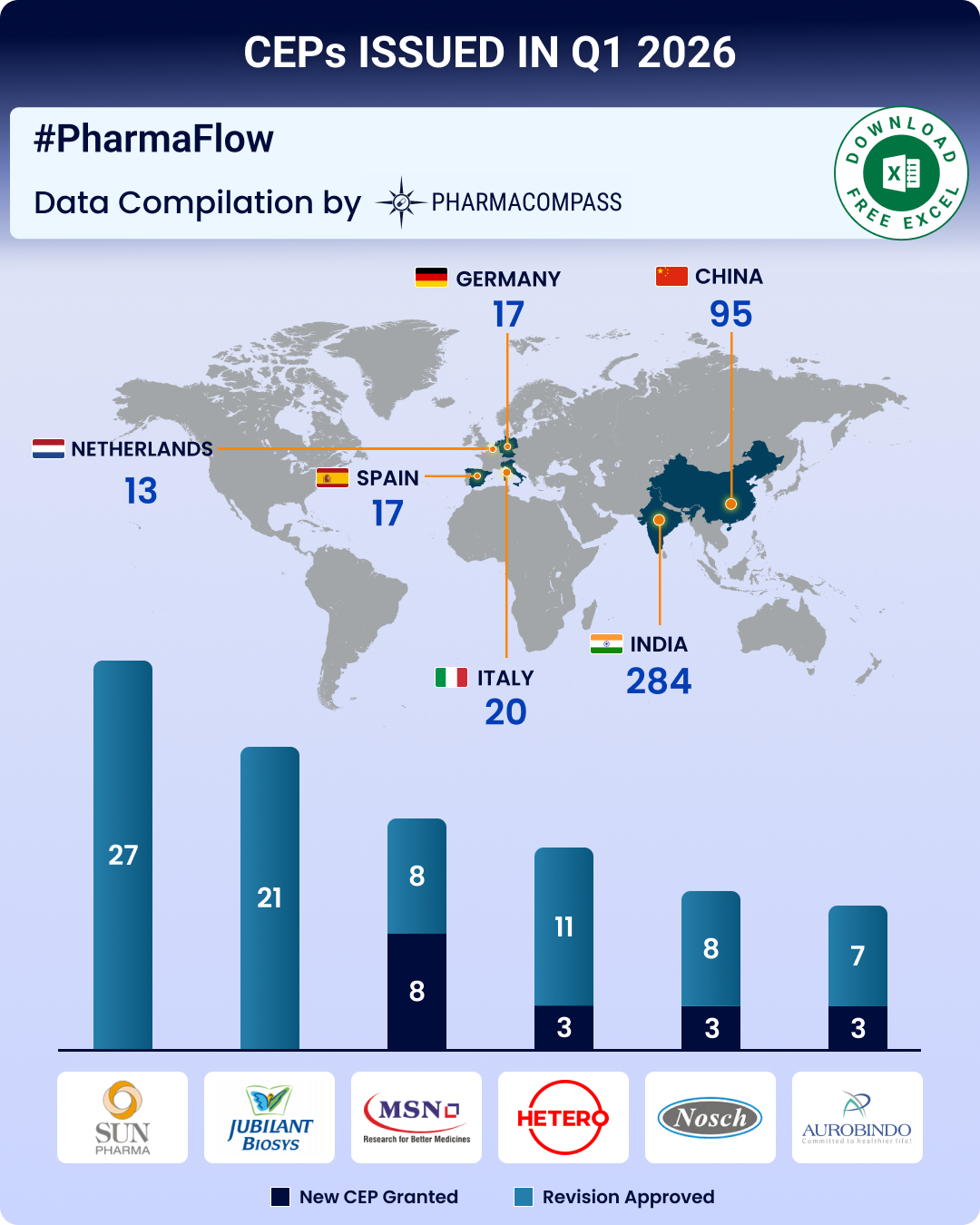
PharmaCompass is introducing a new regulatory update that tracks developments in Certificates of Suitability to the Monographs of the European Pharmacopoeia, referred to as CEPs. These certificates are a critical regulatory instrument in the global pharmaceutical supply chain. Also known as a Certification of Suitability (COS), CEPs are issued by the European Directorate for the Quality of Medicines and HealthCare (EDQM), with or without inspection of the manufacturing site. A CEP must be renewed every five years from its original issue date to remain valid, regardless of any revisions made during the interim period. However, a CEP does not replace Good Manufacturing Practice certification. CEPs are recognized as a trusted reference for API quality, thereby simplifying global registration strategies. Apart from Europe, the CEP system is widely used by many regulatory authorities, including those in Canada, Australia, Brazil, Singapore and South Africa.  View CEPs Issued in Q1 2026 (Power BI Dashboard, Free Excel Available) CEP 2.0 enhances regulatory clarity, brings efficiency, global interoperability  There are several types of CEPs, depending on the nature of the substance and evaluation. The most common type is the Chemical CEP, which confirms that a chemically synthesized API meets standards for purity and impurity control. Then there are Herbal CEPs for herbal substances and preparations. Another key category is the TSE CEP, which addresses risks associated with transmissible spongiform encephalopathies in animal-derived materials. In addition, there are Combined CEPs that may cover multiple aspects, such as chemical quality, TSE risk, and sterility. However, biological products such as vaccines and blood products fall outside the scope of the CEP framework. In 2023, the CEP system underwent a major transformation with the introduction of CEP 2.0, which marks a shift from a largely document-based system to a more structured, transparent, and digitally aligned model. This makes it easier for companies to manage compliance while improving trust among global regulators. While increasing data and compliance requirements for API manufacturers, CEP 2.0 enables better regulatory clarity, streamlined dossier integration, and stronger global acceptance. Overall, CEP 2.0 is designed to enhance regulatory clarity while making the system more efficient and globally interoperable. Indian firms issued maximum CEPs; Sun Pharma and its subsidiaries, Jubilant Biosys top list India topped the charts for CEPs issued, both in terms of new CEPs and revisions in the first quarter (Q1) of 2026. Indian companies were issued 81 new CEPs in Q1 2026 (as against 40 in Q1 2025) and 203 revisions (as against 129 in Q1 2025). In comparison, Chinese companies were issued 42 new CEPs in Q1 2026 (against 25 in Q1 2025) and 53 revisions (against 67 in Q1 2025). Italy came a distant third, followed by Germany and Spain. India’s Sun Pharmaceuticals and its subsidiaries topped the list of companies with the maximum number of CEPs issued— while no new CEP was issued, 27 CEPs were revised in Q1 2026. At second place was Jubilant Biosys — 21 CEPs were revised in Q1 2026. In terms of products, the maximum CEPs were issued for amlodipine besylate (a calcium channel blocker used for treating hypertension), followed by sitagliptin phosphate (a type 2 diabetes medicine) and pregabalin (a drug used to treat neuropathic pain, fibromyalgia, seizures, and generalized anxiety disorder). Both amlodipine besylate and sitagliptin phosphate had not been issued new CEPs or revisions in Q1 2025. EDQM introduces new guidelines to accelerate CEP assessments The EDQM charges fees for various services related to CEPs that depend on the type of request or regulatory activity involved. In general, fees apply to handling CEP applications, revisions or renewals and for offering technical advice (where applicants seek scientific or regulatory guidance). In March 2026, the EDQM introduced two new guidelines aimed at accelerating CEP assessments. The first is a reliance-based assessment pathway, which allows regulators to leverage prior approvals from trusted authorities, such as those in the EU, UK, Australia, Canada, and the WHO pre-qualification program. The second is a fast-track assessment route designed to expedite reviews in situations such as medicine shortages and to support initiatives like the EU Critical Medicines Act. Timelines have been significantly compressed under these new pathways. Initial evaluations are completed within 46 working days, compared to up to 115 days under the standard procedure. Applicants are given 30 calendar days to respond to queries, after which regulators complete the final assessment within 23 working days. Another important regulatory update relates to electronic submissions. From April 1, 2026, the EDQM will reject non-compliant CEP applications at the point of submission. All applications must include a validated electronic Common Technical Document (eCTD) dossier along with a proper validation report, submitted in line with the updated Common European Submission Portal (CESP) guidelines. Taken together, these developments signal a more rigorous yet efficient CEP ecosystem. Our view The shift to CEP 2.0 signals a move toward greater transparency, digitalization, and global regulatory alignment. Though enhanced disclosure and stricter e-submission requirements may increase the compliance burden, especially for smaller manufacturers, the long-term gains are expected to be significant. Going forward, companies that invest in data quality and regulatory readiness stand to gain from these changes.

Impressions: 3970

https://dev1.pharmacompass.com/radio-compass-blog/cep-q1-2026-update-cep-2-0-edqm-s-new-guidelines-strengthen-ecosystem-indian-firms-top-list-of-ceps-issued

#PharmaFlow by PHARMACOMPASS
09 Apr 2026

WEEKLY INDUSTRY NEWS

1read-more
read-more
GSK, Google form first bioelectronics firm; 11 generic companies benefit from the Teva Allergan deal
This week, Phispers brings to you the details of the bioelectronics firm formed by GSK and Google. There is also news on companies like Teva, Takeda, Jinan Jinda and Eli Lilly, besides two other news snippets pertaining to the FDA -- while the first one pertains to generic approvals, the other one relates to an additional black box warning on a few antibiotics.   GSK and Google join hands to form first bioelectronics startupGlaxoSmithKline and Google’s parent company – Alphabet – have joined hands to create a new company that is focused on fighting diseases by targeting electrical signals in the human body. This way, GSK and Alphabet’s life sciences unit – known as Verily Life Sciences – will be jump-starting a new field of medicine known as bioelectronics.Verily Life Sciences and GSK will together contribute US $ 715.12 million over seven years to the startup Galvani Bioelectronics. The startup will develop miniature electronic implants for the treatment of asthma, diabetes and other chronic conditions. The implantable devices developed by Galvani, which is owned 55 percent by GSK and 45 percent by Verily, can modify electrical nerve signals. The aim is to modulate irregular or altered impulses that occur in many illnesses.The new company will be based at GSK’s Stevenage research center north of London, with a second research hub in South San Francisco.The announcement comes just weeks after GSK had said it was going to use Apple’s HealthKit to conduct clinical trials.Three years ago, GSK had first unveiled its ambitions in bioelectronics in the journal – Nature. Bioelectronic remedies attach battery-powered implants the size of a grain of rice (or even smaller) to individual nerves to correct faulty electrical signals between the nervous system and the body’s organs.GSK believes altering these nerve signals could open up the airways of asthma patients, reduce inflammation in the gut from Crohn’s disease and treat patients with a range of other chronic ailments such as arthritis. So far, the implants have only been tested on animals but the aim is to produce treatments that will supplement or replace drugs that often come with side-effects.GSK has been working on bioelectronic medicines since 2012 in a push to develop new patentable treatments, since its Advair respiratory treatment faces competition from generic versions. It has invested US $50 million in a venture capital fund for bioelectronics and provided funding to scientists working in the field.  Teva divests 79 products to 11 generic players to close Allergan dealTeva Pharmaceutical Industries – the world’s largest generics drug company – won a US anti-trust approval to purchase Allergan's generics business, after agreeing to divest 79 generic drugs to rival firms. This was arrived at to settle Federal Trade Commission (FTC) charges that its proposed US $ 40.5 billion acquisition of Allergan’s generic pharmaceutical business would be anti-competitive. The remedy requires Teva to divest the drug portfolio to 11 firms, and marks the largest drug divestiture order in a FTC pharmaceutical merger case.The Teva-Allergan deal, which was announced in July 2015, solidifies Teva’s position as the world's largest maker of generics while freeing Allergan to focus on branded drugs.The companies that have acquired the divested products are Mayne Pharma Group, Impax Laboratories, Dr Reddy’s Laboratories, Sagent Pharmaceuticals, Cipla Limited, Zydus Worldwide DMCC, Mikah Pharma, Perrigo Pharma International, Aurobindo Pharma USA, Prasco and 3M Company. Eli Lilly CEO steps down; company under probe by US Justice Department Eli Lilly CEO John Lechleiter has stepped down after steering the pharma company through long R&D droughts. The company’s president David Ricks will move up to the top spot. And after a brief spell as executive chairman, Lechleiter will leave the company next spring.Lechleiter has been the company's CEO since April 1, 2008, and the chairman of its board of directors since January 1, 2009.The announcement has come at a time when Eli Lilly has been asked by the Justice Department to disclose information on relationships with pharmacy benefits managers (PBMs), the companies that negotiate prices and set reimbursement conditions.It has not been clear what exactly the department of justice is looking for. In the past, drug makers such as Novartis and AstraZeneca have agreed to pay fines and penalties to settle allegations pertaining to PBMs.  FDA continues to race ahead with generic approvals  The American regulator has reduced its pile of ANDA (abbreviated new drug applications) by about 500 applications in the first six months of 2016. The FDA has also approved 315 more ANDAs over the same time period and has sent 66 more complete response letters — or rejections — to drug makers.This news comes after Bloomberg reported last month that the FDA has become ‘something of a bogeyman’ for India’s stock markets by approving generic drug applications from India at a record place. Similarly, PharmaCompass had reported last week that Indian companies have been fixing compliance issues. China’s Jinan Jinda fails another EDQM inspection; compliance troubles in Denmark  In regulatory news from across the world, Jinan Jinda, a Chinese API manufacturer that had failed an inspection by Italian regulators in June 2015, had more bad news awaiting it a year on. In a June 2016 re-inspection, this time by the Spanish Health Authority, the regulator maintained the ‘facilities non-compliance standing’ since two critical observations were made and the corrections from the previous inspection “were found as not having been implemented in a satisfactory way”. And critical deficiencies were found on raw data.In the June 2015 inspection, the critical observation was related to an unofficial and non-controlled storage area containing mainly raw materials and finished products which had been made inaccessible to inspectors as the door had been removed and replaced with a panel fixed with screws to the wall.Meanwhile, the FDA issued an untitled letter (dated July 15, 2016) to Danish allergy immunotherapy company ALK-Abelló (ALK) over manufacturing and quality control issues at its Horsholm, Denmark facility. The letter comes after a 12-day inspection of the facility in March 2016. During the inspection, the FDA had cited ALK for four “significant deviations” from cGMP requirements.  Another black box warning added to antibiotics like Cipro and LevaquinThe FDA has upgraded warnings on certain antibiotics, such as Johnson & Johnson’s Levaquin, Bayer’s Cipro extended-release tablets and Merck’s Avelox. The FDA had added a black box warning in 2008 about the increased risk of tendinitis in which the tissue connecting muscle to bone becomes inflamed. In May this year, the FDA had advised restricting the use of fluoroquinolone antibiotic for certain uncomplicated infections and had warned about the disabling side-effects of the drug.The new warning talks about long-term risks to the drugs’ current black box warning. The agency also advised using the drugs only for serious infections. Manufacturers of fluoroquinolone have faced thousands of lawsuits from patients who claim that their injuries were caused by the drugs. J&J alone faced 3,400 lawsuits over Levaquin’s links to tendon problems and has also settled many of those cases. Takeda to overhaul R&D, downsize operations in the UKTakeda Pharmaceutical of Japan has said it plans to build a new pipeline of drugs. It plans to revamp its research operations at the cost of around US $ 727 million..  The company also plans to close some of its R&D operations in the UK. Takeda is beginning the first ‘consultation stage’ of the layoff process in the UK, which hosts a pre-clinical R&D operation in Cambridge as well as a development center headquarter with facilities in the UK, Switzerland and Denmark.Under the revamp, Takeda’s R&D activities will be concentrated in Japan and the US, the 235-year old drug company said in a statement. Takeda plans to now focus on the three therapeutic areas of oncology, gastroenterology and the central nervous system.“We need to first build new capabilities and embrace new ways of working,” Andy Plump, Takeda’s chief medical and scientific officer, said in the statement. 

Impressions: 3183

https://dev1.pharmacompass.com/radio-compass-phisper/gsk-google-form-first-bioelectronics-firm-11-generic-companies-benefit-from-the-teva-allergan-deal

#Phispers by PHARMACOMPASS
04 Aug 2016

NEWS LIBRARY

141read-more
read-more

https://pubs.acs.org/ancac3/article/20/37/25798/5419643/Multifunctional-Methotrexate-Laden-Nanotherapy

PUBS ACS ORG
26 Oct 2026

https://www.indianpharmapost.com/news/venus-remedies-receives-five-marketing-approvals-in-kazakhstan-peru-kuwait-argentina-22181

INDPHARMAPOST
18 Oct 2026

https://www.pharmacompass.com/pdf/news/fda-confirms-para-iv-patent-litigation-for-rasuvo-17387.pdf

FDA
02 Jul 2026

https://www.globenewswire.com/news-release/2026/06/04/3306659/0/en/onco360-has-been-selected-as-a-national-specialty-pharmacy-provider-for-jylamvo-methotrexate-oral-solution.html

GLOBENEWSWIRE
04 Jun 2026

https://www.prnewswire.com/news-releases/bio-thera-solutions-golimumab-biosimilars-receive-fda-approval-as-first-biosimilars-to-simponi-and-simponi-aria-accord-biopharma-to-commercialize-immgolis-golimumab-sldi-and-immgolis-intri-golimumab-sldi-in-the-united-st-302774570.html

PR NEWSWIRE
18 May 2026

https://www.pharmiweb.com/press-release/2026-05-08/bristol-myers-squibb-receives-european-commission-approval-of-sotyktu-deucravacitinib-for-the-trea

PHARMIWEB
09 May 2026
digital-content126941##p