Please Wait
Applying Filters...
Menu

Digital Content read-more

Create Content with PharmaCompass, ask us

PHARMA & BIOTECH INSIGHTS

1read-more
read-more

A PHP Error was encountered

Severity: 8192

Message: mb_convert_encoding(): Handling HTML entities via mbstring is deprecated; use htmlspecialchars, htmlentities, or mb_encode_numericentity/mb_decode_numericentity instead

Filename: blog/grid.php

Line Number: 52

Backtrace:

File: /var/www/html/application/views/include/media/blog/grid.php
Line: 52
Function: mb_convert_encoding

File: /var/www/html/application/models/Cmn.php
Line: 3595
Function: view

File: /var/www/html/application/views/include/product/digitalContent/grid.php
Line: 17
Function: common

File: /var/www/html/application/views/include/desc/inner.php
Line: 13
Function: view

File: /var/www/html/application/views/include/desc/indexNew.php
Line: 2433
Function: include

File: /var/www/html/application/controllers/Common.php
Line: 11303
Function: view

File: /var/www/html/index.php
Line: 231
Function: require_once

DMF filings rise 4.5% in Q3 2025; China holds lead, India records 20% growth in submissions
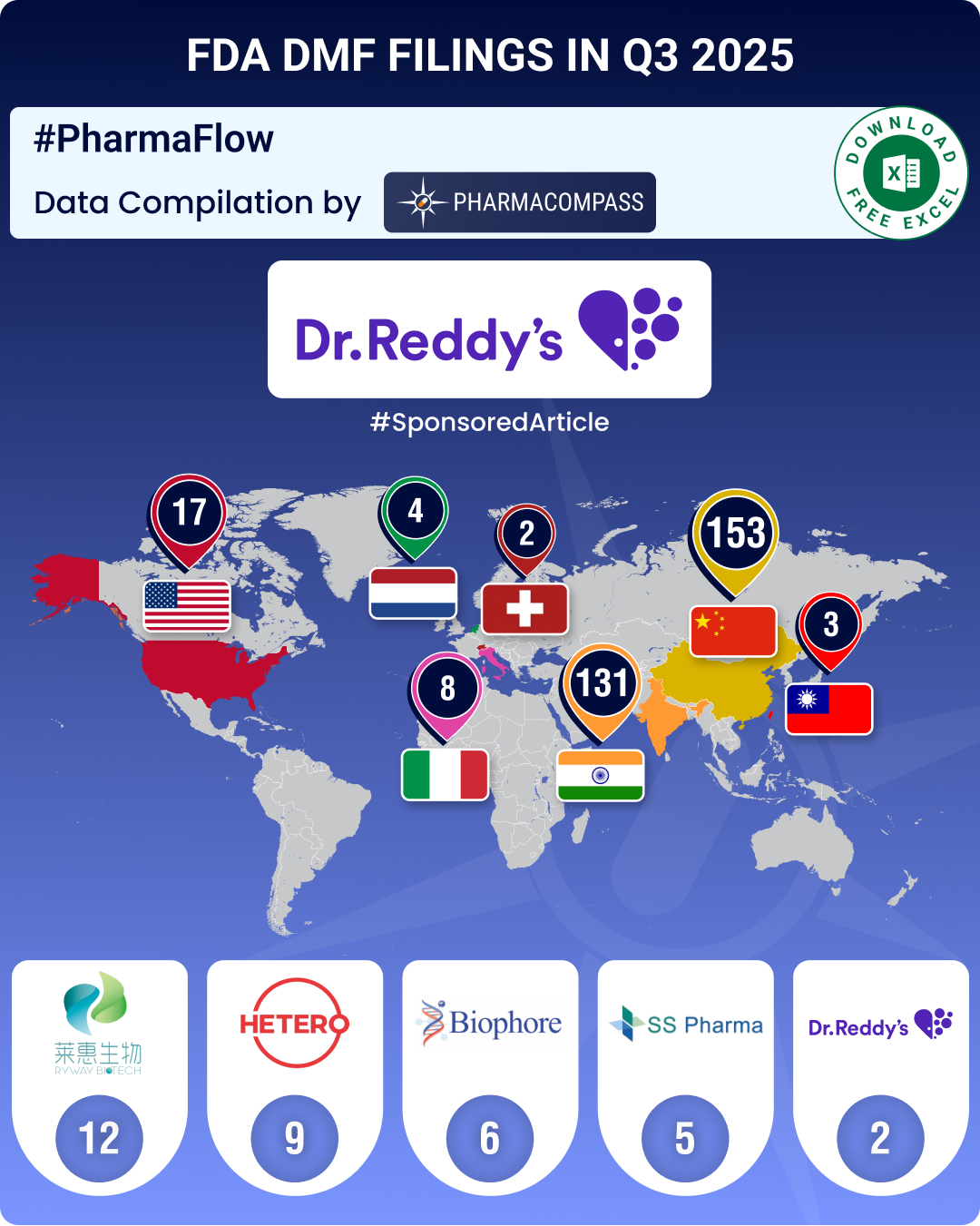
The third quarter (Q3) of 2025 witnessed a steady rise in Drug Master File (DMF) submissions to the US Food and Drug Administration (FDA). DMFs are used to provide confidential, detailed information about facilities, processes, or articles used in the manufacturing, processing, packaging, and storing of human drug products A total of 323 Type II DMFs were submitted during this period, as opposed to 309 submissions in Q3 2024, marking an increase of 4.53 percent. This is the second highest number since 2018. In Q1 2025, 339 Type II filings were recorded. Across all DMF types (II, III, IV, and V), 479 DMFs were filed in Q3 2025, compared to 394 in Q3 2024, representing a 21.57 percent increase. Out of the 323 Type II DMFs submitted in Q3 2025, 40 had completed their review by the end of Q3, reflecting a processing lag between submission and review completion.  View FDA DMF Filings in Q3 2025 (Power BI Dashboard, Free Excel Available) China maintains its lead while India posts double-digit growth in DMF submissions  China and India continued to dominate DMF submissions in Q3 2025. China retained the top spot with 153 Type II DMFs, matching its submission count from Q3 2024. India recorded 131 DMFs, marking a 20.18 percent increase over 109 filings during the corresponding period last year. The United States stood a distant third with 17 filings, compared to 13 in Q3 2024. Among European nations, Italy recorded eight DMFs, doubling its 2024 tally. The Netherlands filed four, up from three. Spain submitted only one DMF, as against seven submitted in Q3 2024. Taiwan made three filings, up from one submitted in Q3 2024. Together, India, China and Taiwan accounted for about 88.9 percent of all Type II DMFs filed during the quarter. China’s Suzhou Ryway Biotech tops corporate tally; India’s Hetero, Biophore follow China’s Suzhou Ryway Biotech led the company-wise tally with 12 DMF submissions in Q3 2025. The company had not filed any DMFs in Q3 2024. India’s Hetero Group followed with nine DMFs, maintaining the same number of filings as Q3 2024. Biophore India Pharmaceuticals ranked third with six DMFs, doubling its count from three last year. Other notable contributors include Sai Sreyas Pharmaceuticals (India) and Shanghai Haoyuan Chemexpress (China), with five DMFs each. Companies such as SNJ Group, Lunan Pharmaceutical, Allsino Pharmaceutical, Shankus Pharma, Jiangxi Xinganjiang Pharmaceutical, Sunpure Extracts, Lee Pharma, Umedica Laboratories, Linhai Tianyu Pharmaceutical and Maithri Drugs filed four DMFs each. Olaparib, semaglutide lead molecular filings; Dr. Reddy’s files DMF for edoxaban & tucatinib Dr. Reddy’s Laboratories also featured among key DMF filers in Q3 2025, submitting two DMFs — for edoxaban tosylate monohydrate and tucatinib copovidone. Edoxaban tosylate monohydrate (marketed as Savaysa by Daiichi Sankyo) is a prescription anticoagulant used to reduce the risk of stroke and to treat deep vein thrombosis and pulmonary embolism. Patent exclusivity for Savaysa extends until October 2026 in the United States, with no generic currently available. In terms of molecules, the highest number of DMFs were filed for olaparib, semaglutide, ruxolitinib phosphate, ferric carboxymaltose, and vismodegib, with three DMFs each in Q3 2025. Olaparib, sold by AstraZeneca under the brand name Lynparza, saw DMFs being filed by BDR Lifesciences and Intas Pharmaceuticals from India, and by ScinoPharm Taiwan during the quarter. Semaglutide, a glucagon-like peptide-1 (GLP-1) receptor agonist developed by Novo Nordisk, continued to draw strong interest from API manufacturers. DMFs for semaglutide were filed by three Chinese companies: Yangzhou Aurisco Pharmaceutical, Zhejiang Peptites Biotech, and Fujian Genohope Biotech. Ruxolitinib phosphate, marketed by Incyte as Jakafi, saw three DMFs. Three Indian companies — Alembic Pharmaceuticals, Valary Labs, and Devi Pharmatech — filed DMFs for this API in Q3 2025. Other molecules that received multiple DMF submissions include ferric carboxymaltose (used to treat iron-deficiency anemia) and vismodegib (an oral therapy for basal-cell carcinoma). First-time DMF filings span 17 companies; India leads with nine first-time DMF The quarter saw first-time DMF filings from 17 companies. India took a lead here with nine first-time DMF filings, followed by China (six), and the US (two). The DMF filings in this quarter included inclisiran sodium (filed by Aurisco Pharmaceutical of China), pacritinib citrate (by TAPI Nl B.V. of the Netherlands), and vosoritide (by Apicore LLC of the US). Out of the 19 first-time DMFs filed in Q3 2025, four completed their Generic Drug User Fee Amendments (GDUFA) review process during the quarter. GDUFA fee for FY 2026: The FDA Generic Drug User Fee Amendments (GDUFA) is a law designed to speed access to safe and effective generic drugs to the public and reduce costs to the industry. Fee rates for fiscal year 2026 were published on July 30, 2025. FDA has revised fees under GDUFA III across all categories. While there is a slight increase in the DMF fee from US$ 95,084 in 2025 to US$ 102,584 in 2026, the ANDA fee has seen a sharp rise: from US$ 321,920 in 2025 to US$ 358,247 in 2026. FY 2025 and FY 2026 User Fee Rates Generic drug fee category Fees rates for FY 2025 Fees rates for FY 2026 Applications:     Abbreviated New Drug Application (ANDA) US$ 3,21,920 US$ 3,58,247 Drug Master File (DMF) US$ 95,084 US$ 1,02,584 Facilities:     Active Pharmaceutical Ingredient (API)—Domestic US$ 41,580 US$ 43,549 API—Foreign US$ 56,580 US$ 58,549 Finished Dosage Form (FDF)—Domestic US$ 2,31,952 US$ 2,38,943 FDF—Foreign US$ 2,46,952 US$ 2,53,943 Contract Manufacturing Organization (CMO)—Domestic US$ 55,668 US$ 57,346 CMO—Foreign US$ 70,668 US$ 72,346 GDUFA Program:     Large size operation generic drug applicant US$ 18,91,664 US$ 19,18,377 Medium size operation generic drug applicant US$ 7,56,666 US$ 7,67,351 Small business generic drug applicant US$ 1,89,166 US$ 1,91,838 Our view For several years prior to the pandemic, India had a lead in Type II DMF submissions. In recent years, China has surpassed India in DMF filings. But Q3 2025 numbers indicate that Indian drugmakers are fast catching up. Since DMFs establish trust in APIs from across the world, we feel this healthy competition between drugmakers from the two countries is good for the global pharmaceutical industry.  

Impressions: 5446

https://dev1.pharmacompass.com/radio-compass-blog/dmf-filings-rise-4-5-in-q3-2025-china-holds-lead-india-records-20-growth-in-submissions

#PharmaFlow by PHARMACOMPASS
13 Nov 2025

WEEKLY INDUSTRY NEWS

1read-more
read-more
GSK uses Apple’s ResearchKit for clinical research; India’s pharma exports drop in Q1
This week, Phispers has lots of interesting pharma news from the across the world, including an analyst’s take on why Pfizer should not split, Elder Pharma’s COO being caught bribing a government official and how Teva’s entry into PhRMA is being resented by other players. And, don’t miss the news on next-generation women who are changing the face of pharma and healthcare in India.  GSK’s uses Apple’s ResearchKit, while Roche and Valeant face problems with clinical trials When it comes to clinical trials, this was certainly a week of action. First, Swiss drug maker Roche reported that a late-stage clinical trial showed its new blood cancer drug – Gazyva – failed to deliver significant improvements over its older Rituxan medicine. And then there was news regarding suicide risks linked to an experimental Valeant Pharmaceuticals drug used to treat psoriasis. The US Food and Drug Administration (FDA) reviewers raised concern over the suicide risk. This news followed similar news about the FDA allowing Juno Therapeutics to resume its clinical trial after the death of three patients.When it comes to clinical trials there was some exciting news from GlaxoSmithKline last week. GSK announced it is taking the next-generation approach to clinical trials by initiating a study on rheumatoid arthritis using Apple’s ResearchKit. This is the first time a drug maker is using the health system for the iPhone to conduct clinical research.GSK intends to record the mobility of 300 participants over three months. The company will also ask these patients to input both physical and emotional symptoms, such as pain and mood. The application created by GSK using ResearchKit comes with a guided wrist exercise that uses the phone’s sensors to record motion. This gives the drug company a standardized measurement across all users. The company will use the results to help design better clinical trials. GSK’s bulk drug plant in UK receives FDA’s warning letter for making contaminated drugs While still on GSK, there was some bad news too for the British drug maker. FDA investigators at GSK’s API manufacturing facility in Worthing, UK, found penicillin in non-penicillin manufacturing areas approximately 69 times in 2012, 72 times in 2013, 30 times in 2014, and 16 times through July 7, 2015.Contamination of non-beta-lactam drugs with beta-lactam drugs (such as penicillin) presents great risks to patient safety, including anaphylaxis and death. There is no safe level of penicillin contamination, as no level has been determined to be tolerable risk.As a follow up to the FDA inspection, GSK had to recall various lots of Bactroban® (mupirocin calcium) products due to potential contamination with penicillin and foreign substances such as glass, paint fragments, and fibers.This is not the first time a facility has had manufacturing compliance issues. In late 2015, a European regulatory body suspended marketing of its drug – Zantac – across Europe for not dealing with a decade-old problem of manufacturing the drug at this facility.  To split or not to split – that may no longer be the question before PfizerThere has been a lot of talk around Pfizer executives indicating that the American pharmaceutical bigwig may be split into different companies in order to bolster shareholder value. This talk gathered momentum three months back, when it scrapped the US $ 160 billion deal to acquire Allergan.However, the idea to split Pfizer was floated five years ago. It was intended to create two different companies – one would produce older drugs, while the other would focus on newer medicines. While a decision on splitting Pfizer is likely to be taken later this year, one Wall Street analyst questioned whether the big drug maker should actually be split. In a note to investors, Sanford Bernstein analyst Tim Anderson suggested a split may not unlock “substantial additional” value for shareholders. Anderson forecasts a value of about US $ 36 a share, which is roughly in line with the current stock price. And unlike in 2011, when growth prospects seemed fuzzy, Pfizer seems to be in a better position today. Competitors resent Teva’s entry into trade associationTeva – the world’s largest generics player – was made a member of the Pharmaceutical Research and Manufacturers of America (PhRMA) last week. The trade association announced it had admitted Teva along with rare-disease manufacturer Alexion and specialty pharma Jazz. AMAG Pharmaceuticals and Horizon Pharma also became full members, transitioning from research associates.However, Teva’s peers are not exactly happy that the Israeli drug maker has joined their exclusive club. For instance, AbbVie argued against letting the copycat giant in. AbbVie claimed that by admitting Teva into PhRMA, the association would dilute its “emphasis on innovation” and spur “internal conflicts” between Teva and companies whose patents it seeks to invalidate.Apart from being a top generics player, Teva is also into branded sales, thanks to multiple sclerosis blockbuster drug Copaxone, and to a lesser extent, the brands it acquired in its Cephalon buyout. Teva had acquired the generics business of Allergan last year for US $ 40.5 billion. As a result, it is selling generic brands in the United States and Europe. In fact, all generic majors – including Dr. Reddy’s, Impax, Mayne, Zydus Cadila, Aurobindo, Intas and Torrent – have queued up to acquire a band of products put on the block by Teva in Europe.  FDA puts four companies that didn’t pay GDUFA fee on import alert. Over the last two years, companies like China’s Jiangsu ZW Pharmaceuticals and Wuxi Kaili Pharmaceutical Company, and India-based Fleming Laboratories and Sharon Bio-Medicine had received warning letters from the FDA for failing to pay the GDUFA (Generic Drug User Fee Amendments) fees.This week, for the first time, the FDA used the authority provided by the Congress to enforce GDUFA’s user fee provisions and placed these firms on import alerts. The FDA added the four companies (mentioned above) to a list of generic drug facilities that are banned from shipping products to the US since they have not paid the GDUFA fee and have failed to meet identification requirements stipulated in the GDUFA of 2012. Next-generation women in Indian pharma and healthcareIndia’s pharmaceutical and healthcare industry has traditionally been a male bastion. This is true of many other countries as well. However, according to a news report published this week, a big change is sweeping across this immensely technical and challenging business landscape. And a new crop of business leaders has emerged in India that is coming up with game-changing ideas. “These women have added tremendous value in shaping these organisations,” says the news report.The story profiled five next-generation women – Namita Thapar (39), CFO of Emcure Pharmaceuticals, Zahabiya Khorakiwala (33), Managing Director of Wockhardt Hospitals, Tara Singh Vachani (29), CEO and Managing Director of Antara Senior Living, Ameera Shah (36), Managing Director of Metropolis Labs and Samina Vaziralli (37), Executive Director of Cipla. Elder Pharma’s COO bribes government official for preventing SFIO probeWhile the next-generation women are busy adding value to their pharma business, another next-generation promoter of a pharma company was indicted for bribing a government official.  Last week, the Central Bureau of Investigation arrested a senior Ministry of Corporate Affairs (MCA) officer – B K Bansal – in Delhi for allegedly taking a bribe of Rs 9 lakh from Anuj Saxena, COO of Elder Pharma, through a middleman for preventing a Serious Frauds Investigation Office (SFIO) investigation pending against the company.Bansal was director general of MCA. At first, Bansal demanded Rs 50 lakh, but later settled for Rs 20 lakh to prevent the investigation. He was caught accepting the second tranche of the payment. Elder Pharma has been going through a crisis recently, after the MCA red-flagged several discrepancies in its finances. The company had only recently sold a major stake in the company.  India’s pharma exports to US, Europe decline by 7 percent in Q1Over the last several months, we have been reading a lot of news regarding compliance issues being faced by Indian pharma companies. Well, all those compliance issues have begun to have a bearing on the financials of Indian pharmaceutical companies. According to figures released by the Pharmaceuticals Export Promotion Council (Pharmexcil), the exports of Indian pharmaceuticals to Europe and the US witnessed a negative growth of 6 to 7 per cent in the April to June quarter this year.Pharmexil will organise an interactive meeting with the joint secretary of the Department of Commerce (DoC) to discuss the reasons behind this decline in exports.Says P V Appaji, director general of Pharmexcil: “Though the Indian pharma exports performed well last year, we have seen a decline in pharma exports, particularly to the US market, in last three months.” 

Impressions: 4852

https://dev1.pharmacompass.com/radio-compass-phisper/gsk-uses-apple-s-researchkit-for-clinical-research-india-s-pharma-exports-drop-in-q1

#Phispers by PHARMACOMPASS
21 Jul 2016

NEWS LIBRARY

10read-more
read-more

https://www.fishfabiogenics.com/pharma-api/why-one-api-can-decide-an-entire-products-success/

PRESS RELEASE
03 Jul 2026

https://www.fishfabiogenics.com/pharma-api/cas-115074-43-6-why-choosing-the-right-mupirocin-calcium-manufacturer-matters/

PRESS RELEASE
22 May 2026

https://www.fishfabiogenics.com/mupirocin-calcium/do-you-really-know-where-your-mupirocin-calcium-api-comes-from/

PRESS RELEASE
04 Apr 2026

https://www.fishfabiogenics.com/mupirocin-calcium/mupirocin-calcium-manufacturer-in-india-behind-effective-bacterial-skin-infection-treatment/

PRESS RELEASE
05 Mar 2026

https://www.fishfabiogenics.com/pharma-api/why-mupirocin-calcium-remains-the-gold-standard-api-for-topical-skin-infection-formulations/

PRESS RELEASE
06 Feb 2026

https://www.fishfabiogenics.com/mupirocin-calcium/beyond-the-label-what-defines-pharmaceutical-grade-mupirocin-calcium-api/

PRESS RELEASE
30 Jan 2026
digital-content6446652##p