Please Wait
Applying Filters...
Menu

Digital Content read-more

Create Content with PharmaCompass, ask us

MARKET PERFORMANCE RECAP

1read-more
read-more
Pipeline Prospector February 2026 highlights: Gilead buys Arcellx for US$ 7.8 bn; FDA okays Vanda’s psychotic pill
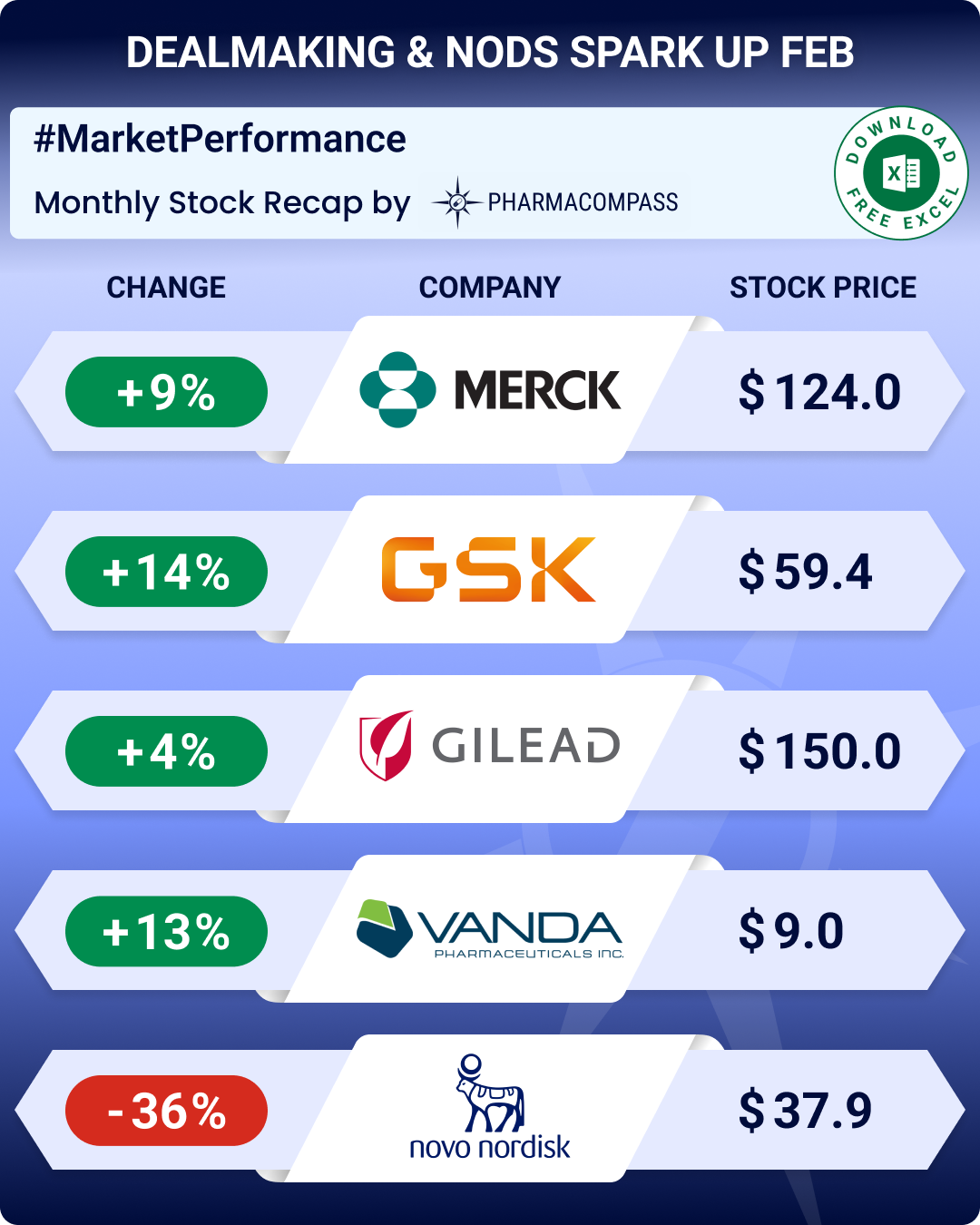
February was a month of upheavals. In the US, the Supreme Court ruled that President Donald Trump exceeded his authority by imposing broad tariffs. Soon after the ruling, Trump imposed a temporary 15 percent global tariff under a separate trade law. The month ended with the US and Israel launching a major military operation against Iran, and the region now appears headed for a prolonged conflict. Despite the turbulent geopolitical environment, the biotech indices continued to grow steadily. The Nasdaq Biotechnology Index (NBI) rose 3.68 percent, moving from 5,852.67 to 6,041.31. The SPDR S&P Biotech ETF (XBI) gained 2.4 percent, rising from 124.75 to 127.27, and the S&P Biotechnology Select Industry Index (SPSIBI) increased 2.4 percent, rising from 9,746.25 to 9,954.51. In comparison, the S&P 500 fell by 0.55 percent — from 6,916.64 to 6,878.88.   Access the Pipeline Prospector Dashboard for February 2026 Newsmakers (Free Excel) Gilead buys Arcellx for US$ 7.8 billion; Lilly acquires Orna for its circular RNA therapeutics  The month’s biggest acquisition was made by Gilead Sciences, which acquired its cancer therapy partner Arcellx for US$ 7.8 billion. The two companies have been collaborating on cell therapy development since 2022 through Kite Pharma, Gilead’s subsidiary. The centerpiece of the deal is Arcellx’s investigational CAR-T therapy for multiple myeloma — anitocabtagene autoleucel. Eli Lilly announced the acquisition of Orna Therapeutics for up to US$ 2.4 billion in cash. The deal will give Lilly access to a new class of therapeutics, known as circular RNA, that allows patients’ own cells to generate therapies (to treat underlying diseases) inside the body, doing away with the need for cell extraction. Among other deals, GSK acquired Canadian biotech 35Pharma for US$ 950 million in cash. The acquisition includes HS235, an investigational therapy being studied for pulmonary arterial hypertension (PAH) and pulmonary hypertension associated with heart failure with preserved ejection fraction. GSK’s stock was up 14 percent in February. FDA approves Vanda’s antipsychotic pill Bysanti; Dupixent okayed for allergic fungal rhinosinusitis The month saw several key approvals. The US Food and Drug Administration (FDA) approved Vanda Pharmaceuticals’ Bysanti (milsaperidone) tablets, a first-line therapy for acute bipolar I disorder and schizophrenia. This marks the company’s third FDA approval in recent months. The agency also approved Sanofi and Regeneron’s Dupixent (dupilumab) for the treatment of adults and pediatric patients with allergic fungal rhinosinusitis (AFRS) who have a history of sino-nasal surgery. AFRS is a chronic inflammatory condition that can cause nasal polyps, persistent congestion, and loss of smell. This is Dupixent’s ninth FDA approval. Merck’s Keytruda (pembrolizumab) and Keytruda Qlex (pembrolizumab and berahyaluronidase alfa-pmph) in combination with paclitaxel, with or without bevacizumab, were approved for treating a form of ovarian cancer. This marks Keytruda’s first FDA approval in ovarian cancer. Pfizer’s Braftovi (encorafenib) was granted full approval when used in combination with Erbitux (cetuximab) and fluorouracil-based chemotherapy to treat adults with a type of metastatic colorectal cancer. The combo therapy had received accelerated approval in 2024. FDA also approved AbbVie’s supplemental new drug application for the combination regimen of Venclexta (venetoclax) and AstraZeneca’s Calquence (acalabrutinib) for the treatment of previously untreated adult patients with chronic lymphocytic leukemia (CLL). Venclexta is manufactured by AbbVie and Genentech. Lilly in another oncology deal with Innovent worth up to US$ 8.85 bn; Novo inks obesity deal with Vivtex Lilly entered into a strategic collaboration with Chinese drugmaker Innovent Biologics to advance novel medicines in oncology and immunology. This is the seventh collaboration between the two drugmakers. Lilly will pay US$ 350 million upfront and as much as US$ 8.5 billion in milestone payments. Madrigal Pharmaceuticals entered into a global license agreement with Suzhou Ribo Life Science and its subsidiary Ribocure Pharmaceuticals for six preclinical small interfering RNA programs targeting metabolic dysfunction-associated steatohepatitis (MASH). Madrigal will pay US$ 60 million upfront and US$ 4.4 billion in milestone payments. Novo Nordisk has inked a deal worth up to US$ 2.1 billion with privately-held American company Vivtex Corp to develop next-generation oral drugs for obesity and diabetes. Astellas Pharma (stock up 16 percent) has entered into a global strategic collaboration with Vir Biotechnology to advance a T-cell engager targeting prostate-specific membrane antigen and CD3 proteins for the treatment of prostate cancer. The deal involves an upfront payment, milestone payments and royalties that could together add up to US$ 1.7 billion. There were also a few AI deals. Takeda Pharmaceutical has entered into a multi-year partnership that could be worth over US$ 1.7 billion with San Diego-headquartered Iambic to use AI to design small-molecule drugs for cancer and gastrointestinal diseases. And, Novartis (stock up 13 percent in February) signed a research collaboration and licensing deal worth up to US$ 1.8 billion with American biotech Unnatural Products (UNP) to develop therapeutics with potential applications in cardiovascular diseases. Novartis will license UNP’s AI-enhanced macrocycle platform. Roche’s Gazyva scores phase 3 win in rare autoimmune kidney disorder; Novo’s CagriSema beats Wegovy In a phase 3 trial, Roche’s Gazyva (obinutuzumab) met its primary endpoint, holding the potential to become the first approved therapy for primary membranous nephropathy, a rare autoimmune kidney disorder. According to top-line results, significantly more patients achieved complete remission at two years with Gazyva, compared to immunosuppressant tacrolimus.  Novo Nordisk said its experimental next-generation weight-loss drug CagriSema (cagrilintide and semaglutide) delivered greater reductions in body weight and blood sugar than its blockbuster Wegovy (semaglutide) in a late-stage trial in patients with type 2 diabetes. Novo has positioned CagriSema as a successor to Wegovy and a potential rival to Eli Lilly’s Zepbound (tirzepatide). Eli Lilly’s Retevmo (selpercatinib), an FDA-approved drug for lung and thyroid cancers that have RET gene alterations, has demonstrated statistically significant improvement in event-free survival in patients with early-stage (2-3A) RET fusion-positive non-small cell lung cancer. In a phase 3 trial, Bayer’s experimental blood thinner — asundexian — reduced the risk of recurrence of stroke by 26 percent. And Compass Pathways’ psilocybin-based therapy — COMP360 — eased symptoms in treatment-resistant depression. This is the second such late-stage trial win for the therapy. Our view The rapidly shifting geopolitical landscape, particularly the conflict in the Middle East and rising trade tensions, is adding a fresh layer of uncertainty for the industry. If the deal-making momentum and progress in clinical trials are maintained, we can safely assume that the innovation pipeline is resilient, the geopolitical turbulence notwithstanding.

Impressions: 2471

https://dev1.pharmacompass.com/pipeline-prospector-blog/pipeline-prospector-february-2026-highlights-gilead-buys-arcellx-for-us-7-8-bn-fda-okays-vanda-s-psychotic-pill

#PharmaFlow by PHARMACOMPASS
05 Mar 2026

WEEKLY INDUSTRY NEWS

5read-more
read-more
FDA refuses to review Moderna’s mRNA-based flu vaccine application; Lilly buys Orna for up to US$ 2.4 billion
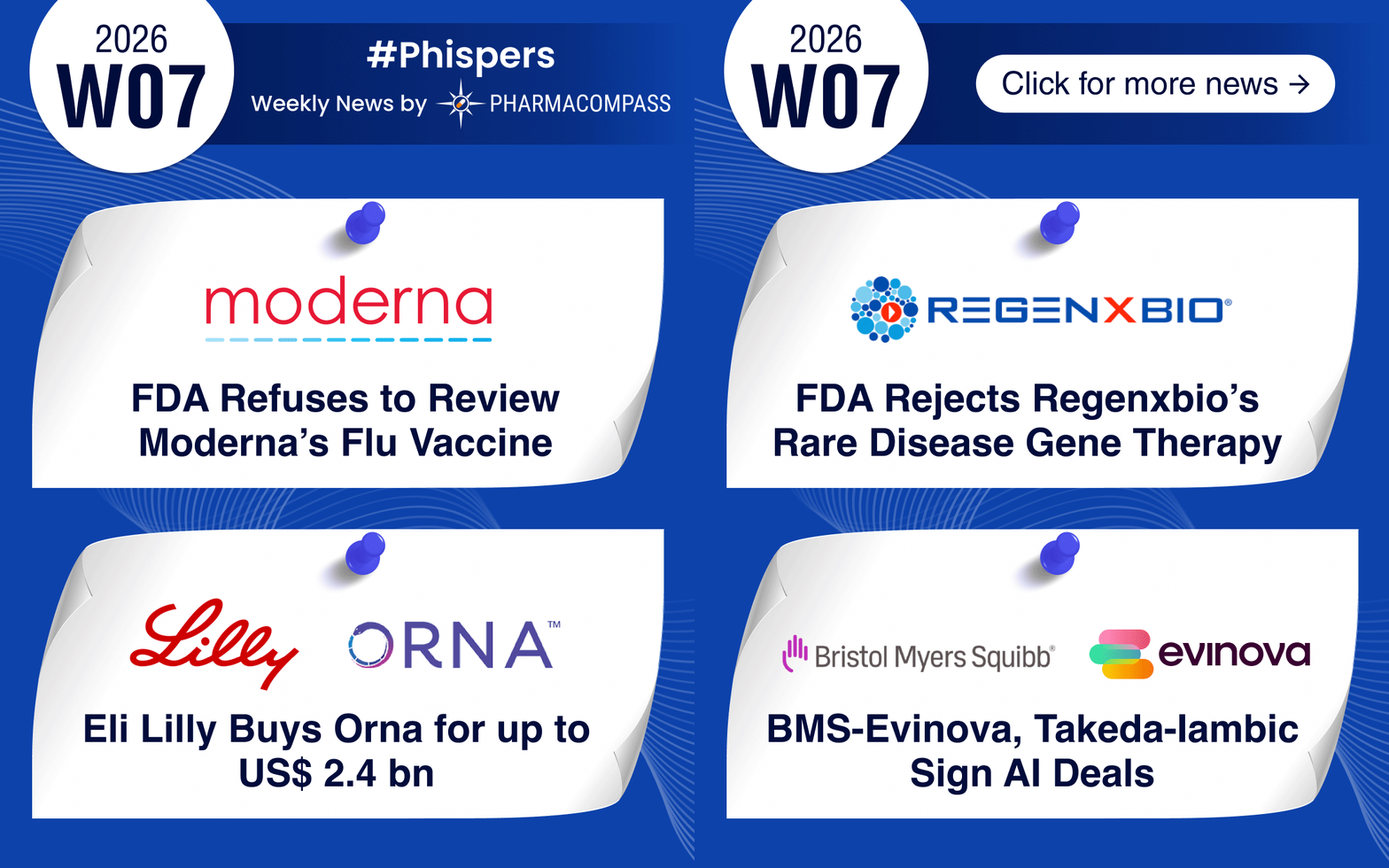
The US Food and Drug Administration (FDA) has said it will not review Moderna’s application for its experimental influenza vaccine — mRNA-1010 — as its control arm did not “reflect the best-available standard of care” in the US.In deals, Eli Lilly has agreed to acquire Orna Therapeutics for up to US$ 2.4 billion in order to expand into cell therapy portfolio. Lilly also entered into a strategic collaboration with Chinese drugmaker Innovent Biologics to advance novel medicines in oncology and immunology. And Madrigal Pharmaceuticals has expanded its pipeline for liver diseases through an exclusive global license agreement with Suzhou Ribo Life Science and its subsidiary Ribocure Pharmaceuticals.Drugmakers are also inking artificial intelligence (AI) deals to speed up drug discovery. Japanese drugmaker Takeda Pharmaceutical has entered into a multi-year partnership worth over US$ 1.7 billion with Iambic and Bristol Myers Squibb (BMS) has signed an agreement with Evinova.After winning dozens of approvals, Merck’s blockbuster cancer drug Keytruda (pembrolizumab) has won its first FDA approval to treat ovarian cancer. The agency rejected Regenxbio’s experimental therapy for Hunter disease (RGX-121).In clinical trials, Bayer’s experimental blood thinner — asundexian — reduced the risk of recurrent stroke by 26 percent. And Novo Nordisk sued Hims and Hers Health over infringement of patent of its weight loss drug Wegovy.FDA refuses to review Moderna’s application for its mRNA-based influenza vaccineFDA has said it will not review Moderna’s application for the approval of its experimental influenza vaccine — mRNA-1010. In its refusal-to-file (RTF) letter, FDA has said the Center for Biologics Evaluation and Research (CBER) does not consider the application to contain an “adequate and well-controlled” trial. This is because “your control arm does not reflect the best-available standard of care in the United States at the time of the study,” it said.Moderna’s CEO Stephane Bancel has said the letter “did not identify any safety or efficacy concerns”. Last year, Moderna had said mRNA-1010 vaccine was 26.6 percent more effective than an approved annual flu shot from GSK in a late-stage trial.Lilly buys Orna, strikes immunology deal with Innovent worth up to US$ 8.8 bnEli Lilly has announced the acquisition of Orna Therapeutics for up to US$ 2.4 billion in cash. This buyout will give Lilly access to a new class of therapeutics (known as circular RNA) that allows patients’ own cells to generate therapies (to treat underlying diseases) inside the body, without the need to extract them.Its lead drug candidate, ORN-252, is a chimeric antigen receptor T-cell (CAR-T) therapy. Lilly plans to explore CAR-Ts for autoimmune disorders.Lilly has also entered into a strategic collaboration with Chinese drugmaker Innovent Biologics  to advance novel medicines in oncology and immunology. This is the seventh collaboration between the two companies. Under the deal, Lilly will pay US$ 350 million upfront and as much as US$ 8.5 billion more to Innovent if certain milestones are met. Additionally, Innovent will be eligible for tiered royalties on net sales of each product outside of Greater China.AI deals: Takeda inks deal with Iambic; BMS ties up with EvinovaTakeda and BMS are the latest drugmakers to turn to AI technologies to speed up drug discovery and cut costs. Takeda Pharmaceutical has entered into a multi-year partnership that could be worth over US$ 1.7 billion with San Diego-headquartered Iambic to use AI for designing small-molecule drugs targeting cancer and gastrointestinal diseases. The partnership will utilize Iambic’s broad suite of AI drug discovery technologies and wet lab capabilities.BMS-Evinova deal: BMS has signed an agreement with Evinova to optimize clinical trials using Evinova’s AI-native clinical development platform. Under the terms of the agreement, BMS will deploy the “cost optimizer” module of Evinova’s study designer solution across the company’s global portfolio. Evinova was launched by AstraZeneca in 2023 to advance digital health solutions.FDA rejects Regenxbio’s gene therapy for Hunter syndrome over trial designAfter putting Regenxbio’s experimental therapy for Hunter syndrome on clinical hold, FDA has declined to approve RGX-121 (clemidsogene lanparvovec). Hunter syndrome is an ultra-rare genetic disorder. In its complete response letter, FDA has said Regenxbio’s biologics license application for RGX-121 was turned down due to uncertainty regarding the trial design.Keytruda approved to treat ovarian cancer: Blockbuster cancer drug Keytruda (pembrolizumab) has been approved to treat ovarian cancer. According to the FDA, Merck’s Keytruda and Keytruda Qlex (pembrolizumab and berahyaluronidase alfa-pmph) in combination with paclitaxel, with or without bevacizumab, have been approved for treating adult patients with platinum-resistant epithelial ovarian, fallopian tube, or primary peritoneal carcinoma whose tumors express PD-L1 as determined by an FDA-authorized test, and who have received one or two prior systemic treatment regimens. This is Keytruda’s first FDA approval for ovarian cancerMadrigal inks pact with Suzhou Ribo to expand its MASH pipelineAfter bagging an FDA approval in 2024 for Rezdiffra (resmetirom) — the first approved drug to treat metabolic dysfunction–associated steatohepatitis (MASH) — Madrigal Pharmaceuticals has now expanded its MASH pipeline. It has entered into an exclusive global license agreement with Suzhou Ribo Life Science and its subsidiary Ribocure Pharmaceuticals for six preclinical small interfering RNA (siRNA) programs (a precision approach to gene silencing in MASH).  Madrigal said it will pay US$ 60 million upfront to Suzhou Ribo Life Science for access to the six siRNA candidates, and another US$ 4.4 billion in milestone payments.Bayer’s experimental blood thinner reduces risk of stroke by 26%In a phase 3 trial, Bayer’s experimental blood thinner — asundexian — reduced the risk of recurrence of stroke by 26 percent. The study compared a combination of standard anti-platelet therapy and Bayer's asundexian with anti-platelet therapy alone in patients who had suffered a stroke or had a blocked blood vessels in the brain. The study involved 12,327 patients.Novo sues Hims & Hers over patent infringement; plans to launch Wegovy in vialsNovo Nordisk has sued Hims and Hers Health over patent infringement after the latter, an American telehealth firm, launched, then cancelled, a US$ 49 copy of its weight-loss drug Wegovy (semaglutide). Novo is also seeking to recover damages from Hims and Hers.Meanwhile, Novo has said it plans to launch Wegovy in vials. Its competitor Eli Lilly has been selling two lowest doses of its obesity drug Zepbound (tirzepatide) in vials since 2024. 

Impressions: 1997

https://dev1.pharmacompass.com/radio-compass-phisper/fda-refuses-to-review-moderna-s-mrna-based-flu-vaccine-application-lilly-buys-orna-for-up-to-us-2-4-billion

#Phispers by PHARMACOMPASS
12 Feb 2026

NEWS LIBRARY

349read-more
read-more

https://ir.corcept.com/news-releases/news-release-details/corcept-reports-positive-results-phase-2-bella-trial-lifyorlir

PRESS RELEASE
26 Oct 2026
Dr Reddy's Gets DCGI Nod for Zytorvi

21 Oct 2026

// INDPHARMAPOST

https://www.indianpharmapost.com/regulatory/dr-reddys-gets-dcgi-nod-for-zytorvi-in-advanced-esophageal-cancer-22207

INDPHARMAPOST
21 Oct 2026

https://www.globenewswire.com/news-release/2026/08/26/3351722/0/en/immuneering-comments-on-today-s-fda-approval-in-second-line-metastatic-pancreatic-cancer-reiterates-focus-on-first-line-patients.html

GLOBENEWSWIRE
26 Aug 2026

https://investors.faeththerapeutics.com/news-releases/news-release-details/faeth-therapeutics-announces-fda-grant-fast-track-designation

PRESS RELEASE
17 Aug 2026

https://www.globenewswire.com/news-release/2026/08/05/3339218/0/en/immuneering-reports-second-quarter-2026-financial-results-and-provides-business-updates.html

GLOBENEWSWIRE
05 Aug 2026

https://www.globenewswire.com/news-release/2026/07/17/3329171/0/en/compass-therapeutics-announces-tovecimig-data-accepted-for-an-oral-presentation-at-the-esmo-congress-2026.html

GLOBENEWSWIRE
17 Jul 2026
digital-content36314##p