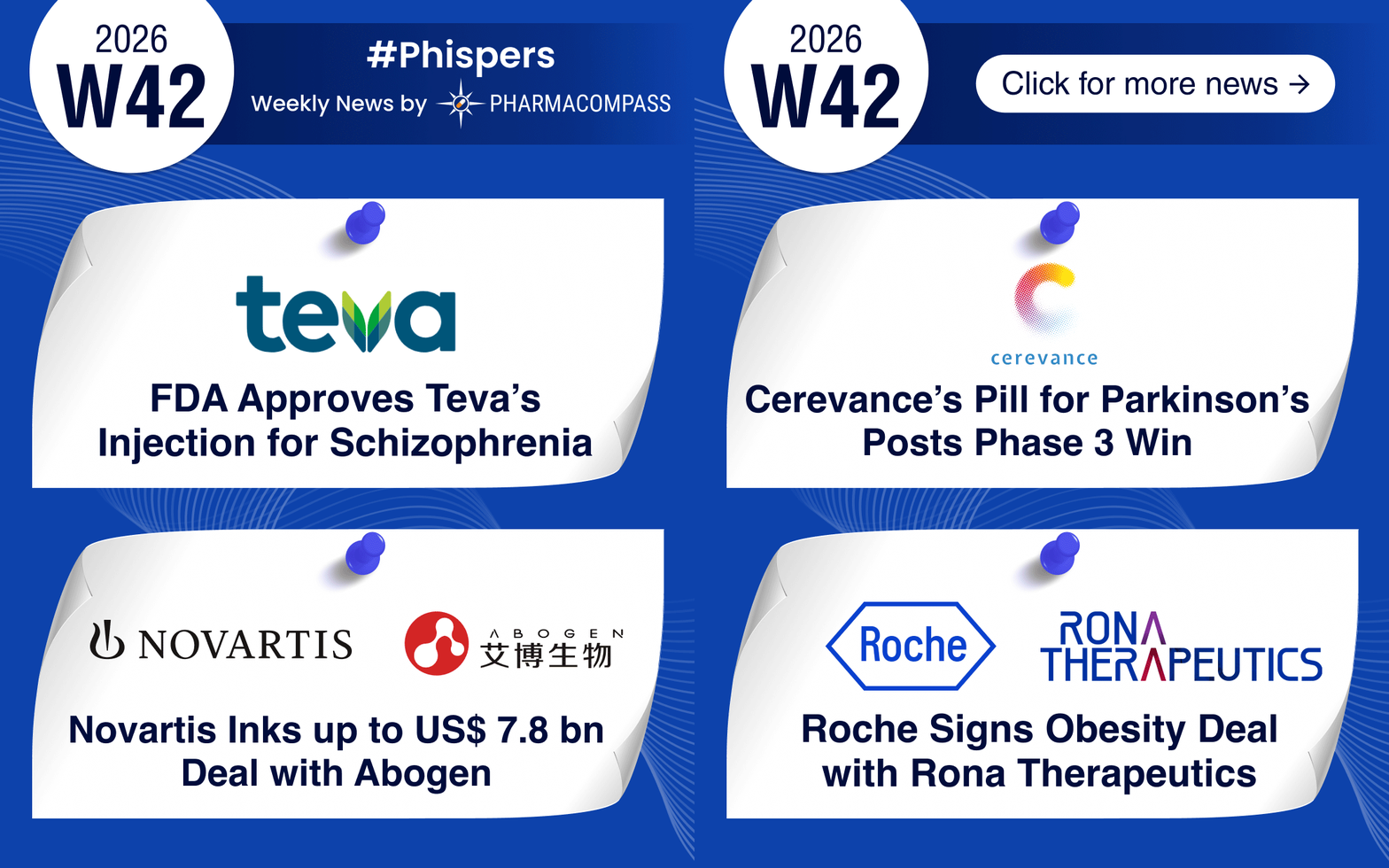
This week’s Phispers is a post-CPhI edition with news from the last two weeks. The US Food and Drug Administration (FDA) approved Teva’s extended-release injection of olanzapine — Weltruza — for adults with schizophrenia. It also cleared Pfizer’s
Tukysa (tucatinib), in combination with trastuzumab and pertuzumab, as
maintenance treatment for a type of breast cancer.Among other key
drug approvals were Asahi Kasei Therapeutics’ Hovilpri
(pritelivir) for treating persistent herpes simplex virus sores, Roche’s
Tecentriq (atezolizumab), in combination with a fluoropyrimidine and
oxaliplatin, for treating a type of colon cancer, Eli Lilly’s
Jaypirca (pirtobrutinib) for treating chronic lymphocytic leukemia and Novartis’ Rhapsido
(remibrutinib) for a chronic skin condition known as symptomatic dermographism.In clinical
trials, Cerevance posted positive results from a phase 3 trial of solengepras,
an investigational drug for Parkinson’s disease. Genmab and AbbVie reported positive
results from a phase 3 study of epcoritamab in treating lymphoma. Meanwhile,
FDA cited four deaths among patients being treated with Newron’s
experimental schizophrenia drug across its clinical studies.In deals,
Novartis signed an up to US$ 7.8 billion licensing and option agreement with
China-based Abogen Biosciences to develop mRNA-encoded therapeutics. Denmark’s
Zealand Pharma signed an AI deal with US-based Generate Biomedicines to design
protein-based drugs for obesity and other metabolic diseases. And Roche secured
an exclusive worldwide license to Rona Therapeutics’ experimental
RNAi therapy targeting ALK7, a receptor found mainly in fat cells.Teva wins FDA
approval for monthly schizophrenia injection Weltruza Teva
has received FDA approval for Weltruza (olanzapine extended-release injectable suspension), a once-monthly subcutaneous formulation for adults with schizophrenia. According to the company, Weltruza is the first and only once-monthly subcutaneous olanzapine injection.Pfizer’s Tukysa okayed for breast cancer: FDA has
approved Pfizer’s Tukysa (tucatinib), in combination with trastuzumab and pertuzumab, as maintenance treatment for adults with unresectable, locally advanced or metastatic HER2-positive breast cancer following induction
therapy.Cerevance reports
phase 3 win for its once-daily pill for Parkinson’s diseaseCerevance has reported positive topline results from a phase 3 trial of solengepras, an investigational once-daily oral treatment for Parkinson’s disease. The study met its primary endpoint, with the 150 mg dose
significantly reducing daily OFF time in patients experiencing motor
fluctuations despite being on levodopa and other Parkinson’s medicines. OFF time is a term for the period when medication wears
off and symptoms return or worsen between doses.Genmab, AbbVie’s drug combo scores phase 3 win: Genmab and AbbVie reported positive topline results from a phase 3 study of epcoritamab in combination with R-CHOP in newly diagnosed diffuse large B-cell lymphoma, the most common type of non-Hodgkin lymphoma. R-CHOP is a standard
combination cancer treatment regimen used for non-Hodgkin lymphomas. The combo
cut the risk of disease progression or death by 51 percent, compared with
R-CHOP alone.FDA flags four
deaths in Newron’s schizophrenia drug trialsFDA has cited four deaths among patients being treated on Italian drugmaker Newron’s experimental schizophrenia drug evenamide across all clinical studies, and has kept its clinical hold on the US sites of a phase 3 trial. In comparison, there was just one death among those given a placebo. FDA’s concerns relate to risk of arrhythmias linked with the drug, which was being tested in people with treatment-resistant schizophrenia, a serious mental illness that affects thinking, emotions and perception of reality.BMS’ radiopharmaceutical
delays tumor growth in rare gut and pancreatic cancersBristol Myers Squibb’s experimental radiopharmaceutical RYZ101 significantly delayed disease progression in patients with gastroenteropancreatic neuroendocrine tumors, rare cancers that typically form in the gastrointestinal tract. RYZ101 carries actinium-225, which emits more powerful, shorter-range alpha particles than Novartis’ Lutathera (lutetium Lu 177 dotatate).Lung disease trial: BMS
has said that a lower dose (60 mg) of its experimental drug admilparant was successful in slowing the decline in lung function in patients with a potentially fatal lung disease, known as idiopathic pulmonary fibrosis (IPF), in a phase 3
trial. The higher 120 mg dose also slowed decline, but the effect was not
statistically significant.Novartis signs up
to US$ 7.8 bn mRNA licensing deal with China-based AbogenNovartis has entered into a licensing and option agreement with
China-based Abogen Biosciences worth up to US$ 7.8 billion to develop mRNA-encoded therapeutics. Abogen will receive US$ 575 million upfront, with further payments tied to
development milestones and the exercise of options. The agreement includes
worldwide rights to ABO2203, an investigational mRNA-encoded therapy being
developed for autoimmune diseases.Bayer to invest US$ 2.2 billion in Ohio: Bayer has announced an investment of US$ 2.2 billion in a new drug manufacturing site in New Albany, Ohio, expanding its production footprint in the US, which
is its largest pharmaceuticals market.FDA approves
Asahi Kasei’s drug for difficult-to-treat herpes infectionsFDA has approved Asahi Kasei Therapeutics’ Hovilpri (pritelivir) for treating immunocompromised adults with persistent herpes simplex virus sores that have not responded to standard
antiviral therapies.Expands label of
Roche’s Tecentriq: FDA has approved Roche’s Tecentriq (atezolizumab), in combination with a fluoropyrimidine and oxaliplatin, for the adjuvant (or post-surgery) treatment of stage 3 deficient mismatch repair
(dMMR) colon cancer.Lilly’s Jaypirca okayed
for lymphocytic leukemia: FDA has
approved Eli Lilly’s Jaypirca (pirtobrutinib) for the first-line treatment of adults with chronic lymphocytic leukemia (CLL) or small
lymphocytic lymphoma (SLL) without a known 17p deletion.Clears Rhapsido for a chronic skin condition: FDA has expanded the use of Novartis’ Rhapsido (remibrutinib) for treating adults with symptomatic dermographism, a chronic skin condition marked by itching. According to Novartis, Rhapsido is the
first FDA-approved treatment for this condition.Zealand Pharma,
Generate Biomedicines ink up to US$ 1.2 bn AI obesity drug deal Denmark’s Zealand Pharma has signed a collaboration and license agreement with US-based Generate Biomedicines to design protein-based drugs for obesity and other metabolic diseases using Generate’s generative AI
platform. For two initial programs, Generate will receive US$ 30 million
upfront and up to US$ 35 million in early preclinical milestones. It is also
eligible for milestone payments of nearly US$ 1.2 billion, along with tiered
royalties.Roche, Rona ink obesity drug deal: Roche has secured an exclusive worldwide license to
Rona Therapeutics’ experimental RNAi therapy targeting ALK7, a receptor found mainly in fat cells that regulates how they
store and burn fat. Blocking ALK7 could reduce harmful belly (visceral) fat,
and could complement GLP-1 drugs such as Wegovy. Rona will receive up to US$
100 million in upfront and near-term payments, and up to US$ 1.06 billion in
milestones, and tiered royalties. Alnylam, Arrowhead, GSK, and Novo Nordisk are also developing ALK7 drugs.













 Share
