Please Wait
Applying Filters...
Menu

Digital Content read-more

Create Content with PharmaCompass, ask us

MARKET PERFORMANCE RECAP

1read-more
read-more

A PHP Error was encountered

Severity: 8192

Message: mb_convert_encoding(): Handling HTML entities via mbstring is deprecated; use htmlspecialchars, htmlentities, or mb_encode_numericentity/mb_decode_numericentity instead

Filename: ppb/grid.php

Line Number: 54

Backtrace:

File: /var/www/html/application/views/include/media/ppb/grid.php
Line: 54
Function: mb_convert_encoding

File: /var/www/html/application/models/Cmn.php
Line: 3616
Function: view

File: /var/www/html/application/views/include/product/digitalContent/grid.php
Line: 18
Function: common

File: /var/www/html/application/views/include/desc/inner.php
Line: 13
Function: view

File: /var/www/html/application/views/include/desc/indexNew.php
Line: 2433
Function: include

File: /var/www/html/application/controllers/Common.php
Line: 11303
Function: view

File: /var/www/html/index.php
Line: 231
Function: require_once

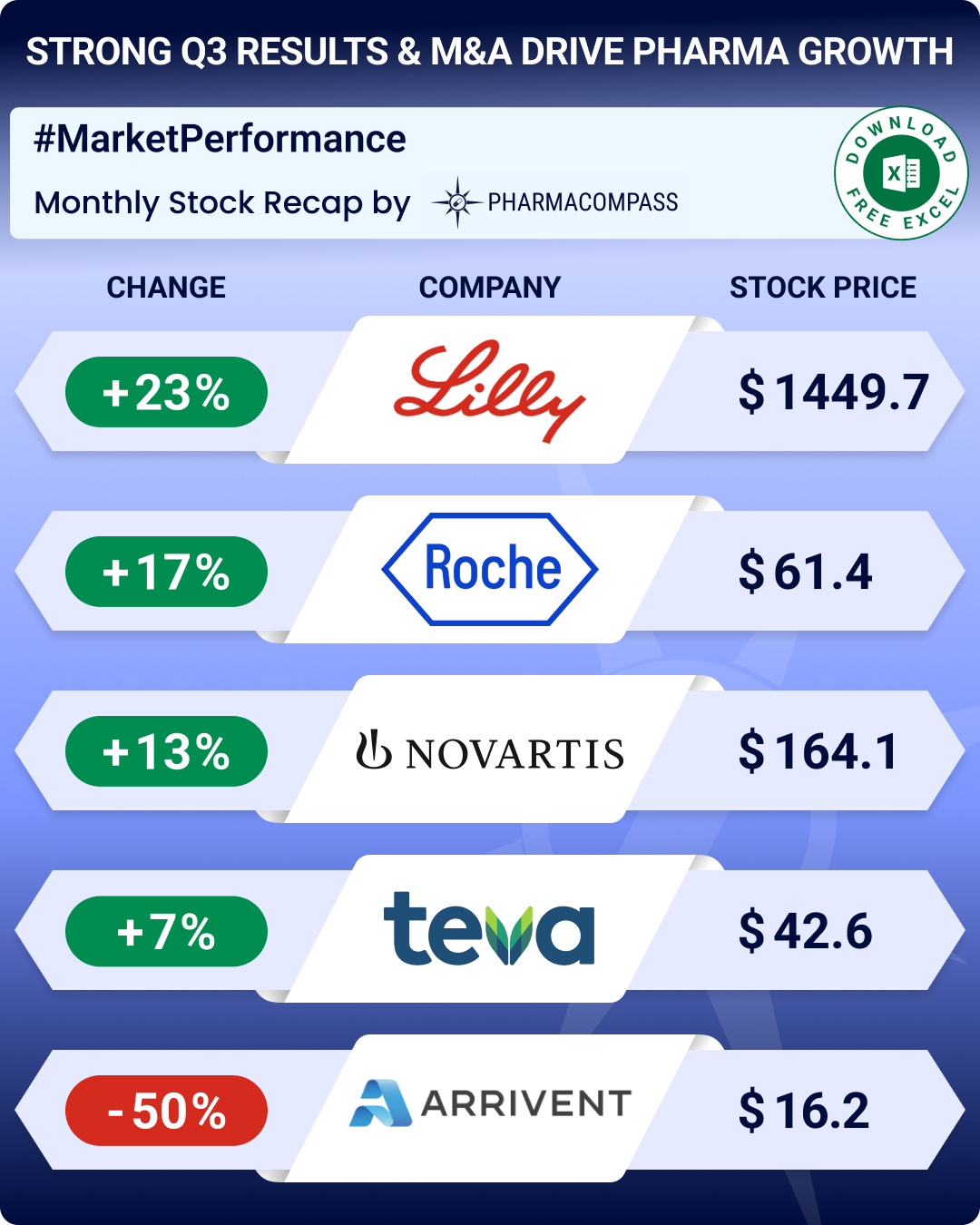
Market Performance Recap October 2026 highlights: FDA clears Teva’s Weltruza for schizophrenia; Novartis inks mRNA deal with Abogen
October was a quiet month for big-ticket acquisitions. That said, several global drug majors announced their third quarter (Q3 2026) results, with a majority reporting healthy growth rates. For instance, Eli Lilly reported a 39 percent rise in revenues compared to Q3 2025, driven by rising demand for its type 2 diabetes and obesity medications. Similarly, Regeneron’s revenues were up 36 percent. AstraZeneca posted a 7 percent rise in total revenue, while Merck reported 5 percent growth in worldwide sales. And Novartis reported 4 percent growth in net sales. The results appear to have had a positive impact on the pharma indices, which have otherwise been under pressure from wars, trade tensions and soaring public debt. The Nasdaq Biotechnology Index (NBI) increased by around 3.05 percent — from 7,102.91 at the end of September to 7,319.57 at the end of October. However, both the SPDR S&P Biotech ETF and the S&P Biotechnology Select Industry Index (SPSIBI) saw a marginal drop. While the former declined from 156.99 to 155.90, the SPSIBI dropped by 1.09 percent — from 12,346.20 to 12,211.80. Overall, the S&P 500 declined from 7,666.47 to 7,580.07.  Access the Pipeline Prospector Dashboard for October 2026 Newsmakers (Free Excel) FDA clears Teva’s drug for schizophrenia, UCB’s autoinjector for myasthenia gravis  Among the most notable approvals of the month was the US Food and Drug Administration’s approval of Teva Pharmaceuticals’ Weltruza (olanzapine) extended-release injectable suspension. This is the first and only once-monthly subcutaneous olanzapine injection for schizophrenia. Another first-time approval was granted to Asahi Kasei’s Hovilpri (pritelivir). It treats sores on the skin and mucous membranes caused by herpes simplex virus (HSV) in adults with weakened immune systems. GSK received FDA approval for Hibsago (bepirovirsen) to treat chronic hepatitis B in adults. Taken alongside existing antiviral therapy, it can offer some patients a functional cure, allowing them to stop lifelong treatment. UCB’s Zilbrysq (zilucoplan) was approved as an autoinjector that patients with generalized myasthenia gravis, an autoimmune disorder, can use by themselves. Among drugs that bagged FDA’s supplemental approvals were Roche’s Enspryng (satralizumab) for the treatment of adults with thyroid eye disease (TED) and Eli Lilly’s Jaypirca (pirtobrutinib). While Enspryng is the first and only at-home subcutaneous treatment option for TED, Jaypirca is now approved as a first-line treatment for adults with chronic lymphocytic leukemia (CLL) or small lymphocytic lymphoma (SLL), two forms of the same slow-growing blood cancer, provided they don't have a particular genetic change. The agency expanded the approvals of Novartis’ Rhapsido (remibrutinib) for symptomatic dermographism (a chronic skin condition) and Roche’s Tecentriq (atezolizumab), in combination with a fluoropyrimidine and oxaliplatin, for the adjuvant (or post-surgery) treatment of stage 3 deficient mismatch repair (dMMR) colon cancer. FDA also granted accelerated approval to AstraZeneca’s Ultomiris (ravulizumab) to reduce proteinuria in adults with primary immunoglobulin A nephropathy (IgAN) at risk of disease progression. And Novo Nordisk received FDA approval for Awiqli (insulin icodec-abae) for children aged 10 years and older with type 2 diabetes. Shionogi acquires IntraBio for US$ 2 bn; Merck KGaA buys Silence Therapeutics In deals, Shionogi agreed to acquire IntraBio, a biopharmaceutical company focused on rare neurodegenerative and genetic neurological diseases, for approximately US$ 2 billion. Viatris agreed to acquire Pacira BioSciences for an equity value of around US$ 1.65 billion. The deal will strengthen Viatris’ innovative medicines portfolio. Merck KGaA announced the acquisition of Silence Therapeutics for an enterprise value of US$ 1.1 billion to expand its RNA-silencing portfolio and strengthen its pipeline of investigational therapies. Gilead said it is acquiring PepStar’s HCXT-2001, an investigational drug, for US$ 1.275 billion upfront. The phase 1 asset is being developed for inflammatory bowel disease (IBD). In other deals, Novartis entered into a licensing and option agreement with China-based Abogen Biosciences worth up to US$ 7.8 billion to develop mRNA-encoded therapeutics. Abogen will receive US$ 575 million upfront. Australian biotechnology company CSL partnered with Switzerland-based Alentis Therapeutics to jointly develop and commercialize lixudebart, an investigational treatment for rare kidney and liver diseases, in a deal valued at up to US$ 1.6 billion before development funding. Hansoh, Roche sign ADC deal worth over US$ 15 bn; Vir, Gilead join hands to target solid tumors Hansoh Pharma signed a collaboration with Roche to develop a portfolio of antibody-drug conjugates (ADCs) for multiple cancers. Hansoh will receive US$ 400 million upfront, a first-anniversary payment of US$ 110 million, and potentially over US$ 15 billion in milestone payments. Several drugmakers signed AI deals in October. Vir Biotechnology entered into a multi-program collaboration and licensing agreement with Gilead Sciences to discover and develop three novel therapies that target solid tumors. Vir will lead the discovery, design, and optimization of the drug candidates using its AI-enabled platform. AstraZeneca entered into a new strategic drug discovery collaboration and licensing agreement with Insitro, an AI therapeutics company. Zealand Pharma and Generate Biomedicines forged a strategic collaboration to develop AI-engineered multi-specific protein therapeutics for obesity and other metabolic diseases. And METiS TechBio partnered with Eli Lilly to discover AI-driven, tissue-specific lipid nanoparticle (LNP) delivery technologies using its proprietary AiLNP platform. Cerevance’s Parkinson’s pill posts phase 3 win; Veradermics’ minoxidil tablet shows hair growth In clinical trials, Cerevance reported positive topline results from a phase 3 trial of solengepras, an investigational once-daily oral treatment for Parkinson’s disease. Genmab and AbbVie reported positive topline results from a phase 3 study of epcoritamab in combination with R-CHOP in newly diagnosed diffuse large B-cell lymphoma, the most common type of non-Hodgkin lymphoma. R-CHOP is a standard combination cancer treatment regimen used for non-Hodgkin lymphomas. Veradermics reported positive phase 3 results for VDPHL01 (extended-release minoxidil tablet) in male pattern hair loss, demonstrating significant hair growth and a favorable safety profile. Bristol Myers Squibb’s experimental radiopharmaceutical RYZ101 significantly delayed disease progression in patients with gastroenteropancreatic neuroendocrine tumors, rare cancers that typically form in the gastrointestinal tract. In negative news from clinical trials, FDA cited four deaths among patients being treated with Italian drugmaker Newron’s experimental schizophrenia drug evenamide across all clinical studies. Our view October’s deals were in line with the pattern we saw in September. The month’s two biggest bets went to Chinese drugmakers: Roche’s ADC pact with Hansoh, potentially worth over US$ 15 billion, and Novartis’ US$ 7.8 billion mRNA deal with Abogen. Equally notable was the wave of AI partnerships. With strong Q3 earnings, drugmakers appear to be showing foresight, and are busy picking up tomorrow’s pipelines.

Impressions: 1009

https://dev1.pharmacompass.com/pipeline-prospector-blog/market-performance-recap-october-2026-highlights-fda-clears-teva-s-weltruza-for-schizophrenia-novartis-inks-mrna-deal-with-abogen

#PharmaFlow by PHARMACOMPASS
05 Nov 2026

WEEKLY INDUSTRY NEWS

5read-more
read-more
FDA approves Pfizer’s Talzenna drug combo for prostate cancer; clears AbbVie’s on-body Skyrizi injector for Crohn’s disease
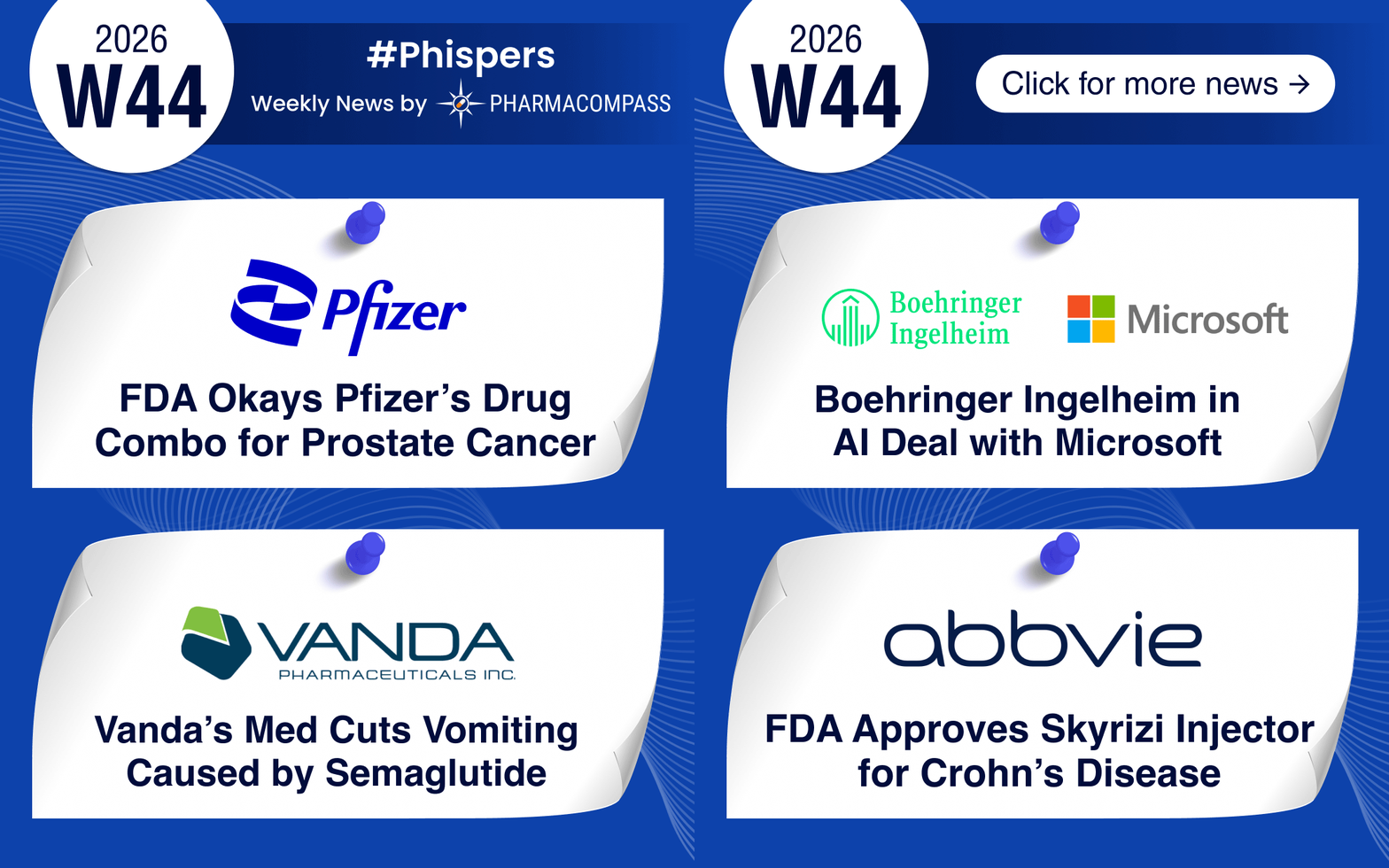
In news this week, the US Food and Drug Administration (FDA) approved Pfizer’s Talzenna (talazoparib), in combination with Xtandi (enzalutamide), for a type of metastatic prostate cancer. The agency approved a subcutaneous regimen of AbbVie’s Skyrizi (risankizumab) to treat Crohn’s disease, and granted accelerated approval to AstraZeneca’s Ultomiris (ravulizumab) to reduce protein in the urine of adults with primary immunoglobulin A nephropathy (IgAN), a rare autoimmune kidney disease. It also cleared Novo Nordisk’s insulin Awiqli for children with type 2 diabetes. In clinical trials, Vanda Pharmaceuticals’ Nereus (tradipitant) reduced vomiting caused by semaglutide, a GLP-1 weight-loss drug. Pfizer’s Elrexfio (elranatamab) met the main goal of a phase 3 trial in patients with multiple myeloma whose cancer had returned after earlier treatment. Meanwhile, Artiva Biotherapeutics had to scrap its experimental cell therapy AlloNK after two patient deaths in a mid-stage trial. A patient with highly active relapsing multiple sclerosis died in an early-stage trial of an experimental CAR-T therapy from Bristol Myers Squibb, known as zolacabtagene autoleucel (zola-cel). In deals, Gilead Sciences said it will acquire PepStar Therapeutics’ experimental oral drug for inflammatory bowel disease — HCXT-2001 — for US$ 1.275 billion in cash upfront. Stemline Therapeutics secured exclusive worldwide rights to Georgiamune’s GIM-621, a preclinical pill designed to boost the immune system against cancer. And Boehringer Ingelheim signed an AI deal with Microsoft to speed up clinical development. Additionally, FDA issued Form 483 to two Indian companies — Gland Pharma and Gufic Biosciences. The agency also issued a warning letter to Baxter International over cGMP violations at its Illinois plant, which makes sterile injectable drugs. FDA approves Pfizer’s Talzenna combo for earlier-stage prostate cancer  FDA has approved Pfizer’s Talzenna (talazoparib), in combination with Xtandi (enzalutamide), for metastatic hormone-sensitive prostate cancer in patients whose tumors carry mutations in DNA-repair genes, known as homologous recombination repair (HRR) genes. Hormone-sensitive cancer still responds to hormone-blocking therapy, so this approval moves Talzenna to an earlier stage of disease. The combination was approved in 2023 for prostate cancer that no longer responds to hormone therapy. Okays AbbVie’s Skyrizi injector for Crohn’s disease: FDA has approved a subcutaneous (under-the-skin) regimen for AbbVie’s Skyrizi (risankizumab) in adults with moderately to severely active Crohn’s disease, an inflammatory bowel disease. Patients can now begin treatment at home with a wearable on-body injector, instead of relying only on intravenous infusions. Vanda’s Nereus reduces vomiting caused by obesity drug semaglutide in phase 3 trial Vanda Pharmaceuticals said its drug Nereus (tradipitant) reduced vomiting caused by the GLP-1 weight-loss drug semaglutide in a phase 3 trial. Nereus was approved in December 2025 for vomiting caused by motion sickness. Vanda plans to file for approval in this new use. Pfizer’s Elrexfio scores phase 3 win: Pfizer said its drug Elrexfio (elranatamab) met the main goal of a phase 3 trial in patients with multiple myeloma (a blood cancer) whose disease had returned after earlier treatment. Given alone, it delayed cancer progression or death compared with standard drug combinations. Pfizer plans to file for approval worldwide. Artiva drops cell therapy after two deaths, cuts 94 percent of staff Artiva Biotherapeutics has scrapped its experimental cell therapy AlloNK after two patient deaths in a mid-stage trial. The company will cut about 94 percent of its workforce. The cell therapy was being tested as a potential treatment for autoimmune conditions such as rheumatoid arthritis. BMS discloses patient death in CAR-T trial: Bristol Myers Squibb has disclosed that a patient with highly active relapsing multiple sclerosis died of septic pneumonia in an early-stage trial of zolacabtagene autoleucel (zola-cel), an experimental CAR-T cell therapy. CAR-T therapies are made by reengineering a patient’s own immune cells. Gilead to buy PepStar’s inflammation drug program for US$ 1.3 billion upfront Gilead Sciences will acquire PepStar Therapeutics’ experimental oral IL-23 receptor blocker, HCXT-2001, along with worldwide rights to the program, for US$ 1.275 billion in cash upfront. IL-23 is a protein that drives inflammation in inflammatory bowel disease (IBD) and psoriasis. Current IL-23 drugs, such as AbbVie’s Skyrizi, are injected. HCXT-2001 is a pill that is in phase 1 trials. Gilead plans to develop it for IBD. Stemline licenses Georgiamune’s immunotherapy: Stemline Therapeutics, part of Italy’s Menarini Group, has secured exclusive worldwide rights to Georgiamune’s GIM-621, a preclinical pill designed to boost the immune system against cancer. Georgiamune will receive US$ 45 million in upfront and near-term payments, with milestone payments taking the deal value up to US$ 1.1 billion, plus royalties. Boehringer Ingelheim in AI deal with Microsoft: Boehringer Ingelheim has partnered with Microsoft to use AI to speed up clinical development. The companies will research digital patient twins, or computer models of individual patients that predict how a disease will progress. The initial focus is lung disease. The companies have not disclosed any financial terms. FDA grants accelerated approval to Astra’s Ultomiris for treating rare kidney disease FDA has granted accelerated approval to AstraZeneca’s Ultomiris (ravulizumab) to reduce protein in the urine of adults with primary immunoglobulin A nephropathy (IgAN) who are at risk of disease progression. IgAN is a rare autoimmune kidney disease in which antibody deposits damage the kidney’s filters, causing protein to leak into the urine. Novo’s insulin okayed for diabetic children: FDA has approved Novo Nordisk’s Awiqli (insulin icodec) for children aged 10 and older with type 2 diabetes. FDA says it is the first once-weekly insulin approved for children with the condition. FDA issues warning letter to Baxter over cGMP violations at its Illinois plant  FDA has issued a warning letter to Baxter International over cGMP violations at its Illinois plant, which makes sterile injectable drugs. An inspection in March and April found that Baxter failed to stop cephalosporin antibiotics from contaminating other drug products made in the same building. Cephalosporins can trigger life-threatening allergic reactions in sensitive patients. Form 483 issued to Gland Pharma’s Hyderabad plant: FDA has issued a Form 483 with four observations to Gland Pharma’s formulation facility in Dundigal, Hyderabad (India), after an unannounced inspection from October 12 to 23. Gufic Biosciences’ Form 483: FDA issued a Form 483 with three observations to Gufic Biosciences after a pre-approval inspection of its plant in Pithampur, Indore (India), from October 15 to 23. The company did not disclose the nature of the observations and said it would address them within the stipulated time.

Impressions: 1783

https://dev1.pharmacompass.com/radio-compass-phisper/fda-approves-pfizer-s-talzenna-drug-combo-for-prostate-cancer-clears-abbvie-s-on-body-skyrizi-injector-for-crohn-s-disease

#Phispers by PHARMACOMPASS
29 Oct 2026

NEWS LIBRARY

93read-more
read-more

https://www.indianpharmapost.com/regulatory/fda-grants-accelerated-approval-to-astrazenecas-ultomiris-for-rare-kidney-disease-igan-22215

INDPHARMAPOST
22 Oct 2026

https://investors.xencor.com/news-releases/news-release-details/xencor-receive-105-million-alexion-resolve-ultomirisr-us-royalty

PRESS RELEASE
29 Jul 2026

https://www.fiercepharma.com/pharma/az-stays-track-80b-revenue-goal-cancer-meds-help-offset-ultomiris-miss

FIERCE PHARMA
27 Jul 2026

https://www.reuters.com/business/healthcare-pharmaceuticals/astrazenecas-rare-disease-drug-misses-main-goal-late-stage-trial-2026-07-27/

REUTERS
27 Jul 2026

https://www.astrazeneca.com/media-centre/press-releases/2026/ultomiris-demonstrated-43-4-reduction-in-proteinuri-vs-placebo-in-adults-with-immunoglobulin-i-can-phase-iii-trial.html

PRESS RELEASE
07 Jun 2026

https://www.astrazeneca.com/media-centre/press-releases/2026/i-can-phiii-interim-analysis-met-primary-endpoint.html

PRESS RELEASE
22 Apr 2026
digital-contentPB000778##p