Please Wait
Applying Filters...
Menu

Digital Content read-more

Create Content with PharmaCompass, ask us

PHARMA & BIOTECH INSIGHTS

1read-more
read-more

A PHP Error was encountered

Severity: 8192

Message: mb_convert_encoding(): Handling HTML entities via mbstring is deprecated; use htmlspecialchars, htmlentities, or mb_encode_numericentity/mb_decode_numericentity instead

Filename: blog/grid.php

Line Number: 52

Backtrace:

File: /var/www/html/application/views/include/media/blog/grid.php
Line: 52
Function: mb_convert_encoding

File: /var/www/html/application/models/Cmn.php
Line: 3595
Function: view

File: /var/www/html/application/views/include/product/digitalContent/grid.php
Line: 17
Function: common

File: /var/www/html/application/views/include/desc/inner.php
Line: 13
Function: view

File: /var/www/html/application/views/include/desc/indexNew.php
Line: 2433
Function: include

File: /var/www/html/application/controllers/Common.php
Line: 11303
Function: view

File: /var/www/html/index.php
Line: 231
Function: require_once

DMF filings rise 4.5% in Q3 2025; China holds lead, India records 20% growth in submissions
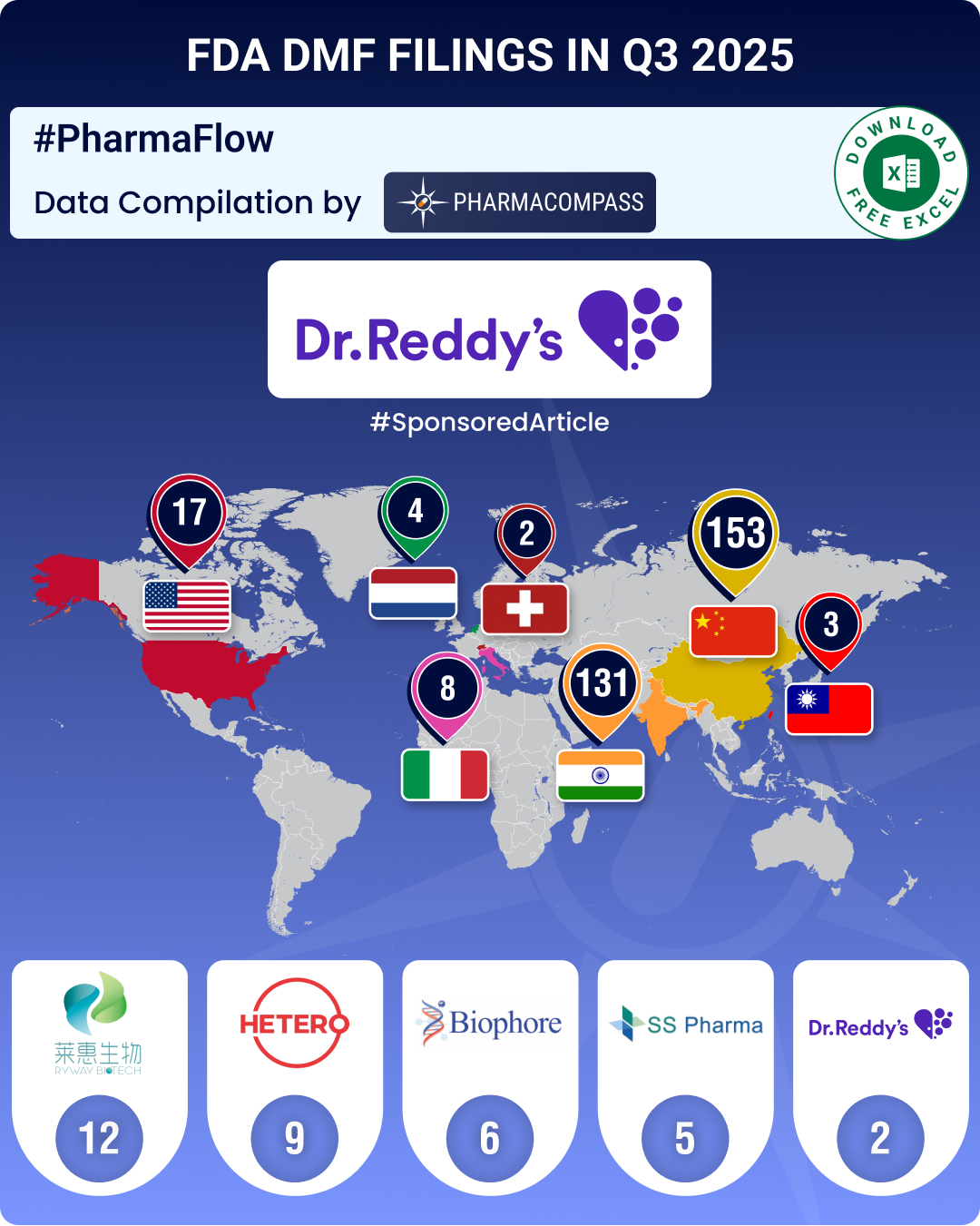
The third quarter (Q3) of 2025 witnessed a steady rise in Drug Master File (DMF) submissions to the US Food and Drug Administration (FDA). DMFs are used to provide confidential, detailed information about facilities, processes, or articles used in the manufacturing, processing, packaging, and storing of human drug products A total of 323 Type II DMFs were submitted during this period, as opposed to 309 submissions in Q3 2024, marking an increase of 4.53 percent. This is the second highest number since 2018. In Q1 2025, 339 Type II filings were recorded. Across all DMF types (II, III, IV, and V), 479 DMFs were filed in Q3 2025, compared to 394 in Q3 2024, representing a 21.57 percent increase. Out of the 323 Type II DMFs submitted in Q3 2025, 40 had completed their review by the end of Q3, reflecting a processing lag between submission and review completion.  View FDA DMF Filings in Q3 2025 (Power BI Dashboard, Free Excel Available) China maintains its lead while India posts double-digit growth in DMF submissions  China and India continued to dominate DMF submissions in Q3 2025. China retained the top spot with 153 Type II DMFs, matching its submission count from Q3 2024. India recorded 131 DMFs, marking a 20.18 percent increase over 109 filings during the corresponding period last year. The United States stood a distant third with 17 filings, compared to 13 in Q3 2024. Among European nations, Italy recorded eight DMFs, doubling its 2024 tally. The Netherlands filed four, up from three. Spain submitted only one DMF, as against seven submitted in Q3 2024. Taiwan made three filings, up from one submitted in Q3 2024. Together, India, China and Taiwan accounted for about 88.9 percent of all Type II DMFs filed during the quarter. China’s Suzhou Ryway Biotech tops corporate tally; India’s Hetero, Biophore follow China’s Suzhou Ryway Biotech led the company-wise tally with 12 DMF submissions in Q3 2025. The company had not filed any DMFs in Q3 2024. India’s Hetero Group followed with nine DMFs, maintaining the same number of filings as Q3 2024. Biophore India Pharmaceuticals ranked third with six DMFs, doubling its count from three last year. Other notable contributors include Sai Sreyas Pharmaceuticals (India) and Shanghai Haoyuan Chemexpress (China), with five DMFs each. Companies such as SNJ Group, Lunan Pharmaceutical, Allsino Pharmaceutical, Shankus Pharma, Jiangxi Xinganjiang Pharmaceutical, Sunpure Extracts, Lee Pharma, Umedica Laboratories, Linhai Tianyu Pharmaceutical and Maithri Drugs filed four DMFs each. Olaparib, semaglutide lead molecular filings; Dr. Reddy’s files DMF for edoxaban & tucatinib Dr. Reddy’s Laboratories also featured among key DMF filers in Q3 2025, submitting two DMFs — for edoxaban tosylate monohydrate and tucatinib copovidone. Edoxaban tosylate monohydrate (marketed as Savaysa by Daiichi Sankyo) is a prescription anticoagulant used to reduce the risk of stroke and to treat deep vein thrombosis and pulmonary embolism. Patent exclusivity for Savaysa extends until October 2026 in the United States, with no generic currently available. In terms of molecules, the highest number of DMFs were filed for olaparib, semaglutide, ruxolitinib phosphate, ferric carboxymaltose, and vismodegib, with three DMFs each in Q3 2025. Olaparib, sold by AstraZeneca under the brand name Lynparza, saw DMFs being filed by BDR Lifesciences and Intas Pharmaceuticals from India, and by ScinoPharm Taiwan during the quarter. Semaglutide, a glucagon-like peptide-1 (GLP-1) receptor agonist developed by Novo Nordisk, continued to draw strong interest from API manufacturers. DMFs for semaglutide were filed by three Chinese companies: Yangzhou Aurisco Pharmaceutical, Zhejiang Peptites Biotech, and Fujian Genohope Biotech. Ruxolitinib phosphate, marketed by Incyte as Jakafi, saw three DMFs. Three Indian companies — Alembic Pharmaceuticals, Valary Labs, and Devi Pharmatech — filed DMFs for this API in Q3 2025. Other molecules that received multiple DMF submissions include ferric carboxymaltose (used to treat iron-deficiency anemia) and vismodegib (an oral therapy for basal-cell carcinoma). First-time DMF filings span 17 companies; India leads with nine first-time DMF The quarter saw first-time DMF filings from 17 companies. India took a lead here with nine first-time DMF filings, followed by China (six), and the US (two). The DMF filings in this quarter included inclisiran sodium (filed by Aurisco Pharmaceutical of China), pacritinib citrate (by TAPI Nl B.V. of the Netherlands), and vosoritide (by Apicore LLC of the US). Out of the 19 first-time DMFs filed in Q3 2025, four completed their Generic Drug User Fee Amendments (GDUFA) review process during the quarter. GDUFA fee for FY 2026: The FDA Generic Drug User Fee Amendments (GDUFA) is a law designed to speed access to safe and effective generic drugs to the public and reduce costs to the industry. Fee rates for fiscal year 2026 were published on July 30, 2025. FDA has revised fees under GDUFA III across all categories. While there is a slight increase in the DMF fee from US$ 95,084 in 2025 to US$ 102,584 in 2026, the ANDA fee has seen a sharp rise: from US$ 321,920 in 2025 to US$ 358,247 in 2026. FY 2025 and FY 2026 User Fee Rates Generic drug fee category Fees rates for FY 2025 Fees rates for FY 2026 Applications:     Abbreviated New Drug Application (ANDA) US$ 3,21,920 US$ 3,58,247 Drug Master File (DMF) US$ 95,084 US$ 1,02,584 Facilities:     Active Pharmaceutical Ingredient (API)—Domestic US$ 41,580 US$ 43,549 API—Foreign US$ 56,580 US$ 58,549 Finished Dosage Form (FDF)—Domestic US$ 2,31,952 US$ 2,38,943 FDF—Foreign US$ 2,46,952 US$ 2,53,943 Contract Manufacturing Organization (CMO)—Domestic US$ 55,668 US$ 57,346 CMO—Foreign US$ 70,668 US$ 72,346 GDUFA Program:     Large size operation generic drug applicant US$ 18,91,664 US$ 19,18,377 Medium size operation generic drug applicant US$ 7,56,666 US$ 7,67,351 Small business generic drug applicant US$ 1,89,166 US$ 1,91,838 Our view For several years prior to the pandemic, India had a lead in Type II DMF submissions. In recent years, China has surpassed India in DMF filings. But Q3 2025 numbers indicate that Indian drugmakers are fast catching up. Since DMFs establish trust in APIs from across the world, we feel this healthy competition between drugmakers from the two countries is good for the global pharmaceutical industry.  

Impressions: 5446

https://dev1.pharmacompass.com/radio-compass-blog/dmf-filings-rise-4-5-in-q3-2025-china-holds-lead-india-records-20-growth-in-submissions

#PharmaFlow by PHARMACOMPASS
13 Nov 2025

WEEKLY INDUSTRY NEWS

1read-more
read-more
Big changes at Teva; FDA approves one of the world’s costliest drugs
This week, Phispers brings you news about hefty pay packages at AstraZeneca and Mylan; FDA’s Form 483 observations at three of India’s leading pharma companies and news about changes at a debt-ridden Teva. Plus, there is news on Japanese drug makers Takeda and Otsuka. Read on.   Shareholders protest against AstraZeneca CEO’s pay package   Last week, AstraZeneca suffered a setback from its shareholders in the form of protest over the US$ 17.3 million (£13.4 million) package for its chief executive — Pascal Soriot. In what seemed to be a repeat of a similar episode three years back, nearly 40 percent of investors voted against the pharmaceutical group’s 2016 remuneration report at its annual meet in London. This is about the same percentage of investors who raised objections to remuneration numbers in 2014. Back then, the package in question was to the tune of US$ 4.31 million (£3.34 million), plus potential performance awards of US$ 5.62 million (£4.35 million). Soriot’s US$ 17.3 million package included a long-term incentive plan and other rewards. However, the 39 percent vote against AstraZeneca’s 2016 compensation report has no direct consequences. It’s only an advisory. Mylan chairman’s $97.6 million pay package: Similarly, Mylan chairman’s pay package made headlines this week, after much furor last year over the skyrocketing price of Mylan’s life-saving EpiPens. Mylan chairman, Robert Coury, received a compensation of US$ 97.6 million in 2016. And that doesn’t include an additional US$ 66.3 million in other retirement benefits and payments that Coury received last year as part of a transition from executive chairman to a ‘non-employee chairman role’. Coury will also continue to receive a US$ 1.8 million per year ‘cash retainer’ by virtue of a deal made with Mylan last year. Big changes at Teva: Cancer drug portfolio being put on the market   Rumors about big changes at Teva have been around for quite sometime. But recently, an earlier report about longtime CFO Eyal Desheh being eased out got confirmed. Following the report about Desheh, there was another Bloomberg report that said the company’s specialty cancer drug portfolio is being put on the market. Attributing to sources, the report said Teva is speaking with financial advisers about the possible sale of the oncology business, which includes treatments for leukemia and a slow-growing form of lymphoma. Teva acquired the generics business from Allergan for US$ 40.5 billion last year. This left the company with a heavy debt and underperforming divisions. And after the exit of CEO Erez Vigodman more than two months ago, the rumor mills are abuzz with talk of “thousands of job cuts”. There have been reports that 6,000 jobs are being cut, but the company has denied them. GSK’s new CEO wants bigger launches   British drug major GlaxoSmithKline's new chief executive — Emma Walmsley (47) — aims to improve returns in drug development, and wants fewer but bigger new medicine launches in the future. According to a Reuters report, Walmsley said recently that her priority was the pharmaceuticals unit, where she wants commercial considerations to be given greater weight in early investment decisions. Speaking post the announcement of first-quarter results, Walmsley said: “We’d like to have probably fewer and more focused priorities, to have bigger launches.” According to her, this would involve tough choices and the closure of some research programs. Novo to settle probe related to marketing of diabetes drugs   Novo Nordisk has agreed to settle a probe in the US into the marketing of its diabetes drugs. According to a whistle-blower lawsuit, Novo allegedly disguised salespeople as medical educators and paid kickbacks to persuade doctors to prescribe its medicines, including its diabetes drug Victoza that is covered by federal health-insurance programs. These allegations were disclosed when the lawsuit was unsealed by a judge. The investigation dates back to 2011. According to Novo’s 2016 annual report, the investigation focuses on claims of illegal marketing of Novo’s top-selling Victoza diabetes drug and other products. “We’ve reached an agreement in principle to settle certain claims related to this investigation,” Ken Inchausti, a US-based spokesman for Novo, said. FDA okays BioMarin’s Brineura; Bayer’s Stivarga approved for liver cancer   Last week, the US Food and Drug Administration (FDA) gave nod to BioMarin Pharmaceutical Inc’s drug — Brineura. It is a treatment for a rare genetic disorder — a form of Batten disease — that ravages the nervous system and can cause symptoms ranging from seizures to trouble coordinating muscles to vision loss. The disease can affect both adults and children. The list price of BioMarin’s Brineura is a whopping US $ 702,000. This makes this the second most-expensive drug after Horizon Pharma’s Ravicti (priced at US $ 793,632). Bayer’s Stivarga gets nod for liver cancer: The FDA also expanded the approved use of Stivarga (regorafenib) to include treatment of patients with hepatocellular carcinoma (liver cancer), who were previously being treated with the drug sorafenib. This is the first FDA-approved treatment for a liver cancer since the approval of sorafenib in 2007. Produced by Bayer, Stivarga is a kinase inhibitor that works by blocking several enzymes that promote growth of cancer. The drug is already approved for treatment of colorectal cancer and gastrointestinal stromal tumors that are no longer responding to previous treatments. What’s in a name? Billions of dollars in tech costs for biosimilars   A new US FDA guidance on how biological products licensed under the Public Health Service Act (PHS Act) need to be named is playing havoc with a number of healthcare organizations. According to this naming convention, the nonproprietary name designated for “each originator biological product, related biological product, and biosimilar product will be a proper name that is a combination of the core name and a distinguishing suffix that is devoid of meaning and composed of four lowercase letters.” According to the healthcare organizations, this step will cost the health care system billions of dollars in technology costs. According to a healthcare data provider — Wolters Kluwer Health — healthcare organizations (such as hospitals, insurers, and physician practices, as well as government agencies) will “collectively, spend billions of dollars to redesign and reprogram information technology systems to accommodate this new mandate.” The organization mentioned this in a letter to the White House Office of Management Budget. Decision on relocation of EMA from London likely in October    The European Union will be taking a decision in October this year on where to relocate the European Medicines Agency (EMA), currently based in London, after Brexit. According to the Romanian President, Klaus Iohannis, EU leaders met in Brussels last week and talked about the relocation issue “for five minutes”. The European Council President Donald Tusk proposed that EU leaders should agree in June on the criteria to be used for the relocation of the EMA. The final decision should be taken in fall, Iohannis said. Takeda’s US $5.2 billion buy begins to pay off; Will Otsuka be next?  Takeda’s US$ 5.2 billion gamble in the form of a buyout of Ariad paid off recently when the US FDA approved the late-stage cancer drug brigatinib, that Takeda acquired via this buyout. The FDA has approved brigatinib for ALK-positive cases of non-small cell lung cancer. Takeda had acquired Ariad in January this year. Takeda can now realize its projections of over US$ 1 billion in annual sales from brigatinib — which will be marketed as Alunbrig. Analysts, however, have predicted US$ 500 million to US$ 800 million in sales for brigatinib. It seems Japanese drugmaker Otsuka Pharmaceutical maybe next in line for receiving pay-offs from its investments. Last year, Ostuka had spent over a billion dollars to partner with Akebia on its experimental anemia drug — Vadadustat — in the US market. But the pact was only a starting point. Last week, Otsuka came back to grab Europe, China, Russia and much of the rest of the world, by paying another US$ 208 million in committed capital. There is more action at Otsuka. India accounts for about 25 percent of the world’s tuberculosis cases. And Otsuka plans to apply for approval of its TB drug — delamanid — in India within three months, a senior company official said. FDA Form 483 observations for India’s Aurobindo, Lupin and DRL  Aurobindo Pharma: The US FDA recently handed an inspection report (Form 483) with six observations to major generic drugmaker Aurobindo Pharma.The inspection at Aurobindo Pharma’s Hyderabad facility was held during April 10 to 18 this year. The six observations relate to the company's laboratory system, including a repeat observation from an inspection the year before. The company’s “laboratory controls do not include the establishment of scientifically sound and appropriate sampling plans and test procedures,” the FDA said. And similar to observations we have seen in other recent inspections, FDA investigators found that Aurobindo’s quality control unit did not adequately investigate out-of-specification (OOS) test results. Lupin: Similarly, Lupin’s Goa facility also received a form 483 from the US FDA, that cited three observations related to violation of good manufacturing practices (GMPs) following an inspection of the site between March 27 and April 7, 2017. The FDA observed that Lupin failed to review and investigate unexplained discrepancy and OOS components of a product batch at the facility. “From January 2016 to March 2017, your firm has invalidated several initial out of specification (product) results…You invalidated the initial results without adequate investigation, performed re-testing using new samples and reported the average results of replicate re-tests,” the FDA said in the Form 483. Similar problems have been cited in past inspections at the Goa facility. Dr. Reddy’s: Last week, drug major Dr Reddy's Laboratories (DRL) said the US FDA has issued it a Form 483 with 11 observations after inspecting its manufacturing plant in Hyderabad. “The observations by the US FDA are mostly procedural in nature, reflecting the need to improve people capabilities and strengthen documentation and laboratory systems,” Dr Reddy’s said in a statement. The audit of the plant was completed last week and the company said it will address the observations comprehensively and respond to the regulator within the stipulated time. Zero observations for Strides Shasun: Strides Shasun announced that its API manufacturing facility at Cuddalore (in Tamil Nadu, India) was recently inspected by US FDA. The company has successfully completed the US FDA inspection without any Form 483 observations.  

Impressions: 4548

https://dev1.pharmacompass.com/radio-compass-phisper/big-changes-at-teva-fda-approves-one-of-the-world-s-costliest-drugs

#Phispers by PHARMACOMPASS
04 May 2017

NEWS LIBRARY

68read-more
read-more

https://www.fiercepharma.com/pharma/bayer-offloads-cancer-drug-stivarga-grunenthal-431m-new-competition-looms

FIERCE PHARMA
21 Sep 2026

https://www.prnewswire.com/news-releases/galmed-announces-acceptance-of-a-late-breaking-abstract-to-be-presented-at-hep-dart-2025-meeting-302635247.html

PR NEWSWIRE
08 Dec 2025

https://www.prnewswire.com/news-releases/galmed-announces-top-line-results-in-oncology-moa-studies-a-3-drug-combination-of-aramchol-stivarga-and-metformin-significantly-enhanced-gi-tumor-cells-killing-in-vivo-and-in-vitro-302617120.html

PR NEWSWIRE
17 Nov 2025
Stomach Cancer Awareness Month

01 Nov 2025

// PRESS RELEASE

https://www.nanoalvand.com/index.php/en/blog-en/9-news/215-stomach-cancer-awareness-month

PRESS RELEASE
01 Nov 2025

https://www.businesswire.com/news/home/20251015179453/en/Exelixis-Announces-Detailed-Results-from-Phase-3-STELLAR-303-Pivotal-Trial-Evaluating-Zanzalintinib-in-Combination-with-an-Immune-Checkpoint-Inhibitor-in-Metastatic-Colorectal-Cancer-Presented-at-ESMO-2025-and-Published-in-The-Lancet

BUSINESSWIRE
20 Oct 2025

https://www.prnewswire.com/news-releases/galmed-announces-first-time-results-in-oncology-studies-aramchol-significantly-enhances-bayers-regorafenib-effect-in-gi-cancer-models-302447161.html

PR NEWSWIRE
06 May 2025
digital-content11167602##p