Please Wait
Applying Filters...
Menu

Digital Content read-more

Create Content with PharmaCompass, ask us

PHARMA & BIOTECH INSIGHTS

1read-more
read-more

A PHP Error was encountered

Severity: 8192

Message: mb_convert_encoding(): Handling HTML entities via mbstring is deprecated; use htmlspecialchars, htmlentities, or mb_encode_numericentity/mb_decode_numericentity instead

Filename: blog/grid.php

Line Number: 52

Backtrace:

File: /var/www/html/application/views/include/media/blog/grid.php
Line: 52
Function: mb_convert_encoding

File: /var/www/html/application/models/Cmn.php
Line: 3595
Function: view

File: /var/www/html/application/views/include/product/digitalContent/grid.php
Line: 17
Function: common

File: /var/www/html/application/views/include/desc/inner.php
Line: 13
Function: view

File: /var/www/html/application/views/include/desc/indexNew.php
Line: 2433
Function: include

File: /var/www/html/application/controllers/Common.php
Line: 11303
Function: view

File: /var/www/html/index.php
Line: 231
Function: require_once

FDA’s first generic approvals slump 21% in 2024; Novartis’ top seller Entresto, cancer blockbuster Tasigna lead 2024 patent cliff
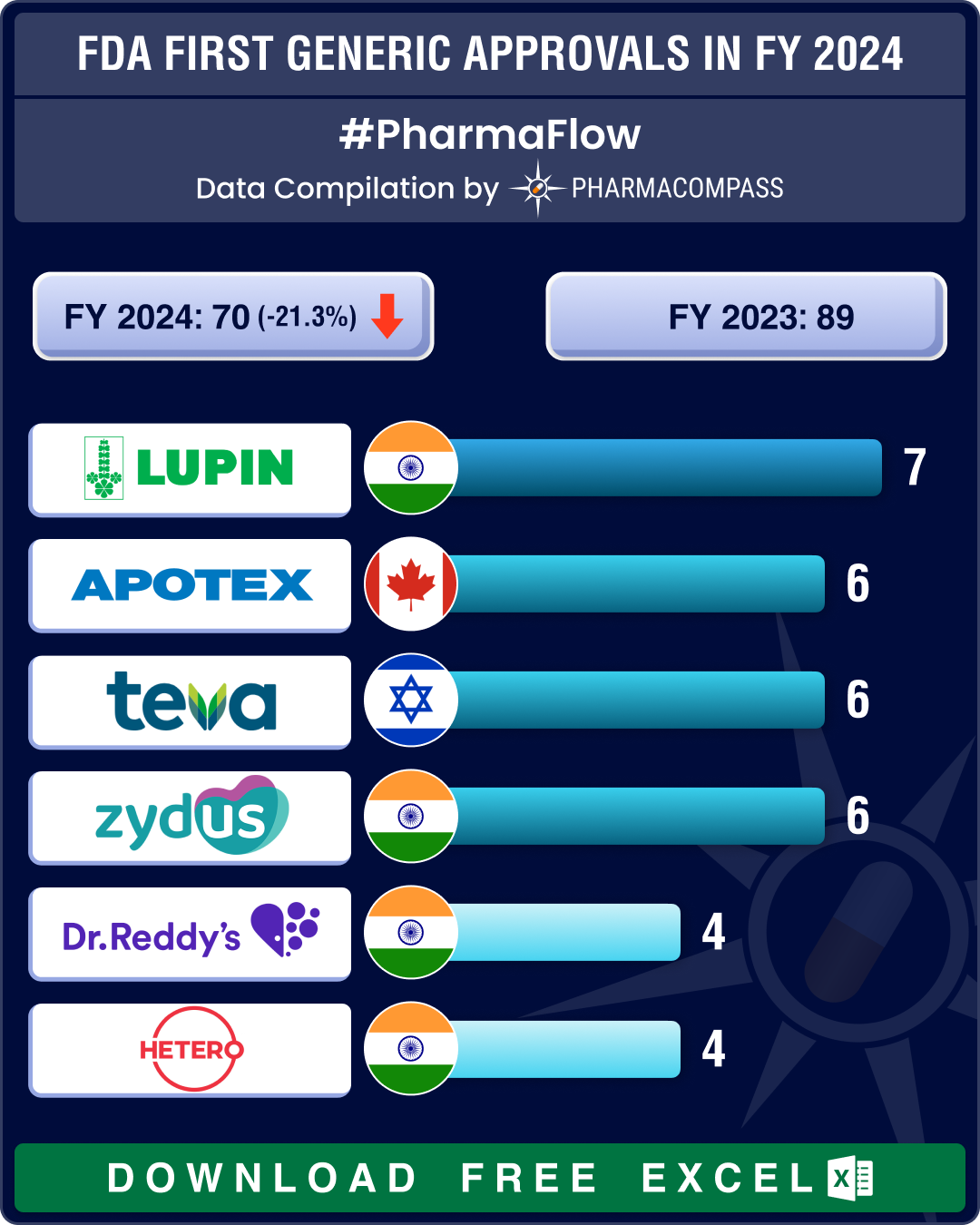
A watershed moment in the journey of a drug is when it transitions from being a patented, high‐priced innovator product to an affordable generic. Through an inaugural approval, or a “first generic”,  the US Food Drug Administration (FDA) permits a manufacturer to market a generic version of a brand‐name drug — a process that, when successful, grants 180 days of exclusivity to the generic sponsor. This exclusivity is especially valuable when the drug in question is a blockbuster. In FDA’s fiscal year 2024 (i.e. from October 1, 2023 to September 30, 2024), the number of first-time generic drug approvals decreased by 21.3 percent — from 89 in FY 2023 to 70 in FY 2024, the lowest in at least nine years. Lupin emerged as a frontrunner in first generics, increasing its approvals from three in FY 2023 to seven in FY 2024, Apotex and Zydus Lifesciences from four to six, and Dr. Reddy’s from two to four. In contrast, Teva, Amneal, and Sun Pharma experienced a decline. Overall, neurology led the way with 10 approvals, while immunology saw eight, including three approvals in dermatology. Oncology and cardiology/vascular disease saw six approvals each. Ophthalmology saw five while psychiatry, and infectious diseases each contributed four approvals.  View First Generic Drug Approvals by FDA in FY 2024 (Free Excel Available)   Novartis’ top seller Entresto, blockbuster Tasigna among six key drugs hit by generic rivals  In 2024, the tide turned sharply for Novartis as it lost exclusivity for six of its drugs. Among them was its blockbuster Entresto, that has generated US$ 29.2 billion in revenue so far, including US$ 7.8 billion in 2024. A combination of sacubitril and valsartan, Entresto has transformed heart failure management. Entresto was the primary driver of Novartis’ sales growth last year. It was also one of the 10 drugs selected by the Biden administration in 2023 for Medicare price negotiations.  Novartis has been fighting a fierce legal battle to protect Entresto from generic competition. In 2024, Entresto’s generic saga reached a crescendo. Alembic Pharmaceuticals, Laurus Labs, and Crystal Pharmaceutical’s generic versions of Entresto received FDA approval in May last year. But the Swiss drugmaker has noted that as of January 2025, there were no Entresto generics available in the US. Novartis’ Tasigna (nilotinib) has been a cornerstone in the treatment of Philadelphia chromosome-positive chronic myeloid leukemia (Ph+ CML). Apotex won approvals for generics of 50 mg, 150 mg, and 200 mg of nilotinib formulations, thereby offering a more affordable option for both adult and pediatric patients. Owing to the generics, Tasigna’s sales fell 10 percent in 2024. Novartis’ Mekinist (trametinib), Votrient (pazopanib), Rydapt (midostaurin), and Promacta (eltrombopag) have long been critical treatments in oncology and hematology. With generic competition hitting these key assets, Novartis is now aggressively forging deals to strengthen its pipeline. FDA clears first generics for Neurocrine’s Ingrezza, Supernus’s Gocovri, ALS drugs In psychiatry, Neurocrine Biosciences’ Ingrezza (valbenazine) capsules have carved out a niche for themselves as a first-in-class treatment for tardive dyskinesia, a movement disorder that can develop as a side effect of long-term use of antipsychotic meds. Two generics for Ingrezza from India’s Zydus and Lupin bagged FDA approval, as Ingrezza sales topped US$ 2.3 billion last year. Zydus also won first generic approval for Supernus Pharmaceuticals’ Gocovri (amantadine) extended-release capsules, which is a treatment of dyskinesia in Parkinson’s disease patients receiving levodopa-based therapy. Four companies received FDA approvals for their first generics of Mitsubishi Tanabe’s patented drug Radicava (edaravone). These are Dr. Reddy’s Laboratories, Gland Pharma (a Fosun Pharmaceutical subsidiary), Hikma and Long Grove. Radicava is a drug that treats amyotrophic lateral sclerosis (ALS), also known as Lou Gehrig's disease. Another treatment for ALS from Italfarmaco — Tiglutik (riluzole) — received a first generic when FDA okayed Alkem Laboratories riluzole oral suspension. The med helps slow disease progression. Pfizer’s Ibrance, Gilead’s Descovy, Lilly’s Olumiant treatment come under generic pressure In oncology, Synthon Pharmaceuticals launched its generic version of Pfizer’s Ibrance (palbociclib) tablets. Generating sales of US$ 4.4 billion in 2024, this groundbreaking CDK4/6 inhibitor is Pfizer’s best-selling cancer drug. It has transformed treatment for hormone receptor-positive, HER2-negative advanced breast cancer by halting cancer cell division and significantly extending progression-free survival when combined with endocrine therapy. Descovy, a combination of emtricitabine and tenofovir alafenamide, stands as one of the most important therapies in the fight against HIV infection and related conditions. Originally developed by Gilead Sciences, Descovy has played a pivotal role in modern antiretroviral therapy, contributing US$ 2.1 billion to Gilead’s revenue in 2024. Apotex’s first generic approval for Descovy marked its second copycat for a blockbuster drug in 2024. The other generic approval it got its hands on was for Boehringer Ingelheim’s Pradaxa (dabigatran etexilate), a blood thinner that posted sales of € 845 million (US$ 883 million) in 2023. In immunology, Eli Lilly’s Olumiant (baricitinib) has emerged as an important therapy for treating inflammatory conditions such as rheumatoid arthritis. Aurobindo Pharma bagged FDA approval for generic baricitinib tablets. Ipsen’s Somatuline Depot (lanreotide) injection, a treatment for neuroendocrine tumors and endocrine disorders that generated about € 1.07 billion (US$1.1 billion) in 2023 sales, also has a generic now, with Cipla’s subsidiary InvaGen Pharmaceuticals receiving an FDA approval. FDA okays copycats for opioid withdrawal med Lucemyra, weight loss drug Qsymia, contraceptive Slynd FDA also demonstrated a focused commitment to addressing two of the nation’s biggest public health concerns — the opioid crisis and obesity.  Lucemyra (lofexidine), originally developed by US WorldMeds, is a non-opioid medication indicated for mitigating symptoms associated with acute opioid withdrawal and facilitating the completion of opioid discontinuation treatment. The introduction of Indoco Remedies’ generic version is poised to expand access to this critical therapy by offering a cost-effective alternative for managing substance use disorders. Vivus’ Qsymia (phentermine/topiramate), a chronic weight management therapy, also received a first generic. Actavis’ generic for Qsymia provides a more accessible option to patients striving to lose weight. Actavis is a subsidiary of Teva. FDA also approved Lupin’s first generic version of Insud Pharma’s Slynd—a progestin‑only contraceptive containing 4 mg drospirenone for use by females of reproductive potential to prevent pregnancy. Our view Over the next two years, several blockbusters such as Novo Nordisk’s Ozempic (semaglutide), AstraZeneca’s Farxiga (dapagliflozin), Bristol Myers Squibb’s Revlimid (lenalidomide) and its Pfizer partnered drug Eliquis (apixaban) stand to lose their patent protection. We expect more patent litigations and some exciting innovations in the generics space.

Impressions: 6816

https://dev1.pharmacompass.com/radio-compass-blog/fda-s-first-generic-approvals-slump-21-in-2024-novartis-top-seller-entresto-cancer-blockbuster-tasigna-lead-2024-patent-cliff

#PharmaFlow by PHARMACOMPASS
20 Feb 2025

WEEKLY INDUSTRY NEWS

2read-more
read-more
Does the FDA promote European manufacturers over others? The ice-bucket challenge winner!
This week, Phispers brings you a short analysis on how FDA might be promoting European drugmakers over others. There is also news on how India plans to set up a drug audit office in China to check quality of APIs coming from there. Besides, there is news on lawsuits against J&J, a report on drug spends in the US and updates on new drug trials and approvals.   Does the FDA promote European manufacturers over others?   Does the US regulator have more faith on European manufacturers over those based in India and China? Recent news reports seem to suggest it does. Thomas Cosgrove, the Director of the Office of Manufacturing Quality (OMQ) within US Food and Drug Administration’s Center for Drug Evaluation and Research (CDER) spoke at the Food and Drug Law Institute's annual conference last week. Cosgrove directs CDER’s compliance activities with respect to current good manufacturing practice (cGMP) and product quality. In the coverage provided by RAPS, Cosgrove detailed some of the biggest challenges drugmakers face when contracting with foreign manufacturers.  “If any firm in the supply chain falls down, the supply chain itself can fall down. This is a very real risk," Cosgrove said, noting that the agency can reject applications for drugs over good manufacturing practice (GMP) issues. He further said: “You're pretty confident that those European companies you're dealing with have a strong culture of quality and can perform pretty consistently," But, like in other parts of the world, these companies might not have a deep experience with how the US regulations work or even how to deal with the FDA, and may not have been inspected by the agency before, he added. Cosgrove’s comments come at a time when a compilation by Barbara Unger on FDAZilla.com highlighted that the warning letters issued due to data-integrity concerns to firms in US and Europe (13 total) were more than those issued to firms in India (9) and almost equivalent to firms in China (14). There have also been other examples where inspection data highlights a difference in inspection outcomes for the same facilities. PharmaCompass had recently covered the US and EU’s efforts to utilize each other’s GMP inspections, and how such a dependence maybe problematic. While FDA has stepped up its inspections of foreign drug manufacturers in recent years, there are more than 1,000 foreign drug facilities the agency has never inspected. India to restart inspection of Chinese API manufacturers   India is cracking the whip on quality and will restart inspecting drug manufacturing facilities in China soon, in order to ensure only quality active pharmaceutical ingredients (API) are imported from countries like China. “In the light of the fact that India has faced repeated scrutiny of its manufacturing facilities in the name of quality medicines, the commerce ministry along with other concerned ministries are serious to set up a permanent audit office in China to conduct inspections on a regular basis in China,” G N Singh, Drug Controller General of India, said. The plan to set up a drug audit office in China for inspecting manufacturing units there is not new. It has been in the pipeline for the past three years, as the project is awaiting approval from several ministries in both India and China. India’s health ministry is also in the final stages to release a draft guideline towards enhancement of GMP to align India-specific standards with global regulations for better product quality of pharmaceutical products. The ice-bucket challenge winner! First new treatment approved by the FDA for ALS in 22 years   Last week, the US FDA approved Radicava (edaravone) — a drug to treat patients with the rare amyotrophic lateral sclerosis (ALS), commonly known as Lou Gehrig’s disease. ALS is a progressive disease that attacks and kills the nerve cells that control voluntary muscles. Eventually, the brain’s ability to start and control voluntary movement is lost, and the patient succumbs to the disease — usually after three to five years from the onset of the symptoms. Around 12,000-15,000 Americans are said to have ALS. Most people with ALS die from respiratory failure. British physicist Stephen Hawking is suffering from ALS. An “ice bucket challenge” conducted in 2014 drew global attention back to ALS. The challenge involved people pouring ice-cold water over each other’s heads, and posting a video on social media, seeking funds for research on the condition. Edaravone is an intravenous drug. The drug is being sold in Japan and South Korea by Mitsubishi Tanabe Pharma Corp. The company is selling the drug at US$ 145,000 per year. In the US, the last drug approved to treat this disease was Riluzole in 1995. However, the drug isn’t a cure for ALS, it only delayed the need for a breathing tube. Six months of treatment with edaravone reportedly reduced the rate of functional decline in patients by about a third. Another bad week for Teva — its new MS drug fails to meet primary endpoint   Teva’s bad days don’t seem to relent. Last week, it’s late-stage trial for laquinimod — considered a successor to the aging flagship multiple sclerosis therapy Copaxone — failed the test on the relapsing-remitting form of the disease. The drug did not meet the primary endpoint, trying to significantly improve the time to disability progression compared to placebo after three months. Teva’s laquinimod was heralded as its brightest pipeline prospect. Investigators are still testing this drug for primary progressive MS and Huntington’s disease. But due to this failure, it’s unlikely that analysts will ascribe much potential value to the drug.  Early last year, Teva (which had partnered with Active Biotech) was forced to suspend use of the highest dose of laquinimod due to cardio side effects. Despite this setback, Teva was hopeful of a win with the lower doses and was preparing for a launch after completing studies this year. Trump administration gets FDA to switch TVs from CNN to Fox News   The Trump administration is ensuring researchers at FDA view the media of its choice. This week, CBS News confirmed an email was sent to researchers at the FDA's Center for Biologics Evaluation and Research to change the channel on internal television screens from CNN to Fox News. CNN and Donald Trump have been feuding for several months now. On May 2, CNN had refused to air an advertisement issued on 100 days of Trump administration, that called mainstream media “fake news” — a term frequently used by the president.  The email from “[White Oak] Digital Display” sent on Wednesday, May 3, was sent to inform the researchers of the “reason for the change from CNN to Fox". White Oak is the name of the FDA’s campus. The email informs employees that the decision came from the Trump administration. “The reason for the change is that a decision from the current administration, administrative officials has requested that all monitors, under our control, on the White Oak Campus, display FOX news,” the email reads. People are paying less for drugs, says IMS Quintiles report While there is widespread outrage in the US over soaring drug prices, a new study by QuintilesIMS Institute shows people are, on an average, actually paying less for their medications than they did a few years ago. QuintilesIMS Institute is a research organization that specializes in healthcare analysis. The report is independent, and did not receive industry funding. While drug prices are on the rise with net prices rising 3.5 percent last year, patients’ out-of-pocket costs for medicines have declined — from US$ 32 per name-brand prescription in 2013 to US$ 28 today, the study said. “The outlook for medicine spending through 2020 is for mid-single digit growth driven by further clusters of innovative treatments, offset by a rising impact from brands facing generic or biosimilar competition,” says a QuintilesIMS report titled ‘Medicines Use and Spending in the U.S. – A Review of 2015 and Outlook to 2020’. However, this isn’t the only report that shows this counterintuitive pattern of declining out-of-pocket costs. A Peterson-Kaiser Health System Tracker report last year found a slight decline in patients' personal spending on prescriptions, even as the overall costs increased. Mixed week for J&J, as it loses talc verdict and wins Xarelto case   Last week was a mixed week for Johnson & Johnson (J&J). On the one hand, the St. Louis jury ordered Johnson & Johnson to pay US$ 110 million to Lois Slemp, a lady who claimed several decades of using talc products caused her ovarian cancer that later spread to her liver. On the other hand, J&J won a bellwether case last week over the alleged risks of its blockbuster drug, Xarelto. The Slemp trial lasted several weeks and had Slemp’s attorneys call upon scientists to testify studies documenting a link between ovarian cancer and talc use. Slemp’s attorneys also presented documents showing that J&J knew about the risks. J&J, however, said it will appeal against the verdict.  A company spokesperson said a previous victory (for J&J) in St. Louis and two in New Jersey “highlight the lack of credible scientific evidence behind plaintiffs’ allegations." In the other case, a US court (the federal jury in New Orleans) cleared Bayer AG and J&J of liability in the first trial emanating from thousands of lawsuits that blamed injuries on the blood thinner Xarelto. “The jury's verdict affirms both the safety and efficacy of Xarelto, and that its FDA-approved label contains accurate, science-based information on the benefits and risks of this life-saving medicine,” Bayer said in a statement. Rivaroxaban's total 2016 sales were $ 5.392 billion.  

Impressions: 3623

https://dev1.pharmacompass.com/radio-compass-phisper/does-the-fda-promote-european-manufacturers-over-others-the-ice-bucket-challenge-winner

#Phispers by PHARMACOMPASS
11 May 2017

NEWS LIBRARY

26read-more
read-more

https://www.accessdata.fda.gov/scripts/cder/daf/index.cfm?event=overview.process&ApplNo=216035

FDA
22 Aug 2024

https://www.pharmacompass.com/pdf/news/enforcement-report-week-of-november-29-2023-18805.pdf

FDA
29 Nov 2023

https://www.globenewswire.com//news-release/2023/10/10/2757986/7767/en/MediciNova-Receives-a-Notice-of-Allowance-for-a-New-Patent-Covering-the-Combination-of-MN-166-ibudilast-and-Riluzole-for-the-Treatment-of-Amyotrophic-Lateral-Sclerosis-ALS-in-Canad.html

GLOBENEWSWIRE
10 Oct 2023

https://www.globenewswire.com/news-release/2022/03/03/2396245/0/en/Aquestive-Therapeutics-and-Haisco-Pharmaceutical-Group-Enter-Licensing-and-Supply-Agreement-for-Riluzole-Oral-Film-for-ALS-Treatment-in-China.html

GLOBENEWSWIRE
03 Mar 2022

https://www.nih.gov/news-events/news-releases/repurposed-als-drug-shows-promise-mouse-model-rare-childhood-genetic-disorder

NIH
19 Nov 2021

https://www.mt-pharma-america.com/2021/06/30/mitsubishi-tanabe-pharma-america-announces-exservan-riluzole-is-now-available-in-the-u-s-for-the-treatment-of-als/

PRESS RELEASE
01 Jul 2021
digital-content5070##p