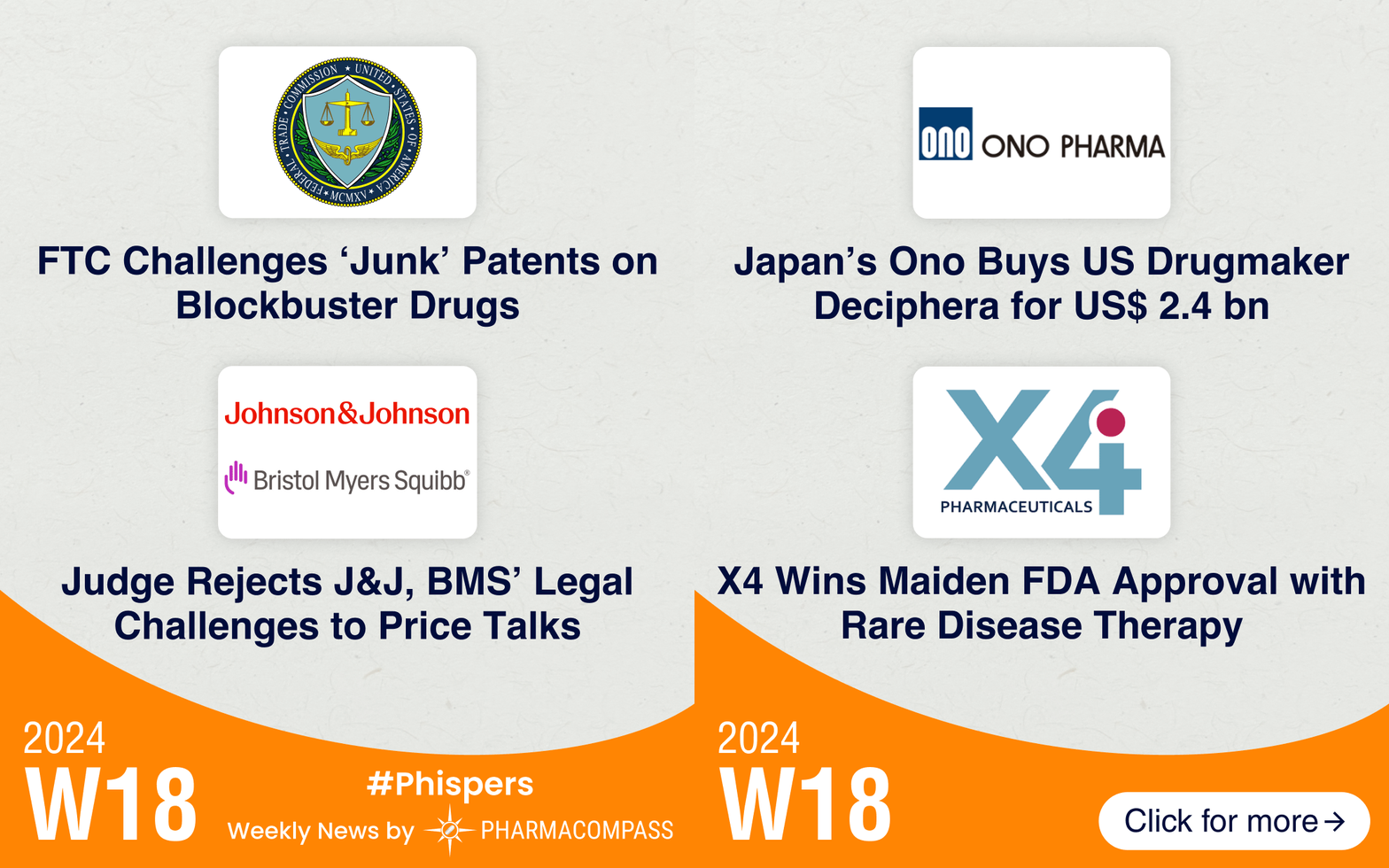
The price of drugs is the highest in the US, and the White House has been working on bringing down drug prices for several years now. This week, the US Federal Trade Commission (FTC) intensified its efforts to bring down the price of drugs by disputing the accuracy and relevance of over 300 patent listings in US Food and Drug Administration’s (FDA’s) Orange Book. It also shot off warning letters to 10 drugmakers in the matter.The White House got another shot in the arm when a federal judge tossed out Johnson & Johnson and Bristol-Myers Squibb’s legal challenges to the constitutionality of price negotiations under the Inflation Reduction Act (IRA).Meanwhile, FDA approved the first gene therapy Pfizer that
treats hemophilia B, a rare bleeding disorder. The agency also handed X4
Pharmaceuticals its maiden approval as it greenlit Xolremdi capsules to treat
patients 12 years of age and older with WHIM syndrome, a rare immunodeficiency
disease. In acquisitions and deals, Japan’s Ono Pharmaceutical has agreed to acquire Massachusetts-based Deciphera Pharmaceuticals for US$ 2.4 billion in cash in a bid to expand its oncology portfolio and presence in the West. Novartis expanded its peptide discovery collaboration with Japan-based PeptiDream in a deal worth over US$ 2.71 billion in milestone payments. And, Morphosys has confirmed that its takeover by Novartis is advancing steadily.FTC challenges over 300 patent listings across 20 brands in FDA’s Orange BookFTC has shot off warning letters to 10 drugmakers and notified the FDA that it disputes the accuracy or relevance of
over 300 patent listings in its Orange Book across 20 different brand name
drugs. The list includes Novo Nordisk’s blockbuster diabetes drug
Ozempic (semaglutide).The consumer protection agency contends that drugmakers are needlessly
listing dozens of extra patents for branded medications to keep their drug
prices high and stall entry of generic competitors into the US market.Among other drugmakers that received warning letters for “bogus patent listings” were AstraZeneca, Boehringer Ingelheim, GSK, Novartis, and Teva for their diabetes,
weight-loss, asthma, and chronic obstructive pulmonary disease (COPD) drugs.FDA approves first gene
therapy from Pfizer to treat rare bleeding disorderFDA has approved Pfizer’s one-time gene therapy — Beqvez (fidanacogene
elaparvovec-dzkt) — for adults with hemophilia B, a rare genetic bleeding disorder. This marks the first gene therapy by the American pharma giant
to win clearance in the US. Beqvez was listed at US $3.5 million, the same
price as its rival gene therapy Hemgenix from Australia’s CSL.X4 lands maiden FDA approval: Boston-based
X4 Pharmaceuticals has landed its maiden FDA approval after the agency okayed Xolremdi (mavorixafor) capsules in patients 12
years of age and older with WHIM syndrome
(warts, hypogammaglobulinemia, infections and myelokathexis). Xolremdi is the first therapy approved in the US for this
rare genetic disease.Judge tosses out lawsuits
contesting constitutionality of IRA price negotiationsA federal judge in New Jersey rejected legal challenges by J&J and BMS to the Biden administration’s Medicare drug-price negotiations, ruling that the program is constitutional. The judge contended that the price negotiations
with Medicare and Medicaid are voluntary and dismissed the notion that they violated the drugmakers’ Fifth Amendment rights, which cover illegal taking
over of property. This was the fourth federal judge to rule in favor of the
White House as it chalks up yet another win in a bitter legal battle with
several pharma companies over the constitutionality of the IRA price negotiations.J&J proposes US$ 6.5 bn settlement to end all talc lawsuits: J&J has offered a US$ 6.48 billion
settlement plan to resolve nearly all of its pending talc
lawsuits, to be paid over 25 years. An overwhelming 99.75
percent of the lawsuits to be resolved claim that the talc caused ovarian cancer. J&J will allow ovarian cancer claimants to vote on the offer and should it reach a 75 percent support threshold, the company can end litigation and prevent future lawsuits via a bankruptcy filing of its subsidiary LTL Management.Ono to buy Deciphera for US$
2.4 bn to expand oncology portfolio, US presenceJapanese drugmaker Ono Pharmaceutical has agreed to acquire Massachusetts-based Deciphera Pharmaceuticals for US$ 2.4 billion in cash. The acquisition
gives Ono access to Qinlock (ripretinib), a kinase inhibitor approved in over 40 countries including in the US, Europe, and China, as a fourth-line treatment for gastrointestinal stromal tumor (a type of cancer that begins in the digestive system). Ono will also get another key investigational drug — vimseltinib — that has shown efficacy in phase 3 trials in patients with tenosynovial giant cell tumor (a benign lesion).Novartis, PeptiDream ink radiopharma deal: Novartis has expanded
its peptide discovery collaboration with Japan-based PeptiDream in a deal worth over US$ 2.71 billion in milestone payments, plus
an upfront payment of US$ 180 million. Under the multi-program
agreement, PeptiDream will use its proprietary Peptide Discovery Platform
System technology to identify and optimize novel macrocyclic peptides against
targets selected by Novartis. Peptide-drug conjugates (PDCs) are the next generation
of targeted therapeutic drugs after antibody-drug conjugates (ADCs) and
Novartis is the only big pharma with FDA-approved radioligand PDCs thus far.BMS, Repertoire tie-up for
vaccines: BMS and Repertoire Immune Medicines have entered into a potential US$ 1.8 billion, multi-year collaboration to create tolerizing vaccines for up to three autoimmune diseases. Repertoire will utilize its T cell receptor (TCR)-epitope
discovery platform, Decode, and its proprietary lipid nanoparticle delivery
technology to discover and develop treatments for
patients suffering from autoimmune diseases by resetting the immune system.Buyout by Novartis on course, says Morphosys: Morphosys has confirmed that its takeover by Novartis is advancing steadily and is
anticipated to close in the first half of 2024.
The news comes after STAT News
published a report stating the lead candidate
of the € 2.7 billion (US$ 2.89 billion) deal — pelabresib — had run into safety problems in a phase 3 trial. The
promising investigational drug is being developed to treat myelofibrosis, a
rare kind of blood cancer that affects the bone marrow.Metagenomi, Moderna part ways: Metagenomi and Moderna have mutually agreed to walk out on their collaboration to develop gene editing therapies.
The deal was reportedly worth up to US$ 3 billion in biobucks.














 Share