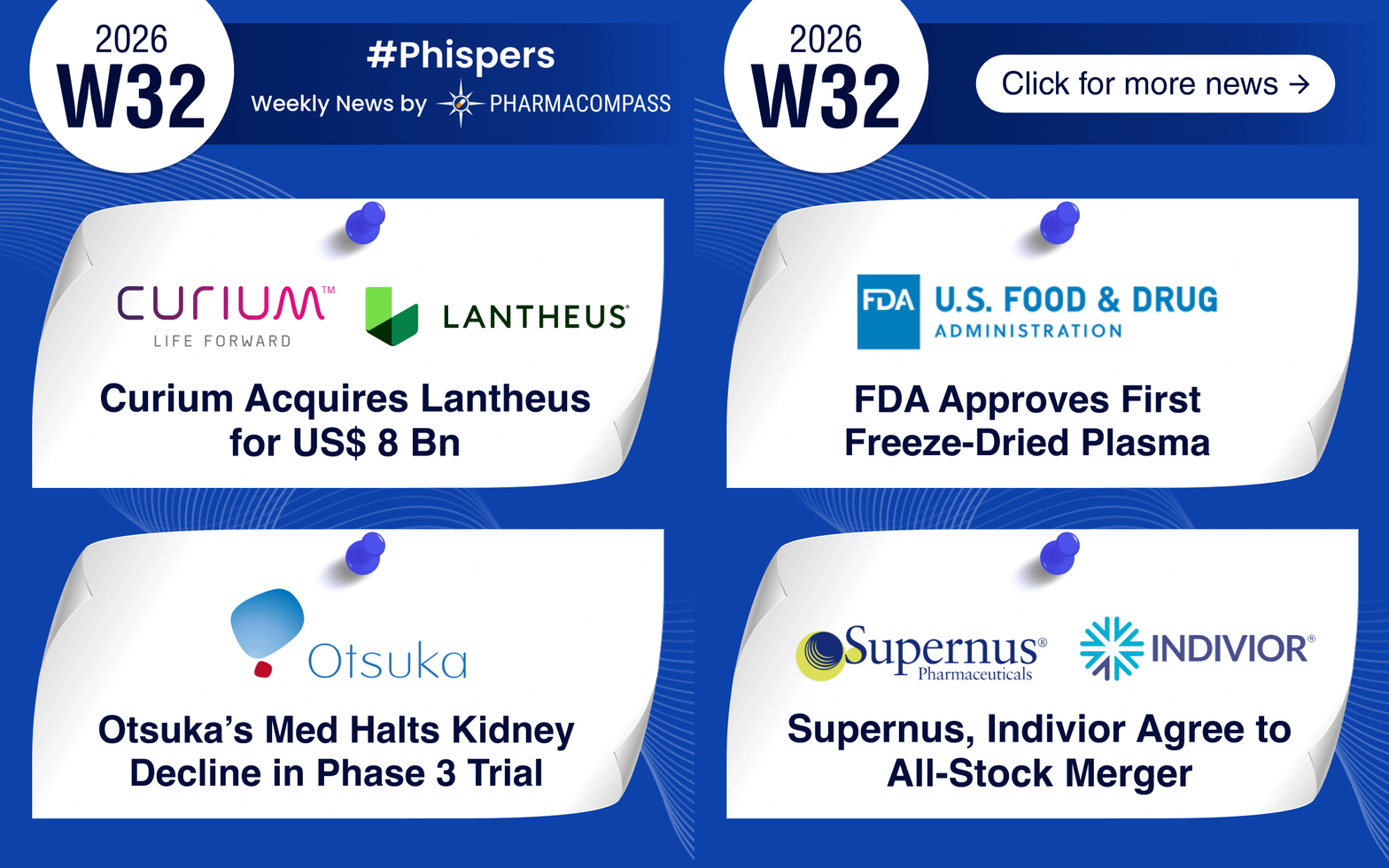
This week’s Phispers is packed with news about mergers. First, Curium announced the acquisition of Lantheus for US$ 8 billion. The merger will create a global radiopharmaceutical player. Second, Supernus and Indivior Pharmaceuticals have agreed to an all-stock merger that would create a central nervous system-focused company.And third, there were reports that AstraZeneca and Bristol Myers Squibb have been holding preliminary talks over a merger. However, a “senior source close to the matter” has denied the news to Reuters, stating there are no ongoing discussions between the two companies.In drug approvals, the US Food and Drug Administration (FDA) has approved Novartis’ Pluvicto to treat metastatic hormone-sensitive prostate cancer. The agency has also approved the first freeze-dried plasma product from Vascular Solutions. And the European Commission has approved AbbVie’s Rinvoq (upadacitinib) for adults and adolescents with severe alopecia areata and non-segmental vitiligo (an autoimmune condition).Otsuka’s Voyxact (sibeprenlimab) has become the first drug to stabilize kidney function in IgA nephropathy to the normal rate seen in healthy adults in a two-year phase 3 trial. And Pfizer has announced positive results from a phase 3 trial on Litfulo (ritlecitinib) in patients with non-segmental vitiligo.Curium to acquire
Lantheus for up to US$ 8 bn to create global radiopharma player Curium has agreed to buy Lantheus Holdings for up to US$ 8 billion. Both companies are into radiopharmaceuticals, or radioactive
isotopes used to diagnose and treat diseases, including cancers. Together,
Curium and Lantheus are positioned to create a radiopharmaceutical company spanning diagnostics and therapeutics, serving oncology, neurology and cardiology patients across more than
70 countries.Supernus,
Indivior merger: Supernus Pharmaceuticals and Indivior Pharmaceuticals have agreed to an all-stock merger that would create a central nervous system-focused company with expected annual sales of US$ 2.2 billion this year. The portfolio of the merged entity
would include drugs for neurological, psychiatric and addiction-related
conditions. The merged company will be known as Supernus.Otsuka’s Voyxact becomes first drug to halt kidney decline in phase 3 trialOtsuka’s Voyxact (sibeprenlimab) has become the first drug to stabilize kidney function in IgA nephropathy to the normal rate seen in healthy adults, according to two-year results from a phase 3 trial. IgA nephropathy is a disease in which faulty antibodies lodge in the kidney’s filters, and it often progresses to dialysis or transplant. A complete analysis of the two-year phase 3 trial will be presented at an upcoming
scientific congress. Pfizer’s Litfulo scores phase 3 win in vitiligo: Pfizer has announced positive topline results from two phase 3 trials on
Litfulo (ritlecitinib) in non-segmental vitiligo, an autoimmune condition in
which the immune system destroys the cells that make pigment. Litfulo helped restore patients’ skin color in the late-stage trials. This paves the way for regulatory submissions. Litfulo is already approved to treat severe alopecia areata.Meanwhile, in its
second-quarter earnings, Pfizer has said it will add another US$ 2.5 billion in cost cuts to its ongoing restructuring program. These additional cutbacks will raise Pfizer’s total cost-saving target to US$ 9.7 billion. The cutbacks will kick in next year and run through 2029.No ongoing merger discussions between AstraZeneca, BMS, reports ReutersLast week, the Financial Times had reported that AstraZeneca and Bristol Myers Squibb (BMS) have held preliminary discussions about the possibility of a merger. There was also talk about the possibility of this being one of the largest deals in history, with a combined value of nearly US$ 400 billion. However, a Reuters news report denied any ongoing discussions between the two drugmakers, quashing
the prospect of the mega merger. The report quoted a senior source close to the
matter.FDA clears Novartis’ Pluvicto for prostate cancer, approves first freeze-dried plasmaFDA has approved Novartis’ Pluvicto (lutetium Lu 177 vipivotide
tetraxetan)
in combination with an androgen receptor pathway inhibitor, in metastatic
hormone-sensitive prostate cancer, also known as PSMA-positive metastatic prostate
cancer. Pluvicto can now be used across all stages of metastatic prostate
cancer, roughly doubling the eligible patient population.Freeze-dried
plasma: FDA has approved Vascular Solutions’ Ezplaz, the first freeze-dried plasma (FDP) product cleared for use in the US. Vascular Solutions is a subsidiary of Teleflex, a leading provider of medical
technologies. Ezplaz is meant for transfusion in adult patients who need plasma
and for whom other plasma products are not available. Plasma (the part of blood
that helps it clot) needs to be kept frozen, and is thawed before transfusion.
Ezplaz is stable at room temperature and comes in a plastic bag rather than
breakable glass.Rinvoq okayed for severe alopecia, non-segmental vitiligo: The European Commission has approved AbbVie’s Rinvoq (upadacitinib) for adults and adolescents aged 12 and above with severe alopecia areata, an autoimmune
disease in which the immune system attacks hair follicles, causing patchy or
total hair loss. On the same day, Europe also approved Rinvoq for the
treatment of non-segmental vitiligo.J&J strikes collaboration deal with Sail Biomedicines to develop CAR-T programsJohnson & Johnson has struck a collaboration deal with American biotech Sail Biomedicines worth up to US$ 925 million to advance the latter’s in vivo CAR-T programs for autoimmune diseases. J&J will pay US$ 785 million upfront, and up to US$ 140 million in milestone payments. Additionally, J&J has the option to acquire Sail for US$ 2.58 billion.Pathos AI-Alphamab ink deal: New York-based Pathos AI, a clinical-stage AI and technology company, has licensed an experimental drug to treat triple-negative breast cancer from China’s Alphamab Oncology. Pathos AI will pay US$ 125 million
upfront for rights outside Greater China, plus up to US$ 2.09 billion in
milestone payments and royalties.Novo’s experimental drug fails to cut cardiovascular risk in phase 3 trial Novo Nordisk’s experimental drug ziltivekimab failed to reduce major adverse cardiovascular events, such as death, heart attack and stroke, when compared with a placebo in a phase 3 trial. The trial enrolled patients with atherosclerotic cardiovascular disease, chronic kidney disease
and inflammation. Novo had acquired ziltivekimab through its US$ 725 million
purchase of Corvidia Therapeutics in 2020.Karyopharm’s Xpovio fails endometrial cancer trial: Karyopharm Therapeutics has said its phase 3 trial of Xpovio (selinexor) as maintenance treatment (vis-a-vis placebo) in advanced or recurrent endometrial cancer missed its primary
goal of delaying disease progression. The trial did not meet its primary
endpoint of progression-free survival.














 Share