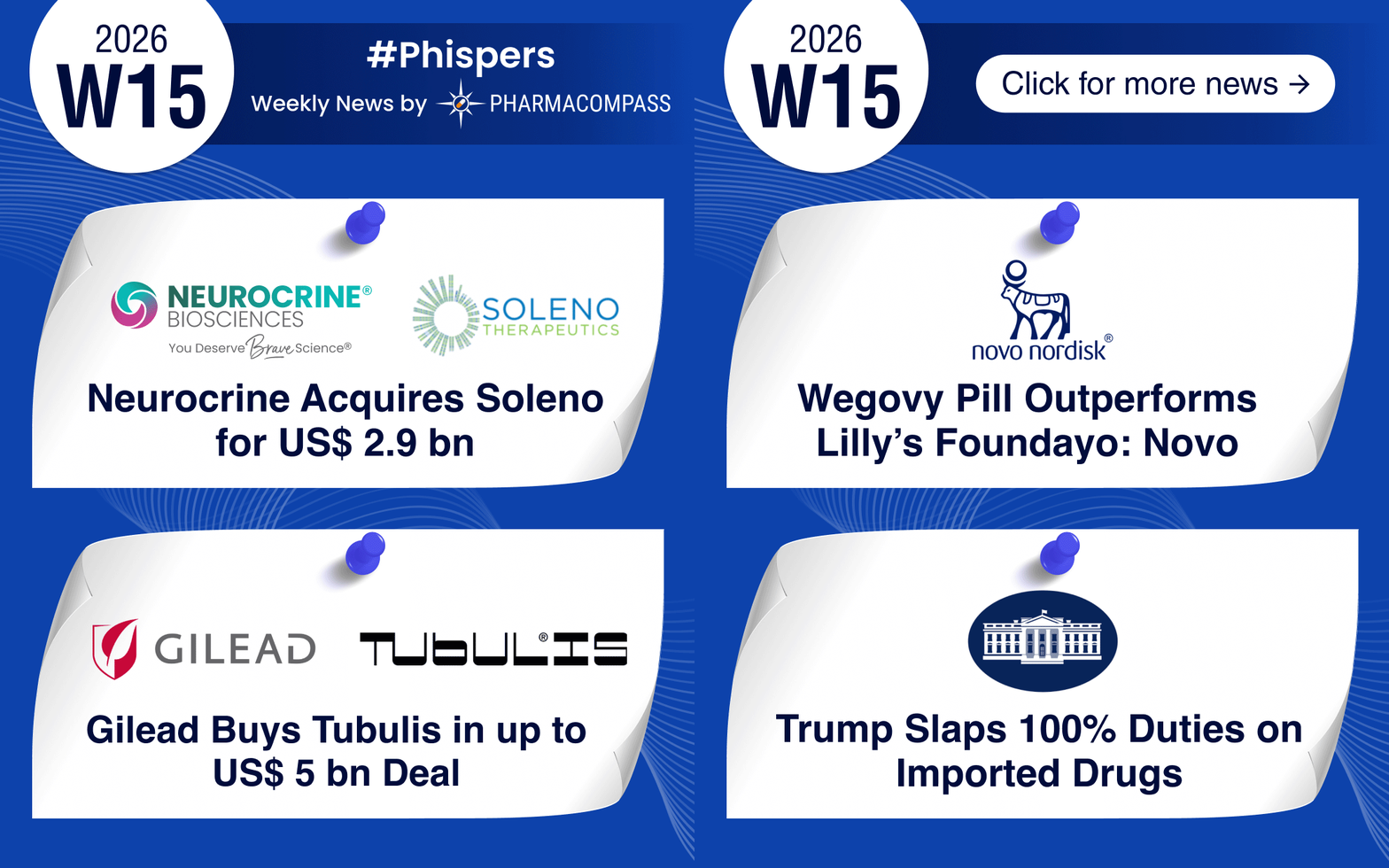
In Phispers this week, Neurocrine Biosciences announced the
acquisition of rare-disease drugmaker Soleno Therapeutics for US$ 2.9 billion
in cash. Gilead announced it would acquire German biotech Tubulis for up to US$
5 billion to strengthen its oncology portfolio.Novo Nordisk has said its recently launched Wegovy (semaglutide) pill has shown more pronounced weight loss and less cumbersome side effects than Eli Lilly’s orforglipron, which received US Food and Drug Administration (FDA) approval last week. These assertions were made based on findings from a cross-trial study using data from two phase 3 clinical trials. Novo also launched a higher-dose variant of Wegovy that received FDA approval last month.There is news from two Covid-19 vaccine drugmakers — Novavax and BioNTech. While BioNTech is shutting its Singapore vaccine plant due to drop in sales, Novavax faced push back from its second largest investor, Shah Capital. The hedge fund wants the leadership to reduce costs.In news from clinical trials, Amgen’s subcutaneous injection Tepezza (teprotumumab-trbw) met its key endpoints in a late-stage trial in patients with thyroid eye disease (TED).And US President Donald Trump signed an executive order, imposing
100 percent tariffs on branded pharmaceuticals imported into the US, albeit
with various exceptions. The US also signed a pharmaceutical trade deal with
the UK, providing tariff-free access for UK-made medicines to the US.Neurocrine buys rare disease drugmaker Soleno Therapeutics for US$
2.9 billionNeurocrine Biosciences is acquiring rare-disease drugmaker Soleno Therapeutics for US$ 2.9 billion in cash.
The deal gives Neurocrine access to Vykat
XR (diazoxide choline), the first drug approved in the US to treat
hyperphagia associated with Prader-Willi syndrome, a rare genetic disorder.
Hyperphagia, or insatiable hunger, is the hallmark symptom of this syndrome. It
can lead to co-morbidities such as obesity and other cardiometabolic diseases.
The deal, which is expected to close in the next 90 days, will be funded with
cash on hand. Meanwhile, Soleno has voluntarily withdrawn the European marketing application for Vykat XR following Neurocrine’s plans to sharpen focus on the US market.Novavax shareholder pushes back: In the upcoming annual meet,
Novavax’s activist investor Shah Capital plans to vote against the re-election of board nominees and the executive compensation package. Himanshu Shah, founder of the hedge fund, has urged Novavax’s leadership to reduce costs and buy back 10 to 20 million shares at an opportune time. Shah Capital is Novavax’s second-largest shareholder with a 9 percent
stake.Gilead boosts cancer pipeline with up to US$ 5 bn buyout of German biotech TubulisGilead has announced the acquisition of Germany-based
clinical-stage biotech Tubulis GmbH for up to US$ 5 billion to strengthen its cancer drugs pipeline. With this acquisition, Gilead will gain access to Tubulis’ next-generation antibody-drug conjugates
(ADCs). These are targeted therapies used in the treatment of hard-to-treat,
recurrent, or metastasized cancers.Gilead
will acquire all outstanding equity of Tubulis for US$ 3.15 billion in upfront
cash and up to US$ 1.85 billion in milestone payments. The companies had
previously entered into licensing agreements to develop ADCs. Once the deal
closes, Tubulis will operate as an ADC research organization within Gilead.BioNTech to shut Singapore plant by early 2027: German biotechnology firm BioNTech has made a strategic decision to close its vaccine and therapeutic drug
manufacturing plant in Singapore by February 2027 due to
falling revenues. The plant currently has 85 employees. BioNTech had purchased
the facility from Novartis in November 2022.Novo says Wegovy pill outperforms Lilly’s Foundayo in cross-trial comparisonAfter
Eli Lilly’s GLP-1 drug Foundayo (orforglipron) won an FDA approval last
week, its arch rival Novo Nordisk has said that
its Wegovy (semaglutide) pill showed more pronounced weight loss and
less cumbersome side effects than orforglipron. The Wegovy pill was launched in January.Novo
made the assertion based on the Orion study, a
population-adjusted indirect treatment comparison evaluating weight loss
efficacy and tolerability between oral semaglutide 25 mg and orforglipron 36
mg, using data from two phase 3 clinical trials.Oral Wegovy demonstrated “significantly greater mean weight loss” than orforglipron in the Orion study, which did not include any fresh data points.Launches higher-dose Wegovy in US: Novo Nordisk has launched a higher-dose Wegovy — Wegovy HD — in the US, which had received FDA approval nearly three weeks back under the Commissioner’s National Priority Review Voucher program. Wegovy HD is a once-weekly injection that contains 7.2 milligrams
of semaglutide.Amgen’s injected version of Tepezza scores phase 3 win in thyroid eye diseaseAmgen has announced positive topline results from a phase
3 trial of subcutaneous injection Tepezza (teprotumumab-trbw), administered by way of an on-body injector (OBI), in patients with moderate-to-severe
active thyroid eye disease (TED). Tepezza OBI hit both the main objective as
well as the secondary endpoint in the late-stage trial. The company has said
that Tepezza OBI provides comparable efficacy to, and builds upon the success
of, intravenous Tepezza, the first and only medicine approved for the treatment
of TED.Trump slaps 100% duties on imported drugs, albeit with plenty of
exceptionsThe
US President Donald Trump signed an executive
order last week, imposing 100 percent tariffs on branded pharmaceuticals imported
into the US. The tariffs will come into effect in 120 days for certain large
companies, and 180 days for smaller companies. However, there are several exceptions. For instance, if a drug is from the European Union, Japan, Korea, or Switzerland and Liechtenstein, a 15 percent tariff will apply. The duty also doesn’t apply to companies that have entered into Most Favored Nation pricing agreements and onshoring agreements with the US government. Moreover, the tariffs do not apply to generic drugs, biosimilars, and associated ingredients. More than 90 percent of medicines sold in the US are generics.UK finalizes tariff-free pharma deal with US: The UK and US have signed a pharmaceutical trade deal, providing tariff-free
access for UK-made medicines to the US, in return for paying higher prices for new medicines. This makes Britain the first country in the world to secure zero percent tariffs on drug exports to the US.Tariffs to harm patients, says Swiss trade body: Switzerland’s pharmaceutical association Interpharma has said Trump’s 100 percent tariffs on drugs threaten global
production supply chains and will ultimately harm the patients. Interpharma has
urged the Swiss government to negotiate a deal similar to the one signed by the UK and the US.













 Share