Please Wait
Applying Filters...
Menu

Digital Content read-more

Create Content with PharmaCompass, ask us

PHARMA & BIOTECH INSIGHTS

2read-more
read-more

A PHP Error was encountered

Severity: 8192

Message: mb_convert_encoding(): Handling HTML entities via mbstring is deprecated; use htmlspecialchars, htmlentities, or mb_encode_numericentity/mb_decode_numericentity instead

Filename: blog/grid.php

Line Number: 52

Backtrace:

File: /var/www/html/application/views/include/media/blog/grid.php
Line: 52
Function: mb_convert_encoding

File: /var/www/html/application/models/Cmn.php
Line: 3595
Function: view

File: /var/www/html/application/views/include/product/digitalContent/grid.php
Line: 17
Function: common

File: /var/www/html/application/views/include/desc/inner.php
Line: 13
Function: view

File: /var/www/html/application/views/include/desc/indexNew.php
Line: 2433
Function: include

File: /var/www/html/application/controllers/Common.php
Line: 11303
Function: view

File: /var/www/html/index.php
Line: 231
Function: require_once

DMF filings rise 4.5% in Q3 2025; China holds lead, India records 20% growth in submissions
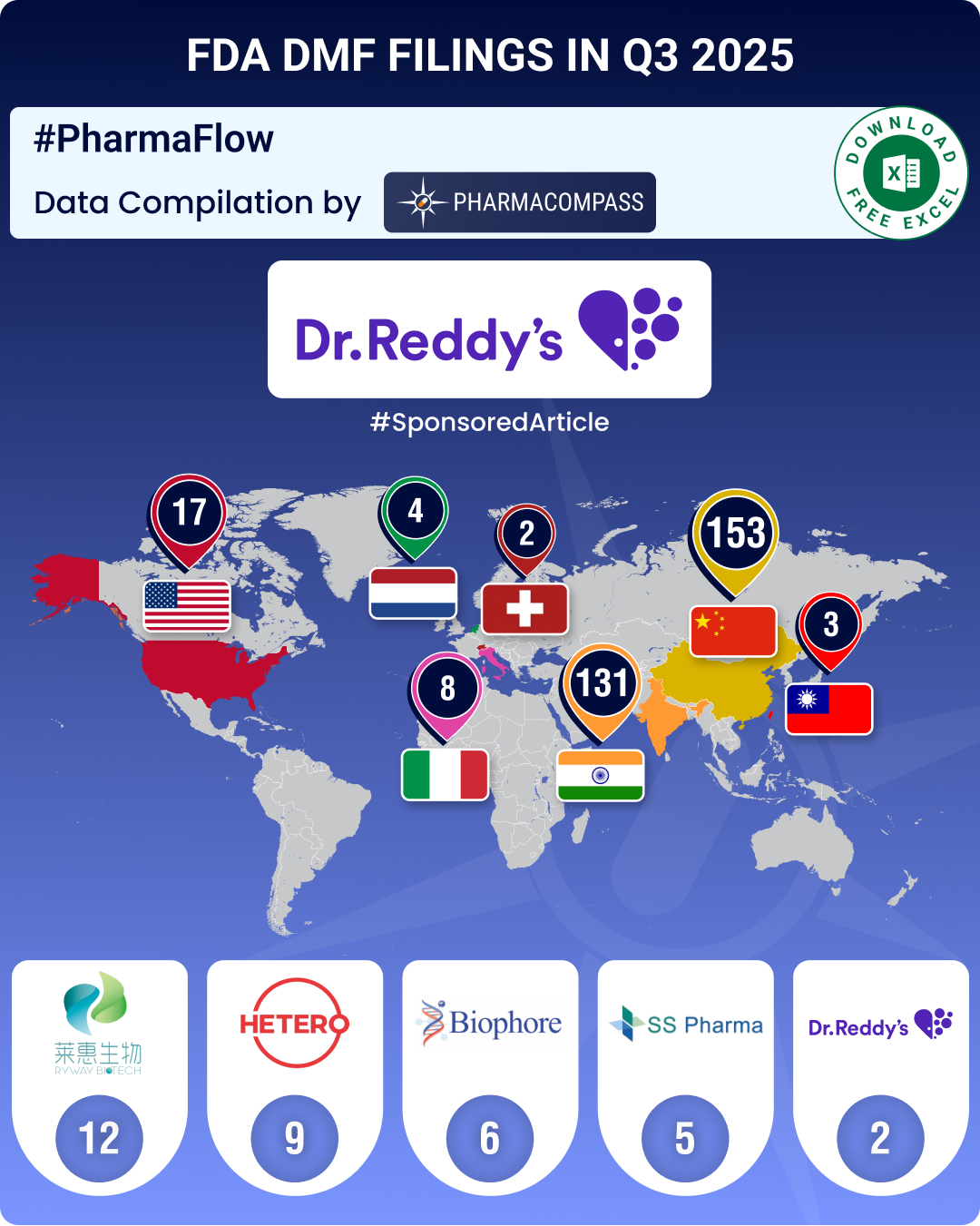
The third quarter (Q3) of 2025 witnessed a steady rise in Drug Master File (DMF) submissions to the US Food and Drug Administration (FDA). DMFs are used to provide confidential, detailed information about facilities, processes, or articles used in the manufacturing, processing, packaging, and storing of human drug products A total of 323 Type II DMFs were submitted during this period, as opposed to 309 submissions in Q3 2024, marking an increase of 4.53 percent. This is the second highest number since 2018. In Q1 2025, 339 Type II filings were recorded. Across all DMF types (II, III, IV, and V), 479 DMFs were filed in Q3 2025, compared to 394 in Q3 2024, representing a 21.57 percent increase. Out of the 323 Type II DMFs submitted in Q3 2025, 40 had completed their review by the end of Q3, reflecting a processing lag between submission and review completion.  View FDA DMF Filings in Q3 2025 (Power BI Dashboard, Free Excel Available) China maintains its lead while India posts double-digit growth in DMF submissions  China and India continued to dominate DMF submissions in Q3 2025. China retained the top spot with 153 Type II DMFs, matching its submission count from Q3 2024. India recorded 131 DMFs, marking a 20.18 percent increase over 109 filings during the corresponding period last year. The United States stood a distant third with 17 filings, compared to 13 in Q3 2024. Among European nations, Italy recorded eight DMFs, doubling its 2024 tally. The Netherlands filed four, up from three. Spain submitted only one DMF, as against seven submitted in Q3 2024. Taiwan made three filings, up from one submitted in Q3 2024. Together, India, China and Taiwan accounted for about 88.9 percent of all Type II DMFs filed during the quarter. China’s Suzhou Ryway Biotech tops corporate tally; India’s Hetero, Biophore follow China’s Suzhou Ryway Biotech led the company-wise tally with 12 DMF submissions in Q3 2025. The company had not filed any DMFs in Q3 2024. India’s Hetero Group followed with nine DMFs, maintaining the same number of filings as Q3 2024. Biophore India Pharmaceuticals ranked third with six DMFs, doubling its count from three last year. Other notable contributors include Sai Sreyas Pharmaceuticals (India) and Shanghai Haoyuan Chemexpress (China), with five DMFs each. Companies such as SNJ Group, Lunan Pharmaceutical, Allsino Pharmaceutical, Shankus Pharma, Jiangxi Xinganjiang Pharmaceutical, Sunpure Extracts, Lee Pharma, Umedica Laboratories, Linhai Tianyu Pharmaceutical and Maithri Drugs filed four DMFs each. Olaparib, semaglutide lead molecular filings; Dr. Reddy’s files DMF for edoxaban & tucatinib Dr. Reddy’s Laboratories also featured among key DMF filers in Q3 2025, submitting two DMFs — for edoxaban tosylate monohydrate and tucatinib copovidone. Edoxaban tosylate monohydrate (marketed as Savaysa by Daiichi Sankyo) is a prescription anticoagulant used to reduce the risk of stroke and to treat deep vein thrombosis and pulmonary embolism. Patent exclusivity for Savaysa extends until October 2026 in the United States, with no generic currently available. In terms of molecules, the highest number of DMFs were filed for olaparib, semaglutide, ruxolitinib phosphate, ferric carboxymaltose, and vismodegib, with three DMFs each in Q3 2025. Olaparib, sold by AstraZeneca under the brand name Lynparza, saw DMFs being filed by BDR Lifesciences and Intas Pharmaceuticals from India, and by ScinoPharm Taiwan during the quarter. Semaglutide, a glucagon-like peptide-1 (GLP-1) receptor agonist developed by Novo Nordisk, continued to draw strong interest from API manufacturers. DMFs for semaglutide were filed by three Chinese companies: Yangzhou Aurisco Pharmaceutical, Zhejiang Peptites Biotech, and Fujian Genohope Biotech. Ruxolitinib phosphate, marketed by Incyte as Jakafi, saw three DMFs. Three Indian companies — Alembic Pharmaceuticals, Valary Labs, and Devi Pharmatech — filed DMFs for this API in Q3 2025. Other molecules that received multiple DMF submissions include ferric carboxymaltose (used to treat iron-deficiency anemia) and vismodegib (an oral therapy for basal-cell carcinoma). First-time DMF filings span 17 companies; India leads with nine first-time DMF The quarter saw first-time DMF filings from 17 companies. India took a lead here with nine first-time DMF filings, followed by China (six), and the US (two). The DMF filings in this quarter included inclisiran sodium (filed by Aurisco Pharmaceutical of China), pacritinib citrate (by TAPI Nl B.V. of the Netherlands), and vosoritide (by Apicore LLC of the US). Out of the 19 first-time DMFs filed in Q3 2025, four completed their Generic Drug User Fee Amendments (GDUFA) review process during the quarter. GDUFA fee for FY 2026: The FDA Generic Drug User Fee Amendments (GDUFA) is a law designed to speed access to safe and effective generic drugs to the public and reduce costs to the industry. Fee rates for fiscal year 2026 were published on July 30, 2025. FDA has revised fees under GDUFA III across all categories. While there is a slight increase in the DMF fee from US$ 95,084 in 2025 to US$ 102,584 in 2026, the ANDA fee has seen a sharp rise: from US$ 321,920 in 2025 to US$ 358,247 in 2026. FY 2025 and FY 2026 User Fee Rates Generic drug fee category Fees rates for FY 2025 Fees rates for FY 2026 Applications:     Abbreviated New Drug Application (ANDA) US$ 3,21,920 US$ 3,58,247 Drug Master File (DMF) US$ 95,084 US$ 1,02,584 Facilities:     Active Pharmaceutical Ingredient (API)—Domestic US$ 41,580 US$ 43,549 API—Foreign US$ 56,580 US$ 58,549 Finished Dosage Form (FDF)—Domestic US$ 2,31,952 US$ 2,38,943 FDF—Foreign US$ 2,46,952 US$ 2,53,943 Contract Manufacturing Organization (CMO)—Domestic US$ 55,668 US$ 57,346 CMO—Foreign US$ 70,668 US$ 72,346 GDUFA Program:     Large size operation generic drug applicant US$ 18,91,664 US$ 19,18,377 Medium size operation generic drug applicant US$ 7,56,666 US$ 7,67,351 Small business generic drug applicant US$ 1,89,166 US$ 1,91,838 Our view For several years prior to the pandemic, India had a lead in Type II DMF submissions. In recent years, China has surpassed India in DMF filings. But Q3 2025 numbers indicate that Indian drugmakers are fast catching up. Since DMFs establish trust in APIs from across the world, we feel this healthy competition between drugmakers from the two countries is good for the global pharmaceutical industry.  

Impressions: 5446

https://dev1.pharmacompass.com/radio-compass-blog/dmf-filings-rise-4-5-in-q3-2025-china-holds-lead-india-records-20-growth-in-submissions

#PharmaFlow by PHARMACOMPASS
13 Nov 2025

MARKET PERFORMANCE RECAP

2read-more
read-more
Pipeline Prospector July 2026 highlights: FDA approves first wearable, subcutaneous drug for cancer; Vertex acquires Crinetics for US$ 10 bn
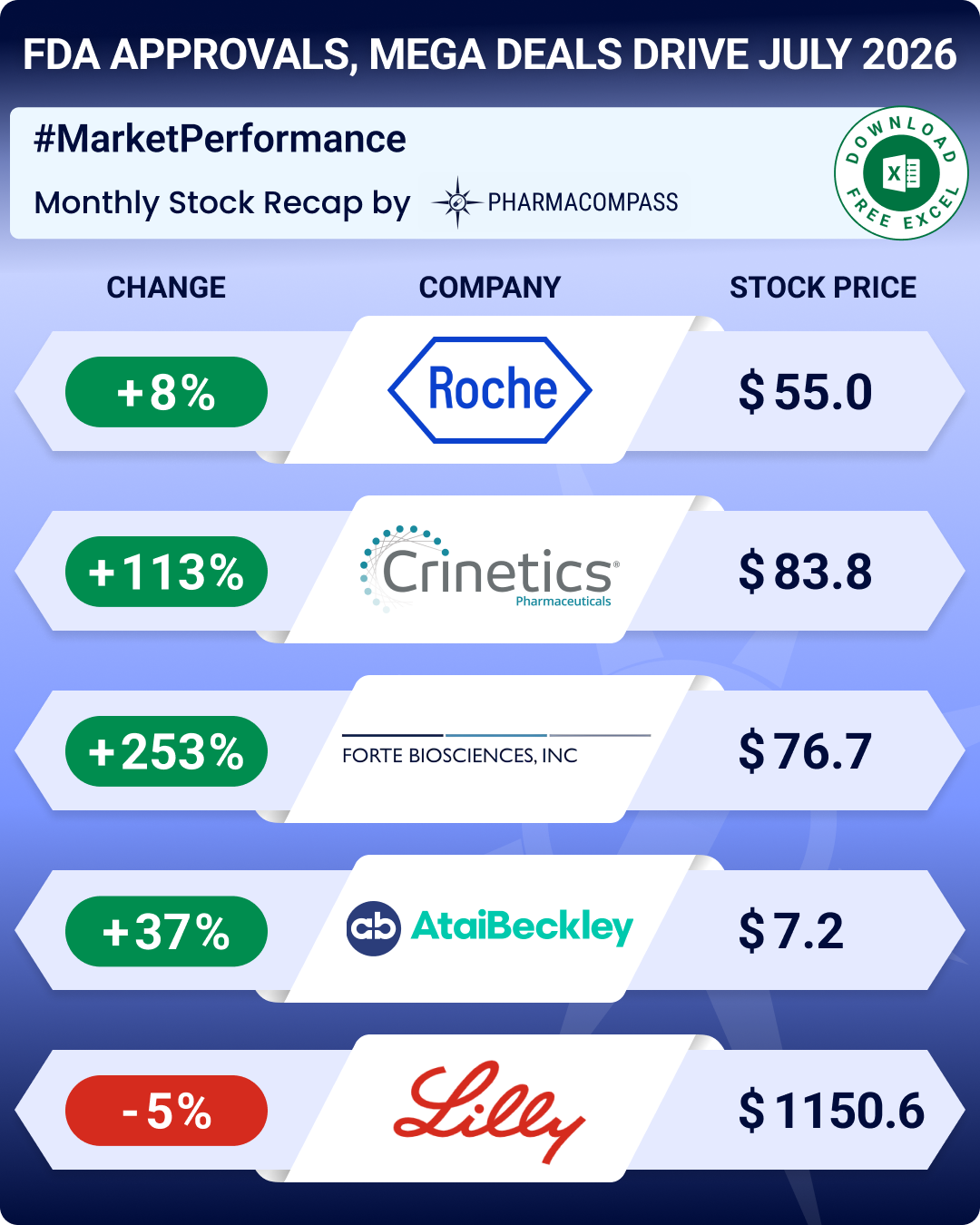
July was a month when the US Food and Drug Administration (FDA) cleared several breakthrough drugs, such as Sanofi’s wearable injector to treat multiple myeloma and Otsuka’s once-daily extended-release capsule to treat attention deficit hyperactivity disorder (ADHD). FDA also approved an at-home starter dose of Eisai and Biogen’s Alzheimer’s drug.The Trump administration announced tariffs on generic drug imports in a bid to “reshore” generic pharmaceutical production in the US. After two years of zero tariffs, generic drug imports would draw tariffs of 100 percent. And third year onwards, tariffs will go up to 200 percent. This measure would impact generic drugmakers across the world, particularly those headquartered in India.For the first time in 2026, pharma indices took a dip. The Nasdaq Biotechnology Index (NBI) declined by 2.08 percent — from 6590.25 at the end of June to 6,452.85 by July-end. The SPDR S&P Biotech ETF fell by 6.91 percent, from 157.93 to 147.01. And the S&P Biotechnology Select Industry Index (SPSIBI) dropped by 7.06 percent, from 12,383 to 11,508.60.   Access the Pipeline Prospector Dashboard for July 2026 Newsmakers (Free Excel)FDA okays first wearable, subcutaneous drug for cancer; approves Otsuka’s ADHD med  July saw several key approvals. FDA approved a wearable injector form of Sanofi’s multiple myeloma drug Sarclisa Escena (isatuximab-irfc), making it the first cancer treatment in the US cleared for delivery through an on-body injector.In oncology, the agency approved American biotech Celcuity’s Revtorpyk (gedatolisib), in combination with fulvestrant, with or without Pfizer’s Ibrance (palbociclib), to treat patients with hormone receptor-positive, HER2-negative breast cancer without any mutations in the PIK3CA gene.FDA approved GSK’s Jideytro (zidesamtinib) for adults with locally advanced or metastatic ROS1-positive non-small cell lung cancer (NSCLC). GSK had acquired the drug through its US$ 10.6 billion buyout of Nuvalent in June this year. Jideytro is the British drugmaker’s first approved lung cancer medicine.Beyond oncology, FDA approved Merck’s Lipfendra (enlicitide) to reduce bad cholesterol (LDL-C, or low-density lipoprotein cholesterol) in adults, including those with heterozygous familial hypercholesterolemia, a genetic condition that causes dangerously elevated LDL from birth. The agency also approved the first new ADHD drug class in decades. Otsuka’s Simtriyo (centanafadine) is a once-daily extended-release capsule for ADHD in patients aged six years and older. It has a new mechanism of action as it boosts three brain chemicals — norepinephrine, dopamine and serotonin — that are involved in attention and behavior regulation.FDA also approved a new at-home subcutaneous starting dose for Leqembi Iqlik (lecanemab-irmb), the Alzheimer’s disease drug developed by Eisai and Biogen. This marks a significant step towards making the treatment more accessible and convenient for patients.The agency cleared Outlook Therapeutics’ Lytenava (bevacizumab-vikg, bevacizumab gamma) for treating wet AMD, a leading cause of severe vision loss in older adults. Meanwhile, FDA granted accelerated approval to Vera Therapeutics’ drug — Trutakna (atacicept-vymj) to reduce proteinuria in adults with primary immunoglobulin A nephropathy (IgAN), a serious, progressive, immune-mediated kidney disease.Vertex acquires Crinetics for US$ 10 bn, Lilly buys AtaiBeckley for its neurological pipelineThe biggest buyout in July was Vertex Pharmaceuticals’ announcement of the acquisition of Crinetics Pharmaceuticals (stock up 113 percent in July) for about US$ 10 billion. Crinetics specializes in treatments for endocrine diseases, while Vertex’s portfolio includes cystic fibrosis therapies. Eli Lilly announced the acquisition of Atai Beckley (stock up 37 percent), a drugmaker working on treatments for mental health conditions. The deal includes an upfront cash consideration of about US$ 2.8 billion and contingent value rights of approximately US$ 1 billion.Immunology company Argenx agreed to acquire Forte Biosciences in an all-cash deal worth US$ 2.2 billion. And Novartis entered into an agreement to acquire Myricx Bio, a privately held UK-based biotechnology company developing a new class of antibody-drug conjugates (ADCs), for up to US$ 1.5 billion.Lilly reports more phase 3 wins for obesity drug retatrutide; Gilead, Merck’s HIV drug posts positive dataEli Lilly reported positive results from two additional phase 3 trials on its experimental obesity drug retatrutide. The drugmaker plans to submit an FDA application in the first quarter of 2027. Retatrutide is designed to target three different metabolic hormones — GLP-1, GIP and glucagon — making it a more comprehensive treatment for obesity than its existing drugs Zepbound (tirzepatide) and Foundayo (orforglipron).Gilead Sciences and Merck have reported positive data from two phase 3 trials for their once-a-week HIV pill, which is a combination of Merck’s islatravir and Gilead’s lenacapavir. The pill kept the virus suppressed in both late-stage trials, supporting a regulatory filing.Arrowhead Pharmaceuticals has reported positive results from two phase 3 trials of Redemplo (plozasiran) in patients with severe hypertriglyceridemia (sHTG). UK-based Compass Pathways has reported six-month durability data from its second phase 3 trial of its psilocybin-based therapy for treatment-resistant depression (TRD). Compass’ COMP360 is a synthetic, proprietary formulation of psilocybin (the psychedelic compound found in certain mushrooms) for TRD, a severe form of depression.Ipsen’s Dysport (abobotulinumtoxinA), a Botox (onabotulinumtoxinA) competitor, posted two phase 3 wins in two migraine indications — episodic and chronic migraine. In both the studies, Dysport significantly reduced the number of monthly migraine days versus placebo.In oncology, Roche’s experimental drug divarasib outperformed two already-approved drugs — Amgen’s Lumakras (sotorasib) and BMS’ Krazati (adagrasib) — in a direct head-to-head, phase 3 trial on patients with NSCLC who have the KRAS G12C mutation.Kelun Biotech’s Merck-partnered ADC candidate sacituzumab tirumotecan, or sac-TMT, succeeded in a late-stage NSCLC trial when combined with Merck’s Keytruda. Johnson & Johnson reported positive results from a phase 3 trial of a combination of two bispecific antibodies — Tecvayli (teclistamab-cqyv) and Talvey (talquetamab-tgvs). The combo reduced the risk of disease progression or death by 89 percent and the risk of death by 62 percent compared with standard-of-care combinations in relapsed or refractory multiple myeloma. And GSK’s licensor Hansoh Pharmaceutical said its ADC, Ris-Rez (risvutatug rezetecan), met the primary endpoint in a late-stage clinical trial on patients with osteosarcoma (a common type of bone cancer), compared with chemotherapy alone.Our viewApprovals in July point towards innovations with new delivery mechanisms. Be it Sanofi’s wearable injector for myeloma or Eisai-Biogen’s at-home Alzheimer's starter dose, or Otsuka’s once-daily ADHD capsule, each takes an existing therapeutic idea and removes barriers such as the need for an infusion chair, or a visit to the clinic. It’s not just efficacy, but also convenience that is defining the competitive edge for drugmakers.

Impressions: 1456

https://dev1.pharmacompass.com/pipeline-prospector-blog/pipeline-prospector-july-2026-highlights-fda-approves-first-wearable-subcutaneous-drug-for-cancer-vertex-acquires-crinetics-for-us-10-bn

#PharmaFlow by PHARMACOMPASS
05 Aug 2026

WEEKLY INDUSTRY NEWS

2read-more
read-more
Vertex to acquire Crinetics for US$ 10 bn; FDA grants accelerated approval to Vera’s therapy for primary IgA nephropathy
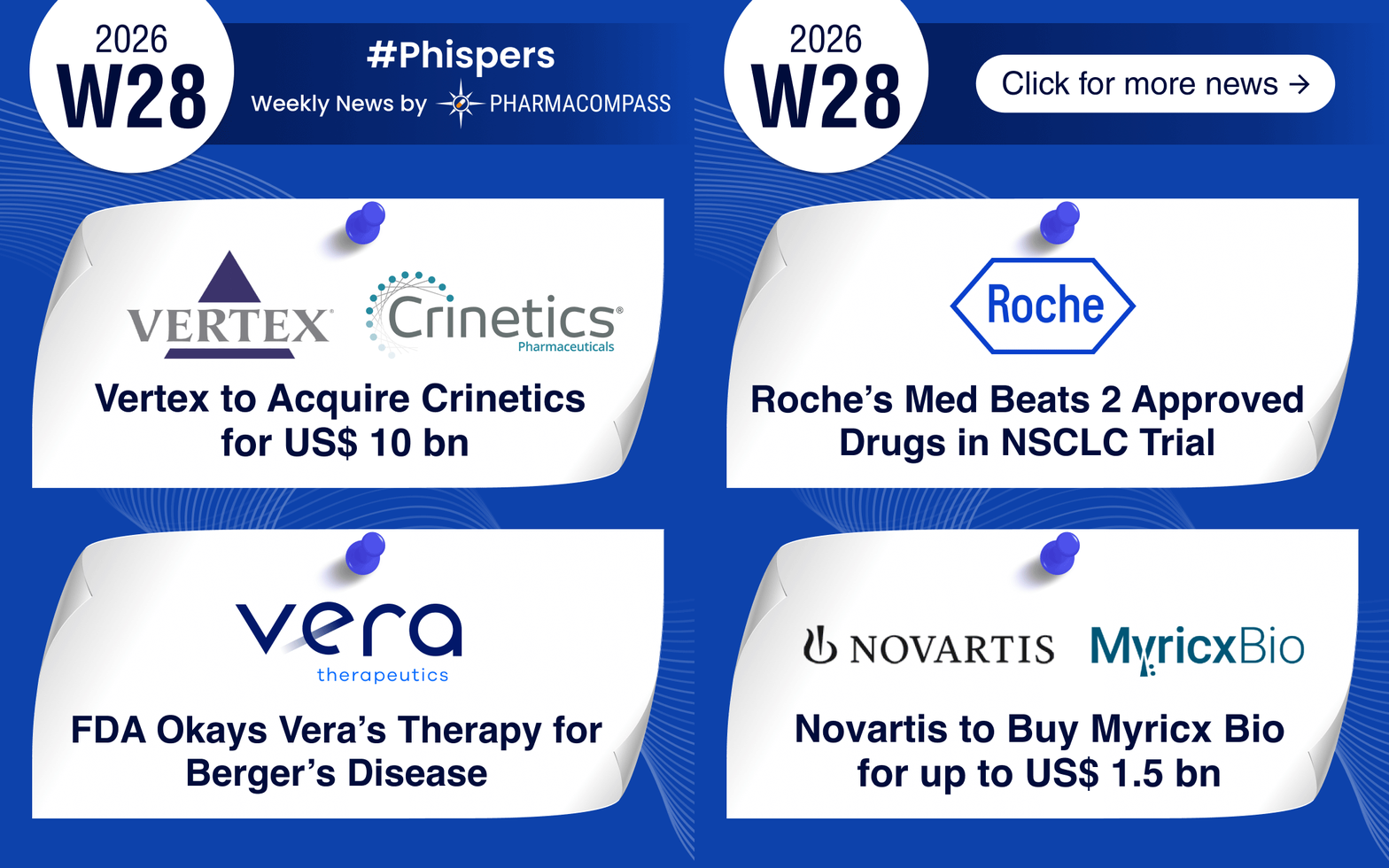
In news this week, Vertex announced it will acquire Crinetics Pharmaceuticals for US$ 10 billion. The buyout is expected to grow Vertex’s annual revenue by US$ 5 billion. Novartis agreed to acquire UK-based Myricx Bio for up to US$ 1.5 billion to gain access to its new class of antibody-drug conjugates (ADCs). AstraZeneca inked a research collaboration worth up to US$ 1.77 billion with China’s CSPC Pharmaceutical Group for kidney disease drugs. And, GSK terminated its neuroscience collaboration with California-based Alector after two experimental drugs suffered clinical setbacks.In drug approvals, the US Food and Drug Administration (FDA) granted accelerated approval to Vera Therapeutics’ drug — Trutakna (atacicept-vymj) — to reduce proteinuria in adults with primary immunoglobulin A nephropathy (IgAN), also known as Berger’s disease.In clinical trials, Roche’s divarasib pulled ahead in a competitive, head-to-head trial for non-small cell lung cancer (NSCLC). Divarasib outperformed two approved drugs — Amgen’s Lumakras (sotorasib) and BMS’s Krazati (adagrasib). Meanwhile, BMS’ Krazati in combination with Eli Lilly’s Erbitux (cetuximab) failed to beat standard chemotherapy in a confirmatory phase 3 trial for colorectal cancer.Additionally, UK-based Compass Pathways reported six-month durability data from its second phase 3 trial of its psilocybin-based therapy for treatment-resistant depression (TRD). The company is on track to complete its rolling regulatory submission to FDA by the fourth quarter of 2026.Vertex to acquire Crinetics for US$ 10 bn; could add US$ 5 bn to annual revenue Vertex Pharmaceuticals has announced the acquisition of Crinetics Pharmaceuticals for about US$ 10 billion. Crinetics specializes in treatments for endocrine diseases, while Vertex’s portfolio mainly includes cystic fibrosis therapies. The acquisition could potentially grow Vertex’s annual revenue by US$ 5 billion.Crinetics’ Palsonify (paltusotine) received FDA approval in September 2025. The treatment was recently approved by the European Medicines Agency (EMA). It is the first and only once-daily oral therapy for adults with acromegaly, a rare and debilitating condition caused by a pituitary tumor that secretes excess growth hormone.FDA grants accelerated approval to Vera’s therapy for primary IgA nephropathyFDA has granted accelerated approval to Vera Therapeutics’ drug — Trutakna (atacicept-vymj) to reduce proteinuria in adults with primary immunoglobulin A nephropathy (IgAN), also known as Berger’s disease. IgAN is a serious, progressive, immune-mediated kidney disease and a leading cause of chronic kidney disease and kidney failure worldwide. Trutakna is injected subcutaneously (under the skin) once weekly.Novartis to acquire UK-based Myricx Bio for up to US$ 1.5 billionNovartis has entered into an agreement to acquire Myricx Bio, a privately held UK-based biotechnology company developing a new class of antibody-drug conjugates (ADCs), for up to US$ 1.5 billion. The deal will  strengthen Novartis’ oncology pipeline, and is likely to close in the second half of 2026.Novartis will pay US$ 1.1 billion upfront along with up to US$ 400 million in potential milestone payments. The deal centres on two leading ADC assets of Myricx, designed to deliver cancer-killing treatments directly to tumor cells and address limitations of current ADCs.Roche’s divarasib beats Amgen’s Lumakras, BMS’ Krazati in head-to-head trialRoche has pulled ahead in the competitive KRAS G12C lung cancer drug race, reporting that its experimental drug divarasib outperformed two already-approved drugs — Amgen’s Lumakras (sotorasib) and BMS’ Krazati (adagrasib) — in a direct head-to-head, phase 3 trial. KRAS G12C is a mutation found in approximately 14 percent of non-small cell lung cancer (NSCLC) cases.The study met its primary and key secondary endpoint, with divarasib achieving clinically meaningful and statistically significant improvements in both progression-free survival and overall survival. Roche is of the view that these results should “establish divarasib as a new standard of care for previously-treated lung cancer patients with this genetically defined tumor subtype.” Amgen's Lumakras was first approved by FDA in 2021, while BMS’ Krazati was cleared in 2022.Krazati-Erbitux combo fails colorectal cancer trial: BMS’ Krazati (adagrasib) in combination with Eli Lilly’s  Erbitux (cetuximab) failed to beat standard chemotherapy in a confirmatory phase 3 trial for colorectal cancer. FDA had granted accelerated approval to the Krazati-cetuximab combination in 2024 based on early response rate data, on the condition that a confirmatory trial would verify clinical benefit. BMS had acquired Krazati through its US$ 5.8 billion acquisition of Mirati Therapeutics in October 2023. In late 2022, Krazati had been granted FDA’s accelerated approval in KRAS-mutated locally advanced or metastatic NSCLC.Compass’ psilocybin drug shows durable effect in severe depression trialWeeks after Definium Therapeutics reported strong phase 3 results for its LSD-based depression drug, UK-based Compass Pathways has reported six-month durability data from its second phase 3 trial of its psilocybin-based therapy for treatment-resistant depression (TRD).Compass’ COMP360 is a synthetic, proprietary formulation of psilocybin (the psychedelic compound found in certain mushrooms) for TRD, a severe form of depression that has not responded to at least two standard antidepressant treatments. Compass is on track to complete its rolling regulatory submission to FDA by the fourth quarter of 2026, with a commercial launch targeted for the first half of 2027.AstraZeneca inks US$ 1.77 billion research deal with China’s CSPC for renal drugsAstraZeneca has signed a strategic research collaboration worth up to US$ 1.77 billion with China’s CSPC ‌Pharmaceutical Group to discover and develop experimental medicines for kidney diseases. CSPC is eligible to receive US$ 30 million as an upfront payment and up to about US$ 1.74 billion in additional payments tied to development and sales-related milestones.Under the deal, AstraZeneca will utilize CSPC’s siRNA drug discovery platform and extra-hepatic targeted delivery platform to jointly discover and develop pre-clinical candidates for two targets, with the potential to treat renal diseases across multiple indications.GSK, Alector end collaboration agreement after failure of two antibody drugs GSK has terminated its neuroscience collaboration agreement with California-based Alector that covered two experimental antibody drugs — latozinemab and nivisnebart — after both ‌drug candidates suffered clinical setbacks. The agreement between the two companies dates back to 2021. Latozinemab failed a late-stage study on a rare, inherited form of frontotemporal dementia last year, while a mid-stage Alzheimer’s disease trial on nivisnebark was discontinued in April.

Impressions: 1357

https://dev1.pharmacompass.com/radio-compass-phisper/vertex-to-acquire-crinetics-for-us-10-bn-fda-grants-accelerated-approval-to-vera-s-therapy-for-primary-iga-nephropathy

#Phispers by PHARMACOMPASS
09 Jul 2026

NEWS LIBRARY

66read-more
read-more

https://endpoints.news/uk-price-watchdog-recommends-against-amgens-lumakras-in-lung-cancer/

ENDPOINTS
09 Jul 2026

https://www.globenewswire.com/news-release/2025/10/22/3171361/0/en/Frontier-Medicines-Presents-Preclinical-Data-from-Three-Programs-at-the-37th-AACR-NCI-EORTC-International-Conference-on-Molecular-Targets.html

GLOBENEWSWIRE
22 Oct 2025

https://www.reuters.com/business/healthcare-pharmaceuticals/us-fda-approves-amgens-colorectal-cancer-therapy-2025-01-17/

REUTERS
17 Jan 2025
ASCO: KRAS upstarts set their sights on NSCLC market

05 Jun 2024

// Phil Taylor PHARMAPHORUM

https://pharmaphorum.com/news/asco-kras-upstarts-set-their-sights-nsclc-market

Phil Taylor PHARMAPHORUM
05 Jun 2024

https://www.fiercepharma.com/pharma/amgen-stumbled-bristol-myers-touts-kras-confirmatory-trial-win-newly-bought-krazati

Angus Liu FIERCE PHARMA
30 Mar 2024

https://www.businesswire.com/news/home/20240118664635/en

BUSINESSWIRE
18 Jan 2024
digital-content137278711##p