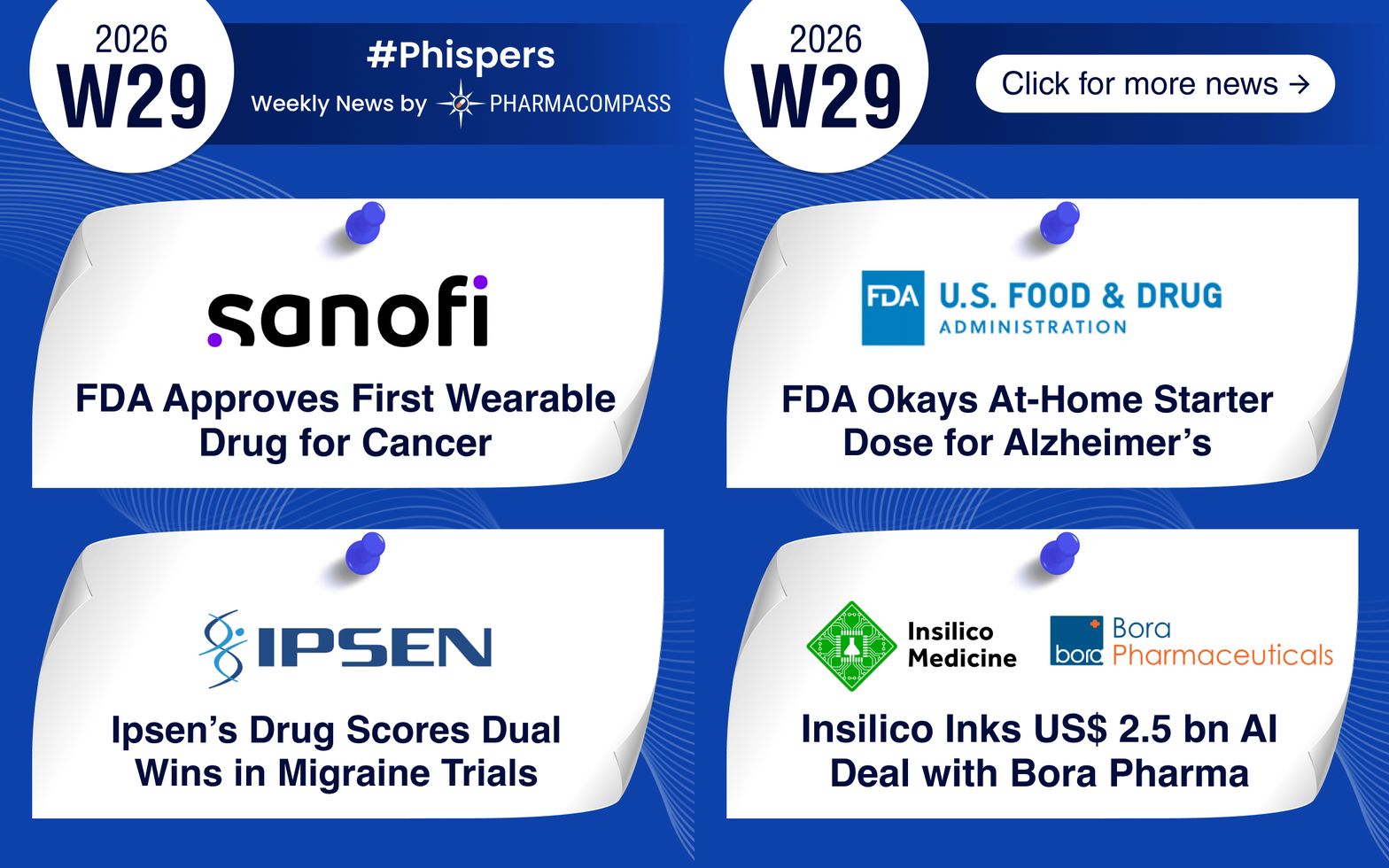
The US Food and Drug Administration (FDA) approved two unique drugs this week — Sanofi’s multiple myeloma drug Sarclisa Escena, which can be administered as an on-body injector; and a subcutaneous version of Eisai and Biogen’s Leqembi Iqlik, which can now be given as a starting dose to Alzheimer’s patients.
In other approvals, FDA cleared American biotech Celcuity’s Revtorpyk (gedatolisib), in combination with fulvestrant, to treat a form of breast cancer. It also approved the use of Pfizer-Astellas Pharma’s Padcev (enfortumab vedotin-ejfv), in combination with Merck’s Keytruda (pembrolizumab), as treatment for muscle-invasive bladder cancer (MIBC).In news from clinical trials, Ipsen’s botox competitor Dysport (abobotulinumtoxinA) posted two phase 3 wins in episodic and chronic migraine. AstraZeneca and its partner Ionis Pharmaceuticals suffered a setback as their injectable drug Wainua (eplontersen) failed a large late-stage trial for a progressive heart disease.In deals, artificial intelligence (AI)-driven drug discovery company Insilico Medicine announced a collaboration with Taiwan-based contract drug manufacturer Bora Pharmaceuticals worth up to US$ 2.5 billion. And Spero Therapeutics signed an exclusive licensing deal with China’s Innovent Biologics for a novel antibody in a deal worth up to US$ 1.1 billion.Meanwhile, FDA published its final guidance on clinical trial
requirements for psychedelic drugs. It has also temporarily stopped publicly releasing complete
response letters (CRLs), following a petition filed by a drugmaker. FDA okays first wearable, subcutaneous drug for cancer — Sanofi’s Sarclisa Escena FDA has approved a
wearable injector form of Sanofi’s multiple myeloma drug Sarclisa Escena (isatuximab-irfc), making it the first cancer treatment in the US cleared for delivery through an on-body injector. This is a hands-free device that attaches to the patient’s skin and delivers the drug subcutaneously over a set period, without the need for a hospital intravenous drip. Multiple myeloma is a rare, aggressive form of blood cancer.Approves at-home starter dose for Alzheimer’s drug: FDA has approved a new at-home subcutaneous starting dose for Leqembi Iqlik (lecanemab-irmb), the Alzheimer’s disease drug developed by Eisai and Biogen. This is a significant step
towards making the treatment more accessible
and convenient for patients.Ipsen’s Dysport scores dual wins in chronic, episodic migraine trialsIpsen Pharmaceuticals’ Dysport (abobotulinumtoxinA), a Botox
(onabotulinumtoxinA) competitor, posted two phase 3 wins in two migraine indications — episodic and chronic migraine. In both the studies, Dysport significantly
reduced the number of monthly migraine days versus placebo, thereby meeting the
primary endpoint of both studies. Allergan’s Botox is already approved for chronic migraine prevention, but not episodic. If approved, Dysport could open a substantially larger market given that a far greater number of patients suffer from episodic migraine.Kelun’s ADC+Keytruda shows benefit in NSCLC: Kelun Biotech’s Merck-partnered antibody-drug (ADC) candidate sacituzumab tirumotecan, or sac-TMT, succeeded in a late-stage non-small cell lung cancer
(NSCLC) trial when combined with Merck’s Keytruda.Meanwhile,
in a phase 3 trial, Merck’s Keytruda (pembrolizumab) showed benefit as a single agent for the
front-line treatment of a subtype of endometrial cancer.Astra-Ionis’ Wainua fails key heart disease trial: AstraZeneca and partner Ionis Pharmaceuticals have suffered a
setback as their injectable drug Wainua
(eplontersen) failed its primary
endpoint in a large late-stage trial for
transthyretin-mediated amyloid cardiomyopathy (ATTR-CM), a progressive, often
fatal heart disease. FDA approves Celcuity’s Revtorpyk for hard-to-treat breast cancerFDA has approved American biotech Celcuity’s Revtorpyk (gedatolisib), in combination with fulvestrant, with or without Pfizer’s Ibrance (palbociclib), to treat patients with hormone receptor-positive,
HER2-negative breast cancer without any mutations in the PIK3CA
gene. Celcuity is also developing the drug for patients with PIK3CA mutations
and plans to file a supplemental application with the FDA in the third quarter
of this year.Expands approval of Padcev-Keytruda combo: FDA has approved the use of Pfizer-Astellas Pharma’s Padcev (enfortumab vedotin-ejfv) in combination with Merck’s Keytruda (pembrolizumab) as treatment of both before and after surgery for
muscle-invasive bladder cancer (MIBC), regardless of whether patients are
eligible for cisplatin chemotherapy. MIBC is a more advanced form of bladder
cancer.Rejects Elevar-Hengrui’s liver cancer therapy: FDA declined to approve Elevar Therapeutics and Jiangsu Hengrui’s combination therapy for the third time as a first-line
treatment for unresectable or metastatic hepatocellular carcinoma (HCC), an
advanced stage of liver cancer. The combination has been in regulatory limbo since its first rejection in 2023. Insilico inks US$ 2.5 bn AI drug discovery alliance with Taiwan’s Bora PharmaInsilico Medicine, a clinical-stage generative
AI-driven drug discovery company, has announced a collaboration with
Taiwan-based contract drug manufacturer Bora Pharmaceuticals worth up to US$
2.5 billion. The deal combines Insilico’s proprietary Pharma.AI platform with Bora’s global development, manufacturing, quality, and commercialization capabilities. Spero licenses Innovent’s autoimmune antibody: Massachusetts-based Spero Therapeutics has made a strategic pivot from antibiotics into immunology by signing
an exclusive licensing deal with China’s Innovent Biologics for SP001 (IBI355) — a novel antibody for rare autoimmune diseases — in a deal worth up to US$ 1.1 billion,
including upfront and milestone payments, plus tiered royalties. A phase 2
study on SP001 is planned for the second quarter of 2027.Astra acquires rights to Zegfrovy from Dizal: AstraZeneca has entered into an exclusive license agreement with Dizal Pharmaceutical for Zegfrovy (sunvozertinib), an oral targeted lung
cancer drug. Dizal was spun out of AstraZeneca’s own Chinese research operations nearly a decade ago. AstraZeneca will acquire worldwide rights to develop and commercialise Zegfrovy by paying US$ 600 million upfront to Dizal, with up to US$ 900 million in development, regulatory and sales milestones, plus tiered royalties. FDA finalizes clinical trial guidance for psychedelics; pauses
release of CRLs FDA has published its final guidance on clinical trial
requirements for psychedelic drugs, completing a process that began with a
draft document issued in June 2023. The final version incorporates industry
feedback and provides guidance on drugs for psychiatric and substance use
disorders. Though the guidance is non-binding, it sets clear regulatory
expectations.Freezes release of CRLs: FDA has temporarily stopped publicly releasing complete response
letters (CRLs), documents that explain why a drug application was rejected,
following a citizen petition from an unnamed pharmaceutical company filed in
April 2026.Lilly to acquire AtaiBeckley: Eli Lilly is in advance talks to acquire AtaiBeckley, a psychedelic drugmaker, Bloomberg has reported. No deal value has been disclosed. According to Bloomberg, Lilly has been exploring opportunities in psychedelic therapies for some time.













 Share
