Please Wait
Applying Filters...
Menu

Digital Content read-more

Create Content with PharmaCompass, ask us

PHARMA & BIOTECH INSIGHTS

3read-more
read-more

A PHP Error was encountered

Severity: 8192

Message: mb_convert_encoding(): Handling HTML entities via mbstring is deprecated; use htmlspecialchars, htmlentities, or mb_encode_numericentity/mb_decode_numericentity instead

Filename: blog/grid.php

Line Number: 52

Backtrace:

File: /var/www/html/application/views/include/media/blog/grid.php
Line: 52
Function: mb_convert_encoding

File: /var/www/html/application/models/Cmn.php
Line: 3595
Function: view

File: /var/www/html/application/views/include/product/digitalContent/grid.php
Line: 17
Function: common

File: /var/www/html/application/views/include/desc/inner.php
Line: 13
Function: view

File: /var/www/html/application/views/include/desc/indexNew.php
Line: 2433
Function: include

File: /var/www/html/application/controllers/Common.php
Line: 11303
Function: view

File: /var/www/html/index.php
Line: 231
Function: require_once

CEP Q1 2026 Update: CEP 2.0, EDQM’s new guidelines strengthen ecosystem; Indian firms top list of CEPs issued
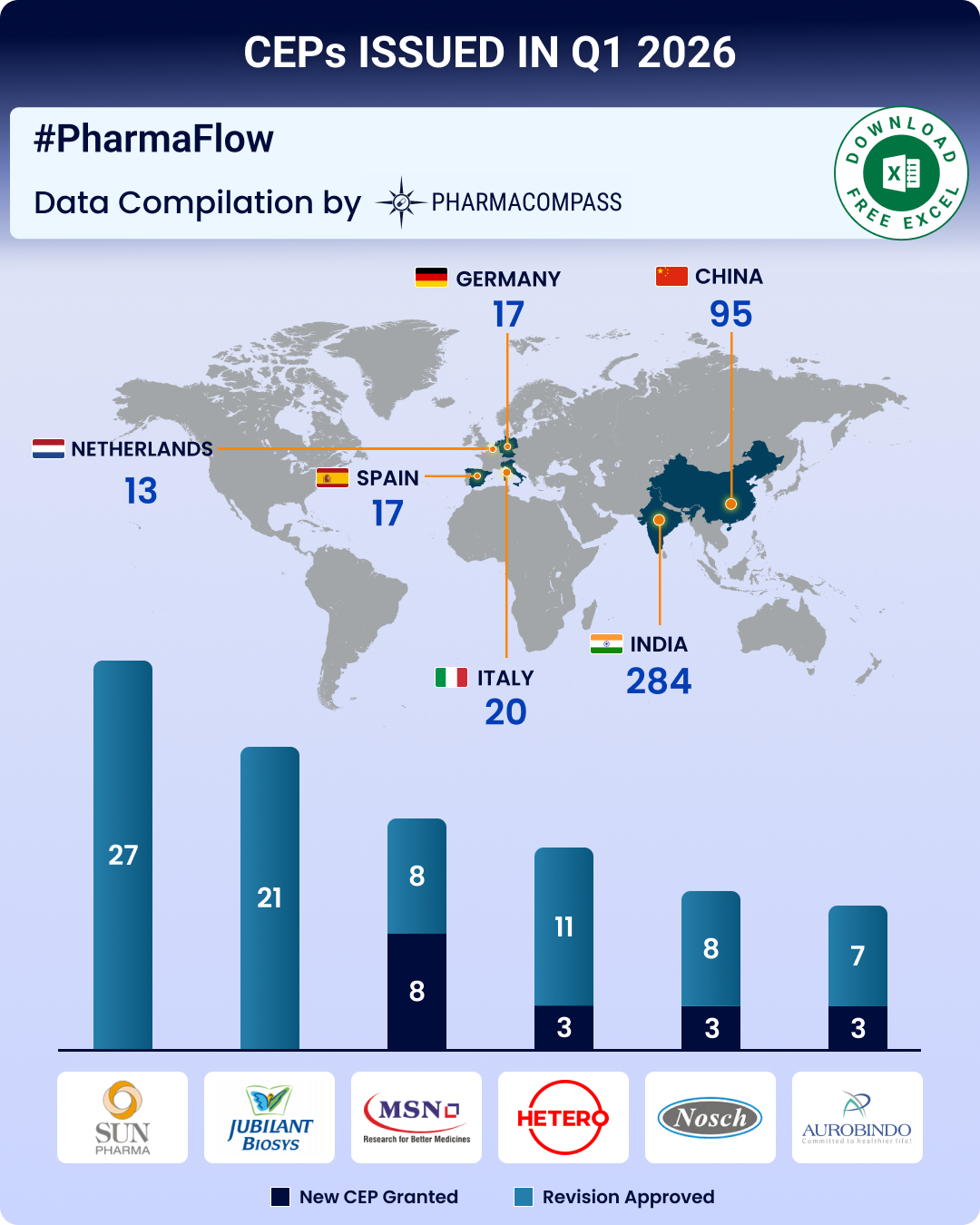
PharmaCompass is introducing a new regulatory update that tracks developments in Certificates of Suitability to the Monographs of the European Pharmacopoeia, referred to as CEPs. These certificates are a critical regulatory instrument in the global pharmaceutical supply chain. Also known as a Certification of Suitability (COS), CEPs are issued by the European Directorate for the Quality of Medicines and HealthCare (EDQM), with or without inspection of the manufacturing site. A CEP must be renewed every five years from its original issue date to remain valid, regardless of any revisions made during the interim period. However, a CEP does not replace Good Manufacturing Practice certification. CEPs are recognized as a trusted reference for API quality, thereby simplifying global registration strategies. Apart from Europe, the CEP system is widely used by many regulatory authorities, including those in Canada, Australia, Brazil, Singapore and South Africa.  View CEPs Issued in Q1 2026 (Power BI Dashboard, Free Excel Available) CEP 2.0 enhances regulatory clarity, brings efficiency, global interoperability  There are several types of CEPs, depending on the nature of the substance and evaluation. The most common type is the Chemical CEP, which confirms that a chemically synthesized API meets standards for purity and impurity control. Then there are Herbal CEPs for herbal substances and preparations. Another key category is the TSE CEP, which addresses risks associated with transmissible spongiform encephalopathies in animal-derived materials. In addition, there are Combined CEPs that may cover multiple aspects, such as chemical quality, TSE risk, and sterility. However, biological products such as vaccines and blood products fall outside the scope of the CEP framework. In 2023, the CEP system underwent a major transformation with the introduction of CEP 2.0, which marks a shift from a largely document-based system to a more structured, transparent, and digitally aligned model. This makes it easier for companies to manage compliance while improving trust among global regulators. While increasing data and compliance requirements for API manufacturers, CEP 2.0 enables better regulatory clarity, streamlined dossier integration, and stronger global acceptance. Overall, CEP 2.0 is designed to enhance regulatory clarity while making the system more efficient and globally interoperable. Indian firms issued maximum CEPs; Sun Pharma and its subsidiaries, Jubilant Biosys top list India topped the charts for CEPs issued, both in terms of new CEPs and revisions in the first quarter (Q1) of 2026. Indian companies were issued 81 new CEPs in Q1 2026 (as against 40 in Q1 2025) and 203 revisions (as against 129 in Q1 2025). In comparison, Chinese companies were issued 42 new CEPs in Q1 2026 (against 25 in Q1 2025) and 53 revisions (against 67 in Q1 2025). Italy came a distant third, followed by Germany and Spain. India’s Sun Pharmaceuticals and its subsidiaries topped the list of companies with the maximum number of CEPs issued— while no new CEP was issued, 27 CEPs were revised in Q1 2026. At second place was Jubilant Biosys — 21 CEPs were revised in Q1 2026. In terms of products, the maximum CEPs were issued for amlodipine besylate (a calcium channel blocker used for treating hypertension), followed by sitagliptin phosphate (a type 2 diabetes medicine) and pregabalin (a drug used to treat neuropathic pain, fibromyalgia, seizures, and generalized anxiety disorder). Both amlodipine besylate and sitagliptin phosphate had not been issued new CEPs or revisions in Q1 2025. EDQM introduces new guidelines to accelerate CEP assessments The EDQM charges fees for various services related to CEPs that depend on the type of request or regulatory activity involved. In general, fees apply to handling CEP applications, revisions or renewals and for offering technical advice (where applicants seek scientific or regulatory guidance). In March 2026, the EDQM introduced two new guidelines aimed at accelerating CEP assessments. The first is a reliance-based assessment pathway, which allows regulators to leverage prior approvals from trusted authorities, such as those in the EU, UK, Australia, Canada, and the WHO pre-qualification program. The second is a fast-track assessment route designed to expedite reviews in situations such as medicine shortages and to support initiatives like the EU Critical Medicines Act. Timelines have been significantly compressed under these new pathways. Initial evaluations are completed within 46 working days, compared to up to 115 days under the standard procedure. Applicants are given 30 calendar days to respond to queries, after which regulators complete the final assessment within 23 working days. Another important regulatory update relates to electronic submissions. From April 1, 2026, the EDQM will reject non-compliant CEP applications at the point of submission. All applications must include a validated electronic Common Technical Document (eCTD) dossier along with a proper validation report, submitted in line with the updated Common European Submission Portal (CESP) guidelines. Taken together, these developments signal a more rigorous yet efficient CEP ecosystem. Our view The shift to CEP 2.0 signals a move toward greater transparency, digitalization, and global regulatory alignment. Though enhanced disclosure and stricter e-submission requirements may increase the compliance burden, especially for smaller manufacturers, the long-term gains are expected to be significant. Going forward, companies that invest in data quality and regulatory readiness stand to gain from these changes.

Impressions: 3969

https://dev1.pharmacompass.com/radio-compass-blog/cep-q1-2026-update-cep-2-0-edqm-s-new-guidelines-strengthen-ecosystem-indian-firms-top-list-of-ceps-issued

#PharmaFlow by PHARMACOMPASS
09 Apr 2026

WEEKLY INDUSTRY NEWS

1read-more
read-more
Dr. Reddy’s faces penalties in the US; metformin found in American waters; Interpol seizes illicit medicines
 This week, Phispers brings to you the latest news from the world of pharma where Merck was found lying under oath, Mylan’s “exceptionally large” drug price hikes reignited the price-gouging debate and data integrity issues surfaced in China. And, a lot more.Dr. Reddy’s acquires products from Teva; but faces penalties in the USThis has been a mixed week for Dr. Reddy’s Laboratories. The company has signed a deal with Israeli drug maker Teva to acquire a portfolio of eight abbreviated new drug applications (ANDAs) in the US for US $ 350 million. In April 2015, Teva had entered into a deal with Allergan to buy its generics products for US $ 40.5 billion, soon after it failed in its bid to buy Mylan. On the flip side, the US Consumer Product Safety Commission (CPSC) has sought civil penalties against Dr. Reddy’s for failing to report problems with packaging of several medicines. In a 4-1 vote held two weeks ago, CPSC said Dr. Reddy’s knowingly violated federal law as issues with child-resistant blister packs for five prescription drugs were not reported within the mandated 24 hours. The violations had occurred between 2002 and 2011.  After antibiotics in Chinese rivers, it’s metformin in American watersIn June last year, we reported on how antibiotics were found in the rivers of China. This week, a new study has found traces of the widely-used diabetes drug – metformin – and other medicines in dozens of streams throughout southeastern United States. The survey was done on 59 streams and it found an average of six different drugs. The findings suggest the cause of contamination was unrelated to discharges from wastewater treatment facilities. Metformin appeared in 89 percent of the samples and 97 percent of the sample sites. Researchers also found traces of tramadol (opioid); carbamazepine (anti-seizure drug) and Allegra (antihistamine). At some of the sample sites, the concentrations of these medicines are expected to affect aquatic life. There was also some good news about metformin this week. Research has suggested that metformin may exert a long-term protective effect against neurodegenerative diseases, including Alzheimer's and Parkinson's. Court overturns US $ 200 million jury award; says Merck ‘lied under oath’A federal judge in San Jose found Merck lied to a business partner and to the court. As a result, the judge threw out a patent infringement judgment Merck had won against Gilead Sciences. He also overturned a US $ 200-million jury award. This judgement is considered a landmark one, considering it involves Gilead’s blockbuster drug Sovaldi, a treatment for the hepatitis C virus, and Merck – the world’s fourth-largest drug company. “Merck's misconduct includes...misusing Pharmasset's confidential information..., and lying under oath at deposition and trial,” the federal judge, Beth Labson Freeman, said. This news comes at a time when a review by the US Food and Drug Administration (FDA) staffers questioned whether an experimental Merck drug is effective in treating Clostridium difficile, or C. difficile, the most common cause of infectious diarrhea in hospitals and nursing homes. Mylan’s ‘exceptionally large’ drug price rise brings pricing debate back in focusPrice gouging has been plaguing the global pharma industry for quite some time now. During the week, there was news about Mylan and Pfizer increasing prices. Over the last six months, Mylan has raised prices by more than 20 percent on 24 products. Meanwhile, Pfizer was in news for increasing the list prices of its medicines in the US by an average of 8.8 percent. This is the second time this year that Pfizer has substantially boosted prices for its prescription drugs. On January 1, Pfizer had raised prices by an average of 10.4 percent. Mylan boosted prices by more that 100 percent on seven other products. Wells Fargo analyst David Maris termed the price hikes as “exceptionally large.” In Europe, the high price of drugs is straining its cash-strapped health systems and depriving patients of the latest products. Ergo, the European pharmaceutical industry is considering a radical shift in the way it prices drugs so that companies are rewarded for the clinical benefit of treatments rather than the number of pills sold. An internal report prepared by the European Federation of Pharmaceutical Industries and Association has called for the removal of external reference pricing and placing curbs on parallel imports. Interpol’s Operation Pangea IX seizes US $ 53 million worth of illicit medicinesInterpol seized potentially life-threating drugs and goods, including fake cancer medication, substandard HIV and diabetes testing kits, counterfeit dental equipment and illicit surgical equipment, through its Operation Pangea IX. The operation involved targeting illicit online sale of medicines and medical devices. It involved 193 police, customs and health regulatory authorities from 103 countries. Operation Pangea resulted in 393 arrests worldwide and the seizure of more than US $ 53 million worth of potentially dangerous medicines. The operation was supported by private partners from the Internet and payment industries and saw the suspension of 4,932 websites selling illicit pharmaceuticals. India’s pharma industry growth dips to two-year lowThe impact of Indian health ministry’s gazette notification banning the immediate manufacture, sale and distribution of 344 fixed dose combination (FDC) drugs has begun to reflect in growth numbers. The Indian pharmaceuticals market’s growth this May was the lowest in two years, impacted by a drop in sales of FDC drugs, fresh price cuts and a lower than expected uptake, according to pharmaceutical market research company AIOCD PharmaTrack. For May, the pharmaceuticals market grew by 7.7 percent compared to 11.6 percent during the same month last year, reaching sales of Rs 994.76 billion (US $ 14.8 billion) over a 12-month period. India’s FDC market dropped 14.6 percent and is now valued at Rs 1.96 billion (US $ 29.1 million). Valeant may sell stake in Egypt’s largest drug company AmounValeant Pharmaceuticals International plans to step up its debt-reduction plans and is considering the sale of Egyptian drug maker Amoun Pharmaceutical. According to a report, Amoun may attract drug companies with an interest in expanding in emerging markets. Valeant is reportedly working with Goldman Sachs Group on the sale. Last year, Valeant had acquired Amoun’s holding company – Mercury Holdings – for around US $ 800 million, along with some contingent payments. Valeant’s intentions at the time were to use Amoun as a platform to further expand in the Middle East and Africa.  GMP problems roundup: Fresh cases emerge in China, India Beijing Taiyang Pharmaceutical Industry, a Chinese manufacturer of diphenyhydramine hydrochloride, a commonly used antihistamine, was placed on the FDA import alert list in April 2016. Last week, Beijing Taiyang was also placed on Health Canada’s Inspection Tracker List as the regulatory agency evaluated the risk the company’s products posed to patients. The primary reason given for the action was data integrity concerns. Akums Drugs & Pharmaceutical Limited is a major Indian contract manufacturer with nine facilities that mostly supply to the domestic market. Akums’ international expansion plans suffered a setback as its facility in Haridwar (India) failed its first EDQM (European Directorate for the Quality of Medicines & HealthCare) inspection.  The critical deficiency observed by the inspectors was the “lack of sterility assurance as there was insufficient evidence during validation to confirm that all ampoules in the load met the sterilizing conditions”. There were also deficiencies observed across all aspects of the quality management system. Akums’ failure is a setback for the Netherlands-based Nordic Pharma Limited for whom Akums was manufacturing progesterone injection 50mg/mL ampoules (Gestone). The inspection failure will result in the recall of four batches from the UK and Ireland and will most likely have Nordic Pharma retain their existing contract manufacturer, Hikma Italia SPA. 

Impressions: 4478

https://dev1.pharmacompass.com/radio-compass-phisper/dr-reddy-s-faces-penalties-in-the-us-metformin-found-in-american-waters-interpol-seizes-illicit-medicines

#Phispers by PHARMACOMPASS
16 Jun 2016

NEWS LIBRARY

66read-more
read-more

http://www.accessdata.fda.gov/scripts/cder/daf/index.cfm?event=overview.process&varApplNo=219647

FDA
26 Jun 2026

https://ipocentral.in/virupaksha-organics-ipo-gmp-price-allotment/

IPOCENTRAL
01 May 2026

https://www.pharmacompass.com/pdf/news/enforcement-report-week-of-april-8-2026-50375.pdf

FDA
08 Apr 2026

https://www.pharmacompass.com/pdf/news/fda-confirms-para-iv-patent-litigation-for-qdolo-oral-solution-62314.pdf

FDA
03 Dec 2024

https://www.globenewswire.com/news-release/2024/08/09/2927924/0/en/Avenue-Therapeutics-Reports-Second-Quarter-2024-Financial-Results-and-Recent-Corporate-Highlights.html

GLOBENEWSWIRE
09 Aug 2024

https://www.pharmacompass.com/pdf/news/enforcement-report-week-of-may-15-2024-59166.pdf

FDA
15 May 2024
digital-content63013##p