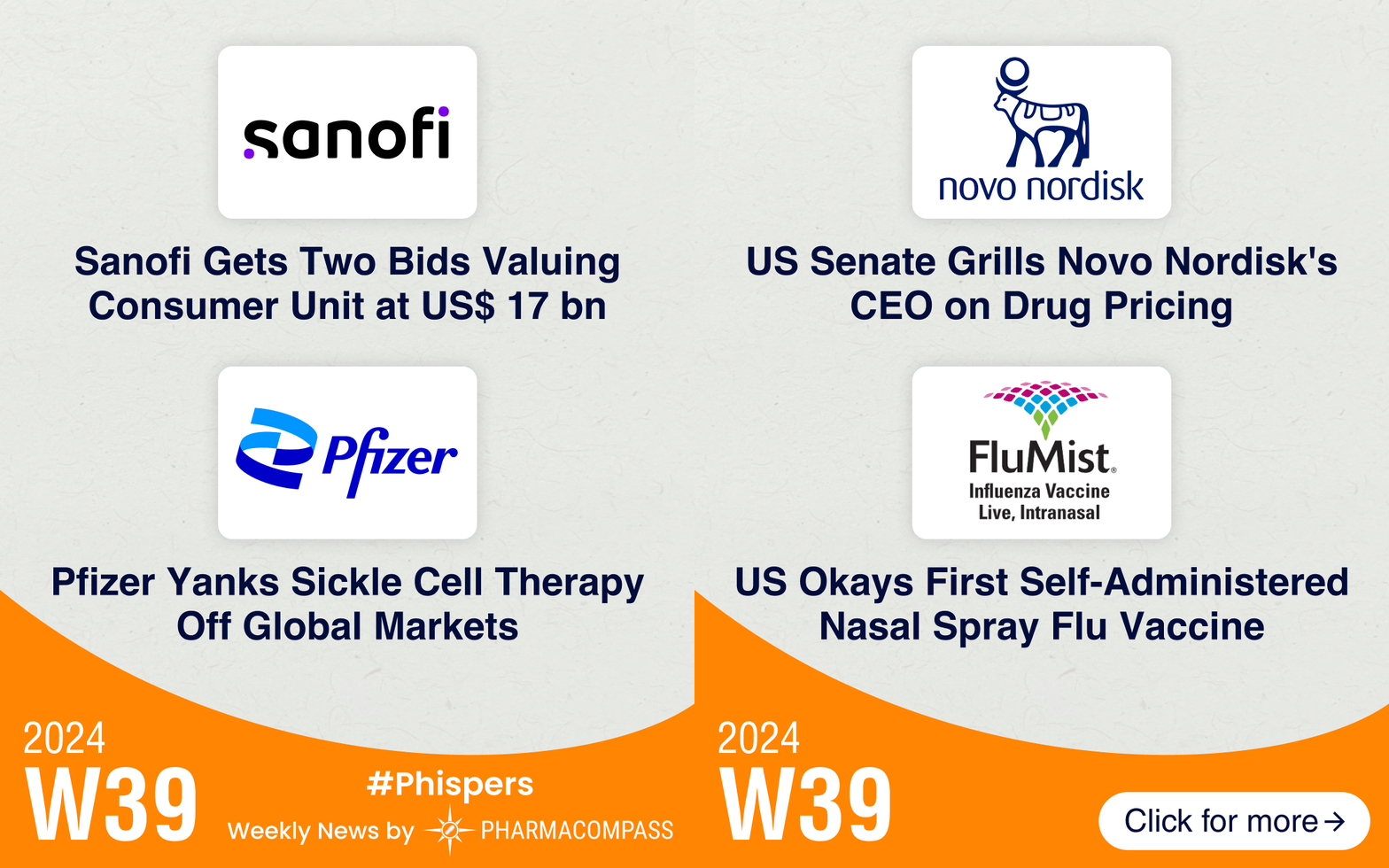
In news this week, Sanofi is considering the sale of its consumer
health unit and has received binding bids valuing the division at around US$ 17
billion, according to a Bloomberg report. Novo Nordisk’s CEO was grilled by the US Senate and accused of “ripping off” Americans by charging exorbitant prices for Ozempic and Wegovy. Pfizer said it is withdrawing its sickle cell disease med Oxbryta
from all markets where it has been approved due to risk of a painful
complication and deaths.The US Food and Drug Administration (FDA) has approved two therapies for the ultra-rare neurodegenerative disorder known as Niemann-Pick disease. FDA also approved the first nasal spray influenza vaccine — AstraZeneca’s FluMist — that can be self-administered.Additionally, Sanofi’s Sarclisa bagged FDA approval as a first line treatment for multiple myeloma, while UCB’s Bimzelx secured three new FDA approvals. In trials, Astra and Daiichi’s antibody-drug-conjugate (ADC) has failed another late-stage trial, the second such failure in a month. Vanda Pharmaceuticals clashed with the FDA after the agency rejected its drug to treat gastroparesis. And Novartis and Flagship’s AI biotech have inked a deal worth up to US$ 1 billion. Sanofi gets two binding bids valuing its consumer unit at ~US$ 17 bn, says report Sanofi has received two separate binding bids for its consumer health unit, potentially valuing the OTC division at around US$ 17 billion, according to a Bloomberg report. The offers have come from private equity firms Clayton Dubilier & Rice (CD&R) and PAI Partners. Sanofi’s review of potential separation scenarios for its consumer health business began in October 2023.Pfizer withdraws sickle cell disease drug due to risks of death, complications Pfizer is withdrawing its sickle cell disease treatment Oxbryta (voxelotor) from all markets where it
has been approved due to risks of a painful complication and deaths.
Pfizer had acquired the drug through its US$ 5.4 billion buyout of Global Blood Therapeutics in 2022. The drug behemoth is also discontinuing all studies and access programs related to the treatment.Novo’s CEO grilled by US Senate over exorbitant Ozempic, Wegovy pricesNovo Nordisk’s CEO Lars Fruergaard Jørgensen found himself in the hot seat as he faced a grilling from the
Senate Committee on Health, Education, Labor, and
Pensions (HELP), chaired by Senator Bernie Sanders. The hearing was over the high prices of Novo’s popular weight-loss and diabetes drugs, Ozempic and Wegovy. Sanders highlighted that Ozempic costs US$ 969 per
month in the US, compared to US$ 155 in Canada and just US$ 59 in Germany.
Wegovy costs US$ 1,349 per month in the US, while it is priced at US$ 137 in
Germany, and US$ 92 in the UK.Zevra achieves first-ever FDA
approval to treat ultra-rare neurodegenerative diseaseFDA approved Zevra Therapeutics’ Miplyffa (arimoclomol) for the treatment of Niemann-Pick disease type
C (NPC), an ultra-rare and progressive
neurodegenerative disease. This approval marks the first-ever
treatment for NPC, addressing a critical unmet
medical need. Tragically, people with NPC only live for about 13 years on
average, according to the FDA.IntraBio’s stand-alone NPC therapy approved: Merely days after FDA okayed Miplyffa, it approved another treatment for NPC — IntraBio’s drug, Aqneursa (levacetylleucine). Aqneursa is designed to alleviate neurological
symptoms in both adults and children weighing at least
15 kilograms. While Aqneursa is not the first NPC treatment to get past the
finish line, it is the only FDA-approved stand-alone therapy.No needle, no doctor: Astra’s FluMist becomes first self-administered flu vaccineIn a groundbreaking move, FDA has approved AstraZeneca’s FluMist that can be self-administered at home. This provides needle-averse people easy access to a nasal spray
influenza vaccine that is potentially lifesaving. The approval will allow,
for the first time, an alternative to the annual flu shot. This approval is
expected to significantly enhance vaccination rates, especially among those who
avoid taking it in traditional healthcare settings.Sanofi’s Sarclisa gets first-line nod for multiple myeloma: Sanofi has secured FDA approval for Sarclisa (isatuximab) in
combination with bortezomib, lenalidomide, and dexamethasone (VRd) as a first-line treatment for newly diagnosed multiple
myeloma patients who are ineligible for stem cell transplants. In a late-stage
study, the regimen with Sarclisa lowered the risk of disease progression or death by 40 percent compared to standard VRd. With this expansion, Sarclisa stands to give Johnson & Johnson’s Darzalex (daratumumab) some competition in this
indication.UCB’s Bimzelx bags three new FDA approvals: UCB has received FDA approval for Bimzelx
(bimekizumab-bkzx) for the treatment of adults with active psoriatic arthritis, non-radiographic axial spondyloarthritis, and ankylosing spondylitis. Bimzelx is now poised to significantly bolster UCB’s sales expectations, with the company projecting peak sales of at least € 4 billion (US$ 4.4 billion). Bimzelx is the first treatment to selectively inhibit both interleukin 17A and 17F, offering a new therapeutic option for patients with these chronic inflammatory diseases.Keytruda comes up short in
late-stage trial on tough colorectal cancer: Merck’s experimental combination therapy of favezelimab and Keytruda
(pembrolizumab) failed to meet its primary endpoint in a
late-stage trial for previously treated PD-L1 positive microsatellite-stable metastatic
colorectal cancer. This indication is the most common
type of colorectal cancer and is a real challenge to treat.Vanda hits back at FDA over
rejection of drug for gastroparesisVanda Pharmaceuticals has hit back at FDA after it issued a Complete Response Letter (CRL) declining to approve its drug — tradipitant — to treat gastroparesis. The company expressed deep frustration, highlighting the urgent need for new treatments in gastroparesis, a condition characterized by delayed gastric emptying and severe gastrointestinal symptoms.Astra- Daiichi’s promising ADC fails again, this time in breast cancer: AstraZeneca and Daiichi Sankyo said their experimental ADC datopotamab deruxtecan
(Dato-DXd) failed to notably improve overall survival compared to chemotherapy in a late-stage breast cancer
trial. The drug had earlier shown promising results with significant
improvement in progression-free survival (PFS) in patients with metastatic
hormone receptor (HR)-positive, HER2-low or negative breast
cancer. Earlier this month, the drug had failed in a late-stage trial on certain
patients with non-small cell lung cancer.Novartis, Flagship’s AI biotech Generate ink deal worth up to US$ 1 bnNovartis and Flagship Pioneering-founded Generate Biomedicines, an AI biotech
company, signed a collaboration agreement potentially worth over US$ 1 billion. The deal focuses on utilizing Generate’s proprietary generative AI platform to create potentially first- and best-in-class molecules through AI-based optimization. The Swiss drugmaker will pay Generate US$ 65 million upfront, with more than US$ 1 billion in milestone payments.















 Share